Portal de Francia, Pamplona
City Gate in Pamplona
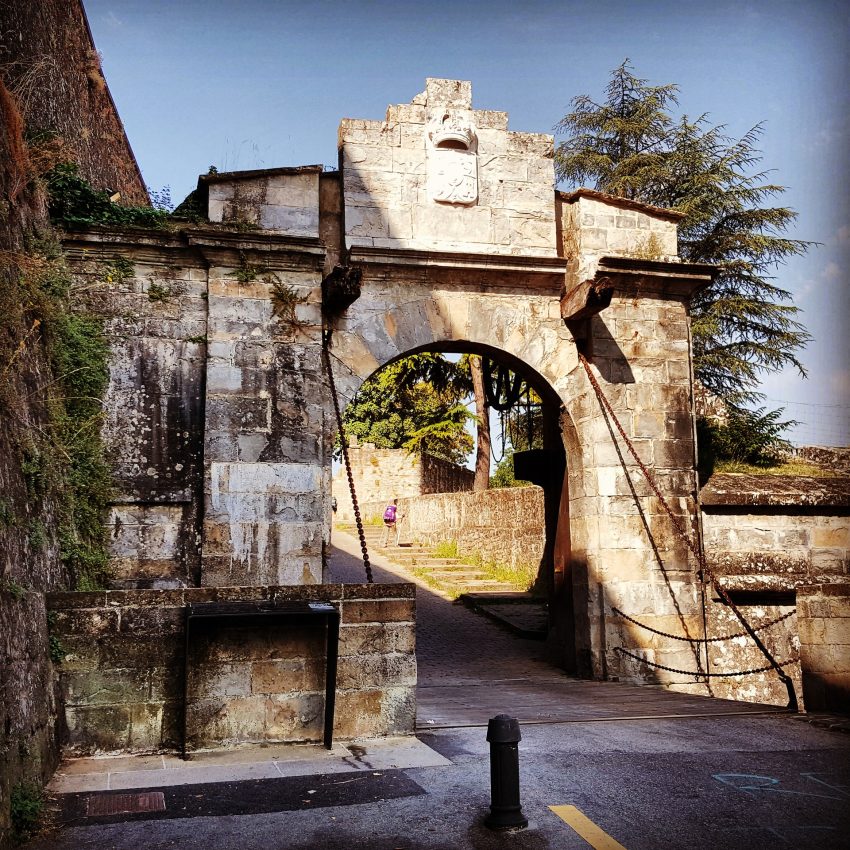
Set into Pamplona's ancient walls, the Gateway of France is where generations of travellers from across the border first entered the city, marking the transition from open countryside to fortified streets. Built in 1553 by the Viceroy of Alburquerque, it is the best preserved of the six original city gates and still feels like a ceremonial entrance into the historic centre. Its stone passageway, flanked by heavy doors, reminds you that Pamplona was once a frontier fortress as well as a bustling stop on long-distance routes, making it one of the where to go in Pamplona if you want to feel the city's defensive past beneath your feet.
The gate's name reflects its role as the main portal for travellers arriving from France, but it has also borne other identities. On the inner side, one of the original doors still carries a carved Renaissance coat of arms with the double-headed eagle and imperial arms, a proud symbol of power looking back into the city. A plaque recalls the departure of General Tomás Zumalacárregui from Pamplona in 1833 to lead Carlist troops, and since 1939 the gate has also been known as the Zumalacárregui Gateway. Today, it remains the traditional entry point for pilgrims on the Camino de Santiago, who come up through the Portal de Francia and into the old streets, making the gateway a highlight of any walking tour of Pamplona that follows the pilgrims' footsteps.
Table of Contents
- History and Significance of the Gateway of France
- Things to See and Do in the Gateway of France
- How to Get to the Gateway of France
- Practical Tips on Visiting the Gateway of France
- Where to Stay close to the Gateway of France
- Is the Gateway of France Worth Visiting?
- FAQs for Visiting Gateway of France
- Nearby Attractions to the Gateway of France
History and Significance of the Gateway of France
The Gateway of France was built in 1553 under the orders of the Viceroy of Alburquerque, at a time when Pamplona's walls were being modernised to face new military realities and to control the flow of people and goods from neighbouring France. As one of six main gates in the city's defensive ring, it guarded a critical access point and served as a customs and control barrier, where travellers, merchants and soldiers passed under the watchful eyes of guards. Its survival in such good condition makes it an invaluable witness to the era when city life and defence were inseparable.
The gate's two main doors once controlled movement in and out; of these, the interior door still preserves a carved Renaissance coat of arms, with a double-headed eagle and the imperial arms. This heraldic display was a statement of authority, reminding all who passed through that they were entering a royal and heavily regulated space. The gate later gained a political layer of meaning when a plaque was added to commemorate the departure of General Tomás Zumalacárregui in 1833, as he left Pamplona to take command of Carlist forces during the First Carlist War. Since 1939, this association has led to its alternative name, the Zumalacárregui Gateway.
For centuries, pilgrims walking the Camino de Santiago have used this route to enter Pamplona, and that tradition continues today. The gate has thus seen not only troops and traders but also countless humble travellers carrying shells and staffs, heading west towards Santiago. This blend of military, civic and spiritual history gives the Gateway of France a special place in the story of the city: it is both a functional piece of fortification and a symbolic threshold, marking the moment when the road from France becomes the streets of Pamplona.
Things to See and Do in the Gateway of France
Walking through the gateway is the simplest and best way to experience it. Approach from outside the walls and let the stone arch frame your first view of the old city beyond; turning back the other way, you can imagine how imposing this passage must have felt to people arriving from France, faced with massive walls and heavy doors. Take time to look up at the masonry details and the scale of the opening, which still conveys a sense of controlled access.
On the inner side, seek out the remaining carved door and its Renaissance coat of arms, with the double-headed eagle and imperial symbols. This detail makes clear that the gate was not just a practical aperture but also a display of power and identity. Nearby you will find the commemorative plaque honouring General Zumalacárregui’s departure in 1833; reading it connects the gate to 19th century conflicts and the political history of Navarre. These small touches help you place the structure within several different historical moments at once.
Because it remains part of the Camino de Santiago route, you will often see pilgrims passing through, backpacks on and boots dusty from the road. Watching them arrive gives the place a living dimension: the path they are following is centuries old, and this gate has witnessed their predecessors for generations. Combine your visit with a stroll along the ramparts or a loop into the Old Quarter to appreciate how the gateway fits into the broader defensive system and the urban layout; it is a compact but atmospheric stop that adds depth to your understanding of Pamplona’s fortified character.
How to Get to the Gateway of France
Most visitors reach Pamplona via Pamplona Airport or larger regional airports such as Bilbao or San Sebastián, continuing into the city centre by bus, taxi or hire car. For the best deals and a seamless booking experience, check out these flights to Pamplona on Booking.com. From the historic core, it is a straightforward walk through the Old Quarter towards the city walls and the section signposted as the Gateway of France or Portal de Francia.
If you are travelling by train, Pamplona's main station links the city with Madrid, Barcelona and other Spanish hubs.Train schedules and bookings can be found on Omio. From the station, take a local bus or taxi into the Casco Viejo, then follow the signed Camino de Santiago route, which naturally leads towards the Portal de Francia and the gateway itself.
Arriving by car, follow the main routes into Pamplona and use one of the central car parks near the edge of the Old Quarter, as the streets around the walls are best explored on foot.If you are looking to rent a car in Spain I recommend having a look at Discover Cars, first, as they compare prices and review multiple car rental agencies for you. From there, walk up through the historic lanes and towards the ramparts, using city maps or Camino waymarkers to guide you to the Gateway of France as part of a short wall-side stroll.
Practical Tips on Visiting the Gateway of France
- Suggested tips: Walk through the gateway in both directions and then follow a short stretch of the walls to see how this portal fits into the wider defensive system.
- Best time to visit: Early morning or late afternoon offer softer light on the stonework and a good chance of seeing pilgrims arriving or departing.
- Entrance fee: Free – this is a public city gate integrated into the historic walls.
- Opening hours: Accessible at all times
- Official website: https://www.pamplona.es/en/turismo/portaldefrancia
- How long to spend: Plan 15-30 minutes to walk through, examine the coat of arms and plaque, and enjoy the views along the walls; longer if combined with a rampart walk.
- Accessibility: Access involves walking on old streets and through the gate passage, with some uneven surfaces and gentle slopes; most visitors manage it easily, but those with reduced mobility should take care.
- Facilities: There are no dedicated facilities at the gate itself; cafés, bars, shops and public toilets are available a short walk away within the Old Quarter.
- Photography tip: Frame the archway with city walls and sky beyond, then capture pilgrims or passersby moving through to show the gate’s ongoing role as a living entrance.
- Guided tours: Many walking tours of Pamplona and Camino-themed routes include the Gateway of France, offering extra context on its defensive role and pilgrim history.
- Nearby food options: After visiting, head back into the Old Quarter for pintxos bars and cafés, or continue towards Plaza del Castillo for more dining choices.
Where to Stay close to the Gateway of France
Choosing accommodation in the Old Quarter puts the Gateway of France within easy walking distance and allows you to visit at quieter times of day. A refined option on Pamplona's main square is Gran Hotel La Perla, from which you can stroll through historic streets to the gate and nearby walls. For a stay closer to the cathedral and ramparts, Pamplona Catedral Hotel makes an excellent base with quick access to the Camino route and city gates. If you prefer a modern hotel beside green spaces yet still close to the historic centre, Hotel Tres Reyes Pamplona offers a comfortable setting within walking distance of the walls, Old Quarter and Gateway of France.
Is the Gateway of France Worth Visiting?
The Gateway of France is definitely worth visiting, especially if you are interested in fortifications, the Camino de Santiago or the way cities controlled their borders in earlier centuries. As the best preserved of Pamplona's old gates, it gives you a concrete sense of how people once entered and left this walled city, while the Renaissance coat of arms and Zumalacárregui plaque add political and symbolic depth. Standing under its arch as pilgrims pass through or as you look back at the walls, you feel the mix of history and movement that still defines this corner of Pamplona.
What Other Travellers Say...

Portal of Zumalacárregui at P.º del Reduín in Pamplona serves as the still-operational gateway into the old walled town and is praised for its beautiful, well-preserved castle walls and pulley-operated door; visitors recommend it as a peaceful park escape on the edge of the old town, a worthwhile historic stop on the Camino Francés and a pleasant spot for short uphill/downhill running, though some note the stream through the park shows signs of pollution.


FAQs for Visiting Gateway of France
Nearby Attractions to the Gateway of France
- Pamplona Cathedral: The city's main Gothic cathedral with Neoclassical façade, cloister and royal tombs, just a short walk from the gate.
- Mirador de Caballo Blanco: A dramatic lookout on the Bastion of Redín with superb views over the walls, the Arga River and distant mountains.
- Museum of Navarra: Regional museum housed in a former pilgrims' hospital, showcasing Navarre's history from prehistory to modern art.
- Royal and General Archive of Navarra: Historic palace wrapped in modern architecture, preserving key documents from the old Kingdom of Navarre.
- Plaza del Castillo: Pamplona's principal square, lined with cafés and arcades, ideal for a drink or meal after exploring the walls and gateway.
The Portal de Francia appears in our Complete Guide to Visiting Pamplona!

Moira & Andy
Hey! We're Moira & Andy. From hiking the Camino to trips around Europe in Bert our campervan — we've been traveling together since retirement in 2020!
This website uses affiliate links which may earn a commission at no additional cost to you!
Planning Your Visit
Accessible at all times
Free - this is a public city gate integrated into the historic walls.
Nearby Attractions
- Mirador de Caballo Blanco (0.1) km
Viewing Point - San Fermín de Aldapa (0.2) km
Church - Catedral de Pamplona (0.2) km
Cathedral - Royal and General Archive of Navarra (0.2) km
Archive and Palace - Albergue de Jesús y María (0.3) km
Church and Hostel - Magdalena Bridge (0.4) km
Bridge - Ayuntamiento de Pamplona (0.4) km
Town Hall - Museo Universidad de Navarra (0.4) km
Museum - Museum of Navarre (0.4) km
Museum - Iglesia de San Saturnino (San Cernin) (0.4) km
Church