Ponte Molino, Padova
Bridge and Historic Building in Padova
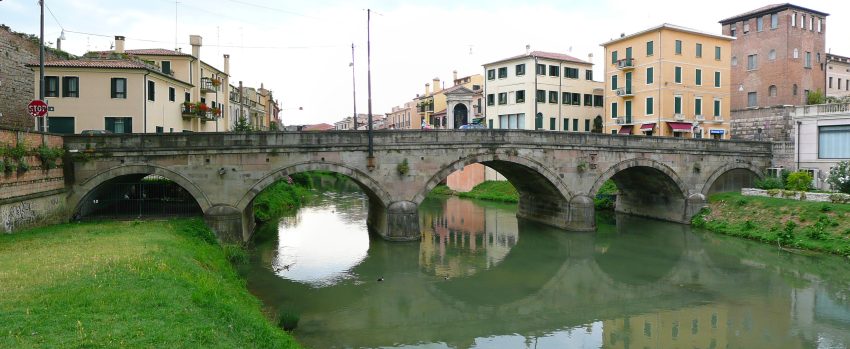
Ponte Molino is one of those places in Padua where the city's long history feels incredibly close. Stretching across the Bacchiglione with its five Roman arches, the bridge has carried people and traffic since the 1st century AD, making it one of the must-see places in Padua for anyone interested in how the city grew up around its waterways. Even with modern buildings nearby, the stone arches and gentle curve of the bridge still convey something of the Roman engineers who first spanned the river here nearly two thousand years ago.
Over the centuries, the bridge has worn many hats: a strategic crossing protected by defensive towers, a hub of industry lined with floating mills, and today a quiet yet characterful link between neighbourhoods. The shadows under its arches once sheltered more than thirty mill wheels, turning day and night to grind grain for the city. Standing here now, watching the Bacchiglione flow beneath your feet and imagining the creak of wooden wheels and the clatter of carts above, you understand why this riverside spot is a great place to visit on a walking tour of Padua.
Table of Contents
History and Significance of the Ponte Molino
Ponte Molino was originally constructed between 30 and 40 AD, when Padua was an important Roman settlement and needed solid crossings over the Bacchiglione to connect its streets and trade routes. The bridge was built robustly enough to support not just pedestrians, but also carts, wagons and other vehicles, which makes it an especially rare survivor among Roman bridges. Its five arches, slightly flattened into segmented curves, are typical of late Republican and early Imperial engineering, designed to balance strength with a lower, more stable profile over the water.
Through the Middle Ages the bridge remained crucial to life in Padua, and it was periodically repaired and reshaped as traffic increased and defensive needs changed. In the thirteenth century it was incorporated into the city's fortifications and protected by structures such as the Tower of Ezzelino, turning the bridge into both a gateway and a barrier. During unrest, controlling Ponte Molino meant controlling access across this branch of the Bacchiglione, which was a lifeline for movement of people and goods.
From at least the 10th century, Ponte Molino took on yet another role as an industrial powerhouse. Dozens of floating mills were moored beneath its arches, with their waterwheels driven by the river's current. At one point, thirty-three wheels worked side by side here, grinding grain for the surrounding region. They remained in place until 1883, when a major flood destroyed the mills and they were finally demolished. Today, while the mills are gone and the defensive works have softened into the urban fabric, the bridge itself still stands as a layered monument to Roman engineering, medieval power and the everyday work that kept Padua fed.
Things to See and Do in the Ponte Molino
A visit to Ponte Molino is all about slowing down and paying attention to details. Start by crossing the bridge itself, pausing midway to lean on the parapet and look down at the Bacchiglione. From here you can see how the arches meet the water and get a sense of the proportions that have kept the structure standing for nearly two millennia. Looking along the river, imagine how the view would once have been full of floating mills, with wooden structures and paddle wheels crowding the channel.
As you walk to either end of the bridge, take a moment to notice the stonework and the way newer elements sit alongside older blocks. This is a bridge that has never been frozen in time; instead, it has been adapted, repaired and reinforced as Padua changed. The nearby Tower of Ezzelino and surviving stretches of defensive walls hint at the era when Ponte Molino formed part of the city's fortified edge, guarding one of its key northern approaches.
The area around the bridge is a pleasant part of town to wander, with streets that invite detours into side lanes, squares and local cafés. Use the bridge as a starting point or anchor for exploring other Roman and medieval remnants in Padua, such as the city walls, historic churches and old riverfronts. In the evening, the light over the water and stone can be especially atmospheric, and the bridge becomes a simple but evocative backdrop for photos and riverside strolls.
How to Get to the Ponte Molino
Padua is well connected by rail and road, and Ponte Molino sits just to the north of the historic centre, within easy walking distance once you are in the city. The nearest major airport is Venice Marco Polo, with Treviso Airport as an additional option for low-cost flights into the region; from either airport you can reach Padua by train, bus or shuttle via Mestre or Venice. For the best deals and a seamless booking experience, check out these flights to Padova on Booking.com.
If you are arriving by train, travel to Padova railway station, which is served by frequent regional and high-speed services from Venice, Mestre, Verona, Vicenza, Bologna and beyond. Use Omnio to easily compare schedules, book train tickets, and find the best prices all in one place for a hassle-free journey across Italy. From the station, it is a straightforward walk or short tram ride into the centre; from there, continue on foot towards the northern part of the old town and the Bacchiglione to find Ponte Molino.
Travelling by car, Padua sits close to the A4 and A13 motorways, with clear signposting into the city from surrounding regions. If you are looking to rent a car in Italy I recommend having a look at Discover Cars, first, as they compare prices and review multiple car rental agencies for you. You can park in one of the car parks around the historic centre and then explore on foot, heading towards the river and following local signs or a map to reach the bridge. Once you are in the old town, distances are compact, and walking is the easiest way to get around.
Practical Tips on Visiting the Ponte Molino
- Suggested tips: Combine a visit to Ponte Molino with a wider riverfront walk, linking other historic bridges and nearby towers so you get a fuller sense of how the Bacchiglione shaped Padua.
- Best time to visit: Early morning and late afternoon offer softer light on the stone and reflections in the water; evenings are atmospheric if you enjoy a quieter stroll.
- Entrance fee: Free (public bridge with no admission charge).
- Opening hours: Accessible at all times as a public thoroughfare, though visiting during daylight is best for appreciating details and views.
- How long to spend: Around 20-30 minutes is enough to walk across, enjoy the river views and explore the immediate surroundings; longer if you are including it in a broader riverside or Roman-themed walk.
- Accessibility: The bridge surface is relatively level but may have some uneven paving; approaches are generally accessible for most visitors, though wheelchair users should check local kerbs and ramps in advance.
- Facilities: There are no specific facilities on the bridge itself; cafés, shops and toilets can be found in the nearby streets of the historic centre.
- Photography tip: Try framing the five arches from the riverbank for a classic profile, and experiment with reflections on calm days; contrasting old stone with passing modern life makes for compelling shots.
- Guided tours: Consider joining a guided walking tour of Roman and medieval Padua that includes Ponte Molino, as a guide can help you spot details you might otherwise miss and connect the bridge with other ancient sites.
- Nearby food options: Look for small bars, bakeries and trattorie in the surrounding streets, where you can pause for an espresso, aperitivo or simple meal before or after your riverside walk.
Where to Stay close to the Ponte Molino
Staying near the historic centre of Padua makes it simple to include Ponte Molino in your explorations, as the bridge sits just a short walk from many central streets and squares. Look for accommodation within or close to the old town so you can move easily between the main sights, the university quarter and the riverfront. A centrally located hotel near the northern edge of the historic core will put you within easy reach of the bridge, as well as other landmarks like the Eremitani complex and Scrovegni Chapel.
Boutique guesthouses and small hotels in historic buildings offer plenty of charm and allow you to enjoy quiet evening walks to and from the bridge when the streets are calmer and the riverfront is softly lit. If you prefer a modern property with convenient transport links, staying closer to the station still keeps Ponte Molino within walking distance while making day trips to Venice, Vicenza or Verona straightforward. Wherever you base yourself, Padua's compact size means you will never be far from this ancient riverside crossing.
Is the Ponte Molino Worth Visiting
Ponte Molino is absolutely worth seeking out, particularly if you are already interested in Padua's Roman roots or enjoy tracing how a city evolved around its waterways. It is not a grand piazza or a lavish basilica, but something more subtle: a working bridge that has quietly anchored daily life for nearly two thousand years. That continuity makes simply crossing it an evocative experience.
As one of the few surviving Roman bridges in Padua, and one of the very few designed to carry vehicles as well as pedestrians, it offers a direct physical link back to the city’s ancient past. When you add in its medieval defensive role and the centuries when thirty-three water mills clustered under its arches, you have a site that encapsulates trade, technology and community in one compact place. For many travellers, that makes it one of the top sights in Padua if you want history woven into an ordinary, lived-in corner of the city.
What Other Travellers Say...

Ponte Molino Gate in Padova sits on Vicolo Ponte Molino and marks a historic crossing over the Tronco Maestro; visitors note the medieval city-gate character, with a tall tower and separate vehicle and pedestrian openings, and appreciate views of the buildings along the stream even though the water can appear green and filled with plants.


FAQs for Visiting Ponte Molino
Nearby Attractions to the Ponte Molino
- Ponte San Lorenzo: Another Roman bridge in Padua, partly hidden beneath later buildings, offering a fascinating glimpse of ancient engineering in the city centre.
- Ponte Altinate: A Roman bridge that once formed part of a key northern route, now integrated into the modern street pattern but still traceable in the cityscape.
- Tower of Ezzelino: A medieval defensive tower that once helped protect Ponte Molino and the northern approaches to Padua.
- Scrovegni Chapel: Home to Giotto's famous fresco cycle, within walking distance and an essential stop for art and history lovers visiting Padua.
- Basilica of Saint Anthony of Padua: One of Italy's major pilgrimage sites, easily combined with a walk that also takes in the city's Roman bridges and riverside views.
The Ponte Molino appears in our Complete Guide to Visiting Padova!

Moira & Andy
Hey! We're Moira & Andy. From hiking the Camino to trips around Europe in Bert our campervan — we've been traveling together since retirement in 2020!
This website uses affiliate links which may earn a commission at no additional cost to you!
Planning Your Visit
Accessible at all times as a public thoroughfare, though visiting during daylight is best for appreciating details and views.
Free (public bridge with no admission charge).
Nearby Attractions
- Palazzo Zuckermann (0.3) km
Historic Building and Museum - Roman Arena of Padua (0.4) km
Amphitheatre - Torre dell'Orologio (0.4) km
Tower - Piazza dei Signori (0.4) km
Square - Chiesa degli Eremitani (0.4) km
Church - Cappella degli Scrovegni (0.4) km
Church - Musei Civici di Padova (0.5) km
Historic Building and Museum - Giardini dell’Arena (0.5) km
Gardens - Palazzo della Ragione (0.5) km
Historic Building and Market - Cafe Pedrocchi (0.5) km
Historic Building