Palazzo dei Cavalieri, Pisa
Palace in Pisa
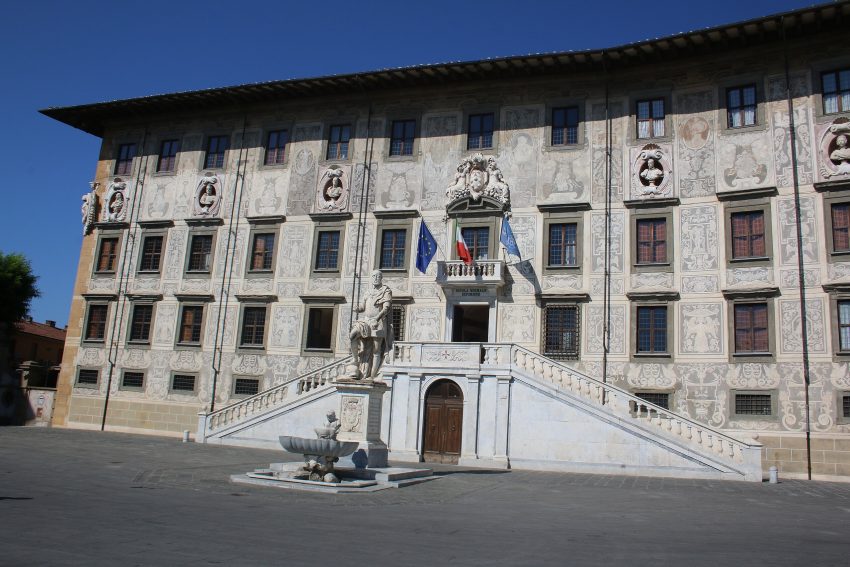
In the heart of Pisa's old town, a short walk away from the crowds around the Leaning Tower, Piazza dei Cavalieri opens up like a refined stage set of Renaissance power. Dominating the square is Palazzo dei Cavalieri, also known as Palazzo della Carovana, its broad façade covered in intricate sgraffito patterns, coats of arms and sculpted busts of the Medici Grand Dukes from Cosimo I to Cosimo III. The sweeping double staircase and bold projecting roof give the palace a theatrical presence that immediately tells you this was once the nerve centre of a powerful order of knights and is now one of the top sights in Pisa for travellers who enjoy history-rich corners away from the main postcard views.
Originally the Palazzo degli Anziani, or Palace of the Elders, the building was transformed from 1562 onwards when Giorgio Vasari was tasked with rebuilding and enlarging it for the Order of St. Stephen, an elite chivalric order created to defend Medici interests in the Mediterranean. Behind that ornate front, knights once trained for naval campaigns against Ottoman and Barbary corsairs. Since 1810, however, the palace has housed the Scuola Normale Superiore, an elite higher-education institution founded by Napoleon, so today its courtyards and classrooms echo more with student conversations than with the clank of armour. The result is a square where layers of civic, military and academic history overlap in a way that makes it a highlight of any walking tour of Pisa.
Table of Contents
- History and Significance of Palazzo dei Cavalieri
- Things to See and Do in Palazzo dei Cavalieri
- How to Get to Palazzo dei Cavalieri
- Practical Tips on Visiting Palazzo dei Cavalieri
- Where to Stay close to Palazzo dei Cavalieri
- Is Palazzo dei Cavalieri Worth Visiting
- FAQs for Visiting Palazzo dei Cavalieri
- Nearby Attractions to the Palazzo dei Cavalieri
History and Significance of Palazzo dei Cavalieri
The story of Palazzo dei Cavalieri begins with its original role as the Palazzo degli Anziani, the seat of Pisa's civic elders. As the city's political heart shifted under Medici rule, Duke Cosimo I saw an opportunity to stamp his authority on the square and to give a prestigious home to his newly founded Order of St. Stephen. In 1562 he turned to Giorgio Vasari, court architect and artist, who set about rebuilding and expanding the existing palace into the grand structure that dominates the piazza today.
Vasari’s design turned the façade into a showcase of Medici power and order symbolism. Sgraffito decoration - patterns scratched through coloured plaster layers - forms elegant geometric and floral designs, while coats of arms and carved busts of six Medici Grand Dukes, from Cosimo I through Cosimo III, proclaim dynastic continuity. The broad, symmetrical front is crowned by a projecting roof and reached by a wide double staircase, designed as much for ceremony and spectacle as for everyday access. When knights of St. Stephen trained here, the square would have been filled with uniforms, rituals and processions that reinforced Medici prestige.
With the decline of the order, the palace took on a scholarly life. In 1810, Napoleon founded the Scuola Normale Superiore and installed it in the palazzo, drawing inspiration from the École Normale Supérieure in Paris. Over the following centuries, the institution grew into one of Italy's most prestigious centres of higher education, especially in the humanities and sciences. This transition from chivalric academy to elite university gives the building a unique continuity of “training” - first for knights, then for students - and it remains a symbol of intellectual life in Pisa as well as a key piece of Renaissance urban theatre.
Things to See and Do in Palazzo dei Cavalieri
Most visitors begin by simply standing back in the piazza to take in the entire façade of Palazzo dei Cavalieri. From this vantage point you can appreciate the rhythm of windows, the decorative sgraffito patterns and the line of Medici busts that look out over the square. The grand double staircase is perfect for photographs and also gives a sense of how processional the building's entrance was intended to be when it served the Order of St. Stephen.
Walk closer to study the details. The sgraffito work, with its intricate scrolls and motifs, rewards inspection up close, and the coats of arms scattered across the façade hint at the families and figures connected to the palace over time. In front of the building stands the statue of Cosimo I by Piero Francavilla, a reminder of the duke whose ambitions reshaped both palace and square. It is worth circling the statue for different angles, noticing how it anchors the open space in front of the palace like a focal point of power.
Take time to explore the rest of Piazza dei Cavalieri too. On the north side you will find Palazzo dell'Orologio, built in 1607 for the Order of St. Stephen and incorporating older medieval tower houses into its structure; its clock tower and irregular volumes contrast nicely with Vasari's more controlled composition opposite. The square as a whole feels like a carefully curated ensemble of power and learning, and simply sitting on a step or café terrace watching students and locals cross the space can be as enjoyable as any formal sightseeing.
How to Get to Palazzo dei Cavalieri
If you are flying into the area, you will most likely arrive at Pisa International Airport Galileo Galilei, a short distance from the historic centre; from there, city buses, a tram link, trains and taxis connect you quickly into central Pisa, from which it is an easy walk to Piazza dei Cavalieri. For the best deals and a seamless booking experience, check out these flights to Pisa on Booking.com.
For many visitors already in Tuscany, the simplest way to reach Pisa is by train, with frequent services into Pisa Centrale from Florence, Lucca, Livorno and other nearby towns; from the station, you can either walk 15-20 minutes through the old streets to Piazza dei Cavalieri or take a local bus or taxi that drops you within a short stroll of the square. Use Omnio to easily compare schedules, book train tickets, and find the best prices all in one place for a hassle-free journey across Italy.
If you are travelling by car, follow the main routes towards Pisa, such as the A12 or Florence-Pisa highways, and park in one of the designated car parks on the outskirts of the restricted historic zone; from there, a pleasant walk through the medieval centre will lead you to Piazza dei Cavalieri and the façade of Palazzo dei Cavalieri. If you are looking to rent a car in Italy I recommend having a look at Discover Cars, first, as they compare prices and review multiple car rental agencies for you.
Practical Tips on Visiting Palazzo dei Cavalieri
- Suggested tips: Treat Piazza dei Cavalieri as a place to linger rather than just a quick photo stop; walk the whole perimeter, then sit for a while to watch how students and locals use the space today.
- Best time to visit: Late afternoon or early evening brings especially atmospheric light on the sgraffito façade and is often quieter than the peak midday hours.
- Entrance fee: Free to enjoy the piazza and palace exterior
- Opening hours: The square itself is accessible at all times
- How long to spend: Allow at least 30-45 minutes to explore the piazza, study the façades and take photos, longer if you are joining a guided walking tour that explains the history in depth.
- Accessibility: The piazza is largely flat and paved, though some stones are uneven; access to building interiors may involve steps and is not always available to the public.
- Facilities: There are cafés, bars and shops within a short walk of the square, as well as public or café restrooms in the surrounding streets.
- Photography tip: Shoot wide from the centre of the piazza to capture the whole façade and staircase, then move closer for details of the Medici busts, sgraffito work and Cosimo I’s statue.
- Guided tours: Many guided tours of Pisa's historic centre include Piazza dei Cavalieri; joining one can help you understand the transition from civic palace to Medici knight school to elite university.
- Nearby food options: Head into the nearby side streets for small trattorias and student-friendly eateries, where you can enjoy reasonably priced meals in a lively but local-feeling setting.
Where to Stay close to Palazzo dei Cavalieri
Staying near Piazza dei Cavalieri puts you in a central, atmospheric part of Pisa's historic core, within walking distance of both the square and major sights like the Arno and Piazza dei Miracoli. A comfortable option is Hotel Bologna Pisa, which offers easy access to the medieval streets leading up to Piazza dei Cavalieri. For those who want to be slightly closer to the Leaning Tower and cathedral but still within range of the square, Grand Hotel Duomo provides a convenient base near the classic sights and about a 10-15 minute walk from Piazza dei Cavalieri. Travellers arriving or departing by train who prefer to stay near Pisa Centrale yet still explore the square on foot might choose NH Pisa, then stroll through the centre to reach Palazzo dei Cavalieri as part of a broader city walk.
Is Palazzo dei Cavalieri Worth Visiting
Palazzo dei Cavalieri and its piazza are absolutely worth including in your Pisa itinerary, especially if you want to see more than the Leaning Tower. Here, you get a sense of the city's political and intellectual history in one compact, beautiful space: a former civic palace turned Medici knight academy, now home to one of Italy's most prestigious universities. The combination of Vasari's ornate façade, the Medici busts, Cosimo I's statue and the contrasting Palazzo dell'Orologio makes the square feel both grand and human in scale. For many visitors, it quickly becomes one of the must-see places in Pisa, a spot where you can slow down, look closely and imagine the different lives that have passed across these stones.
What Other Travellers Say...

Palazzo della Carovana, on Piazza dei Cavalieri in Pisa, is a late 16th-century palace now housing the Scuola Normale Superiore; visitors praise its ornate façade with painted decoration and the wide plaza that offers attractive views and photo opportunities, and note it contains fine art and sculptures, though some report no public access to museum spaces and others warn staff may be unwelcoming to casual visitors.


FAQs for Visiting Palazzo dei Cavalieri
Nearby Attractions to the Palazzo dei Cavalieri
- Narrow Street Borgo Stretto: A lively medieval shopping street with arcades, cafés and markets, perfect for a stroll before or after visiting the piazza.
- Lungarni of Pisa: The scenic embankments along the Arno River, reached in a few minutes' walk, ideal for riverside views and sunset photos.
- Piazza dei Miracoli: The famous square containing the Leaning Tower, cathedral, baptistery and Camposanto, within walking distance of Piazza dei Cavalieri.
- Museo Nazionale di San Matteo: An important art museum showcasing medieval and Renaissance works from Pisan churches and monasteries.
- Tuttomondo mural: Keith Haring's colourful outdoor artwork near Pisa Centrale, offering a modern counterpoint to the Renaissance architecture of Palazzo dei Cavalieri.
The Palazzo dei Cavalieri appears in our Complete Guide to Visiting Pisa!

Moira & Andy
Hey! We're Moira & Andy. From hiking the Camino to trips around Europe in Bert our campervan — we've been traveling together since retirement in 2020!
This website uses affiliate links which may earn a commission at no additional cost to you!
Planning Your Visit
The square itself is accessible at all times
Free to enjoy the piazza and palace exterior
Nearby Attractions
- Santo Stefano dei Cavalieri (0.1) km
Church - Borgo Stretto (0.3) km
Street - Orto Botanico dell’Università di Pisa (0.3) km
Gardens - Baths of Nero (0.3) km
Historic Site - Museo dell'Opera del Duomo (0.4) km
Museum - Palazzo Blu (0.5) km
Gallery and Palace - Leaning Tower of Pisa (0.5) km
Historic Building and Tower - Logge di Banchi (0.5) km
Historic Building - Cathedral of Santa Maria Assunta (0.5) km
Cathedral - Santa Maria della Spina (0.6) km
Church