Palazzo Bo, Padova
Historic Building and Palace in Padova
Palazzo del Bo is one of the top attractions in Padua for anyone fascinated by universities, science and the birth of modern ideas. Since 1493 it has been the historic seat of the University of Padua, the second-oldest university in Italy and one of the oldest in the world, and it still houses the Rectorate and School of Law today. Stepping inside, you walk into a living campus rather than a frozen monument: coats of arms line the walls, lecture rooms are still in use and students cross the courtyard on their way to class.
This is also where Galileo Galilei spent what he called the happiest 18 years of his life, teaching mathematics and astronomy to packed audiences. On a guided visit you can see the wooden desk from which he lectured, as well as tributes to another trailblazing figure, Elena Cornaro Piscopia, the first woman in the world to earn a PhD. Between this powerful academic legacy, the elegant courtyard and the world's oldest permanent anatomical theatre, Palazzo del Bo is a highlight of any walking tour of Padua and an essential stop if you want to understand why the city is so closely associated with learning and scientific freedom.
Table of Contents
- History and Significance of the Palazzo del Bo
- Things to See and Do in the Palazzo del Bo
- How to Get to the Palazzo del Bo
- Practical Tips on Visiting the Palazzo del Bo
- Where to Stay close to the Palazzo del Bo
- Is the Palazzo del Bo Worth Visiting
- FAQs for Visiting Palazzo del Bo
- Nearby Attractions to the Palazzo del Bo
History and Significance of the Palazzo del Bo
The story of Palazzo del Bo is inseparable from the University of Padua itself. The university was founded in 1222 by scholars who left Bologna in search of greater intellectual freedom, and over time it became one of Europe's great centres for law, medicine, astronomy and philosophy. In 1493, the university adopted Palazzo del Bo as its main seat, gradually expanding and reshaping the complex into the labyrinth of courtyards, staircases and lecture halls you see today.
Within these walls, many of the ideas that fuelled the Renaissance and the scientific revolution were discussed and tested. Galileo Galilei taught here from the late 16th to early 17th century, using his lectures to challenge old models of the universe and inspire generations of students. Seeing his desk in situ gives you a direct, physical link to that period, when the boundary between philosophy and science was being redrawn in real time.
Palazzo del Bo is also central to the history of women in higher education. Elena Cornaro Piscopia, a Venetian noblewoman who studied philosophy at Padua, became the first woman to be awarded a PhD in 1678. Her story is told in the palace through statues and interpretive panels, illustrating how the university - despite its limitations - helped open new doors. Today, Palazzo del Bo continues to function as an academic heart of the city, while welcoming visitors who come to trace these extraordinary stories through its courtyards and halls.
Things to See and Do in the Palazzo del Bo
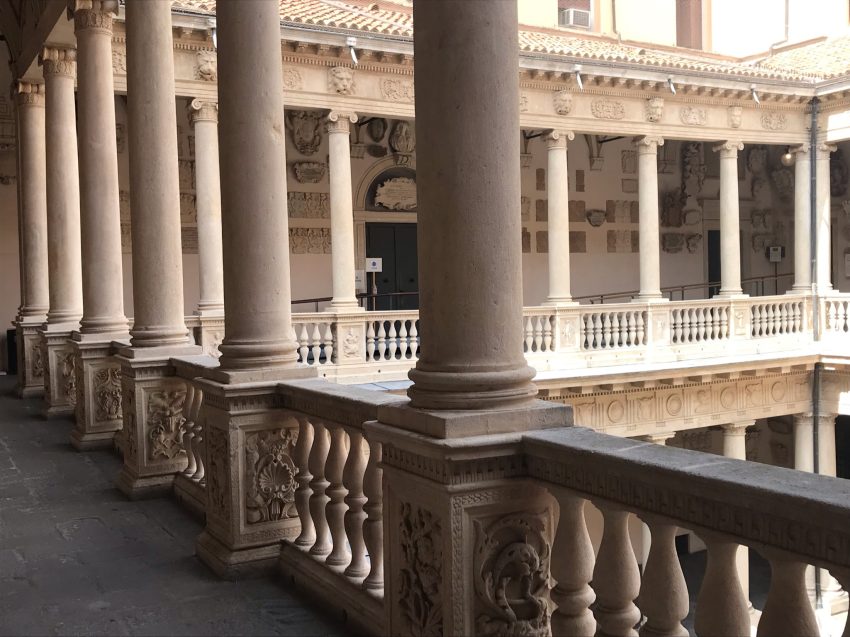
A visit usually begins in the main courtyard, which you can access freely. Here, arcades and stone columns create a classic Italian university atmosphere, and the walls are decorated with coats of arms belonging to former rectors and students. Take a moment to wander slowly around the perimeter: this space alone conveys centuries of academic prestige and tradition.
To see the most important interiors, you will need to join a guided tour. These tours typically include the historic lecture halls, where wood panelling, high ceilings and portraits evoke the university’s golden ages. The highlight for many visitors is the oldest permanent anatomical theatre in the world, a steeply tiered wooden structure where medical students once watched dissections from narrow balconies. Standing inside, you can almost feel how intense these sessions must have been, with the professor at the centre and students leaning over the railings above.
Another key stop is the room where Galileo's wooden lectern is preserved. Even if you are not a science enthusiast, there is something powerful about looking at the modest desk from which he spoke and imagining the impact of his ideas on those packed into the room. Along the way you will also see references to Elena Cornaro Piscopia, whose presence in the palace underlines how ground-breaking her academic achievements were. After your tour, spend a little more time in the courtyard or the surrounding streets; the building's central location makes it easy to pair your visit with nearby squares, churches and cafés, turning Palazzo del Bo into one of the must-see places in Padua for a half-day of exploring.
How to Get to the Palazzo del Bo
Palazzo del Bo is located in the historic centre of Padua, only a short walk from the main market squares and Caffè Pedrocchi. International visitors usually arrive via nearby airports such as Venice Marco Polo or Treviso, then continue to Padua by shuttle, bus or train via Mestre or central Venice before walking into the old town. For the best deals and a seamless booking experience, check out these flights to Padova on Booking.com.
By train, head to Padova railway station, which is on the main Venice-Milan and Venice-Bologna lines with frequent regional and high-speed services. Use Omnio to easily compare schedules, book train tickets, and find the best prices all in one place for a hassle-free journey across Italy. From the station it is about a 15-20 minute walk through the centre to reach Palazzo del Bo; simply follow signs towards the university and the main squares, or take a tram or local bus and then walk the final few minutes.
If you are travelling by car, Padua is close to the A4 and A13 motorways, with clear exits for the city. If you are looking to rent a car in Italy I recommend having a look at Discover Cars, first, as they compare prices and review multiple car rental agencies for you. It is usually easiest to park in one of the car parks around the edge of the historic centre and continue on foot, as many central streets are limited-traffic zones. Once parked, you can comfortably walk to Palazzo del Bo and combine your visit with nearby sites such as Caffè Pedrocchi, Piazza delle Erbe and Piazza dei Signori.
Practical Tips on Visiting the Palazzo del Bo
- Suggested tips: Check tour times in advance, as access to the anatomical theatre and Galileo’s lectern is usually only possible on a guided visit; arrive a little early to enjoy the courtyard before your tour.
- Best time to visit: Late morning or mid-afternoon on weekdays tend to be less crowded than weekends; visiting during term time adds atmosphere as students move through the building.
- Entrance fee: Adult: €8.00
- Opening hours: Guided tours. Monday to Friday: 10:30 am (Italian) – 11:30 am (English) – 12:30 pm (Italian) - 3:30 pm (Italian) - 4:30 pm (English) – 5:30 pm (Italian)
- Official website: https://www.unipd.it/en/visitbo
- How long to spend: Allow 60-90 minutes for a guided tour plus extra time to linger in the courtyard and explore the nearby streets and squares.
- Accessibility: The courtyard is level and accessible; some historic interiors and the anatomical theatre may involve stairs or narrow passages, so check accessibility details if you have limited mobility.
- Facilities: Expect a ticket office or information point and restrooms within the complex; cafés, bars and shops are just outside in the surrounding streets.
- Photography tip: Capture the courtyard from an upper arcade if possible for a classic shot of arches and coats of arms; inside, be respectful of any restrictions on photography in historic rooms.
- Guided tours: Opt for a tour that includes the anatomical theatre, Galileo’s lectern and key historic halls to get the fullest sense of Palazzo del Bo’s significance; tours in multiple languages are often available.
- Nearby food options: Combine your visit with coffee or a snack at nearby Caffè Pedrocchi or with lunch in one of the many trattorie scattered around the main squares.
Where to Stay close to the Palazzo del Bo
Staying near Palazzo del Bo places you at the very heart of Padua's historic centre, ideal for exploring on foot. A long-standing central option is Hotel Majestic Toscanelli, just a short walk from the university buildings, Caffè Pedrocchi and the main market squares. For a boutique atmosphere with spa facilities, Le Camp Suite & Spa offers stylish rooms within easy walking distance of Palazzo del Bo and other major sights. Another convenient choice is Hotel Europa Padova, which sits close to the old town and works well if you are arriving by car or train but still want to reach the university and historic heart of the city in a few minutes on foot.
Is the Palazzo del Bo Worth Visiting
Palazzo del Bo is absolutely worth visiting, especially if you are interested in universities, science or intellectual history. Few places offer such a tangible connection to great figures like Galileo and Elena Cornaro Piscopia while still functioning as a living campus. The combination of historic lecture halls, the extraordinary anatomical theatre and the atmospheric courtyard gives you a layered sense of how knowledge was taught, debated and defended over the centuries.
Because the palace sits in the middle of the city, it also fits easily into a wider day of sightseeing. You can move from a guided tour here to nearby cafés, piazzas and churches without needing transport, making it one of the best places to visit in Padua if you want maximum substance with minimal logistics. For many travellers, it becomes a standout memory of the city - a place where they can picture students and professors of different eras all passing through the same arches.
What Other Travellers Say...

Palazzo Bo, part of Padua's university on Via VIII Febbraio, is a Renaissance palazzo home to an elegant, historic anatomy theatre and notable ceremonial halls; guided tours (reported as around 45 minutes and reasonably priced) give access to the most important rooms, bring the building's academic past to life, and are led by knowledgeable, engaging guides who make the visit informative and well worth the time.


FAQs for Visiting Palazzo del Bo
Nearby Attractions to the Palazzo del Bo
- Caffè Pedrocchi: Historic café and intellectual salon just steps away, ideal for coffee before or after your tour.
- Piazza delle Erbe and Piazza dei Frutti: Lively twin market squares with stalls, cafés and a strong sense of local daily life.
- Palazzo della Ragione: Vast medieval hall with frescoed walls and a historic covered market beneath, located between the main piazzas.
- Piazza dei Signori: Elegant square framed by historic buildings, popular for evening aperitivo and people-watching.
- Padua Cathedral and Baptistery: The city's cathedral on Piazza Duomo, with a nearby baptistery famed for its rich 14th-century frescoes.
The Palazzo Bo appears in our Complete Guide to Visiting Padova!

Moira & Andy
Hey! We're Moira & Andy. From hiking the Camino to trips around Europe in Bert our campervan — we've been traveling together since retirement in 2020!
This website uses affiliate links which may earn a commission at no additional cost to you!
Planning Your Visit
Guided tours. Monday to Friday: 10:30 am (Italian) - 11:30 am (English) - 12:30 pm (Italian) – 3:30 pm (Italian) – 4:30 pm (English) - 5:30 pm (Italian)
Adult: €8.00
Nearby Attractions
- Cafe Pedrocchi (0.1) km
Historic Building - Palazzo della Ragione (0.1) km
Historic Building and Market - Piazza dei Signori (0.3) km
Square - MUSME - Museum of the History of Medicine (0.3) km
Museum - Torre dell'Orologio (0.3) km
Tower - Duomo di Padova (0.4) km
Cathedral - Chiesa degli Eremitani (0.4) km
Church - Musei Civici di Padova (0.5) km
Historic Building and Museum - Roman Arena of Padua (0.5) km
Amphitheatre - Palazzo Zuckermann (0.5) km
Historic Building and Museum