East Mebon Temple, Siem Reap
Buddhist Temple near Siem Reap
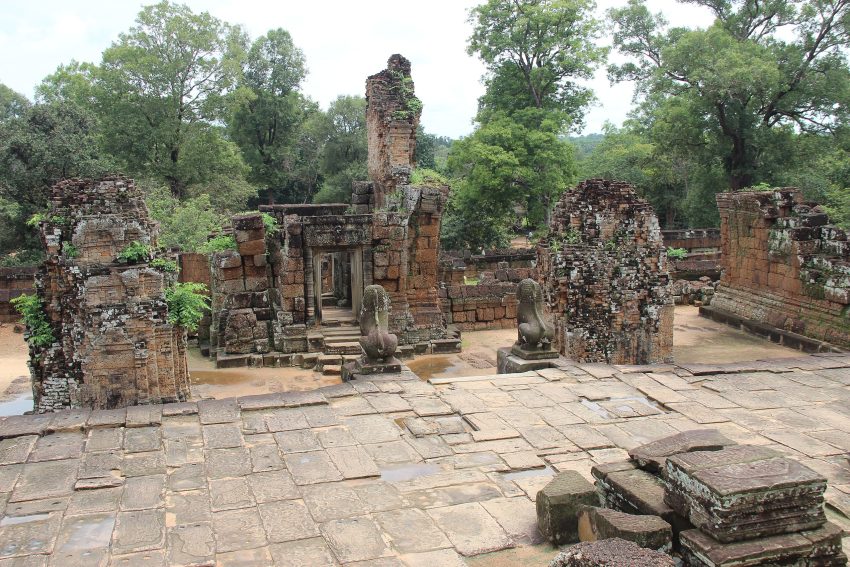
The East Mebon is a 10th-century temple built during King Rajendravarman’s reign (944-968 AD), positioned at the center of the vast Yasodharatataka Baray reservoir. Known today as the East Baray, this reservoir has long been dry, but in its prime, the temple would have appeared as an island accessible only by boat, with its reflection shimmering across the water.
Visiting East Mebon
East Mebon is easy to access, with only a few steps to ascend, and it offers many highlights, including beautiful stone carvings of elephants and lions, along with a remarkable collection of unique and well-preserved lintels. The temple is open from 7:30 am to 5:30 pm, and visitors typically spend about 40 minutes here, though you may want to stay longer to appreciate the intricate lintels. There are food and drink stalls near the entrance, and entry is included with the Angkor Pass as part of the Grand Circuit.
In 1922, a stele discovered by Henri Marchal in the eastern gopura provided the foundation date of the temple (952 AD) and a tribute to King Rajendravarman, detailing his contributions to temple construction and the installation of various idols, including Shiva, Parvati, Vishnu with Brahma, and eight lingas.
Originally built on an island within the Yasodharatataka Baray (spanning 7 km by 1.8 km), the temple aligns along an east-west axis with the East Baray Terrace, Victory Gate, and the Royal Palace of Angkor Thom, and along a north-south axis with Pre Rup to the south.
Layout
The temple complex measures about 100 by 100 meters, with entry staircases at each cardinal point flanked by guardian lions. Stone elephants adorn each corner of the first and second tiers. Inside the outer laterite enclosure wall, accessed through cruciform-shaped gopuras (entrance gates), is a series of long halls of varying lengths. The next tier also has staircases leading to another enclosure wall with additional gopuras.
Within this enclosure are eight brick shrines flanking the gopura, along with five rectangular laterite structures, three of which open to the west (commonly referred to as “libraries”), while the others open to the east. Each structure features sandstone doorframes, ornate door columns, and beautifully carved lintels.
The upper tier, made of sandstone, serves as the platform for five central towers, each reached by staircases flanked by guardian lions. These towers are constructed from brick, while laterite and sandstone are used for the base and doorframes. The doorways are flanked by intricately decorated columns, topped with lintels, and adorned with devata figures carved into the brickwork. Notably, the small holes in the brickwork would have supported a stucco finish, traces of which can still be seen in certain areas.
It is believed that the central tower once held a linga, while the southeast tower housed an image of Brahma (evident from the round pedestal inside on a lower tier), with the contents of the other towers remaining uncertain. Dr. Sophia Baird has proposed a hypothesis on these, as noted in the references below.
Don’t miss the beautiful sandstone offering table near the northern gopura. Additionally, in one of the shrines, an image of the Buddha has been added.
What Other Travellers Say...

Eastern Mebon Temple, located in Krong Siem Reap, is a circa‑10th‑century sandstone temple known for intricate carvings, tiered pyramid terraces and prominent elephant statues at the corners; visitors describe it as a peaceful, open site worth adding to an Angkor itinerary if you have time, a pleasant place to sit and watch the surroundings, and enjoyable even in light rain, with nearby vendors where you can rest or grab lunch.


The East Mebon Temple appears in our Complete Guide to Visiting Siem Reap!

Moira & Andy
Hey! We're Moira & Andy. From hiking the Camino to trips around Europe in Bert our campervan — we've been traveling together since retirement in 2020!
This website uses affiliate links which may earn a commission at no additional cost to you!
Nearby Attractions
- Pre Rup Temple (1.3) km
Buddhist Temple - Pre Rup Temple (1.3) km
Hindu Temple - Ta Som (2.1) km
Buddhist Temple - Srah Srang & Kandal Srah Srang (2.3) km
Historic Site and Reservoir - Banteay Kdei (3.0) km
Buddhist Temple - Neak Pean (3.3) km
Buddhist Temple - Neak Poan – The Mystical Island Temple (3.3) km
Buddhist Temple - Ta Prohm (Tomb Raider Temple) (3.6) km
Buddhist Temple - Krol Ko Temple (3.6) km
Buddhist Temple - Prasat Kravan (3.7) km
Hindu Temple