Srah Srang & Kandal Srah Srang, Siem Reap
Historic Site and Reservoir in Siem Reap
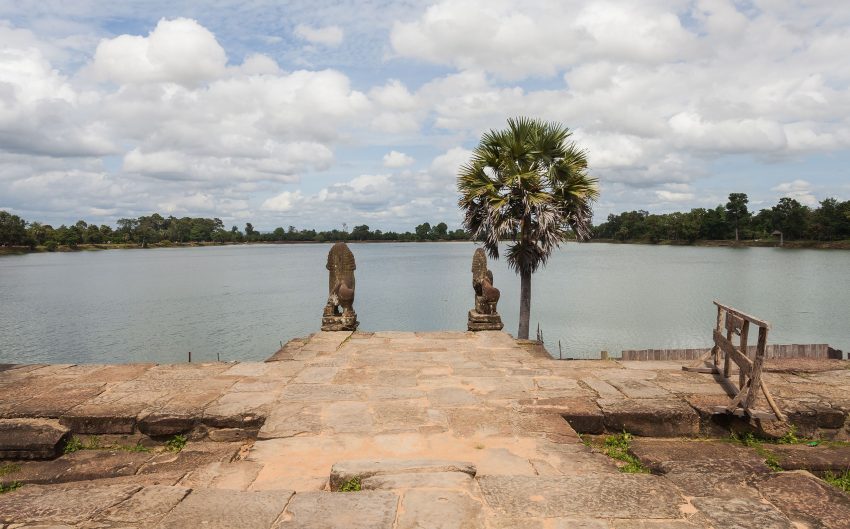
Srah Srang & Kandal Srah Srang in Siem Reap, Cambodia is a large Angkor-era reservoir (baray) with a distinctive stone landing terrace and a small island temple at its center. Set south of the East Baray and east of Banteay Kdei, the water basin stretches roughly 700 by 350 meters, edged with laterite blocks capped in sandstone.
What stands out most is the western terrace: a cruciform platform with naga balustrades, guardian lions on the steps down to the water, and detailed carving that rewards a slow look. It’s also a practical stop for travelers planning a sunrise viewpoint opposite Banteay Kdei’s entrance, while the quieter eastern bank can suit a calmer end-of-day pause. If you like Angkor’s water landscapes, stonework details, and short scenic stops between temples, this is an easy addition.
Table of Contents
- History and Significance of the Srah Srang & Kandal Srah Srang
- Things to See and Do in the Srah Srang & Kandal Srah Srang
- How to Get to the Srah Srang & Kandal Srah Srang
- Is the Srah Srang & Kandal Srah Srang Worth Visiting?
- Practical Tips on Visiting the Srah Srang & Kandal Srah Srang
- Where to Stay Close to the Srah Srang & Kandal Srah Srang
- FAQs for Visiting the Srah Srang & Kandal Srah Srang
History and Significance of the Srah Srang & Kandal Srah Srang
10th-century origins
Srah Srang began as a major reservoir in the mid-10th century, part of the broader Angkor system that combined monumental architecture with engineered water landscapes. Its scale and formal edges show it was designed as more than a simple pond, with carefully built embankments and a planned relationship to nearby temples.
At the center sits Kandal Srah Srang, a small island temple dating to the 10th century. Its position reinforces the reservoir’s ceremonial feel, turning the water into a framed setting for a shrine rather than an empty expanse.
Jayavarman VII and the later terrace
In the early 13th century, Jayavarman VII expanded Srah Srang and added the western landing stage. The terrace's cruciform plan, naga balustrades, and guardians create a formal “arrival” point at the water, aligned directly opposite the entrance of Banteay Kdei.
Archaeology and recent restoration
Excavations in the northwest corner uncovered a cemetery of about 1,600 square meters, including mortuary jars with cremated remains and artifacts linked to the reign of Udayadityavarman II, documented by archaeologist B.P. Groslier. More recently, Kandal Srah Srang was restored by APSARA and reopened to the public in October 2021.
During that restoration, two ancient turtle sculptures were unearthed; one contained a white crystal dragon and a trident, now held for study at the Preah Norodom Sihanouk Angkor Museum. The discovery adds a vivid layer to the site’s long timeline, spanning construction, reuse, archaeology, and conservation.
Things to See and Do in the Srah Srang & Kandal Srah Srang
I'd start at the western landing terrace and take time with the carvings before doing anything else. The naga balustrades, the six-headed naga fan, and the garuda perched above the naga's body are the details that make this reservoir feel like an architectural stop, not just a viewpoint. From the same platform, I like watching the light change over the water-this is the side many people choose for sunrise, especially because it faces Banteay Kdei.
After that, I’d walk along the edge to get a sense of the reservoir’s scale and symmetry. If you want a quieter moment, I find the eastern side works well for a calmer look across the basin, and it’s also noted as a serene place to watch sunset. Keep an eye out for the guardian lions flanking the steps down to the water-they’re easy to miss if you only stop for a quick photo.
How to Get to the Srah Srang & Kandal Srah Srang
The nearest airport is Siem Reap-Angkor International Airport (SAI), with onward road transfers into Siem Reap and the Angkor Archaeological Park. For the best deals and a seamless booking experience, check out these flights to Siem Reap on Booking.com.
Siem Reap can also be reached by train via the station serving the city area, then continue by road transport to Angkor sites. Train schedules and bookings can be found on Omio.
By car or tuk-tuk, travel within the Angkor Archaeological Park to the reservoir area near Banteay Kdei; there is roadside access and typical drop-off/parking space near major stops.
Is the Srah Srang & Kandal Srah Srang Worth Visiting?
Yes-Srah Srang & Kandal Srah Srang is worth a short stop if you want a scenic water landscape, a well-preserved ceremonial terrace, and an easy sunrise/sunset viewpoint between temples. It's best for photographers, cyclists, and travelers who enjoy Angkor's quieter spaces and stonework details. It's less essential if your time is tight and you're prioritizing major temple interiors, because the experience here is mainly the terrace, the water, and the atmosphere rather than a large complex to explore. Skip it if you don't care for viewpoints and would rather allocate every stop to big temple enclosures.
What Other Travellers Say...
Srah Damrei (Elephant Pond), located in Anlong Thum on Phnom Kulen, is an off‑the‑beaten‑path archaeological site featuring life‑size sandstone carvings—a large elephant plus two lions and a frog‑like figure—set beside a basin; visitors praise it as a beautiful, adventurous stop reached best by motorbike (often via a guided loop from the Kulen Waterfall car park), noting rough dirt trails and the need for local guides or riders to navigate the jungle tracks.





Practical Tips on Visiting the Srah Srang & Kandal Srah Srang
- Best time to visit: Early morning for sunrise from the western terrace, or later in the day for a calmer look from the eastern side toward sunset.
- How long to spend: Plan 15-30 minutes for the terrace and a short walk along the edge; add more time if you’re photographing or pairing it with nearby temples.
- Accessibility: Expect uneven ground and steps on the landing stage; the terrace steps down to the water are not mobility-friendly.
- Facilities: As a park stop, facilities can be limited and variable; I’d plan for basic needs before you begin a longer Angkor circuit.
Where to Stay Close to the Srah Srang & Kandal Srah Srang
For most travelers, the best base is central Siem Reap, so you can balance early Angkor starts with easy evenings back in town for food and downtime. From the center, it's straightforward to head out to Angkor Archaeological Park for sunrise stops like Srah Srang, then continue to nearby temples without changing hotels.
If you want a classic, full-service option with a central location, consider Raffles Grand Hotel d'Angkor. For a well-known mid-range base close to the action in town, Somadevi Angkor Resort & Spa can suit travelers who want convenience for evenings after temple touring. If you prefer a reliable international-style stay near central Siem Reap, Park Hyatt Siem Reap is another strong option for comfort-focused itineraries.
FAQs for Visiting the Srah Srang & Kandal Srah Srang
Getting There
Tickets & Entry
Visiting Experience
Tours, Context & Itineraries
Photography
Accessibility & Facilities
Food & Breaks Nearby
Safety & Timing
The Srah Srang & Kandal Srah Srang appears in our Complete Guide to Visiting Siem Reap!

Moira & Andy
Hey! We're Moira & Andy. From hiking the Camino to trips around Europe in Bert our campervan — we've been traveling together since retirement in 2020!
This website uses affiliate links which may earn a commission at no additional cost to you!
Nearby Attractions
- Banteay Kdei (0.8) km
Buddhist Temple - Prasat Kravan (1.4) km
Hindu Temple - Pre Rup Temple (1.6) km
Buddhist Temple - Pre Rup Temple (1.6) km
Hindu Temple - Ta Prohm (Tomb Raider Temple) (1.9) km
Buddhist Temple - East Mebon Temple (2.3) km
Buddhist Temple - Ta Keo (3) km
Buddhist Temple - Prasat Leak Neang (3.2) km
Buddhist Temple - Ta Nei Temple (3.3) km
Buddhist Temple - Thommanon Temple (3.6) km
Buddhist Temple