Complesso Monumentale di San Pietro a Corte, Salerno
Palace and Roman Site in Salerno
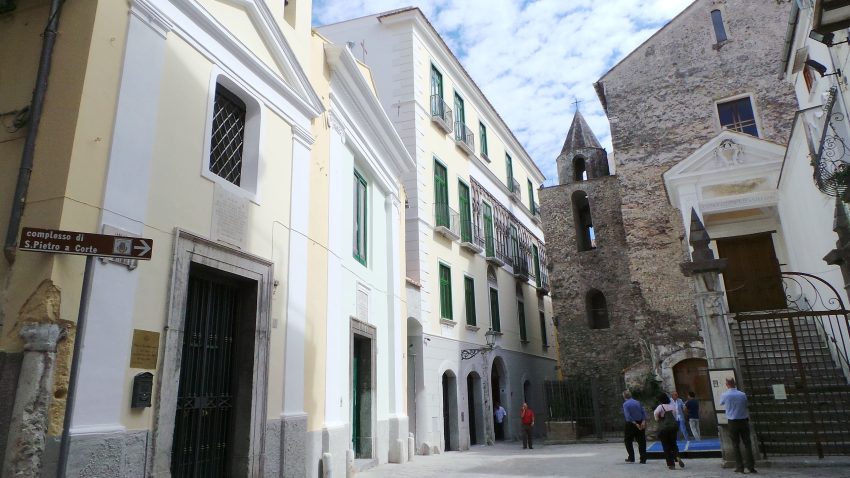
San Pietro a Corte is one of those places that feels like a secret even though it sits right in the historic center of Salerno. From the street, it's easy to walk past without realising that beneath your feet there's a layered time capsule: Roman-era spaces repurposed over centuries, and a Lombard palace complex that once anchored power in southern Italy. For curious travelers, it's one of the must-see places in Salerno because it turns “history” into something you can physically step into and sense.
The best way to enjoy it is to arrive with a little patience and a slow-travel mindset. Give yourself time to notice the transitions-street level to older levels, bright daylight to cooler stone-and let it become a highlight on a walking tour of Salerno, especially if you're stitching together the cathedral area, old-town lanes, and the waterfront in one day.
Table of Contents
- History and Significance of San Pietro a Corte
- Things to See and Do in San Pietro a Corte
- How to Get to San Pietro a Corte
- Practical Tips on Visiting San Pietro a Corte
- Where to Stay Close to San Pietro a Corte
- Is San Pietro a Corte Worth Visiting?
- For Different Travelers
- FAQs for Visiting San Pietro a Corte
- Nearby Attractions to San Pietro a Corte
History and Significance of San Pietro a Corte
San Pietro a Corte is closely associated with the Lombard presence in Salerno and the period when the city became a strategic seat of power in Campania. The site is traditionally linked to Duke Arechi II of Benevento, who shifted his political center south after the fall of the northern Lombard kingdom, and the complex became part of the “court” identity that still echoes through the surrounding street names and small squares.
One of the most compelling aspects is the way the building literally sits on earlier history. Elements of the medieval structure rest over spaces connected to an imperial-age bath complex, which later took on Christian functions and burial use. That layering is the real significance here: San Pietro a Corte is not a single monument frozen in one moment, but a compressed timeline of Salerno itself.
In practical terms, it also helps you understand the city’s geography. This is not a detached hilltop fortress story-it’s power at street level, woven into everyday life, which is exactly what makes the visit feel so immediate compared with more “museum-like” attractions.
Things to See and Do in San Pietro a Corte
The essential experience is moving through the different levels and reading the site like an archaeological cross-section. Look for the contrasts in materials and atmospheres: more formal architectural elements above, then older stonework and spatial logic below that hints at earlier functions. Even if you don’t know every term, you can feel when you’ve stepped into a different era.
Pay attention to the details that are easy to miss when you rush-pillars, wall textures, traces of painted surfaces, and the way later chapels and stairways reframe the older structure. It’s a place where small observations add up: a niche here, a change in masonry there, and suddenly you’re seeing how medieval builders worked with what they inherited rather than starting from scratch.
If you enjoy pairing sites for context, San Pietro a Corte works well as the “deep time” stop before or after Salerno’s more monumental highlights. Do this, then head to open-air viewpoints or the seafront promenade-the shift from subterranean stone to bright coastline makes the day feel nicely balanced.
How to Get to San Pietro a Corte
If you're flying, the most convenient hub is Naples International Airport (NAP), with onward travel to Salerno by train, bus, or private transfer. For the best deals and a seamless booking experience, check out these flights to Salerno on Booking.com. Salerno Costa d’Amalfi Airport (QSR) can be closer when routes line up, but services are typically more limited. For the best deals and a seamless booking experience, check out these flights to Salerno on Booking.com.
By train, arrive at Salerno’s main station, then walk into the Centro Storico or take a short local bus/taxi ride to the old town edge and finish on foot through the lanes.Use Omnio to easily compare schedules, book train tickets, and find the best prices all in one place for a hassle-free journey across Italy. Buses are useful if you want to reduce walking, but the final approach is best done on foot because the historic center streets are narrow and more enjoyable at walking pace.
If you’re driving, plan to park outside the tightest old-town lanes and walk in, since limited access zones and scarce parking can make “door to door” driving more hassle than it’s worth.If you are looking to rent a car in Italy I recommend having a look at Discover Cars, first, as they compare prices and review multiple car rental agencies for you.
Practical Tips on Visiting San Pietro a Corte
- Entrance fee: Free entry
- Opening hours: Tuesday–Sunday 10:00–18:00; Monday not accessible.
- Official website: https://cultura.comune.salerno.it/it/luogo/Complesso-di-S-Pietro-a-Corte
- Best time to visit: Late morning or early afternoon, when you can combine it smoothly with nearby churches and museums without rushing.
- How long to spend: 30-60 minutes is ideal for a slow visit that includes time to absorb the different levels and details.
- Accessibility: Expect steps, uneven surfaces, and level changes; it’s not the easiest site for limited mobility, so plan for a short, careful visit if needed.
- Facilities: Keep expectations simple-this is an archaeological-style site, so plan cafés and restrooms around the surrounding streets of the historic center.
Where to Stay Close to San Pietro a Corte
For a culture-heavy itinerary, the best area to base yourself is Salerno's Centro Storico so you can walk to the main sights early and return easily for breaks; if your trip is focused on transport links for day trips, stay nearer the station area around Piazza Vittorio Veneto for fast access to trains, buses, and ferries.
If you want to stay right in the old-town atmosphere, B&B Palazzo Fruscione places you among the historic lanes for an easy, walk-everywhere rhythm. For a practical, well-connected base that still keeps the center within comfortable reach, Hotel Montestella works well for a mix of sightseeing and day trips. If you prefer a waterfront feel and don’t mind a slightly longer walk into the lanes, Grand Hotel Salerno is a solid option for sea views and evening strolls.
Is San Pietro a Corte Worth Visiting?
Yes, especially if you like places that feel authentic rather than polished. San Pietro a Corte is not about grand interiors or perfectly curated displays-it’s about standing in a real palimpsest of Salerno’s past and seeing how the city has continuously rebuilt on its own foundations.
It’s also excellent value in terms of time. You can slot it into a day without sacrificing bigger headline sights, and it often becomes the stop people talk about afterwards because it feels unexpectedly intimate and “discovered” rather than scheduled.
What Other Travellers Say...

Monumental Complex of San Pietro a Corte - Hypogeum and Palatine Chapel sits in Salerno’s historic centre at Larghetto S. Pietro a Corte, 8 and offers free entry to a compact site that visitors describe as a hidden gem full of well-preserved frescoes, an impressive upper ceiling, a hypogeum chapel and layered archaeology spanning Roman baths and later medieval phases; it’s easy to visit quickly, often uncrowded, and you may find volunteer guides or scheduled guided tours at certain hours, with a simple sign-in at the entrance.


For Different Travelers
Families with Kids
This can work well for families if you frame it as an underground time-travel stop rather than a long history lesson. Keep it short, let kids lead by spotting “oldest stones” or “hidden corners,” and pair it with an outdoor break afterward so the day doesn’t feel too heavy.
If you’re visiting with a stroller, plan for the likelihood of steps and tight spaces and be ready to tag-team. It’s usually easiest to do this as a quick parent rotation rather than trying to make it a long group stop.
Couples & Romantic Getaways
For couples, San Pietro a Corte is ideal as a quieter, atmospheric pause between more open, scenic parts of the city. There’s something memorable about stepping down into cooler stone spaces together, then re-emerging into the bustle of the old town for aperitivo or dinner.
It also pairs beautifully with an evening stroll afterward. Do the site in late afternoon, then slow-walk through the lanes toward the waterfront when the light softens and Salerno feels at its most cinematic.
Budget Travelers
This is a strong budget pick because the experience is genuinely distinctive without requiring a ticket. Use it as one of your “high-impact free stops,” then spend selectively on just one or two paid experiences elsewhere, like a viewpoint or a special museum.
Budget-wise, it also helps that everything around it is walkable. The more you build your day around the Centro Storico, the less you’ll spend on transport, and the more you’ll naturally discover.
History Buffs
History-focused travelers will get a lot out of the site’s layering and adaptive reuse: Roman infrastructure, medieval power structures, later chapels, and modern conservation all in one compact footprint. Go slowly, look for transitions in masonry and layout, and try to imagine how each era reused the previous one rather than erasing it.
If you want deeper context, treat this as your anchor for “Lombard Salerno,” then build outward to other sites that show the city's civic and religious evolution above ground.
FAQs for Visiting San Pietro a Corte
Getting There
Tickets & Entry
Visiting Experience
Tours, Context & Itineraries
Photography
Accessibility & Facilities
Nearby Attractions to San Pietro a Corte
- Salerno Cathedral (Duomo di Salerno): A major landmark of the old town with a layered history and a memorable cloister atmosphere.
- Giardino della Minerva: A terraced botanical garden on the hillside that offers calm paths and a different perspective on the city.
- Centro Storico di Salerno: A dense network of lanes and small squares where the city's everyday life and historic fabric blend beautifully.
- Lungomare Trieste: Salerno's waterfront promenade, perfect for a long, scenic walk after exploring stone interiors.
- Teatro Giuseppe Verdi: A handsome historic theatre that adds a cultural note to an evening route through the center.
The Complesso Monumentale di San Pietro a Corte appears in our Complete Guide to Visiting Salerno!

Moira & Andy
Hey! We're Moira & Andy. From hiking the Camino to trips around Europe in Bert our campervan — we've been traveling together since retirement in 2020!
This website uses affiliate links which may earn a commission at no additional cost to you!
Planning Your Visit
Tuesday-Sunday 10:00-18:00; Monday not accessible.
Free entry
Nearby Attractions
- Complesso Monumentale di Santa Sofia (0.1) km
Church - Chiesa di San Giorgio (0.2) km
Church - Lungomare Trieste (0.2) km
Park - Duomo di Salerno (0.2) km
Cathedral - Museo Diocesano San Matteo di Salerno (0.3) km
Museum - Chiesa della Santissima Annunziata (0.3) km
Church - Villa Comunale di Salerno (0.3) km
Gardens - Giardino della Minerva (0.3) km
Gardens - Museo Archeologico Provinciale of Salerno (0.4) km
Museum - Piazza della Liberta (0.5) km
Square