Charterhouse of Calci, Pisa
Historic Building and Museum in Pisa
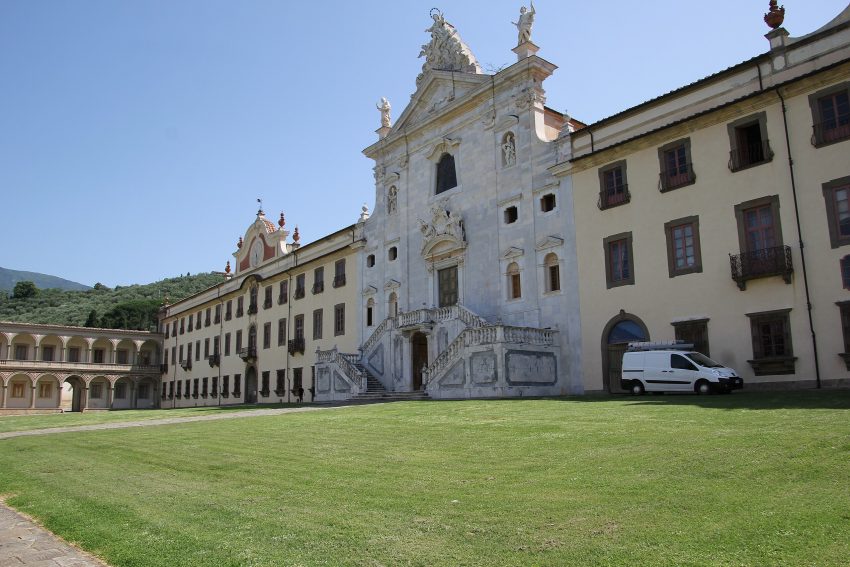
Tucked among the olive trees of the Valgraziosa, about a kilometre from the small town of Calci, the Charterhouse of Calci feels wonderfully removed from the bustle of Pisa yet close enough for an easy half-day trip. Founded in 1366 with the support of leading Pisan families, the complex unfolds in layers: a lower, outward-facing façade that once served local people, and behind it the grand marble-fronted monastery, its white church façade rising above a double flight of steps and crowned by a tympanum showing the Assumption surrounded by angels. It is easy to see why many visitors consider the Charterhouse of Calci one of the top sights in Pisa for travellers who enjoy pairing history with countryside views.
Walk through the outer courtyard and you move from the “public” face of the Certosa - pharmacy, parlor, chapel of San Sebastiano and a broad lawn once used by locals - into the quiet, enclosed world of the monks. Inside, cloisters, chapels and long corridors open up one by one, some still evoking the hermit-like lives of the Carthusian monks who lived here until 1969. Between historic monastic rooms and the vast spaces now occupied by the Natural History Museum of the University of Pisa, you get a rare combination of spiritual, artistic and scientific heritage in a single visit, a highlight of any tour from Pisa that ventures into its countryside.
Table of Contents
- History and Significance of the Charterhouse of Calci
- Things to See and Do in the Charterhouse of Calci
- How to Get to the Charterhouse of Calci
- Practical Tips on Visiting the Charterhouse of Calci
- Where to Stay close to the Charterhouse of Calci
- Is the Charterhouse of Calci Worth Visiting
- FAQs for Visiting the Charterhouse of Calci
- Nearby Attractions to the Charterhouse of Calci
History and Significance of the Charterhouse of Calci
The Charterhouse was founded in 1366 as a cloistered monastery of the Carthusian order of San Bruno, whose monks followed an austere, semi-eremitic lifestyle combining solitude with communal worship. Its location in the tranquil Valgraziosa, just outside Calci, reflected the order's preference for seclusion and nature: close enough to Pisa for support and patronage, but far enough away for contemplation. Wealthy Pisan families helped fund its construction, and over the centuries the complex expanded into an impressive ensemble of courtyards, cloisters and chapels.
From the outset, the site was carefully organised to separate the world of the monks from that of lay visitors. The lower, outer façade accommodated spaces that served the local community: a pharmacy, the chapel of San Sebastiano - also known as the women’s chapel - a parlor for speaking with the monks and a green lawn divided from the inner cloister. Behind this threshold rose the main monastery façade, its white marble church fronted by a double staircase and crowned with a sculpted Assumption, presenting a powerful, almost theatrical image of monastic grandeur against the hills.
Like many religious houses, the Charterhouse suffered repeated suppressions and upheavals, notably under Napoleon and again under the House of Savoy. Each time, monastic life was interrupted or reshaped, yet the complex remained a landmark in the valley. The last Carthusian monks left in 1969, and since then the Certosa has been gradually opened to visitors. Its significance today lies both in its well-preserved monastic architecture - particularly the grand cloister with its 15 cells, one of which can be visited - and in its role as a cultural hub that also houses the extensive Natural History Museum of the University of Pisa.
Things to See and Do in the Charterhouse of Calci
A visit usually begins at the lower façade, where you enter the outer area that once served local residents. Here you can still sense the divide between everyday life and the cloistered world beyond: the former pharmacy, the chapel of San Sebastiano and the parlor speak of the practical and spiritual services the monks provided to the surrounding community. The broad lawn in front adds a sense of openness before you step into the more enclosed monastic spaces.
The main attraction within the Certosa itself is the monastic core. The grand cloister, lined with 15 small houses, or cells, shows how Carthusian monks lived in semi-isolation, each with a private garden and work space; at least one of these cells is usually open to visitors, giving you a rare look at this way of life. As you move through the complex, you will pass through the church, chapels, refectory and chapter hall. The church’s white marble façade is already impressive from outside, but inside you find richly decorated religious spaces that reflect centuries of worship and patronage. The sacristy is particularly notable for housing the Atlantic Bible, a monumental 12th century illuminated Bible spread across four volumes, a standout piece for anyone interested in medieval manuscripts.
The monumental part of the visit often concludes with the Grand Ducal guesthouse and its cloister, the picture gallery and long corridors adorned with frescoes. These spaces hint at the hospitality once offered to important guests and the role the Charterhouse played in regional politics and culture. Finally, many visitors continue into the Natural History Museum of the University of Pisa, which occupies former service areas such as the huge granary, oil mill, laundries and agricultural courtyards. Here, natural history collections bring a very different kind of curiosity to the same walls, making the Certosa not just a historic monument but also one of the things to do in Pisa if you enjoy combining art, architecture and science in a single stop.
How to Get to the Charterhouse of Calci
If you are flying into Tuscany, the nearest major gateway is Pisa International Airport Galileo Galilei; from the airport you can hire a car, take a taxi or use local buses via Pisa to reach Calci and the Charterhouse in the Valgraziosa. For the best deals and a seamless booking experience, check out these flights to Pisa on Booking.com.
By train, your first step is to reach Pisa Centrale, which is well linked to Florence, Lucca and other regional cities; from Pisa Centrale you can continue by local bus towards Calci or take a taxi, with the final approach offering pretty views of the foothills as you leave the city. Use Omnio to easily compare schedules, book train tickets, and find the best prices all in one place for a hassle-free journey across Italy.
Travelling by car is often the most flexible option: from Pisa, follow the local roads towards Calci, then continue about 1 km beyond the town centre into the Valgraziosa, where the Charterhouse sits in a panoramic position among olive groves, with parking typically available nearby for an easy visit and onward exploration of the countryside. If you are looking to rent a car in Italy I recommend having a look at Discover Cars, first, as they compare prices and review multiple car rental agencies for you.
Practical Tips on Visiting the Charterhouse of Calci
- Suggested tips: Combine the Charterhouse with a wider loop through the Valgraziosa and nearby villages so you can balance time indoors with a walk or short hike among olive trees and terraced hills.
- Best time to visit: Late spring and early autumn offer pleasant temperatures and clear views; mornings and late afternoons are usually quieter and better for photography than midday in high season.
- Entrance fee: Adults: €15.00
- Opening hours: Daily: 9.00 to 19.00.
- Official website: https://www.msn.unipi.it/it/
- How long to spend: Plan on 2-3 hours if you want to see the monastic spaces, the Atlantic Bible, the frescoed corridors and at least part of the Natural History Museum without rushing.
- Accessibility: The complex includes historic staircases, uneven floors and multiple levels, so access can be challenging for visitors with reduced mobility; contact the site in advance for the latest information on accessible routes.
- Facilities: Expect basic visitor facilities such as restrooms and ticketing on site; for cafés and restaurants, head into nearby Calci or back towards Pisa.
- Photography tip: Capture the double façade from a slight distance to include both the lower outer front and the marble church behind; inside, focus on cloister views, frescoed corridors and details of the Atlantic Bible where permitted.
- Guided tours: Joining a guided tour, if available, is a good way to understand the Carthusian lifestyle and the symbolism of the architecture; some areas may only be accessible with a guide.
- Nearby food options: Calci has a handful of trattorias, bars and cafés where you can try simple Tuscan dishes before or after your visit, often with views towards the hills.
Where to Stay close to the Charterhouse of Calci
Staying in or near Calci is ideal if you want to enjoy the peaceful atmosphere of the Valgraziosa and have the Charterhouse almost on your doorstep. For a countryside feel, look for agriturismo-style accommodation such as Agriturismo Valgraziosa Retreat, where you can wake up among olive groves and be only a short drive or even a walk from the Certosa. If you prefer a village base with easy access to local services, Calci Historic Stay offers a convenient location in the town itself, making it simple to reach the Charterhouse and explore nearby lanes and viewpoints. Travellers who want to combine time at the Certosa with broader sightseeing in Pisa might choose Hotel San Ranieri, using a hire car or taxi to drive out to Calci while enjoying city comforts and quick access to Pisa’s main attractions.
Is the Charterhouse of Calci Worth Visiting
The Charterhouse of Calci is very much worth visiting, especially if you are looking for a quieter, more contemplative counterpoint to the busy streets and major monuments of Pisa. Its layered history as a Carthusian monastery, later suppressed and repurposed, is written into every courtyard and cloister, and the architecture - from the double façade to the grand cloister of 15 cells - offers plenty to explore. The presence of the Atlantic Bible and other artworks adds artistic depth, while the Natural History Museum introduces an unexpected scientific angle that broadens the experience beyond purely religious heritage. Add in the beautiful Valgraziosa setting and you have a destination that feels both substantial and serene, well worth slotting into a Tuscan itinerary.
What Other Travellers Say...

The Natural History Museum of the University of Pisa, set in a former Carthusian monastery on Via Roma in Calci, combines atmospheric historic architecture with extensive natural history displays — taxidermy in dynamic poses, fossil and bone collections, tropical dioramas, neanderthal reconstructions, aquaria and a cetacean gallery — plus rotating attractions such as moving animatronic dinosaurs; visitors praise the rich, family-friendly exhibits, picnic area and shaded parking lined with olive trees, note some uneven floors and occasional temporary closures, and report accessibility features in parts of the museum like stair lifts, ramps and tactile/Braille information.


FAQs for Visiting the Charterhouse of Calci
Nearby Attractions to the Charterhouse of Calci
- Calci town: A small, charming Tuscan town just down the road, with local cafés, churches and streets that give a sense of everyday life in the valley.
- Pisa city centre: Home to the Leaning Tower, cathedral, baptistery and numerous lesser-known churches and palaces, easily reached by car or bus.
- Parco Naturale Migliarino San Rossore Massaciuccoli: A large coastal nature reserve of dunes, pinewoods and wetlands, ideal for walks, bike rides and guided nature tours.
- Basilica Romanica di San Piero a Grado: A historic church on the road towards Marina di Pisa, built on the site where St Peter is said to have landed in Italy.
- Marina di Pisa: A relaxed seaside town with a promenade, pebble beaches and sea views, perfect for combining with a countryside visit to the Charterhouse.
The Charterhouse of Calci appears in our Complete Guide to Visiting Pisa!

Moira & Andy
Hey! We're Moira & Andy. From hiking the Camino to trips around Europe in Bert our campervan — we've been traveling together since retirement in 2020!
This website uses affiliate links which may earn a commission at no additional cost to you!
Planning Your Visit
Daily: 9.00 to 19.00.
Adults: €15.00
Nearby Attractions
- Museo Nazionale di San Matteo (9.3) km
Museum - Palazzo Vecchio de Palazzo Medici (9.3) km
Historic Building and Palace - Church of Santa Maria della Spina (9.6) km
Church - Borgo Stretto (9.7) km
Street - Baths of Nero (9.7) km
Historic Site - Logge di Banchi (9.8) km
Historic Building - Santo Stefano dei Cavalieri (9.8) km
Church - Palazzo dei Cavalieri (9.8) km
Palace - Palazzo Blu (9.9) km
Gallery and Palace - Corso Italia (9.9) km
Street