Camposanto Monumentale, Pisa
Historic Building in Pisa
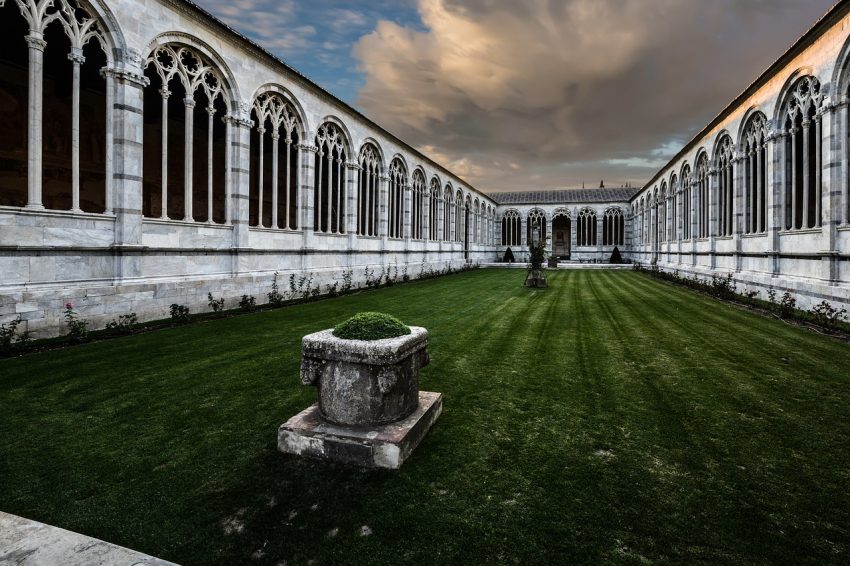
Tucked along one edge of the Piazza dei Miracoli, the Camposanto Monumentale looks at first like a quiet marble cloister, but it holds some of the most moving layers of history in Pisa. According to local legend, Archbishop Ubaldo dei Lanfranchi returned from the Fourth Crusade with shiploads of earth from Golgotha so that the citizens of Pisa could be buried in sacred soil, and in 1278 work began on this “Sacred Field.” The result was a vast rectangular cloister, its inner walls framed by Gothic traceried arches opening onto a serene lawn, making the Camposanto one of the top sights in Pisa for travellers who appreciate art, architecture and atmosphere as much as landmark silhouettes.
Walking through the arcades today, you move between stone tomb slabs of Pisan patricians underfoot and rows of Roman sarcophagi along the walls, feeling the centuries of memory layered into the space. The tragic artillery bombardment of 1944 destroyed much of the original 14th and 15th century fresco cycle when the lead roof melted and fire raced along the galleries, but that disaster also revealed the red preparatory drawings beneath, the sinopie, which are now displayed with great care in the Museo delle Sinopie nearby. Visiting both cloister and museum together is a highlight of any walking tour of Pisa that goes beyond the Leaning Tower to uncover the stories behind the stones.
Table of Contents
- History and Significance of the Camposanto Monumentale
- Things to See and Do in the Camposanto Monumentale
- How to Get to the Camposanto Monumentale
- Practical Tips on Visiting the Camposanto Monumentale
- Where to Stay close to the Camposanto Monumentale
- Is the Camposanto Monumentale Worth Visiting
- FAQs for Visiting Camposanto Monumentale
- Nearby Attractions to the Camposanto Monumentale
History and Significance of the Camposanto Monumentale
The story of the Camposanto begins with legend: Archbishop Ubaldo dei Lanfranchi, returning from the Fourth Crusade, is said to have carried back shiploads of soil from Golgotha, the hill outside Jerusalem where Christ was crucified. This holy earth was destined to give Pisans the privilege of being buried in ground directly linked to the Holy Land, underlining the city's religious ambition and maritime power. In 1278, construction of a monumental cemetery began to house these burials, laid out as a large, rectangular cloister enclosing the sacred soil within its walls.
Architecturally, the Camposanto was conceived as a harmonious frame for memory. A gallery of arches, decorated with fine Gothic tracery, runs around the courtyard, creating long perspectives of light and shadow broken by tombs and sarcophagi. Pisan patrician families were laid to rest beneath floor slabs in the arcades, while ancient Roman sarcophagi, reused and repurposed, lined the sides, tying the city's medieval elite to the prestige of classical antiquity. Over time, the walls became a vast painted narrative, covered with frescoes that explored themes of life, death, judgement and salvation.
The 1944 bombardment that set fire to the lead roof and devastated the frescoes was a turning point in the Camposanto's story. While the loss of so many works was a cultural catastrophe, the fire stripped away upper paint layers in places and exposed the sinopie, the original red-sketch underdrawings that artists used to lay out every detail of their compositions. These sinopie are invaluable for understanding how medieval and early Renaissance painters planned their work, which figures they placed where and how pupils and assistants then followed those guides. Today, the Camposanto stands as both a cemetery and an open archive of artistic process, its restored fresco fragments and sinopie bearing witness to creativity, destruction and painstaking conservation.
Things to See and Do in the Camposanto Monumentale
Start your visit by walking the perimeter of the cloister, following the arcaded gallery that frames the central lawn. Look down at the stone slabs that mark the burials of Pisan patricians and officials, and along the walls at the line of Roman sarcophagi, many with worn reliefs that hint at their original pagan contexts. The contrast between the ordered rhythm of the architecture and the dense layering of tombs creates a calm but powerful atmosphere, a reminder that this is both monument and resting place.
As you move along the galleries, pay close attention to the surviving frescoes and their restored fragments. Originally, these walls were covered in vast cycles from the 14th and 15th centuries, depicting themes such as the Triumph of Death, the Last Judgement and stories of saints. Even in damaged form, the figures, gestures and compositions are striking, and knowing that much of what you see has been rescued and reassembled after severe war damage makes them feel even more precious. Look for areas where you can still sense the original sweep of a narrative running across an entire wall, and imagine how overwhelming it would have been when completely intact.
Do not miss the chance to connect your walk through the cloister with a visit to the Museo delle Sinopie nearby. There, on carefully preserved panels, you can see the red sinopie that were hidden beneath the fresco plaster for centuries. These underdrawings show exactly how the master artists planned their work, with every figure, fold of drapery and architectural line mapped out before colour was applied. Often, the actual painting was carried out by pupils and assistants, so the sinopie can be the purest trace of the master's own hand. Moving between the museum and the Camposanto, comparing sketches with restored fresco patches, adds a rewarding layer of insight for anyone with an interest in how medieval art was actually made.
How to Get to the Camposanto Monumentale
The Camposanto Monumentale stands on the northern edge of the Piazza dei Miracoli in Pisa, which is easily reached from Pisa International Airport Galileo Galilei, located a few kilometres outside the historic centre and connected by local buses, taxis and a short rail or tram link into town. For the best deals and a seamless booking experience, check out these flights to Pisa on Booking.com.
Pisa is very well connected by train, with frequent services to Pisa Centrale from Florence, Lucca, Livorno and other Tuscan and national destinations; from the station it is about a 20-25 minute walk to the Piazza dei Miracoli or a short ride on a city bus or in a taxi that drops you near the square, from where the Camposanto is just a few steps away along the northern flank.Use Omnio to easily compare schedules, book train tickets, and find the best prices all in one place for a hassle-free journey across Italy.
If you are travelling by car, follow the main routes towards Pisa, such as the A12 or the Florence-Pisa highways, and use signposted car parks outside the restricted historic centre, then walk or take a shuttle to the Piazza dei Miracoli where the Camposanto forms part of the main monument group.If you are looking to rent a car in Italy I recommend having a look at Discover Cars, first, as they compare prices and review multiple car rental agencies for you.
Practical Tips on Visiting the Camposanto Monumentale
- Suggested tips: Pair your visit to the Camposanto with the Museo delle Sinopie so you can see both the restored frescoes and their underlying sinopie; take your time, as this is a place best experienced quietly rather than rushed.
- Best time to visit: Early morning or late afternoon tends to be calmer than midday, and the softer light filtering into the cloister makes the stonework and fresco fragments more atmospheric.
- Entrance fee: Adults: €8.00 (including the Cathedral).
- Opening hours: January-February, from 10.00 am to 5.00 pm; March-April, from 9:00 am to 7.00 pm; May-June, from 9.00 am to 8.00 pm; July-October, from 9.00 am to 8.00 pm; November-December, from 9.00 am to 7.00 pm.
- Official website: http://www.opapisa.it/
- How long to spend: Allow at least 45-60 minutes for the Camposanto itself and additional time if you are also visiting the Museo delle Sinopie and other monuments in the square.
- Accessibility: The cloister is largely on one level with relatively smooth floors, though some thresholds and slightly uneven areas may require care for visitors with limited mobility.
- Facilities: Restrooms, ticket offices and small cafés are available in and around the Piazza dei Miracoli; more extensive options lie a short walk away in the historic centre.
- Photography tip: Wide shots along the arcades emphasise the repeating arches and long perspectives, while close-ups of tomb slabs, sarcophagi details and restored fresco fragments capture the site’s quieter beauty; always remain respectful as this is still a burial place.
- Guided tours: Consider a guided visit that combines the Camposanto, cathedral and baptistery; a knowledgeable guide can help you read the fresco narratives and understand the wartime damage and restoration process.
- Nearby food options: Step away from the immediate square for more authentic cafés and trattorias, heading towards the river or university district where locals tend to eat.
Where to Stay close to the Camposanto Monumentale
If you would like to be within easy walking distance of the Camposanto and the rest of the Piazza dei Miracoli, Grand Hotel Duomo is a convenient option, just a few minutes from the main monuments and with upper-floor views towards the tower and cathedral. For a characterful stay slightly removed from the busiest streets around the square but still close enough to stroll over in ten minutes or so, Relais dell’Orologio offers a historic townhouse feel in the medieval core of the city. Travellers arriving by train who want straightforward access to both the Camposanto and the rest of the centre might prefer NH Pisa, directly opposite the station and linked to the Piazza dei Miracoli by local buses or a pleasant walk through Pisa’s old streets.
Is the Camposanto Monumentale Worth Visiting
The Camposanto Monumentale is very much worth visiting, particularly if you are already drawn to the cathedral and Leaning Tower and want a deeper sense of Pisa's history. It offers a different kind of experience from the more instantly iconic monuments: quieter, more reflective and rooted in themes of memory, death and artistic rebirth. Walking through the cloister, pausing at tombs and sarcophagi and then seeing how the frescoes were damaged, restored and linked to the sinopie in the museum adds layers of understanding that many visitors miss. For travellers interested in medieval art, legends of holy soil and the impact of war on heritage, the Camposanto quickly becomes one of the best places to visit in Pisa.
What Other Travellers Say...

Camposanto, on Piazza del Duomo in Pisa, is an elegant monumental cemetery arranged around a cloistered quadrangle where centuries-old marble tombs form part of the floor and impressive frescoed walls have been restored; visitors describe a calm, contemplative atmosphere inside the white Gothic cloister, with long marble corridors, large fresco cycles such as scenes of death and judgment, informative panels about the artworks, occasional visible restoration work, statues and a small garden, and note that it is less crowded than the surrounding tower area.


FAQs for Visiting Camposanto Monumentale
Nearby Attractions to the Camposanto Monumentale
- Borgo Stretto and the historic centre: A lively area of arcaded streets, shops and cafés where you can experience day-to-day Pisan life after your time in the monumental square.
- Cathedral of Santa Maria Assunta: Pisa's grand Romanesque cathedral in the same square, with its famous apse mosaic and Giovanni Pisano pulpit.
- Baptistery of San Giovanni: The circular marble baptistery just in front of the cathedral, renowned for its acoustics, font and Nicola Pisano pulpit.
- Leaning Tower of Pisa: The world-famous campanile of the cathedral complex, a short walk across the Piazza dei Miracoli.
- Museo dell'Opera del Duomo: The museum preserving sculptures, reliefs and liturgical objects from the cathedral complex, offering close-up views of original works.
The Camposanto Monumentale appears in our Complete Guide to Visiting Pisa!

Moira & Andy
Hey! We're Moira & Andy. From hiking the Camino to trips around Europe in Bert our campervan — we've been traveling together since retirement in 2020!
This website uses affiliate links which may earn a commission at no additional cost to you!
Planning Your Visit
January-February, from 10.00 am to 5.00 pm; March-April, from 9:00 am to 7.00 pm; May-June, from 9.00 am to 8.00 pm; July-October, from 9.00 am to 8.00 pm; November-December, from 9.00 am to 7.00 pm.
Adults: €8.00 (including the Cathedral).
Nearby Attractions
- Campo dei Miracoli (0.1) km
Historic Site and Square - Battistero di San Giovanni (0.1) km
Historic Building - Cathedral of Santa Maria Assunta (0.1) km
Cathedral - Leaning Tower of Pisa (0.2) km
Historic Building and Tower - Museo dell'Opera del Duomo (0.2) km
Museum - Orto Botanico dell’Università di Pisa (0.5) km
Gardens - Baths of Nero (0.6) km
Historic Site - Palazzo dei Cavalieri (0.6) km
Palace - Santo Stefano dei Cavalieri (0.7) km
Church - Lungarni of Pisa (0.9) km