Bosco di San Francesco, Assisi
Woods in Assisi
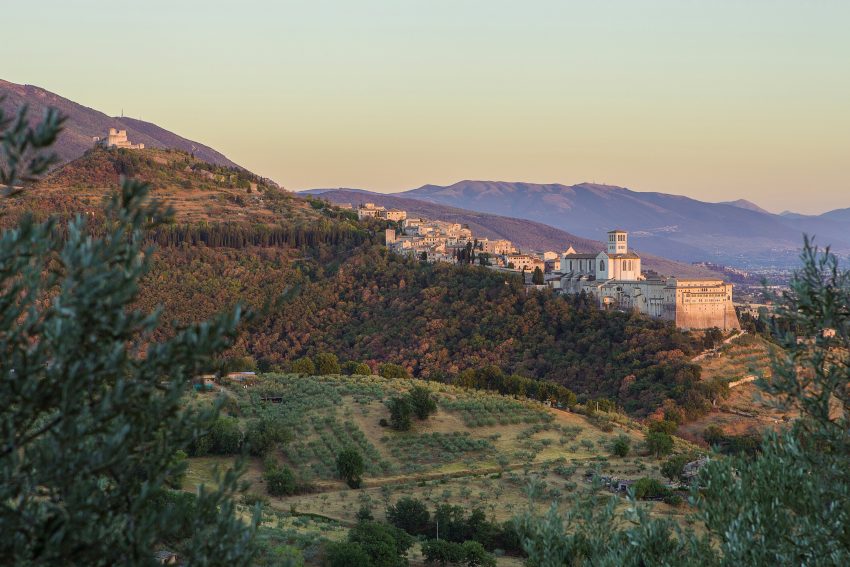
Bosco di San Francesco is the “other half” of Assisi: a green, winding descent that begins right below the Basilica of Saint Francis and quickly pulls you away from crowds, stone lanes, and souvenir streets. Once you enter, the soundscape changes-birds, wind in the trees, and the steady feeling of moving through a landscape that has been shaped by prayer, farming, and slow travel for centuries.
What makes this place special is how many layers you meet on a simple walk. You pass medieval traces-remains of an old monastic presence, a defensive tower silhouette, and the Romanesque church of Santa Croce-then find yourself in living countryside of olive trees and woodland paths. The modern note arrives in the form of Michelangelo Pistoletto’s “Third Paradise,” a conceptual land artwork made from 121 olive trees that turns the landscape itself into something you read as you walk.
Table of Contents
- History and Significance of the Bosco di San Francesco
- Things to See and Do in the Bosco di San Francesco
- How to Get to the Bosco di San Francesco
- Practical Tips on Visiting the Bosco di San Francesco
- Where to Stay Close to the Bosco di San Francesco
- Is the Bosco di San Francesco Worth Visiting?
- For Different Travelers
- FAQs for Visiting Bosco di San Francesco
- Nearby Attractions to the Bosco di San Francesco
History and Significance of the Bosco di San Francesco
The Bosco sits at a rare intersection in Assisi: it is physically under the city's most famous basilica, yet it feels like a separate world. Historically, this terrain was not simply “nature” in the modern leisure sense; it was working landscape and spiritual landscape, a place where monastic life, pilgrims' routes, and defensive needs overlapped across the Middle Ages.
That layered history remains visible in fragments rather than grand façades. The woodland holds traces of older buildings and infrastructure, including the outline of a 14th-century defensive tower and the enduring simplicity of Santa Croce, a small Romanesque church that anchors the walk in stone and silence rather than spectacle.
The Bosco's modern significance is also cultural. Pistoletto's “Third Paradise” adds a contemporary, reflective dimension: the idea that the balance between humanity and the environment is not abstract, but something you can experience physically by moving through the land. In Assisi-a place strongly associated with care for creation-this contemporary layer feels unusually coherent rather than bolted on.
Things to See and Do in the Bosco di San Francesco
The best way to experience the Bosco is to treat it as a slow, linear walk rather than a checklist. Start from the main entrance near the Upper Basilica and give yourself time to settle into the shift in pace. The path is not long, but it is textured-earth underfoot, changes in elevation, and small “reveals” that work better when you’re not rushing.
Along the route, look out for the medieval remnants and the quieter architectural anchors, especially Santa Croce. These are not showy sights, but they change how you read the landscape: suddenly the woods feel like a place people inhabited and protected, not just a scenic backdrop beneath the basilica.
The “Third Paradise” is the modern highlight and is best enjoyed as something you enter, not something you photograph quickly and leave. Walk the edges, then step into the pattern and notice how the olive trees form a symbol you only fully understand by moving through it. If you want to extend the experience, the former mill area (now a trattoria) is a natural end point for a pause that feels earned rather than planned.
How to Get to the Bosco di San Francesco
The nearest airports for reaching Assisi are Perugia San Francesco d'Assisi Airport (PEG) for proximity, with Rome Fiumicino (FCO) and Florence (FLR) as common alternatives depending on flight options. For the best deals and a seamless booking experience, check out these flights to Assisi on Booking.com.
By train, most travellers arrive at Assisi station in Santa Maria degli Angeli and continue uphill by local bus or taxi to the historic centre and the Basilica of Saint Francis area. Use Omnio to easily compare schedules, book train tickets, and find the best prices all in one place for a hassle-free journey across Italy.
Once you are at the Basilica of Saint Francis, the Bosco is straightforward: the main entrance is directly from the square of the Upper Basilica, and there is also access from the Benedictine complex of Santa Croce on the lower side of the route.
If you are travelling by car, park once in Assisi (or at the Santa Croce area if that suits your route) and treat the Bosco as a walking visit rather than trying to drive between entry points. If you are looking to rent a car in Italy I recommend having a look at Discover Cars, first, as they compare prices and review multiple car rental agencies for you.
Practical Tips on Visiting the Bosco di San Francesco
- Entrance fee: Adults €6; Reduced (6–18) €3; Students up to 25 €4; Under 5 free; FAI members free.
- Opening hours: Daily: 10:00 AM – 4:00 PM
- Official website: https://www.fondoambiente.it/luoghi/bosco-di-san-francesco?utm_source=gmb&utm_medium=referral&utm_campaign=bosco
- Best time to visit: Choose a morning slot for softer light and fewer people, or late afternoon if you want a calmer, more contemplative mood under the trees.
- How long to spend: 60-90 minutes for the walk and key stops, longer if you pause at Santa Croce, explore the land art slowly, or include a meal break.
- Accessibility: Expect dirt paths, slopes, and some steps; it can be challenging for wheelchairs or anyone who needs fully level surfaces.
- Facilities: Limited on-site facilities compared with central Assisi; plan water and rest stops around the basilica zone, then treat the Bosco as a quieter “in-between” space.
Where to Stay Close to the Bosco di San Francesco
For a culture-heavy Assisi itinerary, base yourself in the historic centre near the Basilica of Saint Francis so you can visit early and late when the town is quieter; if your trip's main focus is transport efficiency and day trips, staying in Santa Maria degli Angeli near the station is more practical, with the upper town as a daily outing.
For a very convenient base steps from the basilica-side routes, Hotel Sorella Luna keeps you close to the Bosco entry area while staying fully in the historic atmosphere. If you want a classic old-town stay on the main basilica street, Hotel Il Palazzo is well positioned for walking between San Francesco, the forest, and the central lanes. For a slightly more traditional larger-hotel feel still close to the basilica complex, Hotel Subasio is a strong, practical option.
Is the Bosco di San Francesco Worth Visiting?
Yes. If Assisi is starting to feel like a sequence of interiors, the Bosco gives you the clearest “reset” you can get without leaving town: real countryside under the basilica, medieval traces you encounter at walking speed, and a contemporary artwork that makes the landscape feel purposeful rather than purely scenic.
Honest pivot: if you have very limited time and your priority is only the basilica interiors and the central streets, you can skip the Bosco without missing Assisi’s headline monuments. It is also not ideal if mobility constraints make uneven paths stressful, because the experience depends on walking comfortably.
What Other Travellers Say...

Bosco di San Francesco (Via Ponte dei Galli, 1) is a peaceful nature-and-heritage area on the edge of Assisi, offering an easy walking trail through woodland and a river valley with small historic features such as a chapel and garden. Visitors most often praise the calm atmosphere, the sense of “escape” from the crowded town, and the helpful staff, describing it as a restorative stop that pairs well with time around the Basilica of St Francis. It is strongly rated overall (4.5 from about 1,285 ratings), although conditions can be seasonal (for example, the riverbed may be dry at times), so it is best framed as a worthwhile stroll rather than a headline sight.


For Different Travelers
Families with Kids
Bosco di San Francesco works well for families because it turns sightseeing into movement. Kids usually engage more when the “attraction” is a walk with changing scenery-trees, stone remnants, and a clear start and finish-rather than another quiet interior space with rules and hushed voices.
To keep it smooth, set a simple goal: find one medieval feature, then “discover” the olive-tree artwork as a pattern you can walk through. The visit tends to go best when you treat it as an outdoor break between the big basilica moments, not as a long, educational lecture.
Couples & Romantic Getaways
For couples, the Bosco is one of Assisi’s most quietly romantic experiences because it trades crowds for atmosphere. The woodland and olive groves feel intimate and unforced, and the landscape views make the town’s spiritual reputation feel grounded in place rather than marketing.
If you visit later in the day, the walk can feel like a shared pause in the itinerary-a way to absorb Assisi together without constantly reading plaques. Pair it with a slow meal afterwards and it becomes one of the most memorable “non-museum” parts of the trip.
Budget Travelers
This is a high-value stop because it adds a full, satisfying experience without requiring a packed schedule of paid interiors. If you’re watching costs, the Bosco is also a smart way to balance your day: you can do the major basilica moments, then spend real time somewhere beautiful without feeling you need to keep paying for “the next thing.”
It also helps you avoid over-planning. The route is self-contained, and the best version of the visit is simply walking well and pausing deliberately, which is exactly the kind of travel that costs the least and often feels the richest.
FAQs for Visiting Bosco di San Francesco
Getting There
Tickets & Entry
Visiting Experience
Tours, Context & Itineraries
Photography
Accessibility & Facilities
Food & Breaks Nearby
Safety & Timing
Nearby Attractions to the Bosco di San Francesco
- Basilica di San Francesco d'Assisi: The essential Assisi monument for frescoes, pilgrimage atmosphere, and the town's most famous art and architecture.
- Oratorio dei Pellegrini: A smaller, quieter Franciscan stop nearby that adds texture without the crowds of the basilica interiors.
- Rocca Maggiore: The hilltop fortress that delivers Assisi's best panoramas and a strong sense of the town's defensive history.
- Basilica di Santa Chiara: A major Clare-linked basilica that rounds out the Franciscan story from a different angle than San Francesco.
- Eremo delle Carceri: The forest hermitage on Monte Subasio, ideal if you want to extend the “Assisi in nature” theme beyond the city walls.
The Bosco di San Francesco appears in our Complete Guide to Visiting Assisi!

Moira & Andy
Hey! We're Moira & Andy. From hiking the Camino to trips around Europe in Bert our campervan — we've been traveling together since retirement in 2020!
This website uses affiliate links which may earn a commission at no additional cost to you!
Planning Your Visit
Daily: 10:00 AM - 4:00 PM
Adults €6; Reduced (6-18) €3; Students up to 25 €4; Under 5 free; FAI members free.
Nearby Attractions
- Piazza Inferiore di San Francesco (0.1) km
Square - Palazzo Bernabei (0.1) km
Museum and Palace - Basilica di San Francesco d'Assisi (0.1) km
Basilica - Pinacoteca Comunale (0.2) km
Gallery and Palace - Abbey of San Pietro (0.4) km
Abbey - Teatro Metastasio in Assisi (0.5) km
Theatre - Roman Forum and Archaeological Museum (0.7) km
Roman Site - Rocca Maggiore (0.7) km
Castle - Palazzo del Capitano del Popolo (0.7) km
Palace - Temple of Minerva (0.7) km
Roman Site