Anta Grande do Zambujeiro, Évora
Historic Site in Évora
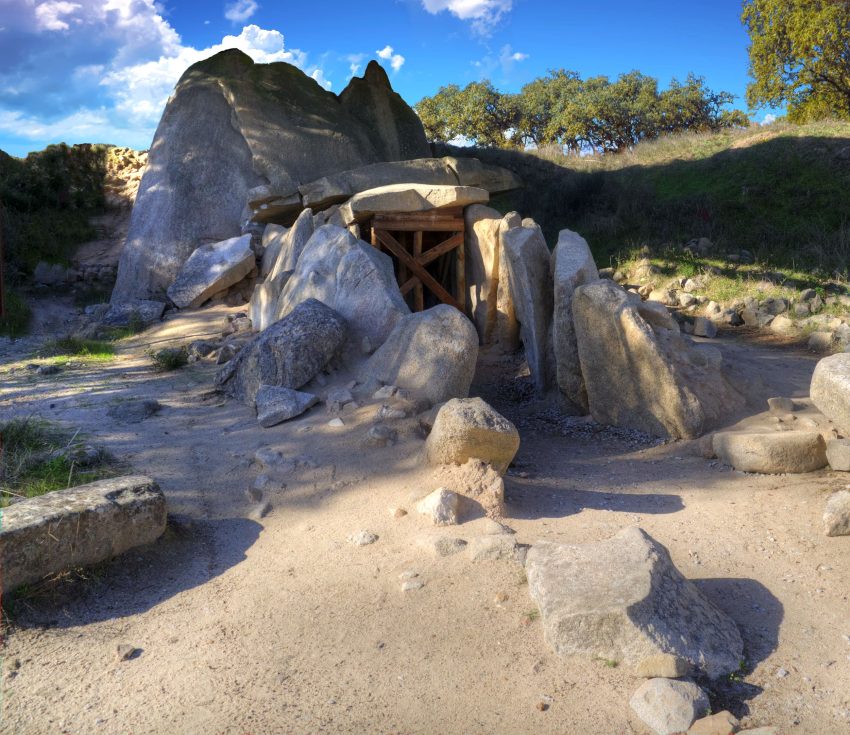
Anta Grande do Zambujeiro is the kind of place that makes you recalibrate your sense of time. Out in the quiet Alentejo landscape, a short drive from Évora, this megalithic tomb rises from the earth in massive granite slabs, with a protective structure overhead that hints at both its fragility and its importance. It doesn't feel like a “tourist attraction” in the usual sense; it feels like you've stumbled onto a threshold between worlds.
For travellers who like their history raw and unpolished, this is one of the things to see in Évora's wider area, and it pairs surprisingly well with a walking tour of Évora: you can spend the morning among cathedrals and Roman stones, then come here and experience something far older, in near-total silence. The contrast is part of the appeal, and it makes the city's famous monuments feel like just one layer in a much deeper story.
Table of Contents
- History and Significance of the Anta Grande do Zambujeiro
- Things to See and Do in the Anta Grande do Zambujeiro
- How to Get to the Anta Grande do Zambujeiro
- Practical Tips on Visiting the Anta Grande do Zambujeiro
- Where to Stay Close to the Anta Grande do Zambujeiro
- Is the Anta Grande do Zambujeiro Worth Visiting?
- For Different Travelers
- FAQs for Visiting Anta Grande do Zambujeiro
- Nearby Attractions to the Anta Grande do Zambujeiro
History and Significance of the Anta Grande do Zambujeiro
This monument belongs to Évora’s broader megalithic landscape, dating to the late Neolithic and Chalcolithic horizon, when communal tombs were built as both burial places and enduring markers in the terrain. (The scale is what sets it apart: a vast chamber and long passage built from huge stones, originally covered by a mound that would have made the site even more dominant in its surroundings.
It is classified as a National Monument, and it has been intensively studied over decades, with excavations and surveys aimed at understanding both its construction and the people who used it.What visitors see today reflects that tension between access and preservation: the site remains monumental, but parts of it are protected and stabilised because time, erosion, and earlier interventions have left it vulnerable.
Things to See and Do in the Anta Grande do Zambujeiro
Approach slowly and take in the setting first. One of the pleasures here is the feeling of distance from the city: the air is clearer, the landscape opens up, and the monument appears almost like a natural outcrop-until you notice the deliberate geometry of upright stones forming the chamber.
Spend time walking around the structure to understand its layout. From different angles you can read the relationship between the passage and the chamber, and you start to imagine the original mound that once covered and contained it, turning this into a sealed, sacred interior rather than an open ruin.
Finally, look for the small details that make prehistoric sites feel human rather than abstract: the way stones lean inward, the careful placement of slabs, and the sense that this was built to endure and to be returned to. Even without entering the chamber, you can still feel how the space was meant to impress and to hold meaning.
How to Get to the Anta Grande do Zambujeiro
Most visitors base themselves in Évora and visit the monument as a short countryside detour, either first thing in the morning or as a late-afternoon escape from the busiest city hours.
If you're arriving from abroad, Lisbon Humberto Delgado Airport (LIS) is the most practical gateway for Évora and the surrounding megalithic sites. For the best deals and a seamless booking experience, check out these flights to Évora on Booking.com. Faro Airport (FAO) can also work if your itinerary links the Alentejo with the Algarve. For the best deals and a seamless booking experience, check out these flights to Évora on Booking.com.
Évora is reachable by train from Lisbon, and once you're in the city it's straightforward to arrange a taxi, tour, or rental car for the final rural stretch to the monument. Train schedules and bookings can be found on Omio. Regional buses can get you toward the Valverde area, but the last part is often easiest with a taxi or pre-arranged transport because the site sits outside the main urban grid.
Driving gives you the most flexibility, but note that access rules may affect how close you can get by vehicle, so plan for a short walk at the end rather than assuming you can park right beside the stones. If you are looking to rent a car in Portugal I recommend having a look at Discover Cars, first, as they compare prices and review multiple car rental agencies for you.
Practical Tips on Visiting the Anta Grande do Zambujeiro
- Entrance fee: Free
- Opening hours: 24 Hours
- Official website: https://www.cm-evora.pt/en/locais/anta-grande-do-zambujeiro/
- Best time to visit: Late afternoon is ideal for atmosphere and photos, when the light softens and the countryside feels calmer.
- How long to spend: 30-60 minutes is perfect for a slow circuit, photos, and a few quiet minutes to take in the scale without rushing.
- Accessibility: Expect uneven ground and a short approach on foot, so sturdy shoes help and mobility-limited visitors may prefer organised transport.
- Facilities: There are no on-site services in the usual sense, so bring water and treat it like a countryside stop rather than a staffed attraction.
Where to Stay Close to the Anta Grande do Zambujeiro
For a culture-heavy itinerary, stay inside Évora’s historic centre so you can walk to the main monuments and enjoy evenings in town; if your main focus is countryside calm and easy access to rural sites, consider a quieter base on the outskirts where driving and parking feel simpler.
A strong all-round base is M'AR De AR Aqueduto, which balances comfort with a location that makes it easy to combine city sightseeing and quick drives out to the megaliths. If you want to be firmly in the walkable centre for restaurants and landmark-hopping, Évora Olive Hotel keeps you close to the heart of town while still being a practical launch point for day trips. For a more resort-like stay in a historic setting just outside the centre, Convento do Espinheiro, Historic Hotel & Spa is ideal if the trip is as much about downtime as it is about archaeology.
Is the Anta Grande do Zambujeiro Worth Visiting?
Yes, especially if you’re even slightly curious about prehistoric Europe. The monument delivers a rare combination of scale, authenticity, and atmosphere-there’s nothing “manufactured” about the experience, and that’s exactly why it stays with you.
It’s also a smart complement to Évora’s better-known sights. Roman temples and Gothic interiors are impressive, but this takes you back to a different kind of human ambition, when moving and raising stone was itself a statement of belief and community.
What Other Travellers Say...

Great Dolmen of Zambujeiro, located at 7000 Nossa Sra. de Guadalupe, is a massive megalithic burial chamber set into a hillside and built from huge granite slabs; visitors praise its unusually large polygonal chamber and broad roof, note there’s onsite information, and describe a scenic walk through farmland to reach it. Access involves an unpaved, sometimes very rough road with parking about 100 meters away and a gate to open before following a path; the site is free to visit, you can approach and touch the structure but cannot enter it, and the uneven terrain makes it difficult for wheelchair users.


For Different Travelers
Families with Kids
This visit works best as an outdoor adventure with a simple story: a “giant stone house” built thousands of years ago. Keep it playful-let kids walk the perimeter, spot the biggest slabs, and imagine what the site looked like when it was covered by a mound.
Because it’s a countryside setting, the practical win is flexibility. Bring snacks and water, keep the stop short, and pair it with another nearby open-air site so it feels like a mini road-trip rather than a single remote landmark.
Couples & Romantic Getaways
For couples, the appeal is the quiet. There’s something memorable about standing beside a monument this old with almost no distractions-just wind, stone, and the sense of distance from the modern world.
If you time it for later in the day, the light across the fields and the softer tones of granite make the whole stop feel more cinematic. It's an easy, low-effort detour that still feels special, especially if you follow it with a slow dinner back in Évora.
Budget Travelers
This is a high-impact stop that doesn’t require a ticket, so it’s excellent value if you’re building your itinerary around free or low-cost experiences. The main expense is transport, which is why it pairs well with other nearby megalithic sites in the same outing.
If you're travelling without a car, look for a small-group tour from Évora that bundles multiple prehistoric stops. That approach often works out cheaper than piecing together rural taxis, and it removes the stress of navigating back roads.
FAQs for Visiting Anta Grande do Zambujeiro
Getting There
Tickets & Entry
Visiting Experience
Tours, Context & Itineraries
Photography
Accessibility & Facilities
Food & Breaks Nearby
Safety & Timing
Nearby Attractions to the Anta Grande do Zambujeiro
- Cromeleque dos Almendres: A famous stone circle outside Évora that makes a perfect companion stop for a megalith-themed half-day.
- Menir dos Almendres: A solitary standing stone nearby that’s quick to visit and helps you read the wider prehistoric landscape.
- Convento do Bom Jesus de Valverde: A nearby historic site that adds a very different, later layer of local heritage close to the megaliths.
- Évora Cathedral: The city's monumental hilltop cathedral, ideal for switching from prehistory to medieval Évora in a single day.
- Roman Temple of Évora: A compact but iconic Roman landmark that anchors any classic Évora centre walk.
The Anta Grande do Zambujeiro appears in our Complete Guide to Visiting Évora!

Moira & Andy
Hey! We're Moira & Andy. From hiking the Camino to trips around Europe in Bert our campervan — we've been traveling together since retirement in 2020!
This website uses affiliate links which may earn a commission at no additional cost to you!
Planning Your Visit
24 Hours
Free
Nearby Attractions
- Almendres Cromlech (4.6) km
Historic Site - Évora City Walls (9.5) km
City Walls - Agua de Prata Aqueduct (9.7) km
Aqueduct - Capela dos Ossos (9.8) km
Church - Praça do Giraldo (9.8) km
Square - Museu de Évora (10.0) km
Museum - Évora Roman Temple (10.0) km
Historic Site - Évora Cathedral (10.0) km
Cathedral - Universidade de Évora (10.2) km
Historic Site - Amoreira Aqueduct (82.2) km
Aqueduct