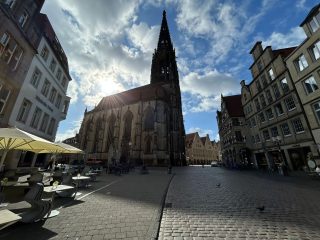
Überwasserkirche, Münster
Church in Münster

Überwasserkirche, often called the Overwater Church, is one of Münster's oldest and most atmospheric churches, standing just beyond the Old Town and close to the Aasee. Its roots go back to the 14th century, and the mix of Gothic and later Baroque elements gives it a distinctive profile: a tall tower, arched windows, and a simple yet elegant façade that has watched over the city for centuries. Step inside and you swap cobbled streets and bike bells for a cool, calm space where stone, wood, and soft light set a reflective mood.
Because of its location between the historic centre and the Aasee, Überwasserkirche feels woven into both the city's spiritual story and its everyday rhythm. It is a natural stop as you wander from Domplatz toward the lakeside paths, and a highlight of any walking tour of Münster if you enjoy quieter, less crowded churches where you can really absorb the details of the architecture and artwork.
Table of Contents
- History and Significance of the Überwasserkirche
- Things to See and Do in the Überwasserkirche
- How to Get to the Überwasserkirche
- Practical Tips on Visiting the Überwasserkirche
- Where to Stay close to the Überwasserkirche
- Is the Überwasserkirche Worth Visiting?
- FAQs for Visiting Überwasserkirche
- Nearby Attractions to the Überwasserkirche
History and Significance of the Überwasserkirche
Überwasserkirche traces its origins to the 14th century, when Münster was expanding beyond its earliest core and new parishes were being established to serve the growing population. Its name-literally “Overwater Church”-likely reflects its position near the watercourses and later the Aasee, setting it apart from churches clustered closer to the market streets. Over the centuries, it has stood as a spiritual anchor on the edge of the Old Town, marking the transition toward the more open landscape beyond.
Architecturally, the church combines clear Gothic lines with later Baroque touches added during repairs and refurbishments. Pointed arches, a strong tower, and simple buttresses root it firmly in the medieval tradition, while some interior details and fittings hint at later tastes and changing liturgical needs. This blend gives Überwasserkirche a layered character: neither a pristine Gothic monument nor a completely reworked Baroque interior, but a living building that has evolved alongside the city it serves.
Through wars, religious shifts, and urban development, the church has remained an important place of worship and community life. Its survival and continued use make it a symbol of Münster's resilience, offering continuity in a city whose history includes both cultural flowering and episodes of conflict and rebuilding. Today, regular services, concerts, and events ensure that Überwasserkirche is not just a historical curiosity but an active part of Münster's spiritual and cultural landscape.
Things to See and Do in the Überwasserkirche
Inside Überwasserkirche, the first impression is one of calm and space. Vaulted ceilings draw your gaze upward, while the soft light filtering through arched windows gives the interior a gentle, contemplative feel. Take time to walk slowly up the central aisle and along the side aisles, noting how the structure's Gothic bones frame the more ornate altars and furnishings added over later centuries.
The altars, sculptures, and paintings scattered through the nave and side chapels reflect the church’s long history of devotion. Wooden figures, carved details, and carefully maintained artwork offer glimpses into different eras of religious art, from more restrained medieval forms to richer Baroque expressions. Even if you are not an expert, you can enjoy the craftsmanship and the sense of continuity these pieces convey.
After exploring the interior, step back outside and circle the church if possible. From different angles you can appreciate how its tower rises above the surrounding streets and how its position near the Aasee gives it an almost village-church feel despite being close to the city centre. It is an ideal spot to pause for a few photos before continuing either into the Old Town or down toward the lakeside paths.
How to Get to the Überwasserkirche
Überwasserkirche is located just west of Münster's Old Town, within easy walking distance of Domplatz and Prinzipalmarkt, and close to the route that leads toward the Aasee. Most international visitors arrive via Münster Osnabrück International Airport, from where buses, shuttles, or taxis connect to the city centre in around 30 minutes. For the best deals and a seamless booking experience, check out these flights to Münster on Booking.com.
Münster is very well connected by train, with frequent regional and long-distance services arriving at Münster (Westf) Hauptbahnhof.Train schedules and bookings can be found on Omio. From the station, you can walk into the city centre in about 15-20 minutes and then continue across Domplatz toward Überwasserkirche, or take a short bus ride to stops near the Old Town and complete the journey on foot.
If you are travelling by car, follow signs to the Innenstadt and use one of the public car parks around the edge of the historic centre, as the streets closest to the church are best explored on foot.If you are looking to rent a car in Germany I recommend having a look at Discover Cars, first, as they compare prices and review multiple car rental agencies for you. Once parked, it is an easy stroll through the Old Town toward the cathedral and then across the river or green spaces to reach Überwasserkirche, with clear views of its tower helping you navigate.
Practical Tips on Visiting the Überwasserkirche
- Suggested tips: Combine a visit to Überwasserkirche with a walk around the Aasee for a relaxed loop that mixes architecture, history, and lakeside views.
- Best time to visit: Late morning or early afternoon on weekdays is usually quiet, giving you space to sit, reflect, and enjoy the details of the interior.
- Entrance fee: Free
- Opening hours: Daily: 11:00 am - 19:00 pm
- Official website: https://liebfrauen-muenster.de/
- How long to spend: Plan for 20-40 minutes inside, plus extra time if you want to linger outside or continue on toward the Aasee.
- Accessibility: The main entrance is relatively straightforward, but as with many historic churches, there may be some steps and uneven flooring; visitors with reduced mobility should check conditions on arrival.
- Facilities: There are no major facilities inside beyond seating and basic information; cafés, toilets, and shops are available in the nearby Old Town and around the Aasee.
- Photography tip: If photography is allowed, make use of natural light from the side windows and aim for wide shots of the nave as well as close-ups of altars and sculptures.
- Guided tours: Check whether any church or city walking tours include Überwasserkirche; guides can offer insight into its role in Münster's religious and social history.
- Nearby food options: Head back toward the Old Town or along the lakefront for cafés, bakeries, and restaurants where you can take a break after your visit.
Where to Stay close to the Überwasserkirche
Staying near Überwasserkirche puts you in a pleasant position between the tranquil Aasee and the lively streets of Münster's Old Town. A convenient choice within walking distance is Stadthotel Münster, offering comfortable, modern rooms and easy access on foot to both the church and the city’s main sights. For a more design-focused experience in a converted industrial complex, Factory Hotel combines characterful interiors with good bus and bike connections into the centre and toward the Aasee. If you prefer to be close to both the railway station and the historic core, Hotel Kaiserhof makes a solid base, from which you can stroll or cycle to Überwasserkirche and the lakeside in under half an hour.
Is the Überwasserkirche Worth Visiting?
Überwasserkirche is definitely worth visiting, especially if you enjoy quieter historic churches that feel deeply embedded in their surroundings. Its blend of Gothic and Baroque elements, serene interior, and location near the Aasee give it a different character from the more central St. Paulus Dom and St. Lamberti Church. As a result, it offers a gentler, more reflective experience while still telling an important part of Münster's religious and architectural story, making it one of the things to do in Münster for travellers who like to explore beyond the main squares.
What Other Travellers Say...

Liebfrauen-Überwasserkirche at Überwasserkirchpl. 4 in Münster is a restored 14th-century Gothic church whose soaring interior, tiled floors and organ draw visitors seeking quiet, reflection and architectural detail; guests praise its stained glass, peaceful atmosphere, the welcoming nature during services and enjoy viewing the building from outside (especially from the leafy spot behind it), while seasonal markets nearby can add festive appeal.


FAQs for Visiting Überwasserkirche
Nearby Attractions to the Überwasserkirche
- St. Paulus Dom (Münster Cathedral): The city's main Romanesque-Gothic cathedral on Domplatz, with an impressive interior and famous astronomical clock.
- Prinzipalmarkt: Münster's historic arcade-lined main street, filled with gabled houses, shops, and cafés.
- St. Lamberti Church (Lambertikirche): A striking Gothic church near Prinzipalmarkt, known for its tower and the Anabaptist cages.
- Historical City Hall of Münster: Gothic city hall on Prinzipalmarkt, where part of the Peace of Westphalia was signed in 1648.
- Aasee: A large urban lake just beyond the Old Town, perfect for walking, cycling, boating, or relaxing after visiting Überwasserkirche.
The Überwasserkirche appears in our Complete Guide to Visiting Münster!

Moira & Andy
Hey! We're Moira & Andy. From hiking the Camino to trips around Europe in Bert our campervan — we've been traveling together since retirement in 2020!
This website uses affiliate links which may earn a commission at no additional cost to you!
Planning Your Visit
Daily: 11:00 am – 19:00 pm
Free
Nearby Attractions
- Kiepenkerl Denkmal (0.2) km
Statue - Buddenturm (0.2) km
Tower - Münster Cathedral (0.2) km
Cathedral - Westphalian State Museum of Art and Cultural History (0.3) km
Museum - Prinzipalmarkt (0.4) km
Square - Lambertikirche (0.4) km
Church - Krameramtshaus (0.5) km
Historic Building - City Hall of Münster (0.5) km
Town Hall - Pablo Picasso Museum (0.5) km
Museum - Prince-Bishop’s Palace (0.7) km
Palace