Paestum
near Salerno
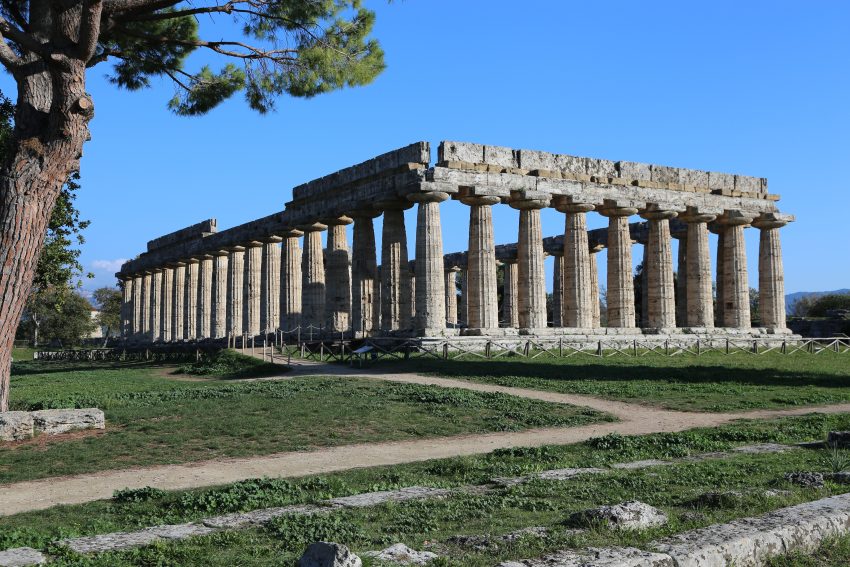
For history lovers and travellers drawn to the ancient Mediterranean, Paestum Archaeological Park is one of those places that feels almost unreal in its scale and preservation. On a broad, sunlit plain south of Salerno, you step into a landscape of weathered stone and wild grasses where three Doric temples still stand with a kind of calm authority, their columns catching the light like sculpted cliffs.
It's one of the must-see places in Paestum, but it also has the rare gift of space: instead of a quick “tick-box” ruin, it's a place to slow down, hear your footsteps on ancient paving, and let the silence do some of the storytelling. With the park's main areas and museum close together, it's easy to build a relaxed walking tour of Paestum that feels immersive rather than rushed.
Table of Contents
- History and Significance of the Paestum Archaeological Park
- Things to See and Do in the Paestum Archaeological Park
- How to Get to the Paestum Archaeological Park
- Practical Tips on Visiting the Paestum Archaeological Park
- Where to Stay Close to the Paestum Archaeological Park
- Is the Paestum Archaeological Park Worth Visiting?
- For Different Travelers
- FAQs for Visiting Paestum Archaeological Park
- Nearby Attractions to the Paestum Archaeological Park
History and Significance of the Paestum Archaeological Park
Paestum began life as Poseidonia, a Greek colony founded on fertile land with access to trade routes and a coastline that linked southern Italy to the wider Greek world. The city's wealth and confidence are written into its architecture: the great temples were not just places of worship, but statements of identity, built to last and to be seen from afar across the plain.
Over time, control shifted from the Greeks to the Lucanians and then to Rome, and the city's role changed with it. As routes and priorities moved elsewhere, and as the local environment became more challenging, Paestum faded from daily life and gradually slipped into abandonment, leaving its monumental core behind like a stone memory of a once-thriving community.
Its rediscovery in the modern era turned Paestum into a landmark for anyone fascinated by classical antiquity. Artists and scholars of the Grand Tour came here to study proportion, light, and the emotional power of ruins, and today the site remains one of the top attractions in Paestum because it delivers a direct, almost physical connection to Magna Graecia.
Things to See and Do in the Paestum Archaeological Park
The temples are the heart of the visit, and the best way to experience them is to approach slowly, letting each one reveal its personality. The so-called Basilica (traditionally linked to Hera) feels ancient and weighty, with a robust, early Doric presence that makes you appreciate just how long these stones have held their ground. The Temple of Athena sits slightly apart and often feels quieter, a good place to pause when you want a calmer moment away from the most-photographed viewpoints.
Then there's the Temple of Neptune, the one that tends to stop people mid-sentence. Its proportions are so assured, and its preservation so striking, that it feels less like a ruin and more like a structure temporarily paused in time. This spot is one of the best places to see in Paestum if you care about architecture, because it's a masterclass in how power and elegance can coexist in stone.
Beyond the temples, give yourself time to trace the outline of a real city: ancient streets, public spaces, and the remnants of daily life that make the monumental feel human. Pair the outdoor ruins with the museum, where key finds add depth to what you’ve just walked through-especially the celebrated Tomb of the Diver, which provides a rare, intimate glimpse into ancient beliefs and artistry.
How to Get to the Paestum Archaeological Park
The nearest airports are Salerno Costa d'Amalfi (QSR) and Naples International (NAP), with Naples offering the widest range of flights and onward connections. For the best deals and a seamless booking experience, check out these flights to Sorrento on Booking.com.
From Naples or Salerno, trains stop at Paestum station, and from there it's an easy walk across open ground to the archaeological park entrance, which is one of the most pleasant “arrival walks” to a major site in Campania. Use Omnio to easily compare schedules, book train tickets, and find the best prices all in one place for a hassle-free journey across Italy.
Buses also run from Salerno and other nearby towns, but services can be seasonal and slower in peak traffic, so trains are usually the most straightforward option if you want predictable timings.
If you're travelling by car, Paestum is simple to reach via the main routes south of Salerno, and driving works especially well if you want to combine the visit with the wider Cilento coast or countryside in the same day. If you are looking to rent a car in Italy I recommend having a look at Discover Cars, first, as they compare prices and review multiple car rental agencies for you.
Practical Tips on Visiting the Paestum Archaeological Park
- Entrance fee: €15 (March–November); €10 (December–February). Reduced: €2 (EU ages 18–25). Free: under 18.
- Opening hours: Daily: 08:30–19:30.
- Official website: https://parchipaestumvelia.cultura.gov.it/en/
- Best time to visit: Spring and autumn are ideal for comfortable walking, but any time of year is rewarding if you go early or late to avoid the harshest sun on the open plain.
- How long to spend: Plan 2-3 hours to do the temples and museum properly, or half a day if you want a slower pace with time to read displays and linger at viewpoints.
- Accessibility: The terrain is largely flat, but surfaces can be uneven; stick to the main paths for the easiest route between temples and the museum.
- Facilities: Expect a visitor-oriented set-up with restrooms and basic services, but bring water in warm months because the site’s openness can feel hotter than you expect.
Where to Stay Close to the Paestum Archaeological Park
For most travellers, the best area to base yourself is Paestum or Capaccio Paestum if you want an early, quiet start among the ruins and a countryside feel, while Salerno suits trips where evening dining, transport links, and day trips across Campania are the priority.
For a calm, design-forward stay with an easy run to the park, Tenuta Duca Marigliano Boutique Hotel is a strong choice. If you like being close to the archaeological area while still having a resort-like atmosphere for downtime, Hotel Villa Rita is well placed. For a more rural, agriturismo-style base that pairs temples with local food culture, Agriturismo Porta Sirena gives you that slower Cilento rhythm.
Is the Paestum Archaeological Park Worth Visiting?
Absolutely. The temples alone justify the trip, because they’re among the most complete and visually powerful Greek monuments you can see anywhere, and the setting-fields, mountains, wide sky-makes the experience feel spacious and unforced.
Paestum also rewards anyone who likes to connect the dots between architecture and everyday life. You can stand in front of a temple that has survived for over two millennia, then walk a few minutes and find the traces of streets and public spaces that made the ancient city function, which is exactly what turns a “ruins visit” into a real encounter with history.
What Other Travellers Say...

Archaeological Park of Paestum, on Via Magna Graecia in Capaccio Paestum, is an expansive, well maintained site of ancient Greek temples dedicated to Hera, Athena and Neptune, with an amphitheater and an on‑site museum; visitors praise the superb preservation, peaceful atmosphere and informative wayside signs (and an explanatory app some recommend downloading beforehand), note limited shade so bring water, and report easy parking and nearby food options, with plenty of space to explore at a relaxed pace despite a slightly awkward journey to reach it.


For Different Travelers
Families with Kids
Paestum works well for families because it's visually clear and open: big temples, wide paths, and lots of space to move without the stop-start pressure of a cramped old town site. Bring snacks and water, set a simple “three temples” goal, and let the visit feel like exploration rather than a lesson.
If you’re travelling with younger kids, make the museum the shorter portion and prioritise the outdoor wow-factor first. The most effective strategy is usually temples first, museum second, then a break.
Couples & Romantic Getaways
For couples, Paestum is at its best when you treat it as a slow experience. Arrive early, take a long loop through the temples, then linger for photos when the light warms the stone and the site feels almost private.
Pair it with a relaxed meal nearby featuring local mozzarella di bufala and Cilento produce. Paestum is less about glamour and more about atmosphere, which makes it quietly romantic in a grounded, timeless way.
Budget Travelers
Paestum is a strong value day trip because you get major monuments and a museum in one ticket, and you can reach it easily by train without needing expensive tours. Pack water and sun protection, go early, and you'll get a full, satisfying day at a predictable cost.
If you're watching your budget closely, base in Salerno and do Paestum as a day trip by rail, then spend your evenings enjoying Salerno's food and waterfront without resort-area prices.
History Buffs
If you love ancient architecture, Paestum is a dream site because the Doric temples are readable, intact, and set up for close observation. Take time to walk around each temple fully, noting how proportions, column spacing, and light change the mood from one structure to the next.
The museum adds the essential second layer: objects, art, and burial culture that put human stories back into the stones. For a history-first itinerary in Campania, Paestum is the kind of place that anchors the whole trip.
FAQs for Visiting Paestum Archaeological Park
Getting There
Tickets & Entry
Visiting Experience
Tours, Context & Itineraries
Photography
Accessibility & Facilities
Nearby Attractions to the Paestum Archaeological Park
- Velia Archaeological Park: Another major Magna Graecia site with a different landscape feel and layered Greek-Roman history.
- Salerno Old Town: A compact historic centre with a cathedral, lively streets, and a more local evening atmosphere than the coast resorts.
- Agropoli: A coastal town with a hilltop old centre and sea views, ideal for a relaxed post-ruins stroll.
- Cilento Coast beaches: A quieter alternative to the Amalfi Coast, with long stretches of sand and a slower, less crowded rhythm.
- Pompeii: The iconic Roman city frozen in time, a powerful contrast to Paestum's Greek monumental architecture.
The Paestum appears in our Complete Guide to Visiting Sorrento!

Moira & Andy
Hey! We're Moira & Andy. From hiking the Camino to trips around Europe in Bert our campervan — we've been traveling together since retirement in 2020!
This website uses affiliate links which may earn a commission at no additional cost to you!
Planning Your Visit
Daily: 08:30-19:30.
€15 (March-November); €10 (December-February). Reduced: €2 (EU ages 18-25). Free: under 18.
Nearby Attractions
- Forte La Carnale (33.6) km
Castle - Salerno Porta Nova (35.0) km
City Gate - Acquedotto Medievale di Salerno (35.1) km
Aqueduct - Museo Archeologico Provinciale of Salerno (35.2) km
Museum - Lungomare Trieste (35.3) km
Park - Stazione Marittima di Salerno (35.3) km
Port - Chiesa di San Giorgio (35.3) km
Church - Duomo di Salerno (35.4) km
Cathedral - Piazza della Liberta (35.4) km
Square - Museo Diocesano San Matteo di Salerno (35.4) km
Museum