Arles Obelisk
Monument in Arles
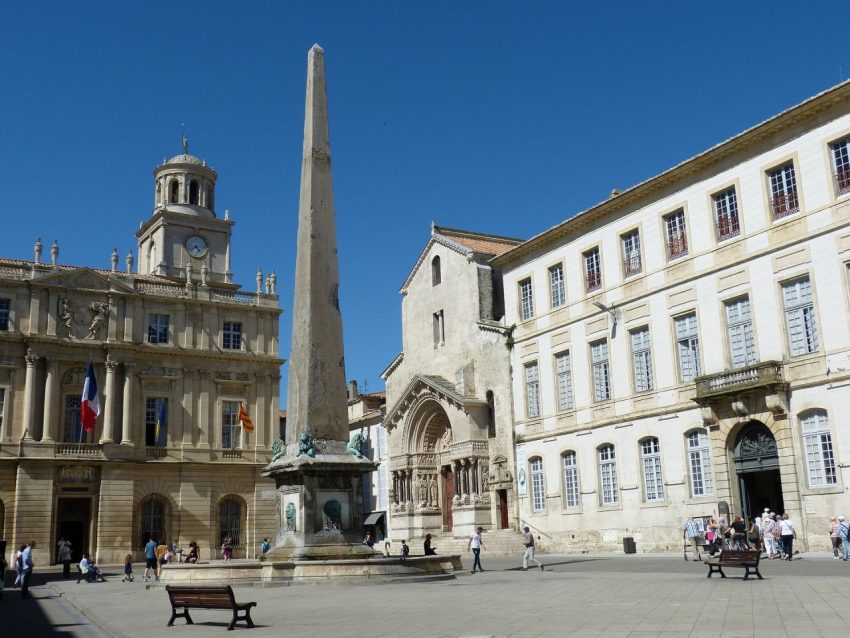
Rising gracefully in the Place de la République, the Arles Obelisk captures the essence of the city's layered history - from Roman grandeur to modern Provençal charm. This 20-meter granite monument, carved from stone brought all the way from Asia Minor, has become one of the top sights in Arles, embodying centuries of transformation and renewal. Its unadorned yet commanding form stands as a quiet testament to the power and permanence of the Roman Empire, whose influence still lingers in every corner of this southern French city.
Standing before the obelisk, with the Town Hall and the Church of Saint-Trophime framing the square, you feel the seamless blend of antiquity and civic life that defines Arles. It's a great place to visit on a walking tour of Arles, where every step through the square reveals another layer of the city's evolving story - from Constantine's empire to the modern-day rhythms of Provençal life.
History and Significance of the Arles Obelisk
The story of the Arles Obelisk begins in the 4th century AD, during the reign of Emperor Constantine II, when it originally stood on the central spine (spina) of the city's Roman circus. This granite monument, remarkable for its lack of inscriptions, was likely erected to celebrate imperial power and Roman architectural mastery. After the decline of the Roman Empire, the obelisk collapsed and lay in ruins for nearly a millennium.
Rediscovered in the 14th century, it was reassembled and raised once more in 1676, this time in the Place de la République - transforming the civic heart of Arles into a stage where ancient Rome and Renaissance artistry converged. Architect Jacques Peytret designed the base, while decorative elements atop the obelisk shifted with the politics of each era - a sun during the monarchy, a Phrygian cap during the Revolution, an eagle under the Empire, and later, a bronze capstone in the 19th century. The addition of a fountain designed by Antoine Laurent Dantan in the 1800s added further elegance to the monument's surroundings.
Recognized in 1840 as a historic monument and later included in the “Arles, Roman and Romanesque Monuments” UNESCO World Heritage listing in 1981, the obelisk remains a central symbol of the city's enduring connection to its Roman roots.
Things to See and Do in the Arles Obelisk
Visiting the Arles Obelisk is more than admiring an ancient artifact - it's stepping into the beating heart of Arles. The obelisk dominates the Place de la République, where you can also admire the neoclassical façade of the Town Hall and the magnificent Church of Saint-Trophime, a Romanesque masterpiece known for its intricate carvings. As the sunlight shifts throughout the day, the obelisk's polished granite surface reflects warm hues that echo the tones of the surrounding stone architecture.
Take time to observe the fountain designed by Dantan at its base - its bronze sculptures and flowing water perfectly complement the obelisk's vertical grandeur. Sit at a café terrace nearby to absorb the atmosphere, as the square buzzes with life around this 1,600-year-old monument. This spot is one of the best places to see in Arles, offering a tangible connection between the city's Roman heritage and its Provençal charm.
How to Get There
The Arles Obelisk is located in the Place de la République, right in the heart of the city's old town. It's an easy 10-minute walk from Arles railway station, passing through the lively Rue de la République. If you’re arriving by car, parking is available at Parking du Centre or Parking des Lices, both just a short stroll from the square. The obelisk is impossible to miss - it rises high above the square, surrounded by the city’s most iconic landmarks.
Practical Tips on Visiting the Arles Obelisk
- Best time to visit the Arles Obelisk: Early morning or late afternoon for the best light and fewer crowds.
- Entrance fee in Euros: Free; public access.
- Opening hours: Open year-round, accessible at all hours.
- Official website: www.arlestourisme.com
- How long to spend: Around 30 minutes to admire the obelisk and explore the surrounding square.
- Accessibility: Fully accessible; located in a flat pedestrian area.
- Facilities: Benches, cafés, and restaurants surrounding the square.
- Photography tip: Capture the obelisk framed by Saint-Trophime’s façade or reflected in the fountain below.
- Guided tours: Included in most walking-tours of central Arles.
- Nearby food options: Try nearby cafés and brasseries around the square for coffee, wine, or Provençal dishes.
Is the Arles Obelisk Worth Visiting?
Absolutely. The Arles Obelisk is one of the top attractions in Arles - not only a magnificent remnant of Roman engineering but also a symbol of the city's enduring vitality. Its towering silhouette against the Provençal sky embodies the city's unique blend of antiquity and everyday life. Whether you're passing through on a walking tour or pausing to admire the fountain's gentle flow, this monument offers a profound sense of continuity through time.
What Other Travellers Say...

Arles Obelisk stands in the middle of Place de la République in Arles and is a striking Roman monument anchoring a pleasant public square; visitors note the surrounding town hall and a nearby beautiful church, say the square offers lovely scenery (sometimes hosting events like weddings), and recommend exploring other nearby attractions such as the Colosseum and choosing smaller restaurants off the main square for better value.


Nearby Attractions to the Arles Obelisk
- Church and Cloister of Saint-Trophime - A Romanesque gem beside the square with intricate sculptures.
- Réattu Museum - Home to works by Jacques Réattu, Picasso, and contemporary artists along the Rhône.
- Arles Amphitheatre - An impressive Roman arena still hosting events today.
- Alyscamps - A serene Roman necropolis immortalized by Van Gogh and Gauguin.
- Musée Départemental Arles Antique - A modern museum dedicated to Arles' rich archaeological past.
The Arles Obelisk appears in our Complete Guide to Visiting Arles!

Moira & Andy
Hey! We're Moira & Andy. From hiking the Camino to trips around Europe in Bert our campervan — we've been traveling together since retirement in 2020!
This website uses affiliate links which may earn a commission at no additional cost to you!
Planning Your Visit
24 Hours
Free
Nearby Attractions
- Place de la République (0.0) km
Historic Site and Square - Église Sainte-Anne d'Arles (0.0) km
Church - Église Saint Trophime d'Arles (0.1) km
Church - Town Hall and Cryptoportics of Arles (0.1) km
Town Hall - Saint-Trophime Cloister (0.1) km
Cathedral - Place du Forum (0.1) km
Square - Roman Theatre in Arles (0.2) km
Historic Site and Roman Site - Jardin d'Ete (0.2) km
Gardens - Fondation Vincent Van Gogh (0.2) km
Museum - Thermes de Constantin (0.3) km
Roman Site