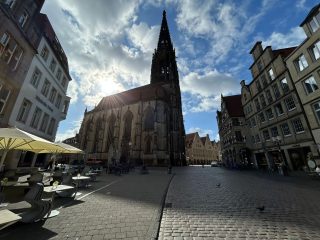
City Hall of Münster
Town Hall in Münster

Rising above the arcade-lined Prinzipalmarkt, the Historical City Hall of Münster is one of the top attractions in Münster and the building that immediately anchors you in the city's past. Its intricate Gothic façade, with delicate tracery, pointed gables, and a forest of finials, looks almost like lace carved in stone, and it is no surprise that this is one of the most photographed spots in the Old Town.
Behind that fairy-tale exterior lies a building that helped shape the course of European history. Inside, the famous Peace Hall (Friedenssaal) recalls the negotiations that ended the Thirty Years' War in 1648, while other rooms still host civic ceremonies and receptions today. This mix of landmark architecture and living city politics makes the Historical City Hall a highlight of any walking tour of Münster, especially if you enjoy places where history and everyday life still overlap.
Table of Contents
- History and Significance of the City Hall of Münster
- Things to See and Do in the City Hall of Münster
- How to Get to the City Hall of Münster
- Practical Tips on Visiting the City Hall of Münster
- Where to Stay close to the City Hall of Münster
- Is the City Hall of Münster Worth Visiting?
- FAQs for Visiting City Hall of Münster
- Nearby Attractions to the City Hall of Münster
History and Significance of the City Hall of Münster
Constructed in the late 14th century, the Historical City Hall has long been the symbolic and practical heart of municipal power in Münster. From here, councillors oversaw trade, justice, and local governance, making decisions that shaped the fortunes of merchants, guilds, and residents alike. The richly decorated façade facing Prinzipalmarkt was as much a statement as a shield, announcing the city's status and self-confidence to anyone approaching the square.
The building’s greatest claim to fame, however, is its role in the Peace of Westphalia. In 1648, representatives from across Europe gathered in the City Hall’s Peace Hall to negotiate an end to the devastating Thirty Years’ War. The agreements signed here and in nearby Osnabrück redrew borders, recognised new forms of statehood, and are still remembered as a foundation of modern diplomacy. Standing in the same room today, surrounded by wooden panelling and portraits, you get a powerful sense of how much was at stake within these walls.
Despite wars, changes in government, and the pressures of modernisation, the Historical City Hall has retained its civic role. It continues to house municipal offices and ceremonial rooms, connecting medieval self-governance to contemporary city life. This continuity is part of what makes a visit so compelling: you are not just walking through a preserved monument, but through a building that still matters to Münster’s identity and daily functioning.
Things to See and Do in the City Hall of Münster
The main draw inside is the Peace Hall (Friedenssaal), where carved wooden panelling, painted coats of arms, and historic portraits create a rich, solemn atmosphere. Guided tours explain the key figures in the paintings, the phases of the negotiations, and the symbolism embedded in the room’s décor. Even if you know only a little about the Thirty Years’ War, it is hard not to feel the weight of history as you stand where the peace was finally agreed.
Elsewhere in the City Hall, ceremonial rooms and council chambers reveal more about Münster’s civic traditions. You may see portraits of mayors, decorative ceilings, or historic furnishings that show how the building has adapted over centuries while keeping its formal character. During special events or open days, additional spaces may be accessible, giving an even fuller picture of how the City Hall has been used over time.
Outside, take time to appreciate the façade from different angles along Prinzipalmarkt. The interplay between the City Hall's pale stone front and the colourful gabled houses around it creates one of the best places to visit in Münster for anyone who loves historic urban scenery. Early morning or late afternoon light is especially flattering, bringing out the depth of carvings and the rhythm of the pointed arches.
How to Get to the City Hall of Münster
The Historical City Hall stands directly on Prinzipalmarkt in the centre of Münster's Old Town, so once you are in the city it is very easy to reach on foot. International visitors typically arrive via Münster Osnabrück International Airport, which offers connections to various European cities and onward travel into Münster by bus, shuttle, or taxi. For the best deals and a seamless booking experience, check out these flights to Münster on Booking.com.
Münster is exceptionally well connected by train, making rail one of the most convenient ways to arrive.Train schedules and bookings can be found on Omio. From Münster (Westf) Hauptbahnhof, you can walk to Prinzipalmarkt in about 15-20 minutes, following well-signposted routes through the Innenstadt, or use local buses that stop close to the historic centre. Either way, once you reach the arcades of Prinzipalmarkt, the City Hall's Gothic façade is hard to miss.
If you are driving, follow signs to the Innenstadt and look for public car parks on the edge of the Old Town, as the streets around Prinzipalmarkt are best explored on foot and may have access restrictions.If you are looking to rent a car in Germany I recommend having a look at Discover Cars, first, as they compare prices and review multiple car rental agencies for you. After parking, it is only a short walk into the historic centre, and you can use the cathedral towers and the line of arcades as landmarks to guide you towards the City Hall.
Practical Tips on Visiting the City Hall of Münster
- Suggested tips: Join a guided tour of the Peace Hall if you can; the stories and context provided by guides add enormous depth to what you see.
- Best time to visit: Weekday mornings or early afternoons are usually calmer, while evenings are great for admiring the illuminated façade from Prinzipalmarkt.
- Entrance fee: Tours €3 per person
- Opening hours: Tuesday to Friday: 10:00 AM – 5:00 PM; Saturday, Sunday, and public holidays: 10:00 AM – 4:00 PM; Closed on Mondays
- Official website: https://www.stadt-muenster.de/tourismus/startseite
- How long to spend: Allow 45-60 minutes for a guided tour and time to admire the exterior and Prinzipalmarkt, longer if you linger with the details in the Peace Hall.
- Accessibility: The historic building includes steps and uneven surfaces, but some areas may be accessible via lifts or ramps; contact the tourist office or city website for up-to-date accessibility information.
- Facilities: Basic visitor information is usually available inside or via nearby tourist offices; cafés, shops, and toilets are readily found around Prinzipalmarkt.
- Photography tip: If photography is permitted, use a wide lens to capture the full height of the façade and interior rooms; avoid flash and be mindful of reflections on wooden panelling and glass.
- Guided tours: Look out for scheduled tours in German and sometimes other languages, which cover both the Peace of Westphalia and the City Hall’s architectural history.
- Nearby food options: Prinzipalmarkt and the surrounding streets are packed with bakeries, traditional restaurants, and cosy cafés, perfect for lunch or coffee after your visit.
Where to Stay close to the City Hall of Münster
Staying near the Historical City Hall puts you at the very heart of Münster, with the cathedral, museums, and main shopping streets just steps away. A convenient choice within walking distance of Prinzipalmarkt is Stadthotel Münster, offering comfortable, modern rooms and easy access to the Old Town. For a more design-led experience, Factory Hotel combines industrial-chic interiors with good connections by bike or bus into the centre. If you prefer to be close to both the train station and the historic core, Hotel Kaiserhof makes a solid base, letting you walk to the City Hall and other key sights in under 15 minutes.
Is the City Hall of Münster Worth Visiting?
The Historical City Hall of Münster is absolutely worth visiting, whether you are fascinated by European history, Gothic architecture, or simply beautiful urban spaces. It offers a rare chance to step into a room where the end of a major European conflict was negotiated, while its façade and internal details showcase the pride and skill of medieval city builders. Combined with its central location on Prinzipalmarkt and its ongoing role in civic life, it stands out as a highlight of any walking tour of Münster and one of the must-see places in the city.
What Other Travellers Say...

Historic City Hall, at Prinzipalmarkt 10, Münster, is a striking late 14th-century Gothic town hall with an ornate, multi-tiered façade of traceried windows, ogival arches, gables and pinnacles; inside the Peace Hall features carved wooden panelling and is presented to visitors (small admission, with concessions for students), while the building also houses the tourist information center—an essential stop in the city centre for admirers of grand secular architecture and historical interiors.


FAQs for Visiting City Hall of Münster
Nearby Attractions to the City Hall of Münster
- St. Paulus Dom (Münster Cathedral): The city's impressive Romanesque-Gothic cathedral on Domplatz, known for its astronomical clock and soaring interior.
- Prinzipalmarkt: The arcaded main street lined with gabled houses, shops, and cafés, forming the backdrop to the City Hall and a perfect place for a stroll.
- Westphalian State Museum of Art and Cultural History (LWL-Museum für Kunst und Kultur): A major regional art museum nearby, showcasing works from the Middle Ages to contemporary art.
- Lamberti Church (Lambertikirche): A striking Gothic church with a notable tower and a powerful connection to Münster's Reformation-era history.
- Pablo Picasso Museum Münster: An intimate museum dedicated to Picasso's graphic works, just a short walk away in the Old Town.
The City Hall of Münster appears in our Complete Guide to Visiting Münster!

Moira & Andy
Hey! We're Moira & Andy. From hiking the Camino to trips around Europe in Bert our campervan — we've been traveling together since retirement in 2020!
This website uses affiliate links which may earn a commission at no additional cost to you!
Planning Your Visit
Tuesday to Friday: 10:00 AM - 5:00 PM; Saturday, Sunday, and public holidays: 10:00 AM - 4:00 PM; Closed on Mondays
Tours €3 per person
Nearby Attractions
- Prinzipalmarkt (0.1) km
Square - Lambertikirche (0.2) km
Church - Pablo Picasso Museum (0.2) km
Museum - Krameramtshaus (0.2) km
Historic Building - Erbdrostenhof (0.2) km
Historic Building - Münster Cathedral (0.3) km
Cathedral - Westphalian State Museum of Art and Cultural History (0.3) km
Museum - Stadtmuseum Münster (0.3) km
Museum - Kiepenkerl Denkmal (0.4) km
Statue - Überwasserkirche (0.5) km
Church