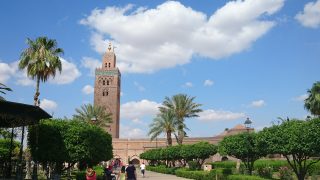
Kasbah Mosque, Marrakesh
Mosque in Marrakesh

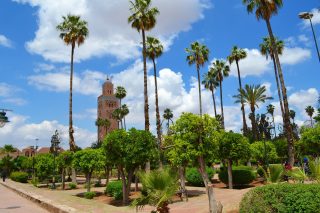
The Kasbah Mosque sits at the heart of Marrakech's old royal district, where palaces, gardens, and gateways once defined the power centre of the Almohad empire. Built by Caliph Yaqub al-Mansour between 1185 and 1190, this was the Friday mosque of the imperial kasbah, the place where the ruler and his court came to pray and to be seen. Today, its pale minaret rises above Place Moulay el Yazid, flanked by the Saadian Tombs on one side and the city walls and Bab Agnaou on the other, making it a natural anchor when you explore the southern medina. Even viewed only from the outside, it is a highlight of any walking tour of Marrakech.
Non-Muslim visitors cannot enter the prayer hall, but the story of the Kasbah Mosque is written on its walls. Almohad foundations, Saadian repairs after a devastating 16th-century gunpowder explosion, and later Alaouite restorations all contribute to the building you see today. Standing in the square, you are surrounded by layers of royal history: El Badi Palace just a short walk away, the royal palace (Dar el-Makhzen) still in use nearby, and the Saadian royal necropolis tucked into the mosque's southern side. Taken together, this compact district is one of the must-see places in Marrakech if you want to understand how faith, power, and architecture overlap in the city.
Table of Contents
- History and Significance of the Kasbah Mosque
- Things to See and Do in the Kasbah Mosque
- How to Get to the Kasbah Mosque
- Practical Tips on Visiting the Kasbah Mosque
- Where to Stay close to the Kasbah Mosque
- Is the Kasbah Mosque Worth Visiting?
- FAQs for Visiting the Kasbah Mosque
- Nearby Attractions to the Kasbah Mosque
History and Significance of the Kasbah Mosque
The Kasbah Mosque was commissioned by Almohad caliph Yaqub al-Mansour at the height of his empire. Around 1185 he began creating a new imperial kasbah, a self-contained royal district attached to the south of the existing city, following a wider tradition in the Islamic world of building palace-cities such as Madinat al-Zahra near Cordoba or Samarra in Iraq. The mosque, finished by about 1190, was conceived as the congregational mosque of this new district: the place where the caliph could attend Friday prayers and where official sermons signalled his authority. Architecturally, it shared the sober, powerful language of other Almohad monuments: strong lines, a square minaret, and carefully proportioned prayer spaces.
Even after the Almohad dynasty fell, the Kasbah Mosque retained its prestige. Alongside the Kutubiyya Mosque, it remained one of Marrakech's most important religious buildings, and rulers continued to honour it. From at least the Marinid era, a cemetery to its south became a burial ground for notable figures and eventually for the Saadian dynasty, whose richly decorated mausoleums now form the Saadian Tombs. The mosque's role as both religious and symbolic centre of the southern medina was cemented; to pray here, or to be buried nearby, was to remain close to power.
The building has also survived catastrophe. In the late 16th century a nearby gunpowder store exploded, severely damaging the mosque. Saadian sultan Moulay Abd Allah al-Ghalib oversaw extensive repairs, probably altering the interior layout and replacing much of the earlier decoration with the stucco work that defined Saadian style. Long cracks in the minaret remained visible well into the 20th century as scars of this event. Later, in the 18th century, Alaouite ruler Sidi Muhammad Ibn Abd Allah led further restorations, including the wooden cupola at the main entrance from the courtyard. Yet through all these phases, the overall form of the Almohad mosque was carefully preserved, a sign of the respect it commanded.
Things to See and Do in the Kasbah Mosque
Although non-Muslims may not enter the prayer hall, there is still plenty to see around the Kasbah Mosque. Start in Place Moulay el Yazid, the square on its eastern side, where local life and history mingle. From here you can take in the full profile of the mosque and its minaret, noting the characteristic Almohad proportions and the way the building anchors the kasbah skyline. The square is also a good vantage point for people-watching: worshippers arriving for prayer, children playing, and locals using the mosque as a landmark in their daily routines.
On the southern side, look for the discreet entrance to the Saadian Tombs, where richly decorated chambers and quiet courtyards house the remains of Saadian sultans, their families, and courtiers. The proximity of this royal necropolis to the Kasbah Mosque underlines how closely dynastic memory was tied to this sacred space. Just beyond, you can stroll towards the city walls and Bab Agnaou, the ornate Almohad gate whose carved stone façade is one of the most photogenic in Marrakech. Linking these three sites-mosque, tombs, and gate-makes for a compact but rewarding exploration of the kasbah district.
From the mosque, it is an easy walk to El Badi Palace, the ruined Saadian reception complex that once dazzled visitors with imported marble and vast sunken gardens, and to other corners of the kasbah where mechouars (royal squares), palaces, and gardens once formed a coherent royal city. Between sights, take time to appreciate smaller details: the way the kasbah walls turn and fold, the older houses with their simple façades, and the glimpses of minaret and palm trees that line up in unexpected ways. Even if you only spend a short time here, the Kasbah Mosque helps you read the wider landscape of southern Marrakech.
How to Get to the Kasbah Mosque
To visit the Kasbah Mosque, you will first need to travel to Marrakech. Most international visitors arrive via Marrakech Menara Airport, which is just a short drive from the historic centre and is served by frequent flights from major European cities and other Moroccan hubs. For the best deals and a seamless booking experience, check out these flights to Marrakesh on Booking.com. From the airport, you can take a taxi or pre-booked transfer to the medina; asking for Bab Agnaou, the kasbah district, or the Saadian Tombs will usually bring you within a few minutes' walk of the mosque.
If you are travelling within Morocco, Marrakech is well connected by train to cities such as Casablanca, Rabat, and Tangier, with services arriving at the main railway station in the modern Gueliz district.Train schedules and bookings can be found on Omio. From there, a petit taxi ride of around 10-15 minutes will bring you close to the southern medina gates, including Bab Agnaou or Bab er-Robb, after which you can continue on foot through the kasbah streets to Place Moulay el Yazid and the mosque. Long-distance buses from other regions arrive at various stations outside the centre, and taxis from these terminals follow similar routes to drop you near the walls.
If you are driving, you will follow the ring roads and main avenues around the medina until you reach the southern sections of the ramparts. Several guarded car parks are located near the kasbah, including areas close to the Saadian Tombs and Bab Agnaou. From there, it is only a short walk into the heart of the district, where the Kasbah Mosque stands almost directly opposite the tombs and a few minutes from El Badi Palace.
Practical Tips on Visiting the Kasbah Mosque
- Suggested tips: Combine your visit to the Kasbah Mosque with the Saadian Tombs and El Badi Palace for a concentrated dose of royal Marrakech in a small area.
- Best time to visit: Late morning or mid-afternoon offer good light on the minaret and less intense crowds; avoid prayer times if you simply want to photograph the exterior calmly.
- Entrance fee: Viewing the exterior is free; nearby Saadian Tombs and El Badi Palace charge separate entrance fees of a few euros each.
- Opening hours: The mosque is active for daily prayers; non-Muslims may visit the surrounding square and streets at any time during daylight hours.
- How long to spend: Plan 30-45 minutes to explore the square, admire the exterior, and wander around the neighbouring streets, longer if you are also visiting nearby attractions.
- Accessibility: The area around the mosque is mostly level, but pavements can be uneven and busy with scooters and pedestrians; those with mobility issues may find some narrow lanes challenging.
- Facilities: There are no visitor facilities inside the mosque for non-worshippers, but cafés, small shops, and basic services are available around Place Moulay el Yazid and along the nearby streets.
- Photography tip: For the best angle, stand on the far side of Place Moulay el Yazid to capture the mosque’s façade, minaret, and everyday life in the square in a single frame.
- Guided tours: A local guide can help bring the Almohad, Saadian, and Alaouite history of the district to life and explain how the mosque fits into royal and religious rituals.
- Nearby food options: You will find small cafés and restaurants in the kasbah and along the roads leading back towards Jemaa el-Fnaa, ideal for a tea or meal after exploring.
Where to Stay close to the Kasbah Mosque
Staying near the Kasbah Mosque puts you in a quieter, more residential corner of the medina, with royal monuments on your doorstep and Jemaa el-Fnaa still within walking distance. A popular choice nearby is Riad Dar Anika, which offers warm hospitality, a small pool, and easy access to the kasbah sights. For a boutique hideaway with a strong sense of place, Riad Hikaya sits deep in the kasbah lanes, making it simple to stroll to the mosque and tombs at quieter times of day. Travellers who prefer a slightly larger property with lush gardens might consider Les Jardins de la Médina, where you can balance days spent exploring the royal quarter with evenings by the pool under citrus and olive trees.
Is the Kasbah Mosque Worth Visiting?
The Kasbah Mosque is absolutely worth including in your Marrakech itinerary, even if you can only admire it from the outside. Its Almohad origins, Saadian scars, and continued use as a place of worship make it a powerful symbol of the city's continuity. When you combine a stop here with the Saadian Tombs, Bab Agnaou, and El Badi Palace, you get a concentrated snapshot of how dynasties rose, ruled, and remembered themselves in brick, stucco, and stone, making the kasbah district one of the must-see places in Marrakech for historically minded travellers.
What Other Travellers Say...

Moulay al-Yazid Mosque (Kasbah Mosque), at 23 Rue de La Kasbah in Marrakesh, is praised for its striking Moorish architecture and detailed craftsmanship; visitors note it remains impressive even while undergoing restoration after earthquake damage, and recommend a guide to learn more. The mosque is a prominent, quieter stop in the Kasbah near the Saadian Tombs, where non-Muslims generally admire the exterior and nearby rooftop cafés offer good views. Some visitors mention a large women's section but limited private washing facilities and unclear restroom locations, so plan accordingly.


FAQs for Visiting the Kasbah Mosque
Nearby Attractions to the Kasbah Mosque
- Saadian Tombs: Ornate mausoleums and quiet courtyards housing the Saadian royal family directly alongside the mosque's southern wall.
- El Badi Palace: Atmospheric ruins of a once-splendid Saadian reception palace, a short walk from the kasbah square.
- Bab Agnaou: A richly carved Almohad gate marking the ceremonial entrance to the kasbah district, ideal for photos.
- Royal Palace (Dar el-Makhzen) surroundings: While the palace itself is closed to visitors, its outer walls, gates, and nearby mechouars offer a sense of the royal quarter’s scale.
- Mellah (Jewish Quarter): The historic Jewish district just east of the kasbah, with markets, synagogues, and distinctive architecture that add another layer to the city’s story.
The Kasbah Mosque appears in our Complete Guide to Visiting Marrakesh!

Moira & Andy
Hey! We're Moira & Andy. From hiking the Camino to trips around Europe in Bert our campervan — we've been traveling together since retirement in 2020!
This website uses affiliate links which may earn a commission at no additional cost to you!
Planning Your Visit
The mosque is active for daily prayers; non-Muslims may visit the surrounding square and streets at any time during daylight hours.
Viewing the exterior is free; nearby Saadian Tombs and El Badi Palace charge separate entrance fees of a few euros each.
Nearby Attractions
- Koutoubia Mosque (0) km
Mosque - Koutoubia Gardens (Lalla Hassna Park) (0.1) km
Gardens - Jemaa el-Fnaa (0.5) km
Market and Square - Souks of Marrakesh (0.7) km
Market - Walls of Marrakesh (0.8) km
City Gate and City Walls - Dar el Bacha (0.9) km
Historic Building and Museum - Le Jardin Secret (0.9) km
Gardens and Historic Building - Saadian Tombs (0.9) km
Palace - Dar Si Said (1.0) km
Historic Building and Museum - Tiskiwin Museum (1.0) km
Museum