Hermitage of Saint Emilion, Saint-Émilion
Religious Building in Saint-Émilion
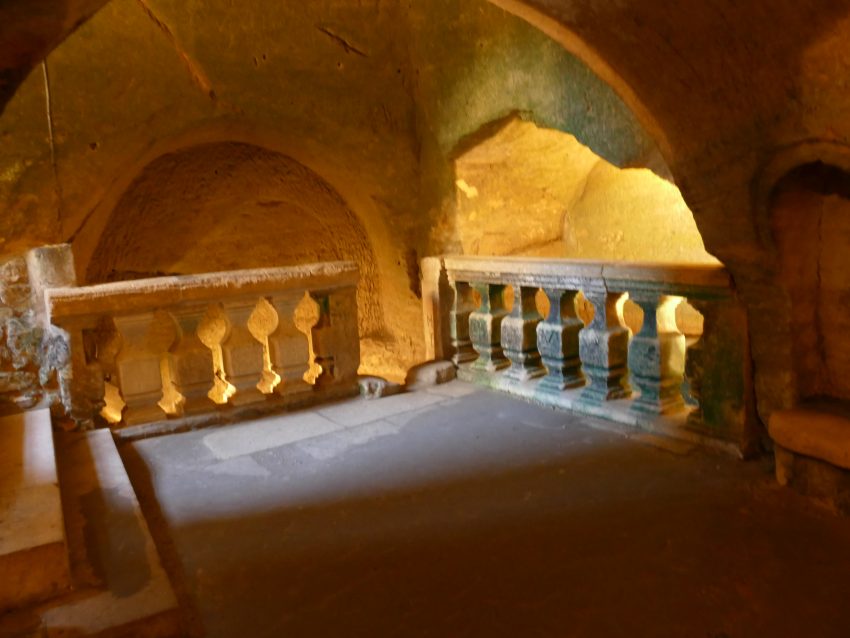
Ermitage Saint-Émilion is one of the town's most evocative underground spaces, tucked beneath the Chapelle de la Trinité and visited on the guided underground circuit. It's believed to be the cave where Saint Émilion lived as a hermit in the 8th century, carving a simple refuge into the limestone that later became a place of pilgrimage and storytelling. If you're looking for the kind of stop that feels intimate and genuinely unique, this is one of the top attractions in Saint-Émilion because it connects the village's beauty to its origin story, deep in the rock.
Because you can't enter independently, it's best planned as a highlight within a walking tour of Saint-Émilion: wander the lanes and viewpoints first, then descend for a completely different perspective-cool stone, hushed spaces, and legends that have lingered for centuries. The hermitage is small, but it leaves a strong impression precisely because it feels personal, like stepping into the town's earliest chapter rather than a grand monument designed to impress.
Table of Contents
- History and Significance of the Ermitage Saint-Émilion
- Things to See and Do in the Ermitage Saint-Émilion
- How to Get to the Ermitage Saint-Émilion
- Practical Tips on Visiting the Ermitage Saint-Émilion
- Where to Stay Close to the Ermitage Saint-Émilion
- Is the Ermitage Saint-Émilion Worth Visiting?
- For Different Travelers
- FAQs for Visiting Ermitage Saint-Émilion
- Nearby Attractions to the Ermitage Saint-Émilion
History and Significance of the Ermitage Saint-Émilion
The hermitage is closely linked to Saint Émilion, the Breton monk traditionally credited with shaping the spiritual identity that later gave the town its name. The idea of a solitary life carved into limestone is not just a picturesque legend here; it's one of the keys to understanding why Saint-Émilion developed as a religious centre long before it became a wine destination.
Over time, what began as a simple refuge was absorbed into a broader underground complex, eventually forming part of the guided circuit that also includes the monolithic underground church and nearby burial spaces. That evolution matters: it shows how a private, solitary place could become a communal site of memory, pilgrimage, and ritual as the town grew around it.
The hermitage also carries a layer of living folklore that keeps it culturally relevant. The so-called seat of fertility is a long-standing local legend that sits alongside the more formal religious narrative, illustrating how sacred spaces often accumulate popular beliefs that travel across generations.
Things to See and Do in the Ermitage Saint-Émilion
The first focus is the space itself: a limestone-carved interior that feels markedly different from the sunlit squares above. Pay attention to the scale and simplicity-this is the kind of place where the atmosphere is the attraction, and quiet observation is more rewarding than rushing for photos.
Look for the details the guide points out, especially the features associated with the hermit tradition and the site’s later expansion into a pilgrimage-worthy stop. The hermitage experience works best when you treat it as a narrative space: not just what you see, but what it meant to people who came here over centuries.
Finally, use the visit to reframe the rest of your day. After the underground quiet, the town's churches, lanes, and viewpoints feel more layered, because you've experienced the “inside” of Saint-Émilion-its limestone foundation as both geology and history.
How to Get to the Ermitage Saint-Émilion
The closest major airport is Bordeaux-Mérignac Airport (BOD), with Bergerac Dordogne Périgord Airport (EGC) a useful secondary option for some routes. For the best deals and a seamless booking experience, check out these flights to Saint-Émilion on Booking.com. From either airport, you'll typically route via Bordeaux or Libourne to reach Saint-Émilion.
From Bordeaux Saint-Jean, take a regional train toward Libourne and continue to Saint-Émilion station, then walk uphill into the historic centre or take a short taxi for the climb. You can use SNCF Connect to check schedules, compare routes, and purchase tickets for National (SNCF ) and regional trains (TER). For a more streamlined experience, we recommend using Omio, which allows you to easily compare prices, schedules, and book tickets for both National and Regional travel across all of Europe, all in one place. The underground tour meeting point is in the central monument area, so once you’re in the old town, everything becomes walkable. (Saint-Emilion Tourisme)
Buses can help with some regional links, but they’re less practical for matching a booked tour time, so many travellers use trains plus a taxi or walk for the final uphill approach.
If you’re driving, plan to park outside the medieval core and walk in, then give yourself a buffer because parking can take longer than expected in peak periods. If you are looking to rent a car in France I recommend having a look at Discover Cars, first, as they compare prices and review multiple car rental agencies for you. (Saint-Emilion Tourisme)
Practical Tips on Visiting the Ermitage Saint-Émilion
- Entrance fee: €15.00
- Opening hours: Guided Tours (English) Daily at 11:00am or 2:00pm See Website
- Official website: https://boutique.saint-emilion-tourisme.com/
- Best time to visit: Choose a morning slot for a calmer pace, or early afternoon as a cool break after walking the steep lanes.
- How long to spend: Treat it as part of the full underground tour and plan roughly an hour for the complete guided circuit.
- Accessibility: Expect steps, uneven limestone surfaces, and enclosed underground passages; if you’re sensitive to tight spaces, plan accordingly.
- Facilities: There are no facilities inside the underground monuments, so use cafés and restrooms near the main squares before your tour.
Where to Stay Close to the Ermitage Saint-Émilion
For a culture-heavy itinerary, base yourself inside Saint-Émilion's medieval centre so you can walk to the main monuments and join tours easily; if your trip is mainly vineyard visits and day trips, staying just outside the village is often quieter and better for parking.
If you want to stay right in the heart of the historic atmosphere, Hôtel de Pavie places you steps from the central monument zone and makes early starts effortless. For a comfortable, characterful base that stays close to the lanes without feeling too busy at night, Auberge de la Commanderie is a practical choice for walk-everywhere days. If you prefer more space and downtime between sightseeing and tastings, Château Hôtel Grand Barrail gives you a calmer retreat just outside the medieval core.
Is the Ermitage Saint-Émilion Worth Visiting?
Yes, especially if you want an experience that feels specific to Saint-Émilion rather than interchangeable with another pretty French village. The hermitage adds depth to the town's story, tying the name, the limestone landscape, and the religious heritage into one atmospheric stop.
It’s also a strong choice if you want one paid cultural activity that delivers multiple sites in a single visit. The hermitage is small on its own, but within the underground circuit it becomes one of the most memorable moments because it feels intimate and genuinely ancient.
What Other Travellers Say...

The Monolithic Church of Saint-Emilion sits on Pl. du Marché and is an underground limestone church begun in the 12th century with a 68‑m bell tower; visitors praise the guided visits for making the site's history accessible and engaging, note the compact tour area that doesn't extend far underground, and recommend enjoying the surrounding narrow streets and nearby restaurants (and local macarons); it is open Wednesday–Sunday 10:30–12:30 and 14:00–17:00 and the tourist office offers guided-tours.


For Different Travelers
Families with Kids
This can work well for families if your kids are comfortable with guided settings and underground spaces. The visit is easier when children have a simple “hook” to follow, and the hermit-cave story naturally gives them one.
If you’re travelling with younger kids, keep expectations realistic: it’s a quiet, enclosed environment with group pacing. A snack break beforehand and a clear plan for fresh air afterward usually makes the experience smoother.
Couples & Romantic Getaways
For couples, the hermitage is one of the most atmospheric stops in Saint-Émilion because it feels calm, hidden, and slightly mysterious. The contrast between the busy lanes above and the cool limestone below can be a genuinely memorable shared moment.
It also pairs nicely with a slower day: do the underground visit for depth, then return to the streets for a relaxed glass of wine and an unhurried wander, with the sense that you’ve seen a more secret side of the town.
Budget Travelers
If you're going to pay for one cultural activity in Saint-Émilion, the underground tour that includes the hermitage is a smart pick because it bundles several distinctive monuments into one ticket. It delivers a “you can't do this for free” experience, which helps justify the spend.
Balance it by building the rest of your day around free highlights: viewpoints, gates, lanes, and the central squares. Saint-Émilion rewards that approach because the atmosphere and streetscapes are attractions in themselves.
FAQs for Visiting Ermitage Saint-Émilion
Getting There
Tickets & Entry
Visiting Experience
Tours, Context & Itineraries
Photography
Accessibility & Facilities
Food & Breaks Nearby
Safety & Timing
Nearby Attractions to the Ermitage Saint-Émilion
- Chapelle de la Trinité: A serene chapel stop on the underground circuit, known for its medieval wall paintings and quiet limestone atmosphere.
- Église Monolithe de Saint-Émilion: The vast monolithic underground church carved into rock, giving Saint-Émilion one of its most distinctive identities.
- Place de l'Église Monolithe: The town's central square and easiest orientation point, framed by terraces and the bell-tower skyline.
- Tour du Roy: A medieval keep that adds a defensive-history layer to your visit and offers a rooftop viewpoint when open.
- Cloître des Cordeliers: A picturesque cloister with limestone cellars that blends history with a distinctly local sparkling-wine experience.
The Hermitage of Saint Emilion appears in our Complete Guide to Visiting Saint-Émilion!

Moira & Andy
Hey! We're Moira & Andy. From hiking the Camino to trips around Europe in Bert our campervan — we've been traveling together since retirement in 2020!
This website uses affiliate links which may earn a commission at no additional cost to you!
Planning Your Visit
Guided Tours (English) Daily at 11:00am or 2:00pm
See Website
€15.00
Nearby Attractions
- Chapelle de la Trinité (0) km
Church - Monolithic Church of Saint-Émilion (0) km
Church - Place de l’Église Monolithe (0) km
Square - Bell Tower of the Monolithic Church (0) km
Tower - Porte de la Cadène (0.1) km
City Gate - Washhouses of Saint-Émilion (0.1) km
Historic Site - Logis de Malet (0.1) km
Historic Building - Cloître des Cordeliers (0.1) km
Convent - Collegiate Church of Saint-Émilion (0.1) km
Church - Tour du Roy (0.1) km
Castle and Tower