Fritschi Fountain, Lucerne
Fountain in Lucerne
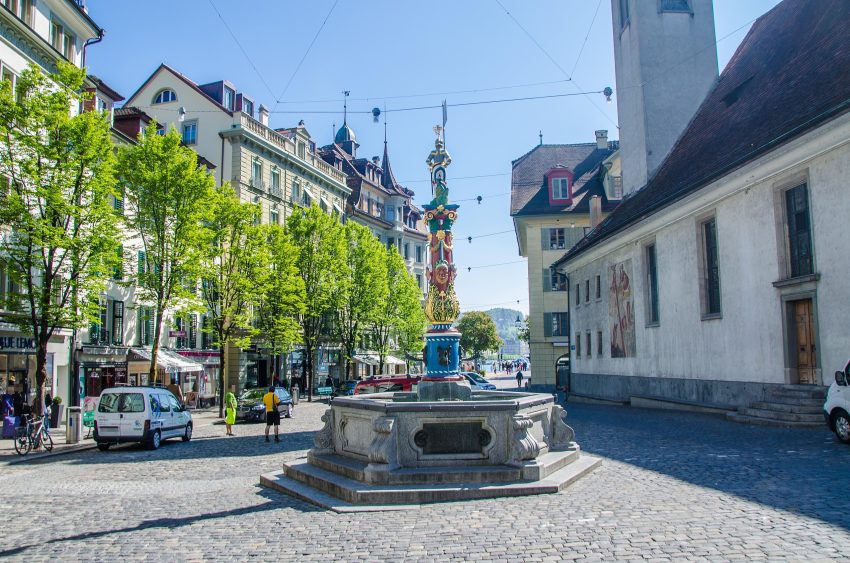
Right at the entrance to Lucerne's Old Town, Kapellplatz opens up around the Fritschi Fountain, a vivid burst of colour and carnival folklore in stone. Designed by architect August von Rhyn and unveiled in 1918, the fountain's tall column is crowned by a bannerman and ringed with expressive masks, including those of Brother Fritschi and his spouse, while water spills from four grinning jester heads into the basin below. In a city famous for its bridges and lake views, this fountain is one of the things to do in Lucerne if you want to understand how humour, ritual, and community are woven into everyday public space.
Yet the Fritschi Fountain is more than a pretty landmark; it is the beating heart of Lucerne's carnival season. Festivities begin here at 5 a.m. on Dirty Thursday, when the square fills with costumed revellers and the Fritschi wagon arrives to circle the fountain three times, formally opening Fasnacht. Look closely at the man in the red hat: this is Brother Fritschi, a figure whose legend stretches back to the 15th century and whose story of generosity and good cheer still shapes the way Lucerne celebrates today. It is a highlight of any walking tour of Lucerne, especially if you can visit during carnival and see the square at its wildest.
Table of Contents
- History and Significance of the Fritschi Fountain
- Things to See and Do at the Fritschi Fountain
- How to Get to the Fritschi Fountain
- Practical Tips on Visiting the Fritschi Fountain
- Where to Stay close to the Fritschi Fountain
- Is the Fritschi Fountain Worth Visiting?
- FAQs for Visiting Fritschi Fountain
- Nearby Attractions to the Fritschi Fountain
History and Significance of the Fritschi Fountain
The Fritschi Fountain as you see it today is a relatively “young” monument with very old roots. Completed in 1918 to a design by Lucerne architect August von Rhyn, it brought a new, sculptural focal point to Kapellplatz, just steps from the Kapellbrücke and the Old Town's busiest streets. The fountain's column, masks, and bannerman were carefully conceived to embody the spirit of Fasnacht, drawing on centuries of carnival imagery and local legend to create a kind of three-dimensional emblem of Lucerne's festive identity.
At the centre of that identity is Brother Fritschi, the man in the red hat whose image appears among the masks. According to the tale, Fritschi was a farmer in the mid-1400s, known for his good humour and his habit of buying drinks for others whenever he came into town. When he died, he is said to have left money to one of the guilds on the condition that they offer wine to the poor during carnival - a wish which, remarkably, is still honoured by guilds today. Although there is no firm evidence that Fritschi’s grave lies beneath the fountain, historical records tell us this medieval burial ground was used for unmarried women, farm labourers, parentless children, and strangers, so it may well have included a farmer like him.
The fountain also marks a site of long-standing ritual. Since the 15th century, the Fritschi parade has been used to usher in the carnival season, with a life-sized straw effigy of Fritschi carried through the streets in the company of guilds and clubs. Drummers and pipers lead the procession, followed by bearded, armoured “soldiers” that recall both historic military triumph and the serious side of communal defence. Today, the fountain anchors these traditions in a single spot: the Fritschi wagon circles it three times during the carnival parade, symbolically tying together legend, guilds, and the city’s collective memory.
Things to See and Do at the Fritschi Fountain
Start by taking in the fountain as a whole: the tall column rising from the octagonal basin, the proud bannerman at the top, and the ring of masks climbing the shaft. Each face has its own character, from mischievous to grotesque, echoing the spirit of carnival where social roles are inverted and nothing is quite as serious as it seems. Move around the fountain to catch different expressions and details; the interplay of colour, carving, and water gives the monument a lively, almost theatrical presence even when the square is quiet.
Then zoom in on the key figures. Look for Brother Fritschi himself, identifiable by his red hat, and his spouse among the masks. Knowing the legend, it’s easy to imagine him as the generous farmer who funded wine for the poor and whose name still resonates centuries later. At the base, notice how the water flows from four jester masks, reinforcing the link between the fountain and the city’s sense of humour and play. This blend of solemn legend and cheeky carnival imagery makes the fountain particularly fun to photograph and sketch.
If you're visiting during Fasnacht, the Fritschi Fountain becomes a stage rather than just a backdrop. On Dirty Thursday at 5 a.m., join locals in Kapellplatz as the carnival kicks off amid drums, confetti, and elaborate costumes. Watch as the Fritschi wagon circles the fountain three times, and look out for the life-sized straw Fritschi in the parade, accompanied by guild members, musicians, and mock soldiers. Even outside carnival season, standing here and picturing the square packed with noise and colour helps you grasp just how central the fountain is to Lucerne's cultural calendar.
How to Get to the Fritschi Fountain
Most international visitors arrive via Zurich Airport (ZRH), which has the best range of European and long-haul connections and offers straightforward rail links to Lucerne. For the best deals and a seamless booking experience, check out these flights to Lucerne on Booking.com. From the airport, frequent trains run directly to Lucerne or via Zurich HB, with journey times typically around one to one and a quarter hours.Train schedules and bookings can be found on Omio.
Once you reach Lucerne's main railway station, the Fritschi Fountain in Kapellplatz is an easy walk away. Exit the station towards the lake and cross the river via the Kapellbrücke or the nearby Seebrücke, then follow the signs into the Old Town; Kapellplatz sits just behind the bridgehead, at the entrance to the historic streets.Train schedules and bookings can be found on Omio. The walk takes around 10-15 minutes and leads you past some of the city’s most iconic views.
If you're arriving by car, Lucerne is connected to the Swiss motorway network via the A2 and A14, and there are several multi-storey car parks close to the station and the edge of the Old Town. From there, the most practical option is to continue on foot into the pedestrian area, following wayfinding signs or a city map to Kapellplatz. This lets you experience the transition from modern traffic to medieval lanes just as countless carnival-goers have done over the centuries.
Practical Tips on Visiting the Fritschi Fountain
- Suggested tips: Take a slow lap around the fountain to appreciate the different masks and figures, and try to time your visit for early morning or late afternoon when the light is soft and the square less crowded.
- Best time to visit: Fasnacht season (especially Dirty Thursday) offers the most dramatic experience, but the fountain is atmospheric year-round and particularly charming in the golden hour before sunset.
- Entrance fee: Free — the fountain stands in a public square open to everyone.
- Opening hours: Accessible at all times; carnival events and parades follow specific seasonal schedules.
- Official website: https://www.luzern.com
- How long to spend: Allow 15-30 minutes to study the details, read any nearby information, and soak up the atmosphere; during carnival events, you may find yourself staying much longer.
- Accessibility: Kapellplatz is a paved, mostly level square; cobblestones in surrounding streets may be uneven for wheelchairs or strollers, but overall access is good.
- Facilities: There are no dedicated facilities at the fountain itself, but cafés, shops, and public toilets can be found within a few minutes’ walk in the surrounding Old Town.
- Photography tip: Frame the fountain with the Kapellbrücke or surrounding façades in the background, and experiment with close-ups of the masks and jester heads to capture the fountain's playful character.
- Guided tours: Many Old Town and carnival-themed walking tours stop at the Fritschi Fountain to explain its legends and Fasnacht traditions, adding depth and context to what you see.
- Nearby food options: The streets around Kapellplatz are full of cafés, bakeries, and restaurants, making it easy to grab a coffee or meal before or after your visit, or to sit and watch the square come to life.
Where to Stay close to the Fritschi Fountain
If you want to stay right in the heart of the Old Town, Hotel des Balances is a stylish choice with a long history and lovely river views. From the hotel, it's just a short stroll through atmospheric lanes to Kapellplatz and the Fritschi Fountain, so you can see the square in the quiet of early morning as well as at its busiest.
For a characterful stay on one of Lucerne’s most picturesque squares, Altstadt Hotel Krone Luzern puts you in a perfect position to explore the Old Town on foot. Kapellplatz and the fountain are only a few minutes away, and you're also close to the Kapellbrücke, Town Hall, and many shops and restaurants.
Travellers who prefer to be near the station while still within easy walking distance of Kapellplatz might like Ameron Luzern Hotel Flora. This modern, comfortable hotel sits between the railway station and the Old Town; from here you can walk to the Fritschi Fountain in around 5-10 minutes, crossing the river en route and getting a great first taste of Lucerne's historic core.
Is the Fritschi Fountain Worth Visiting?
The Fritschi Fountain is absolutely worth seeking out, especially if you're interested in how legends and festivals shape a city's identity. Even on an ordinary day, its carved masks, lively water jets, and central position in Kapellplatz make it a memorable stop and a great place to pause on your way into the Old Town. During carnival, it becomes something more: a living stage where centuries-old traditions, guilds, and stories of Brother Fritschi come together in a swirl of sound, colour, and community spirit. As a compact but powerful symbol of Lucerne's Fasnacht, it adds real depth to any visit.
What Other Travellers Say...

Fritschibrunnen sits in Lucerne's Old Town at Kapellplatz, a colorful, sculpted fountain that reviewers praise as a charming photo spot and pleasant place to pause; visitors note it depicts a carnival figure and companions, is free to view, wheelchair accessible, sometimes serves as a focal point for gatherings or Fasnacht festivities when it can be transformed into a stage, and is attractive lit up at dusk or night with potable water available for refilling bottles.


FAQs for Visiting Fritschi Fountain
Nearby Attractions to the Fritschi Fountain
- Kapellbrücke (Chapel Bridge) - Lucerne's iconic covered wooden bridge with its water tower and painted panels, just steps away across the river.
- Jesuit Church - A beautiful Baroque church along the Reuss, offering a contrasting sacred calm to the playful carnival spirit of the fountain.
- Weinmarkt - A historic Old Town square with the Fritschi Fountain's “cousin” carnival stories, guild history, and colourful façades.
- History Museum Lucerne - Located along the river, showcasing the cultural history of Lucerne and featuring links to the Danse Macabre and Fasnacht traditions.
- Old Town Lanes of Lucerne - The surrounding streets and squares filled with shops, cafés, and historic buildings, perfect for wandering before or after your visit to Kapellplatz.
The Fritschi Fountain appears in our Complete Guide to Visiting Lucerne!

Moira & Andy
Hey! We're Moira & Andy. From hiking the Camino to trips around Europe in Bert our campervan — we've been traveling together since retirement in 2020!
This website uses affiliate links which may earn a commission at no additional cost to you!
Planning Your Visit
Accessible at all times; carnival events and parades follow specific seasonal schedules.
Free - the fountain stands in a public square open to everyone.
Nearby Attractions
- Peter's Chapel (0.0) km
Church - Chapel Bridge and Water Tower (0.1) km
Bridge - Lucerne Town Hall (0.1) km
Town Hall - Kornmarkt (0.2) km
Square - Hirschenplatz (0.2) km
Square - Weinmarkt (0.2) km
Square - Torbogen Luzern (0.3) km
Railway - Jesuitenkirche (0.3) km
Church - Museggmauer (Musegg Wall) (0.3) km
City Gate and City Walls - Museum Rosengart Collection (0.3) km
Arts Venue