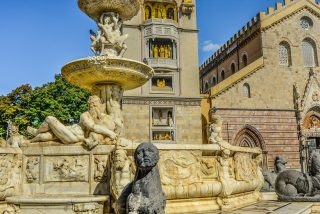
Fontana di Orione, Messina
Attraction and Fountain in Messina
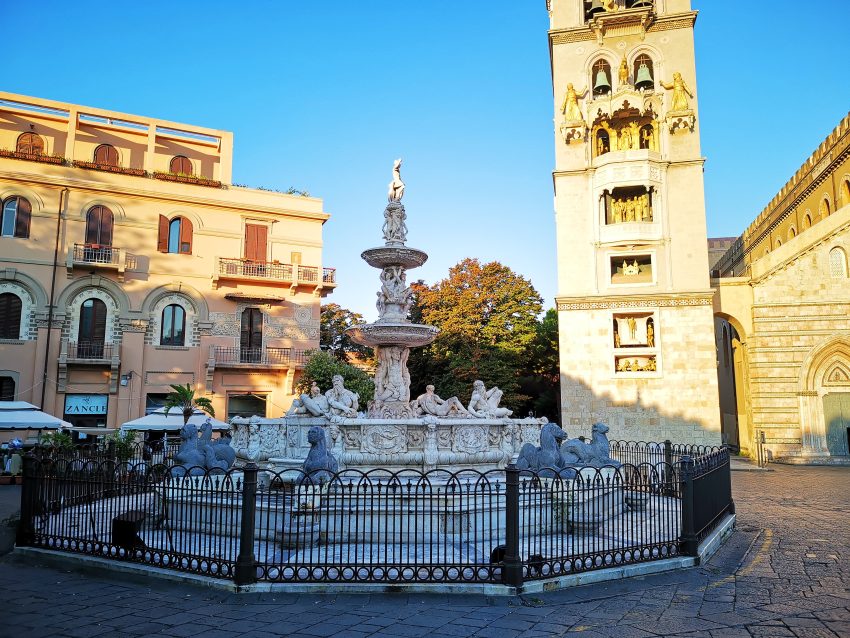
Set in the heart of Messina's historic center, the Fontana di Orione is a striking Renaissance marble fountain in Piazza Duomo, just steps from the Cathedral and its famous astronomical clock tower. It's the kind of landmark you'll likely “bump into” while exploring the city on foot, yet it rewards a slower look thanks to its layered sculpture and storytelling details.
Because it sits right on one of Messina's main walking routes, the fountain is easy to include on a self-guided walking tour that also takes in the Duomo façade, the bell tower, and the surrounding cafés. For the best views, circle it once at a distance to appreciate the overall composition, then move closer to spot the river figures, sea creatures, and inscriptions.
Table of Contents
- History and Significance of the Fontana di Orione
- Things to See and Do in the Fontana di Orione
- How to Get to the Fontana di Orione
- Practical Tips on Visiting the Fontana di Orione
- Where to Stay Close to the Fontana di Orione
- Is the Fontana di Orione Worth Visiting?
- For Different Travelers
- FAQs for Visiting Fontana di Orione
- Nearby Attractions to the Fontana di Orione
History and Significance of the Fontana di Orione
The Fontana di Orione was created in the mid-16th century as a celebration of Messina's new aqueduct and the arrival of running water to the city. Commissioned by the city's authorities and executed by the Florentine sculptor Giovanni Angelo Montorsoli, a pupil of Michelangelo, it stands as one of the most important Renaissance monuments in Messina.
Its iconography is more than decorative: the fountain uses myth, allegory, and civic symbolism to link Messina’s identity to water, prosperity, and prestige. At the top, Orion (Orione) appears as the city’s mythical founder, turning the fountain into a public statement about origins and pride as much as a beautiful piece of urban design.
Look closely and you'll notice how the composition stacks upward in tiers, guiding your eye from the basin's figures and sea motifs to the central column and the crowning statue. This vertical “storytelling” is part of what makes the fountain feel theatrical, especially when Piazza Duomo is lively.
Things to See and Do in the Fontana di Orione
Start by walking a full loop around the base. The fountain’s sculptural program is packed with figures, including personifications connected to rivers (often identified as the Tiber, Nile, Ebro, and the local Camaro), along with marine monsters and mythological elements that give the whole monument a dynamic, watery energy.
Next, step back toward the Cathedral side of the square to frame the fountain with the Duomo and bell tower behind it. This is one of the most satisfying “Messina postcard” angles, and it's also a great way to understand how the fountain was designed to work as part of a larger civic stage set.
Finally, use the fountain as a hub for a short Piazza Duomo circuit: pause for a coffee nearby, time your visit around the bell tower's clock show, and then continue on foot toward other central sights. Even if you only have a brief stop in Messina, this is an easy, high-impact landmark.
How to Get to the Fontana di Orione
The nearest major airports are Catania–Fontanarossa Airport (CTA) and Reggio Calabria Airport (REG), with additional options via Palermo Airport (PMO) if you're building a longer Sicily itinerary. For the best deals and a seamless booking experience, check out these flights to Messina on Booking.com.
Messina is well connected by rail, and arriving at Messina Centrale makes it straightforward to continue by local transport or a walk toward Piazza Duomo in the historic center. Use Omnio to easily compare schedules, book train tickets, and find the best prices all in one place for a hassle-free journey across Italy.
If you're driving, expect limited traffic zones and scarce street parking near the center, so it's often easiest to park outside the tight core and walk the last stretch into Piazza Duomo. If you are looking to rent a car in Italy I recommend having a look at Discover Cars, first, as they compare prices and review multiple car rental agencies for you.
Practical Tips on Visiting the Fontana di Orione
- Entrance fee: Free.
- Opening hours: 24 Hours.
- Best time to visit: Early morning for quieter photos and a calmer Piazza Duomo, or late afternoon when the light softens the marble and the square feels lively.
- How long to spend: Plan 15–30 minutes for a proper look around the carvings, plus extra time if you’re pairing it with the Cathedral and the bell tower.
- Accessibility: The fountain is viewed from the surrounding flat square, which is generally step-free, though surfaces can be uneven and crowded at peak times.
- Facilities: There are no dedicated facilities at the fountain itself, but you'll find cafés, restrooms in nearby venues, and plenty of places to take a short break around Piazza Duomo.
Where to Stay Close to the Fontana di Orione
Base yourself in central Messina near Piazza Duomo and the waterfront so you can walk to the city's main sights and keep evenings simple.
For a classic, convenient stay, consider Hotel Royal Palace for its central location and easy access to both the historic core and transport links.
If you want a comfortable, modern-feeling option that works well for short city breaks, Elysium B&B is a good pick for being close to the center and practical for walking itineraries.
For travelers who prioritize a straightforward, no-fuss base, Hotel Touring is worth considering for its simplicity and proximity to central Messina.
If you like the flexibility of apartment-style lodging for families or longer stays, Residence San Martino can be a smart choice thanks to the added space and self-catering potential.
And for a more boutique-leaning, design-forward stay within easy reach of central sights, Vmaison Hotel stands out as a comfortable splurge that still keeps you close to the action.
Is the Fontana di Orione Worth Visiting?
Yes, the Fontana di Orione is absolutely worth a stop, especially because it's right in Piazza Duomo and delivers a lot of visual and historical payoff in a short time. It's one of those attractions that works whether you're doing a quick “best of Messina” walk or slowing down to appreciate Renaissance sculpture and civic symbolism.
Honest Pivot: if you’re short on time and not particularly interested in sculpture, fountains, or city-center landmarks, you might prefer to prioritize a viewpoint, a museum, or a coastal excursion instead. The fountain is best appreciated when you’re willing to pause, circle it, and look closely rather than just snap a fast photo.
What Other Travellers Say...

Grand 16th-century fountain with statues of mythological figures built to celebrate ru ing water.


For Different Travelers
The Fontana di Orione is flexible: it's free to see, easy to reach, and naturally fits into most Messina itineraries. How much you'll enjoy it depends on whether you like detail-driven sights or prefer experiences that are more immersive.
Families with Kids
Kids often enjoy the “spot the creatures” aspect, since the fountain is full of figures, sea monsters, and dramatic shapes that feel like a storybook. It’s also in an open square, which can make the stop feel less formal than a museum visit.
That said, it’s still a sculpture-first attraction, so younger children may be done quickly. Pair it with a snack break nearby and another nearby highlight so the stop feels like part of a fun walk rather than a standalone “must-see.”
Couples & Romantic Getaways
For couples, the fountain is a great anchor point for a slow stroll through the historic center, especially if you time it for golden-hour light. The setting in Piazza Duomo gives it a classic Sicilian city atmosphere, with architecture and street life all around.
It also works well as a “meet here” spot before dinner, since it’s central and easy to find. Add a short evening walk toward the waterfront afterward for a simple, romantic plan.
Budget Travelers
This is an ideal budget-friendly sight: you can see it without paying an entry fee, and it sits on a walkable route that doesn't require taxis or tours. If you're building a low-cost day in Messina, combine it with other nearby landmarks and enjoy the city on foot.
To keep spending down, visit early, take your photos, and then pick up a quick snack from a bakery rather than sitting for a long café stop in the busiest part of the square.
History Buffs
History lovers will appreciate how the fountain ties together Renaissance art, civic identity, and the practical achievement of bringing water to the city. It’s also a strong example of how public monuments were used to communicate status and values in the 1500s.
Bring a little context with you and the carvings become much more than decoration. Even a brief read on Montorsoli and Messina’s Renaissance period can turn this into a highlight rather than a quick photo stop.
FAQs for Visiting Fontana di Orione
Getting There
Tickets & Entry
Visiting Experience
Tours, Context & Itineraries
Photography
Accessibility & Facilities
Food & Breaks Nearby
Safety & Timing
Nearby Attractions to the Fontana di Orione
- Duomo di Messina: The city's cathedral right beside the fountain, ideal to pair for architecture and atmosphere.
- Bell Tower and Astronomical Clock: A famous nearby landmark where timed displays draw crowds in Piazza Duomo.
- Fontana di Nettuno: Another monumental fountain by Montorsoli, closer to the waterfront and great for a second sculpture stop.
- Church of Santissima Annunziata dei Catalani: A compact medieval church in central Messina with distinctive architectural character.
- Messina Waterfront (Passeggiata a Mare area): A pleasant place to walk after Piazza Duomo, especially around sunset.
The Fontana di Orione appears in our Complete Guide to Visiting Messina!

Moira & Andy
Hey! We're Moira & Andy. From hiking the Camino to trips around Europe in Bert our campervan — we've been traveling together since retirement in 2020!
This website uses affiliate links which may earn a commission at no additional cost to you!
Planning Your Visit
24 Hours.
Free.
Nearby Attractions
- The Bell Tower of the Cathedral of Messina (0.0) km
Attraction, Cathedral and Tower - Duomo di Messina (0.0) km
Cathedral and Religious Building - Palazzo Calapaj-d'Alcontres (0.1) km
Historic Building, Historic Site and Palace - Palazzo dei Leoni (0.2) km
Historic Building, Historic Site and Palace - Palazzo Cerruti - Bisazza (0.2) km
Attraction, Historic Building and Notable Building - Galleria Vittorio Emanuele III (0.2) km
Attraction, Historic Building and Shopping Centre - Church of Most Holy Annunciation of the Catalans (0.2) km
Church, Historic Building and Religious Building - Palazzo Zanca (0.2) km
- Messina Cruise Port (0.3) km
Docks, Harbour and Port - Santuario della Madonna di Montalto (0.3) km
Church, Religious Building and Viewing Point