Cathédrale Saint-Pierre de Poitiers
Cathedral in Poitiers
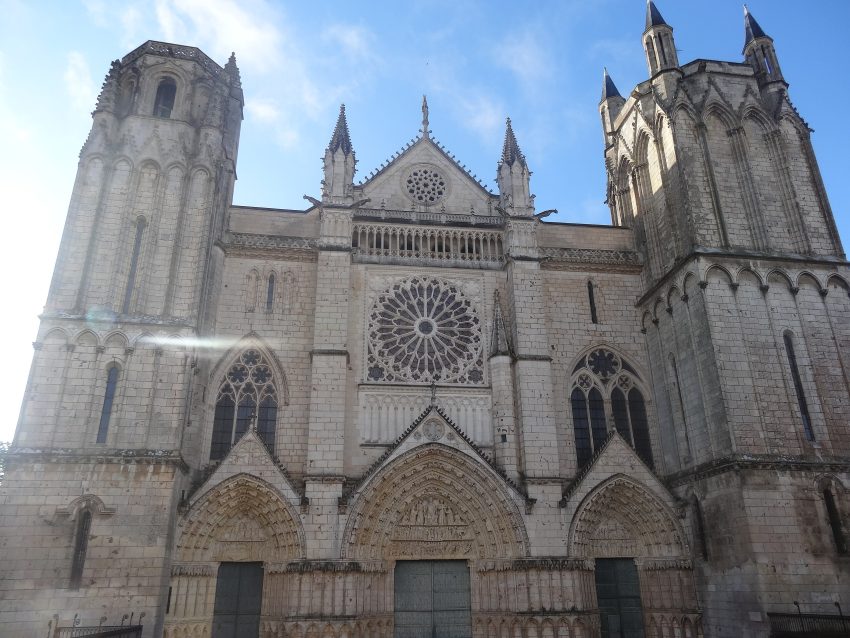
Rising above the rooftops of Poitiers, the Cathédrale Saint-Pierre feels every bit the spiritual and architectural anchor of the city. Begun in 1162 under Henry II of England and Eleanor of Aquitaine and built over a former Roman basilica, it showcases the distinct lines of Angevin Gothic architecture rather than the more familiar northern French style. Its sheer length, 94 metres from west front to flat chevet, and its massive buttresses give the building real presence on the skyline and a clear sense of why this was once both a Plantagenet statement of power and a centre of worship. Inside, the balance of vertical space, filtered light and rich decoration makes this cathedral a highlight of any walking tour of Poitiers.
Step through the doors and you are greeted by one of the most important ensembles of medieval art in western France. The 12th century Crucifixion Window, donated by Henry II and Eleanor, is among the earliest stained glass windows in any French cathedral, and its vivid storytelling still draws the eye. The carved wooden choir stalls, created between 1235 and 1257, are some of the oldest in the country, their intricate details reflecting the skill and devotion of the craftsmen who produced them. As you move beneath the high vaults and along the three naves of equal height, it is easy to feel how the building brings together art, politics and faith in a single sweeping interior.
Table of Contents
- History and Significance of the Cathédrale Saint-Pierre de Poitiers
- Things to See and Do in the Cathédrale Saint-Pierre de Poitiers
- How to Get to the Cathédrale Saint-Pierre de Poitiers
- Practical Tips on Visiting the Cathédrale Saint-Pierre de Poitiers
- Where to Stay close to the Cathédrale Saint-Pierre de Poitiers
- Is the Cathédrale Saint-Pierre de Poitiers Worth Visiting
- FAQs for Visiting Cathédrale Saint-Pierre de Poitiers
- Nearby Attractions to the Cathédrale Saint-Pierre de Poitiers
History and Significance of the Cathédrale Saint-Pierre de Poitiers
The Cathédrale Saint-Pierre de Poitiers was conceived at a moment when the Plantagenet dynasty held sway across large parts of what is now France. When Henry II and Eleanor of Aquitaine sponsored its construction in 1162, they were not only commissioning a place of worship but also marking Poitiers as a regional capital of considerable importance. Built over the remains of an earlier Roman basilica, the new cathedral signalled continuity with the city's ancient past while projecting a very contemporary image of Plantagenet authority.
Architecturally, the cathedral is a prime example of Angevin Gothic, a regional variation characterised by broad, relatively low spaces and complex rib vaulting rather than extreme verticality. The flat ended chevet with its three apsidioles, the massive buttresses and the twin western towers (never fully finished, which adds to their charm) give the exterior a distinctive silhouette. Inside, the decision to keep the three naves at the same height creates a kind of vast hall church, more unified and less tiered than many northern Gothic cathedrals.
Through the centuries, the building has been battered and repaired more than once. It suffered during the Hundred Years' War and later in the Wars of Religion, but unlike many churches it never lost its basic 12th and 13th century structure. Restorations have focused on stabilising the fabric and preserving key artworks: the 12th century stained glass in the chevet and clerestory, the medieval sculpture and the remarkable choir stalls. Today, it stands as both a working cathedral and a valuable document of how royal ambition, regional style and religious life intertwined in medieval Poitiers.
Things to See and Do in the Cathédrale Saint-Pierre de Poitiers
Begin with a slow walk around the exterior to understand the building’s scale and layout. Note the unfinished western towers, which stop short of the soaring spires you might expect but still frame the façade effectively. From certain angles you can see how the massive buttresses support the long nave and flat eastern end, reminders that all this stone and glass has stood through centuries of conflict and change.
Inside, make your way towards the chevet to admire the Crucifixion Window and the other 12th century stained glass. Their colours may be softer than they were eight centuries ago, but the density of detail and storytelling remains impressive. Look up to appreciate the ribbed vaulting that spans the full width of the three naves; this unified space is part of what distinguishes Angevin Gothic from its northern cousins. The carved choir stalls, with their intricate misericords and panels, reward close inspection, especially if you enjoy spotting small faces, foliage and symbolic creatures.
Take time as well to wander along the side aisles and chapels, where later additions, artworks and altars sit comfortably within the medieval shell. Because this is still an active cathedral, you may encounter a quiet Mass, choir rehearsal or organ practice, which adds to the sense that the building is not a frozen museum but a living part of the city. When you step back outside, consider combining your visit with nearby sites such as the Baptistère Saint-Jean and the Palace of the Counts of Poitou, turning the cathedral into the anchor point for one of the things to do in Poitiers if you are exploring its religious and political heritage.
How to Get to the Cathédrale Saint-Pierre de Poitiers
If you are arriving by air, the closest airport is Poitiers-Biard Airport, from which you can take a taxi or local bus into central Poitiers and then walk up to the cathedral in the historic quarter. For the best deals and a seamless booking experience, check out these flights to Poitiers on Booking.com.
By train, head for Poitiers' main railway station; from there it is roughly a 15-20 minute walk into the old town, or you can take a local bus that drops you closer to the cathedral precinct before completing the approach on foot. You can use SNCF Connect to check schedules, compare routes, and purchase tickets for National (SNCF ) and regional trains (TER). For a more streamlined experience, we recommend using Omio, which allows you to easily compare prices, schedules, and book tickets for both National and Regional travel across all of Europe, all in one place.
If you are travelling by car, follow signs to the city centre and use one of the public car parks serving the historic core; from your parking spot, it is a short walk through the old streets to the cathedral itself. If you are looking to rent a car in France I recommend having a look at Discover Cars, first, as they compare prices and review multiple car rental agencies for you.
Practical Tips on Visiting the Cathédrale Saint-Pierre de Poitiers
- Suggested tips: Give yourself time to sit quietly inside and let your eyes adjust to the stained glass; bring a small pair of binoculars or a zoom lens if you want to study the window details and choir carvings.
- Best time to visit: Late morning or mid afternoon often provide the best natural light through the stained glass, while early evening can be beautifully atmospheric with fewer visitors.
- Entrance fee: General entry to the cathedral is free.
- Opening hours: Typically open daily during daylight hours, with variations around services and religious festivals; check locally for current times.
- Official website: https://www.trinitepoitiers.fr/
- How long to spend: Plan on 45-60 minutes for a relaxed visit, longer if you are particularly interested in the stained glass or want to attend a service or concert.
- Accessibility: Main access is generally step free or low step, but some interior areas may have uneven flooring; visitors with reduced mobility should use the principal entrance and move carefully inside.
- Facilities: As an active church, on site facilities are limited; cafés, restaurants and public conveniences are available in the nearby streets of the historic centre.
- Photography tip: Use a higher ISO and steady hands for interior shots, avoiding flash; focus on the Crucifixion Window, the clerestory glass and the repeating lines of the three naves for striking images.
- Guided tours: Check with the tourist office or cathedral staff for guided visits that explain the Plantagenet background, the history of the windows and the choir stalls.
- Nearby food options: The surrounding streets offer plenty of cafés and bistros where you can sit outside and enjoy views of the cathedral or use it as a landmark while you dine.
Where to Stay close to the Cathédrale Saint-Pierre de Poitiers
Staying within the historic centre makes visiting the Cathédrale Saint-Pierre very straightforward. A good all round choice is Hôtel de l'Europe, from which you can walk easily to the cathedral, Baptistère Saint-Jean and the main squares. For travellers who want a practical base between the station and the old town, Best Western Poitiers Centre Le Grand Hôtel offers comfortable rooms and direct access on foot to the cathedral district. If you prefer a simpler, central option, Hotel Central keeps you close to public transport while still being within walking distance of the Cathédrale Saint-Pierre and other key sights.
Is the Cathédrale Saint-Pierre de Poitiers Worth Visiting
The Cathédrale Saint-Pierre de Poitiers is absolutely worth visiting, both as a major spiritual centre and as a textbook of Angevin Gothic architecture. Few places bring together royal patronage, early stained glass of such importance and some of the oldest choir stalls in France under one roof. Add in its position at the heart of the city and its links to figures such as Henry II and Eleanor of Aquitaine, and you have a site that connects local history to the broader story of medieval Europe. For travellers interested in architecture, history, art or simply atmospheric sacred spaces, it more than earns a place on any Poitiers itinerary.
What Other Travellers Say...

Cathédrale Saint-Pierre de Poitiers, at 1 Rue Sainte-Croix, is an ancient Roman Catholic landmark noted for its Gothic architecture, expansive interior and impressive stained-glass windows—visitors praise particularly well-preserved medieval glass and a notable Crucifixion window above the choir—inside you'll also find paintings, vaulted wooden ceilings and translated explanatory panels, and it's described as peaceful and worth a visit; note that parts may be closed during religious services.


FAQs for Visiting Cathédrale Saint-Pierre de Poitiers
Nearby Attractions to the Cathédrale Saint-Pierre de Poitiers
- Baptistère Saint-Jean: An early Christian baptistery with ancient frescoes and a rediscovered immersion pool, offering a fascinating contrast to the Gothic cathedral.
- Palace of the Counts of Poitou: Former Plantagenet residence featuring the vast Salle des Pas Perdus and the Maubergeon Tower, closely tied to the same royal patrons.
- Church of Notre-Dame-la-Grande: A beautiful Romanesque church with an intricately carved façade and a more intimate interior space.
- Place du Maréchal Leclerc: A broad central square framed by civic buildings, ideal for a pause between sightseeing stops.
- Historic streets of the old town: Wander the lanes linking the cathedral, palace and squares to experience Poitiers' layered urban history at street level.
The Cathédrale Saint-Pierre de Poitiers appears in our Complete Guide to Visiting Poitiers!

Moira & Andy
Hey! We're Moira & Andy. From hiking the Camino to trips around Europe in Bert our campervan — we've been traveling together since retirement in 2020!
This website uses affiliate links which may earn a commission at no additional cost to you!
Planning Your Visit
Typically open daily during daylight hours, with variations around services and religious festivals; check locally for current times.
General entry to the cathedral is free.
Nearby Attractions
- Baptistère Saint-Jean (0.1) km
Baptistery - Musée Sainte-Croix (0.2) km
Museum - Church of Notre-Dame-la-Grande (0.5) km
Church - Palace of the Counts of Poitou (0.6) km
Palace - Place du Maréchal Leclerc (0.7) km
Square - Place de la Liberté (0.8) km
Square - Amphithéâtre de Poitiers (0.8) km
Amphitheatre and Roman Site - Poitiers Prefecture (1.1) km
Historic Building - City Walls of Poitiers (1.4) km
City Walls - Parc de Blossac (1.4) km
Park