Castelo de Guimarães
Castle in Guimarães
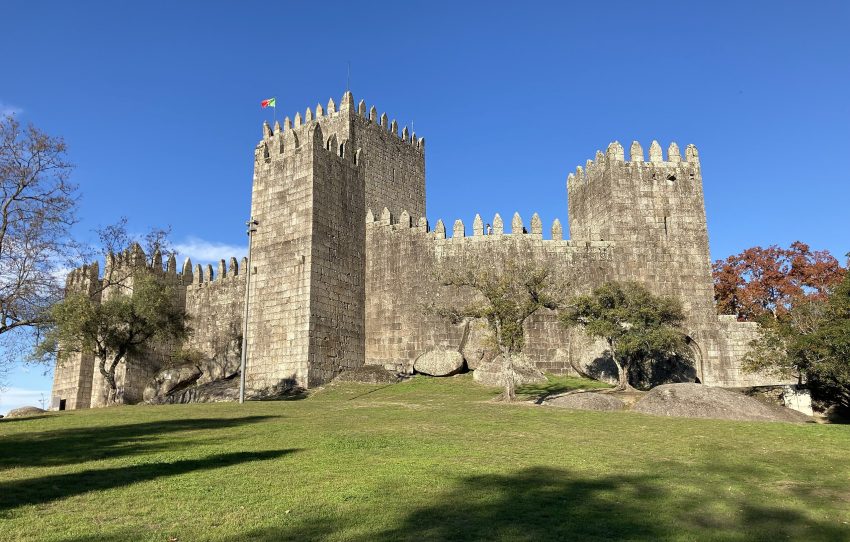
Castelo de Guimarães in Guimarães, Portugal, is a medieval hilltop castle and one of the city's main historic attractions. Set above Monte Largo, it is reached by an uphill walk from the old centre and is known for its granite keep, square towers, and fortified walls.
The castle matters because it is closely tied to the early history of Portugal, with traditions linking it to Countess Mumadona, Count Henry, and the birth of Afonso Henriques. Visitors come for the walls, the views over Guimarães, and the clear medieval layout. It works best for travellers who want a short, history-focused stop rather than a large museum-style visit.
Table of Contents
History and Significance of Castelo de Guimarães
The origins of the castle date to 968, when Countess Mumadona Dias, a powerful noblewoman of Galicia and the Portucalense region, ordered the construction of a fortified refuge to protect the local population from Viking incursions and Muslim raids. This early structure marked the beginning of the castle’s long defensive role.
In the early 12th century, Count Henry of Burgundy, who governed Portucalense as a vassal of León, expanded and reinforced the castle. He ordered a stronger defensive complex that introduced the square keep and four towers guarding the corners, forming the essential structure still visible today. Though not officially documented, tradition holds that this was the residence of Count Henry and the birthplace of his son, Afonso Henriques, who would become the first king of Portugal.
The castle played a central part in the battles that shaped the new kingdom. In 1127, Afonso Henriques clashed with his cousin, Alfonso VII of León, to free himself from vassalage and assert independence. The story of Egas Moniz, Afonso’s tutor, also echoes through these walls - a tale of honour, broken oaths, and passionate loyalty that helped define the national spirit.
Throughout medieval history, the castle defended the young Portuguese kingdom against conflicts with Castile and other forces. However, with the development of artillery, its strategic importance declined. By the 17th century, the fortress fell into disuse, eventually succumbing to ruin until its careful restoration in the early 20th century.
Things to See and Do in Castelo de Guimarães
Walking through the fortified gate and into the stone courtyard immediately conveys the weight of history. The central keep, rising above the complex, offers a commanding presence and excellent vantage points over Guimarães. Visitors can climb parts of the structure to enjoy sweeping views of the town and surrounding hills.
The walkway along the defensive walls lets you appreciate the towers, battlements, and military layout imagined by Count Henry. Interpretive signs share stories of the castle’s early years and the legends associated with Afonso Henriques and Egas Moniz. Exploring the ruins and reconstructed sections gives a vivid sense of medieval life and the strategic role the castle once played.
Outside the main walls lies a scenic green area connecting the castle to the Paço dos Duques and the Church of São Miguel do Castelo. This wider ensemble forms one of the best places to visit in Guimarães for understanding the intertwined religious, political, and cultural origins of the nation.
How to Get to Castelo de Guimarães
The nearest major airport is Porto Airport (OPO). For the best deals and a seamless booking experience, check out these flights to Guimarães on Booking.com. From Porto, frequent trains run to Guimarães, making it easy to reach the town in just over an hour. Train schedules and bookings can be found on Omio. Once in Guimarães, the castle is located on Monte Largo and is accessible by a pleasant uphill walk from the historic centre, or by local bus or taxi. Travellers arriving by car will find parking near the historic core before walking to the castle entrance. If you are looking to rent a car in Portugal I recommend having a look at Discover Cars, first, as they compare prices and review multiple car rental agencies for you.
Practical Tips on Visiting Castelo de Guimarães
- Suggested tips: Wear comfortable shoes; the castle grounds include uneven medieval stone surfaces.
- Best time to visit: Early morning or sunset for beautiful lighting on the granite walls.
- Entrance fee: Approximately €2-€3.
- Opening hours: Typically open daily; hours vary seasonally.
- Official website: Check the Direção-Geral do Património Cultural (DGPC) for updates.
- How long to spend: Around 45 minutes to 1 hour.
- Accessibility: Limited due to steep paths and steps; some areas not accessible for wheelchair users.
- Facilities: Small visitor centre, signage, rest areas nearby.
- Photography tip: Capture the keep from the outer green space to frame its full height.
- Guided tours: Available through local tour companies or as part of heritage routes.
- Nearby food options: Restaurants and cafés in the historic centre below the castle.
Where to Stay close to Castelo de Guimarães
For convenient access to Monte Largo, consider Pousada Mosteiro de Guimarães, a stunning historic stay in an old monastery overlooking the castle area. Another excellent choice is Hotel Toural, located in the old town with easy access to major sights. For a boutique experience, Santa Luzia ArtHotel offers modern comfort close to the castle paths.
Is Castelo de Guimarães Worth Visiting?
Absolutely - it is one of the most important heritage sites in Portugal and central to the story of the nation's birth. Its dramatic architecture, legendary associations, and panoramic setting make it an unmissable stop for any visitor to northern Portugal.
What Other Travellers Say...
Guimarães Castle sits on a hill above R. Conde Dom Henrique and is a compact Romanesque fortress with largely intact stone walls and towers; visitors praise its commanding presence, panoramic views and pleasant surrounding grounds, and many mention a VR experience that reconstructs the castle's past (often paid separately). Some guests note limited interior access when areas or the central tower are closed for renovation and warn some surfaces can be slippery, while others recommend combining a visit with the nearby Ducal Palace for a fuller outing.





FAQs for Visiting Castelo de Guimarães
Can I climb the towers?
Some areas are open to visitors depending on safety conditions.
Is it suitable for children?
Yes, children often enjoy exploring the walls and courtyards.
How steep is the walk?
Moderately uphill but manageable for most visitors.
Is the castle part of a larger complex?
Yes, it is close to the Paço dos Duques and the Church of São Miguel do Castelo.
The Castelo de Guimarães appears in our Complete Guide to Visiting Guimarães!

Moira & Andy
Hey! We're Moira & Andy. From hiking the Camino to trips around Europe in Bert our campervan — we've been traveling together since retirement in 2020!
This website uses affiliate links which may earn a commission at no additional cost to you!
Nearby Attractions
- Igreja de São Miguel do Castelo (0.1) km
Church - Paço dos Duques de Bragança (0.2) km
Palace - Muralhas de Guimaraes (0.4) km
City Gate and City Walls - Convento de Santa Clara (0.4) km
Convent - Rua de Santa Maria (0.5) km
Street - Largo dos Laranjais (0.5) km
Historic Building and Square - Fonte do Largo Dr. João da Mota Prego (0.5) km
Fountain and Square - Praça de São Tiago (0.5) km
Square - Largo da Oliveira (0.6) km
Square - Alberto Sampaio Museum (0.6) km
Museum