Arco da Porta Nova, Braga
City Gate in Braga
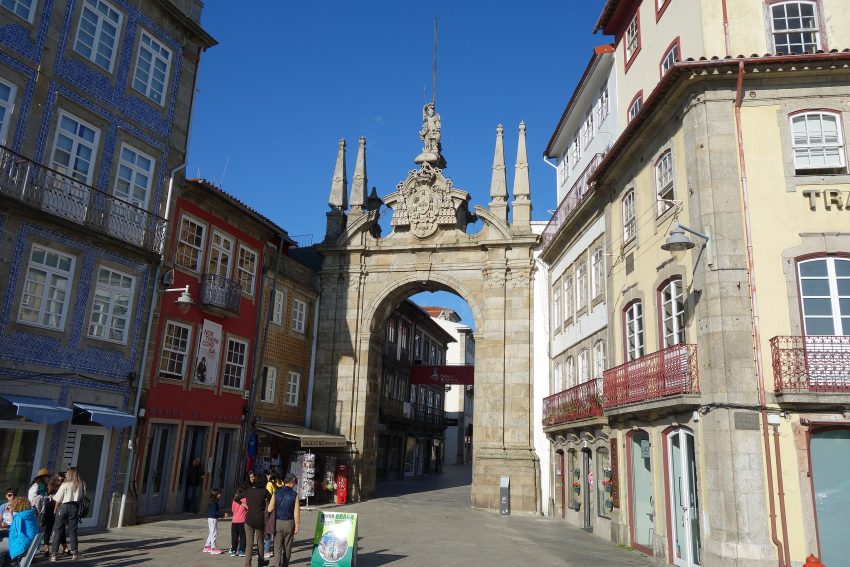
Arco da Porta Nova in Braga, Portugal, is an ornamental stone gateway at the western edge of the historic centre. The present arch was designed in the 18th century by André Soares, replacing an older gate that once formed part of Braga's defensive walls. Set on Rua Dom Diogo de Sousa, it marks the point where the modern city gives way to the older street pattern beyond.
Visitors usually stop here to look at the two different faces of the arch: one side is richly Baroque, with sculpted detail and a figure representing Braga, while the other is more restrained and neoclassical, with a statue of the Virgin Mary. It is best for people interested in architecture, urban history, or a short walk into the old centre. The visit is quick, and the arch works well as a starting point for exploring the streets behind it.
History and Significance of Arco da Porta Nova
The Arco da Porta Nova has guarded the entrance to Braga's old town for centuries. The original gate was part of the defensive wall built during the reign of King Dinis in the late 13th century and later reinforced by King Fernando in 1373. Over the centuries, the gateway evolved from a military necessity into a civic monument symbolizing Braga's prosperity and prestige.
In 1512, Bishop Diogo de Sousa oversaw strengthening works, but the current structure dates from the 18th century. At the request of Archbishop José de Bragança, the brilliant local architect André Soares - famed for his exuberant Baroque designs - reimagined the arch into the form we see today. His design features ornate scrolls, sculptural flourishes, and a feminine figure crowning the top, symbolizing the city of Braga itself.
While the medieval walls that once surrounded Braga have largely disappeared, the Arco da Porta Nova remains as their most graceful survivor. It has become such a defining feature of the city that locals affectionately use the expression “He entered Braga by the New Gate” to describe someone who appears unexpectedly - a nod to the arch's welcoming spirit.
Things to See and Do at Arco da Porta Nova
Standing beneath the arch, you can sense the layers of Braga’s history converging. From one side, the lively Rua do Souto stretches into the city centre, lined with shops, cafés, and historic façades. From the other, you can look back toward the railway station, tracing the path that countless travellers have taken through this symbolic entrance.
Take time to appreciate André Soares' artistry - the intricate stonework, the sculptural motifs, and the female allegory that represents Braga. The Baroque details are particularly striking in the late afternoon light, when shadows bring out the curves and carvings of the arch.
Nearby stands the Tower of Porta Nova, once part of the city’s defensive structure and now home to the Museum of Image. The museum showcases contemporary photography and visual art, providing an intriguing contrast to the centuries-old stonework just outside its doors. Climbing the tower also rewards visitors with views over the rooftops of Braga’s historic centre.
How to Get There
For those arriving by train, simply walk straight along Rua Andrade Corvo from Braga Station for about 10 minutes until you reach the Arco da Porta Nova. Train schedules and bookings can be found on Omio. The arch stands at the start of Rua do Souto, within easy walking distance of major landmarks like Praça da República and the Cathedral of Braga. Visitors arriving by car can use nearby public car parks around Campo da Vinha or Avenida Central. If you are looking to rent a car in Portugal I recommend having a look at Discover Cars, first, as they compare prices and review multiple car rental agencies for you.
Practical Tips on Visiting Arco da Porta Nova
- Best time to visit Arco da Porta Nova: Late afternoon for the best light on the Baroque details.
- Entrance fee in Euros: Free.
- Opening hours: Always accessible; the Museum of Image inside the adjacent tower has separate hours.
- Official website: www.cm-braga.pt
- How long to spend: 15-30 minutes, longer if visiting the tower or museum.
- Accessibility: Fully accessible at street level.
- Facilities: Nearby cafés and shops along Rua do Souto.
- Photography tip: Capture the arch framing the lively street behind it or photograph it from both sides for contrasting perspectives.
- Guided tours: Often included in city heritage and architecture walking tours.
- Nearby food options: Enjoy local pastries or coffee at cafés along Rua do Souto or Praça da República.
Is Arco da Porta Nova Worth Visiting?
Absolutely. The Arco da Porta Nova is one of the must-see places in Braga, both for its historical importance and architectural beauty. As a surviving link to the city's medieval past and a masterpiece of Baroque design, it embodies the spirit of Braga - welcoming, elegant, and full of character. Passing beneath its graceful archway is a symbolic rite of entry into one of Portugal's oldest and most fascinating cities.
What Other Travellers Say...
Arco da Porta Nova in Braga is an iconic stone pedestrian archway blending Baroque and Neoclassical details that serves as a welcoming entrance to the city; visitors note its ornate western façade and simpler eastern side, its role as a historic gateway once tied to the old city walls, and that it's freely accessible day and night along a pedestrian route leading into the centro where you can continue exploring nearby streets, churches and cafés.





FAQs for Visiting Arco da Porta Nova
The Arco da Porta Nova appears in our Complete Guide to Visiting Braga!

Moira & Andy
Hey! We're Moira & Andy. From hiking the Camino to trips around Europe in Bert our campervan — we've been traveling together since retirement in 2020!
This website uses affiliate links which may earn a commission at no additional cost to you!
Planning Your Visit
24 hours
Nearby Attractions
- Biscainhos Museum (0.1) km
Museum - Braga Cathedral (0.2) km
Cathedral - Episcopal Palace (0.3) km
Palace - Santa Barbara Garden (0.3) km
Gardens - Pius XII & Medina Museum (0.4) km
Museum - Termas Romanas do Alto da Cividade (0.4) km
Historic Site - Torre de Menagem (0.5) km
Tower - Museu D. Diogo de Sousa (0.5) km
Museum - Theatro Circo (0.6) km
Theatre - Palácio do Raio (0.6) km
Historic Building and Museum