Teatro Romano, Gubbio
Amphitheatre in Gubbio
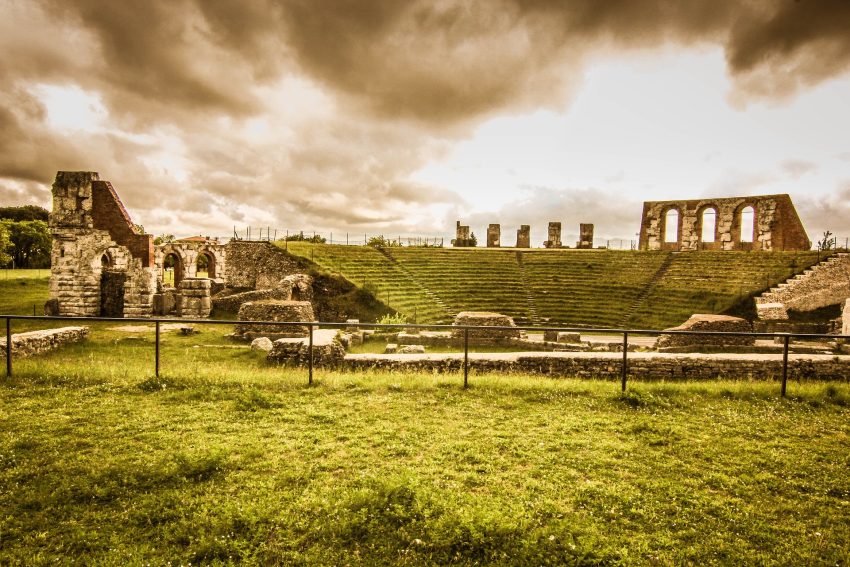
Rising from the Guastuglia archaeological area at the foot of Gubbio, the Teatro Romano is one of the top attractions in Gubbio and a highlight of any walking tour of Gubbio. Built around 20 BC, it showcases the ingenuity of Roman engineering through its semicircular form, towering arches, and carefully carved limestone blocks. Even in its ruined state, you can still feel the scale of performances that once animated this enormous structure.
Walking among the stone tiers and surviving arcades is a deeply atmospheric experience, especially with the backdrop of Gubbio's medieval skyline rising behind it. This spot is one of the must-see places in Gubbio for anyone curious about ancient urban life, as the theatre sits within the former Roman quarter of Iguvium, where streets, homes, and public spaces once thrived.
History and Significance of Teatro Romano
The Teatro Romano was commissioned around 20 BC by Gnaeus Satrius Rufus, a magistrate overseeing the civic development of Iguvium's Roman quarter. Positioned within the urban area bounded today by Via Matteotti, Via Perugina, Via Ubaldi, and Via Parruccini, it represented both cultural expression and civic pride. With seating for roughly 6,000 spectators, it was one of the largest theatres in the region and a prime venue for drama, oration, and public gatherings.
Much of the structure was built from locally quarried limestone arranged in rustic ashlar, forming two levels of arcades. While only the lower tier and fragments of the upper gallery remain, these remnants help convey the building’s original grandeur. The cavea was divided into four sectors, likely accessed by wooden staircases and stone aisles, providing a snapshot of how spectators were organised by status and seating category.
Below the stage, Roman engineering reveals itself in the finely laid limestone slabs and an advanced drainage system directing water to a large cistern beneath the pulpitum. The remains of the frons scaenae, including two rectangular side niches and a semicircular central alcove, hint at the richly decorated backdrop that once framed performances.
Things to See and Do in Teatro Romano
The first impression of the Teatro Romano comes from its sweeping semicircular cavea, where you can stand on the ancient seating tiers and imagine the crowds gathering for festivals or dramatic productions. Its position in the Guastuglia plain makes it especially photogenic in the late afternoon when the mountain light softens across the ruins.
Take time to explore the preserved vomitoriums, where patches of reticulated masonry reveal the decorative choices of Roman builders. The lower arcade's arches remain among the most striking features, offering a sense of scale and structural rhythm that defined Roman theatre architecture. Nearby, the Antiquarium displays findings from excavations, including ceramics, tools, and small artifacts that help reconstruct daily life in Iguvium.
Many visitors also enjoy walking the perimeter of the site to understand how the theatre fit within the broader Roman quarter. With the medieval city rising above it, the contrast between ancient and medieval Gubbio is one of the best places to see in Teatro Romano's surrounding landscape.
How to Get to Teatro Romano
The nearest airports are Perugia “San Francesco” Airport (PEG) and Ancona Airport. For the best deals and a seamless booking experience, check out these flights to Gubbio on Booking.com. From either, you can continue to Gubbio by regional train and bus connections. Use Omnio to easily compare schedules, book train tickets, and find the best prices all in one place for a hassle-free journey across Italy. Once in town, the theatre is located in the Guastuglia area just below the historic centre, and visitors often reach it on foot from Piazza 40 Martiri. If arriving by car, there is convenient parking near the site before walking into the archaeological area. If you are looking to rent a car in Italy I recommend having a look at Discover Cars, first, as they compare prices and review multiple car rental agencies for you.
Practical Tips on Visiting Teatro Romano
- Suggested tips: Wear comfortable shoes, as the ground is uneven around the ruins.
- Best time to visit: Early morning or late afternoon for softer light and cooler temperatures.
- Entrance fee: Approximately €5 for the combined archaeological area and Antiquarium.
- Opening hours: Wednesday to Sunday: 8.30am – 7.30pm, last admission allowed at 7pm: 00. Closed on Monday and Tuesday.
- Official website: musei.umbria.beniculturali.it
- How long to spend: Around 45 minutes to one hour.
- Accessibility: Limited due to uneven terrain and ancient steps.
- Facilities: Basic signage and outdoor seating; restrooms may be available near the Antiquarium.
- Photography tip: Capture the arches from the lower level and the medieval skyline behind the theatre for the best angles.
- Guided tours: Occasional guided visits available during cultural events or upon request.
- Nearby food options: Cafés and trattorias can be found around Piazza 40 Martiri and the historic centre.
Where to Stay close to Teatro Romano
For a stay near the archaeological area, consider Hotel Gattapone which offers a classic atmosphere within walking distance of the theatre and old town. Another comfortable option is Park Hotel Ai Cappuccini, a restored monastery with modern amenities and easy access to the Guastuglia area. For something more intimate, Residenza Le Logge places you close to both the Roman ruins and the medieval streets above.
Is Teatro Romano Worth Visiting?
Yes - the Teatro Romano is one of Gubbio's most atmospheric historic sites. Its vast scale, remarkable masonry, and position within the Roman quarter offer a compelling look at ancient Iguvium. Whether you're interested in archaeology, architecture, or simply love wandering through evocative open-air ruins, it provides a memorable experience and helps you understand Gubbio's deep historical layers.
What Other Travellers Say...

Parco archeologico del teatro romano di Gubbio sits on Viale Teatro Romano in Gubbio and offers visitors a well-preserved Roman theatre set in a garden-like space where you can stroll, sit and admire the ruins; while access to the interior can be limited at times, you can still get close to observe the structure, enjoy views on a clear day, and note the nearby café with a playground for families.


FAQs for Visiting Teatro Romano
Is the site suitable for children?
Children enjoy exploring the open spaces, though supervision is recommended due to uneven stones.
How far is it from the historic centre?
Around a 10-15 minute walk from Piazza 40 Martiri.
Can I take photos?
Yes, photography is allowed throughout the archaeological area.
Is there shade on the site?
Only limited shade is available, so consider visiting during cooler hours.
Nearby Attractions to Teatro Romano
- Palazzo dei Consoli - Gubbio's iconic medieval civic palace overlooking Piazza Grande.
- Piazza Grande - The spectacular hanging square at the heart of town.
- Gubbio Cathedral - A serene medieval cathedral with panoramic views.
- Palazzo Ducale - Renaissance residence with elegant courtyards and exhibitions.
- Via dei Consoli - A historic lane climbing into the heart of medieval Gubbio.
The Teatro Romano appears in our Complete Guide to Visiting Gubbio!

Moira & Andy
Hey! We're Moira & Andy. From hiking the Camino to trips around Europe in Bert our campervan — we've been traveling together since retirement in 2020!
This website uses affiliate links which may earn a commission at no additional cost to you!
Planning Your Visit
Wednesday to Sunday: 8.30am - 7.30pm, last admission allowed at 7pm: 00.
Closed on Monday and Tuesday.
Approximately €5 for the combined archaeological area and Antiquarium.
Nearby Attractions
- Logge dei Tiratori (0.4) km
Historic Building - Fontana del Bargello (0.5) km
Fountain - Palazzo dei Consoli (0.5) km
Palace - Piazza Grande (0.5) km
Square - Palazzo dei Priori (0.6) km
Palace - Museo Diocesano (0.6) km
Museum - Palazzo Ducale (0.6) km
Museum and Palace - San Francesco della Pace (0.6) km
Church - Gubbio Cathedral (0.6) km
Cathedral - Gubbio Funivia (1.0) km
Cable Car