Self-Guided Walking Tour of Zell am See (+Maps!)
This website uses affiliate links which earn a small commission at no additional cost to you.
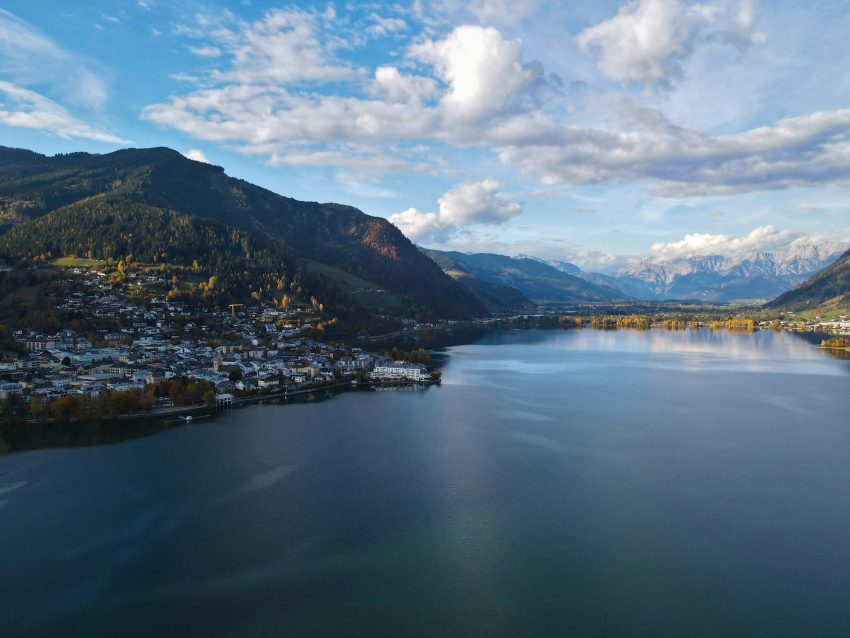
Zell am See is the kind of place that rewards slowing down: a lakeside promenade that keeps pulling you back for “one more” view, a compact centre you can cover easily on foot, and a mix of historic details and modern resort energy that changes with the light. This self-guided route is designed to feel natural rather than rushed, with plenty of chances to pause for coffee, photos, or a quick detour when something catches your eye.
On this walk you'll stitch together waterfront scenes along the Elisabeth-Promenade, pockets of greenery like Stadtpark, and the town's older core where churches, civic buildings, and traditional façades give Zell am See its character. The aim is to help you hit the best things to see in Zell am See without turning your day into a checklist.
Because you’re navigating with maps, you can treat this as a framework: do the full route in one go, split it into a morning-and-afternoon plan, or cherry-pick stops around your hotel and the weather. The town is small, but the scenery is big-so build in time to simply wander.
Table of Contents
- How to Get to Zell am See
- A Short History of Zell am See
- Early Zell am See and the Roots of a Market Town
- Medieval Zell am See and the Rise of Parish Life
- Zell am See in the Early Modern Era and Civic Confidence
- Resort-Era Zell am See and the First Grand Hotels
- Modern Zell am See: Culture, Public Space, and Contemporary Landmarks
- Zell am See Today: Heritage on Display as You Walk
- Where to Stay in Zell am See
- Your Self-Guided Walking Tour of Zell am See
How to Get to Zell am See
By Air: The closest major airports are Salzburg (often the easiest) and Munich (with more long-haul options), with onward transfers by train, shuttle, or rental car. If you're flying into Vienna, it's still straightforward but usually longer door-to-door. When you land, aim to connect to Zell am See Bahnhof (the main station) or directly to your accommodation in the centre for the easiest start to the walking route. For the best deals and a seamless booking experience, check out these flights to Zell am See on Booking.com.
By Train: Train travel is one of the simplest ways to arrive, especially if you're coming from Salzburg, Innsbruck, Munich, or Vienna. Zell am See's station is walkable to many central hotels, and once you're checked in you can do most of this itinerary entirely on foot. If you're travelling with luggage, consider a short taxi hop from the station to avoid hauling bags over any uneven streets. You can easily check timetables and book train tickets through the ÖBB (Austrian Federal Railways) website. However, for a smoother experience, we recommend using Omio, which simplifies the booking process and lets you compare routes, prices, and departure times all in one place.
By Car: Driving gives you flexibility for side trips and scenic approaches, but parking is the main consideration once you arrive. If you want a walking-tour-first stay, choose an accommodation with parking included, then leave the car parked and explore the centre and lakeside on foot. In winter conditions, factor in alpine road rules and allow extra time for mountain routes. If you are looking to rent a car in Austria I recommend having a look at Discover Cars, first, as they compare prices and review multiple car rental agencies for you.
By Bus: Regional buses connect nearby towns and valleys, and local services can be useful if you're staying outside the centre. How to get around the city: Zell am See is very walkable, and the core sights are close together, but you can mix walking with short bus rides or taxis if the weather turns or you want to save your legs. If you're planning to add viewpoints or lift stations around your walk, check seasonal operating times and last-return options so you don't get stranded at the wrong end of town.
A Short History of Zell am See
Early Zell am See and the Roots of a Market Town
Long before Zell am See became a holiday name, it developed as a small community shaped by movement-of people, goods, and seasonal work-through the valley. Over time, a recognisable town centre formed, with civic functions and local trade giving it a stable rhythm. The older urban fabric you experience today-compact streets, traditional façades, and a walkable core-reflects that steady growth from practical beginnings into a more organised settlement.
Medieval Zell am See and the Rise of Parish Life
In the medieval period, church life anchored daily routines and influenced the town's layout. St. Hippolytus Pfarrkirche became a defining landmark, not just spiritually but visually, setting a focal point you still sense when you approach the centre on foot. Around it, administrative and community structures strengthened, laying the groundwork for later civic buildings and the idea of Zell am See as a place with local authority and identity rather than just a waypoint.
Zell am See in the Early Modern Era and Civic Confidence
As the town matured, more formal administration and “public presence” became visible in the streetscape. Buildings associated with governance and regional oversight-such as the Bezirkshauptmannschaft-represent that shift toward clearer civic organisation. This period also helps explain why Zell am See’s centre feels cohesive: rather than sprawling outward randomly, it consolidated around recognisable institutions and the practical needs of residents, traders, and visitors passing through.
Resort-Era Zell am See and the First Grand Hotels
The arrival of modern tourism reshaped Zell am See’s identity, turning natural scenery into an economic engine and the lakeside into prime public space. The Grand Hotel and Hotel Lebzelter speak to this transformation: accommodation became part of the town’s architecture and story, not just a background service. Strolling today, you can read this era in the façades and in the way the waterfront is treated as a destination in its own right-an experience refined over generations of guests.
Modern Zell am See: Culture, Public Space, and Contemporary Landmarks
In more recent decades, Zell am See has continued investing in culture and public life alongside tourism. The Ferry Porsche Congress Center signals a modern, event-focused dimension, while the Elisabeth-Promenade reinforces how central the lakeside walk has become to the town's identity. Features like the Hundertwasser Osterreich-Brunnen show a taste for distinctive public art and design, and green spaces such as Stadtpark underline an emphasis on making the centre pleasant to linger in, not merely pass through.
Zell am See Today: Heritage on Display as You Walk
Today's walking route threads together “everyday history” and curated heritage. The Vogtturm Stadtmuseum is a natural anchor for understanding how the town evolved, while smaller details-traditional shopfronts, older inns, and re-used historic buildings-fill in the gaps between headline sights. Places referenced in local lore and built heritage, including Schloss Rosenberg and the Ginhouse, add texture to the story you're walking through: Zell am See isn't frozen in time, but it does a good job of keeping its past visible in the present.
Where to Stay in Zell am See
To make the most of visiting Zell am See and this walking tour then you consider stay overnight at the centre. If you base yourself around the Old Town and the streets between the station and the lake, you can start walking straight from your door, dip back to your hotel between stops, and enjoy the promenade in the early morning or after dinner when the crowds thin out. Solid central options include Grand Hotel Zell am See for a classic lakeside base, and Hotel Lebzelter if you want to be right in the historic core with everything close at hand.
If you’d rather prioritise waterfront atmosphere, look along the lake-facing stretches near the Elisabeth-Promenade, where you can weave the lakeside sections of the route into your day in short, scenic loops. This area is ideal if you want sunrise or sunset walks without committing to a long outing, and it’s still easy to reach the church, museum, and central squares on foot. For a quieter feel while staying connected, consider accommodation just outside the tight centre but still walkable, such as Hotel Tirolerhof or Hotel Salzburgerhof-both are typically convenient for walking while giving you a bit more breathing room.
If you’re arriving by car or want a more retreat-like stay, the edges of town can work well-especially if your accommodation includes parking and you’re happy to do a 10-25 minute walk into the centre each day. This approach suits travellers planning to add day trips or mountain excursions around the walking tour. A good “basecamp” style choice is Schloss Prielau Hotel & Restaurants, which leans more toward destination-stay vibes while still letting you reach the town sights when you’re ready.
Your Self-Guided Walking Tour of Zell am See
Explore Zell am See on foot with our walking tour map guiding you from one stop to the next as you trace the lakeside, cut into the Old Town for its landmarks, and pause in parks and small squares along the way. Because this is a self-guided walk, you can shape it around your pace-skip anything that doesn't interest you, linger where the views are best, and build in coffee or pastry breaks whenever you feel like it. The route is designed to be flexible, so you can do it as one continuous stroll or treat it as a set of easy mini-walks that fit around the rest of your day.
1. Vogtturm Stadtmuseum
The Vogtturm is Zell am See’s medieval town tower, and today it houses the city museum in the very heart of the old town. The museum itself began as a local “Heimatmuseum” founded in 1973 by historically minded residents, and it later moved into the Vogtturm in 1984, giving the collection a fitting historic setting. Inside, the experience is designed as a compact journey through the region’s past, from early artefacts through medieval life and later civic culture. Because it’s set across multiple levels in a tower, you get that satisfying “up through time” rhythm as you climb, with different themes unfolding floor by floor. When you visit, focus on the blend of local history and material culture rather than expecting a single headline masterpiece. It’s also worth taking a moment outside to appreciate why a defensive and administrative tower became such a strong symbol of the town’s identity over the centuries.
Location: Stadtpl. 8, 5700 Zell am See, Austria | Hours: January 7, 2026 – April 3, 2026: Wednesday – Sunday: 13:00–18:00. April 4, 2026 – May 12, 2026: Closed. May 13, 2026 – June 28, 2026: Wednesday – Sunday: 13:00–18:00. July 1, 2026 – August 31, 2026: Tuesday – Sunday: 10:00–18:00. September 1, 2026 – October 31, 2026: Wednesday – Sunday: 13:00–18:00. | Price: Adults: €10; Reduced: €7; Teenagers (10–18): €5; Children under 10: free; Families: €22. | Website

2. Bezirkshauptmannschaft
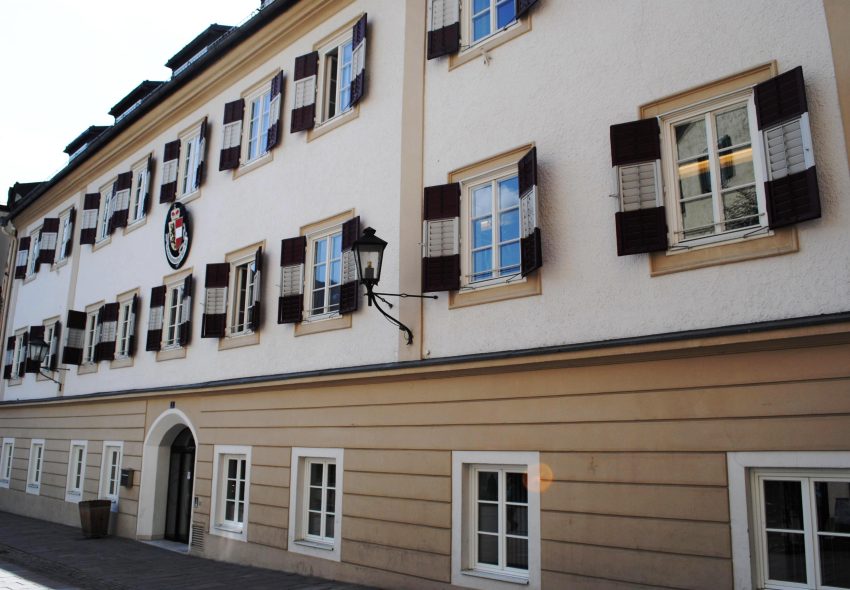
The Bezirkshauptmannschaft is the district administrative authority, and in Zell am See it sits right on the Stadtplatz in a building with a long civic history. Sources describing the building note origins before 1500, with later phases when it functioned as an administrative centre and was substantially remodelled in the 19th century. Architecturally, it reads as a “working” historic building: a town-centre façade that has adapted to changing governmental roles rather than a monument built for display. That continuity is part of the interest—this is the sort of place that anchors how the town has been run, taxed, and regulated across generations. For visitors, the value is mostly exterior: notice its placement on the main square and how it relates to the surrounding historic core. If you’re paying attention to urban history, it’s a useful stop for understanding how administration and public life clustered around the Stadtplatz.
Location: Stadtpl. 1, 5700 Zell am See, Austria | Hours: Monday – Friday: 08:00–12:00. | Price: Free. | Website
3. Schloss Rosenberg
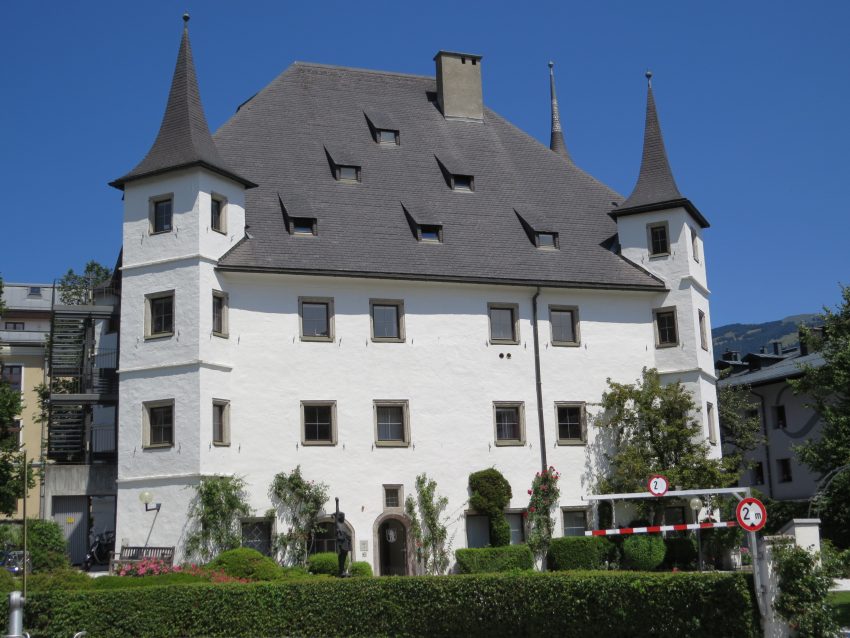
Schloss Rosenberg sits right in the centre of Zell am See and is closely tied to the town’s civic story, because it functions today as the Rathaus (town hall). Local historical notes describe it as being built in the late 16th century by the Rosenberger brothers, and over time it passed through different owners and uses before becoming an administrative seat. That pattern—private prestige building to public function—is part of what makes it interesting. Its later roles have included government-related uses (such as courts and offices, depending on the era), which is typical of prominent central buildings in Alpine market towns as power structures shifted. For what to see, focus on the exterior massing and the way it commands the townscape rather than expecting an open-palace interior. It’s best appreciated as a landmark you read from the square: the building that signals where local decision-making physically lives.
Location: Brucker Bundesstraße 2, 5700 Zell am See, Austria | Hours: Monday, Wednesday: 08:00–12:00 & 13:00–17:00. Tuesday, Thursday, Friday: 08:00–12:00. Saturday: Closed. Sunday: Closed. | Price: Free. | Website
4. Ferry Porsche Congress Center
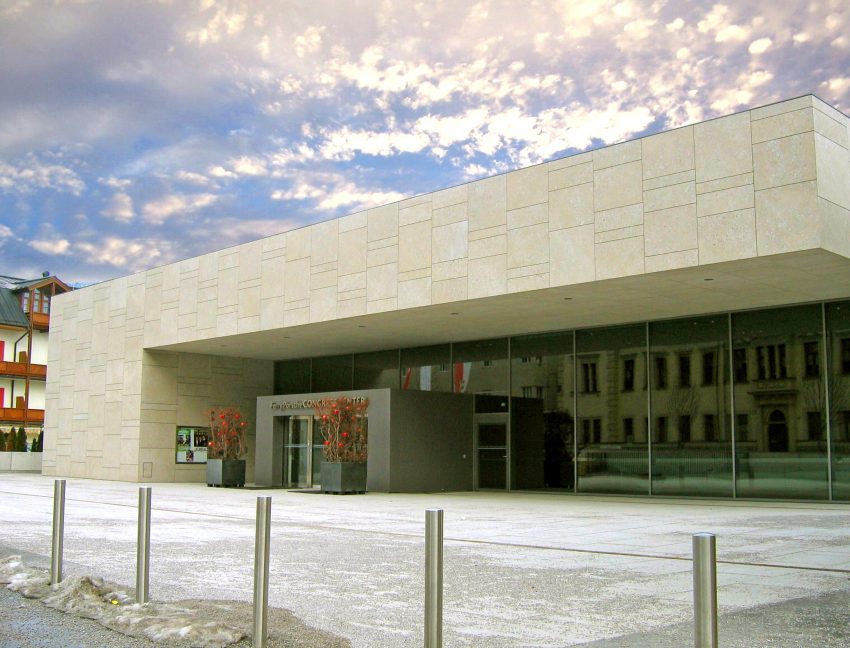
The Ferry Porsche Congress Center is a modern landmark in Zell am See’s centre, created as a purpose-built events venue rather than an adapted historic structure. Its own background material describes a rapid development timeline culminating in a grand opening in September 2007, giving the town a contemporary civic stage for conferences and large events. Historically, its significance is about Zell am See’s evolution into a year-round destination: a place that needs indoor cultural and business infrastructure alongside seasonal outdoor tourism. The building represents the “modern resort town” layer of the local story—investment in capacity, architecture, and event programming that complements lake-and-mountain appeal. When you visit, the best approach is to treat it as architecture and atmosphere unless you’re attending something. Step inside if it’s open to the public, look for the main hall scale and the way the venue is designed to flex between formats, then pair it with the surrounding town-centre streets for contrast between old and new Zell am See.
Location: Brucker Bundesstraße 1a, 5700 Zell am See, Austria | Hours: Monday – Friday: 08:00–12:00. | Price: Prices vary by show. | Website
5. St. Hippolytus Pfarrkirche
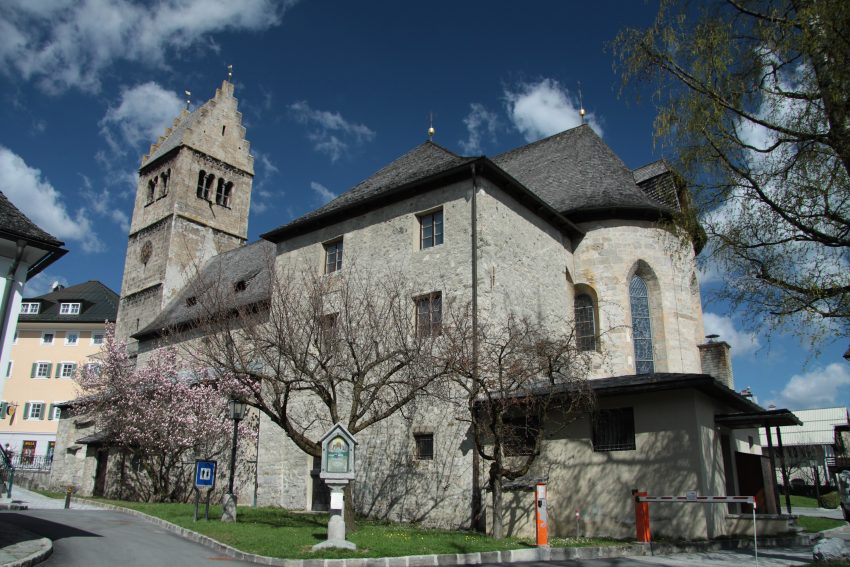
The parish church of St. Hippolytus is one of Zell am See’s oldest sacred sites, with sources placing parts of its fabric back to the early medieval period. What remains especially notable is the survival of an early crypt, while the main church reflects later expansions and stylistic layers, including Romanesque and Gothic development. This is the kind of building where the “history” is literally visible in stonework, proportions, and the way different parts meet. Instead of a single construction moment, you’re seeing centuries of religious life, rebuilding, and artistic taste accumulating as the town grew in importance. When you go inside, slow down and look for those older structural elements (especially anything connected to the earliest surviving sections), then take in the overall basilica form. Even a short visit gives a strong sense of continuity—how the town square and the church have anchored each other over time.
Location: Stadtpl. 5b, 5700 Zell am See, Austria | Hours: Check official website. | Price: Free; donations appreciated. | Website
6. Elisabeth-Promenade
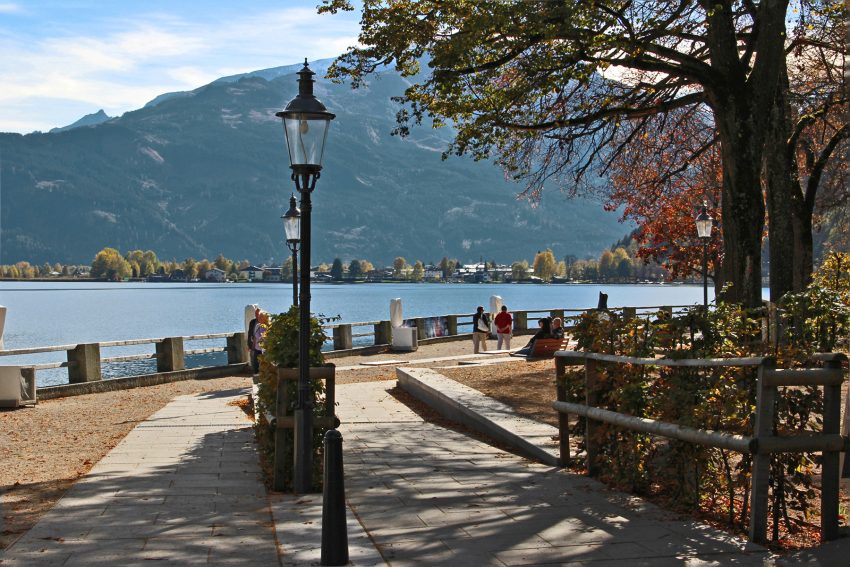
The Elisabeth-Promenade is the classic lakeside promenade line in Zell am See, linking views, parkland, and a distinctly “holiday town” rhythm along Lake Zell. It’s closely associated with Elisabethpark, which local destination history connects to changes around the lakeshore and railway development, and the name references Empress Elisabeth (“Sisi”) and her association with the town. Promenades like this are part of how late-19th-century and early-20th-century resort culture shaped Alpine towns: scenery was curated into an experience, with paths, viewpoints, and social spaces turning the lake edge into a civic living room. In Zell am See, that tradition remains visible in how the promenade frames the water and mountains as the main event. For what to see, it’s about small moments: the changing light over the lake, the boats coming and going, and the way the park and promenade infrastructure encourages lingering. If you catch activity at the lakeside pavilion area in season, it can add a lively local touch to an otherwise calm, scenic stretch.
Location: Elisabeth-Promenade 4, 5700 Zell am See, Austria | Hours: 24 Hours. | Price: Free. | Website
7. Grand Hotel
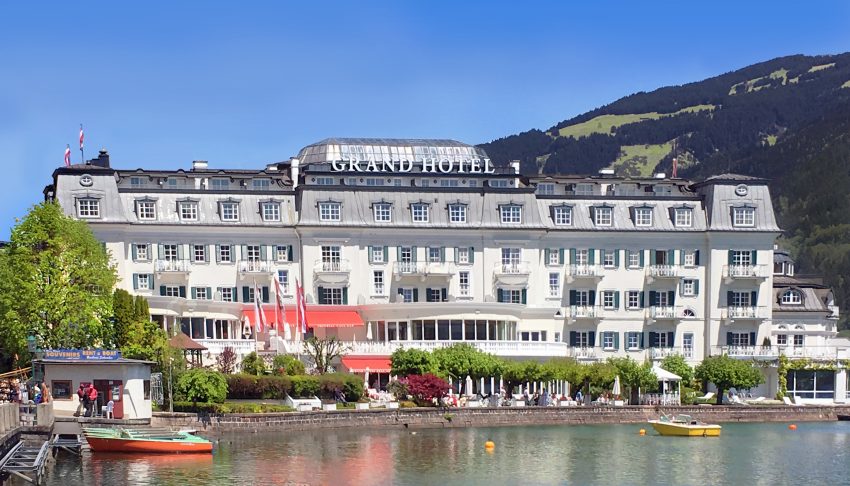
The Grand Hotel Zell am See is a flagship piece of the town’s tourism history, tied to the era when Alpine lake resorts began attracting affluent summer visitors. The hotel’s own history narrative traces origins to a late-19th-century lakeside hotel story (with early openings and expansions in the 1870s–1880s) and a reopening in 1896 that established the recognisable “Grand Hotel” identity on its peninsula setting. Its significance is bigger than the building: it represents Zell am See’s shift into an international leisure destination, with the lakefront becoming a stage for fashionable travel and long-stay holidays. That pre–World War I “summer retreat” culture is part of why the lakeside architecture here feels intentionally elegant and outward-facing. When you visit, the defining feature is the location—directly at the water, where the hotel reads almost like a ship at anchor. Even if you’re not a guest, viewing it from the lakeside and nearby promenade points makes it easy to understand why this spot became one of the town’s iconic images.
Location: Esplanade 4-6, 5700 Zell am See, Austria | Hours: Daily: 09:00–19:30. | Price: Check official website. | Website
8. Hundertwasser Osterreich-Brunnen
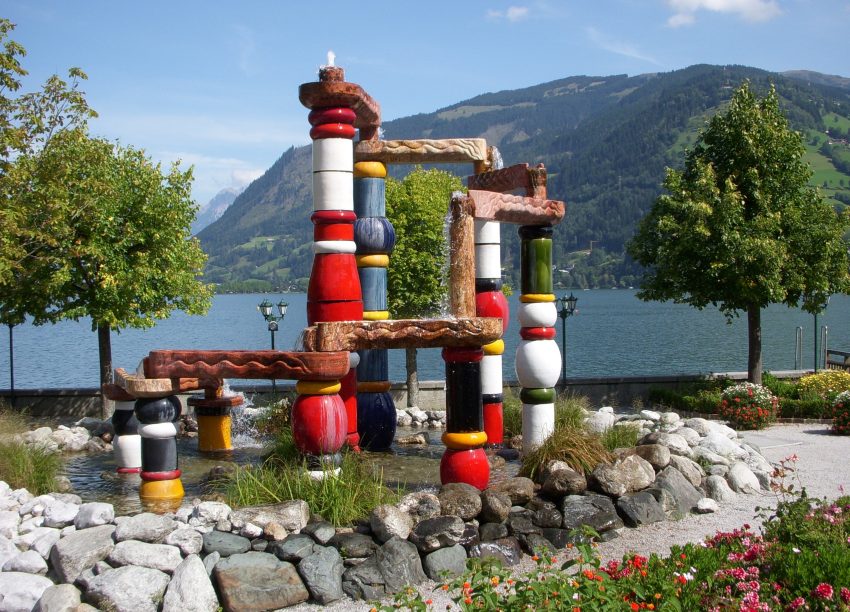
The Österreich-Brunnen in Zell am See is a Hundertwasser-designed landscape fountain concept commissioned by the Grand Hotel, and it sits right by the lake near the hotel. Hundertwasser’s description frames it as an ecological installation where water circulates through vegetation in a closed cycle, flowing from the lake into the fountain system and cascading back down. In historical terms, it reflects a late-20th-century layer of Austrian public art: playful, organic forms and environmental motifs introduced into prominent public-facing spaces. It’s also notable as an example of how a private patron (connected to a landmark hotel) can shape the cultural character of a lakeside townscape. When you’re there, look closely at how the fountain is integrated into its surroundings rather than treating it as a single sculpture-on-a-plinth. The experience works best up close, where you can follow the water’s movement and notice the intentionally irregular, nature-forward design language Hundertwasser is known for.
Location: Seegasse 5700, 5700 Zell am See, Austria | Hours: 24 Hours. | Price: Free. | Website
9. Stadtpark
Zell am See’s Stadtpark is a small but important piece of lakeside public space, set right on the waterfront where the town meets Lake Zell. It’s the sort of park that grew in importance as the lakefront became central to leisure culture—providing shade, paths, and a calm counterpoint to the busier streets around the centre. Although it’s not presented as a single “historic monument,” parks like this are part of the modern civic history of resort towns: they formalise access to scenery and give locals and visitors a shared place to pause, meet, and linger. In Zell am See, that matters because the lake is the town’s visual anchor, and the park is one of the easiest ways to experience it at human pace. What to see is simple and satisfying: lakeside promenading, benches with wide views, and the everyday life of the waterfront. If you’re travelling with kids or just want a low-effort break, the park setting is designed for exactly that—quiet time with the lake and mountains doing the heavy lifting.
Location: Esplanade 16, 5700 Zell am See, Austria | Hours: 24 Hours. | Price: Free.

Moira & Andy
Hey! We're Moira & Andy. From hiking the Camino to trips around Europe in Bert our campervan — we've been traveling together since retirement in 2020!
This website uses affiliate links which earn a small commission at no additional cost to you.
Walking Tour Summary
Distance: 2 km
Sites: 9