Self-Guided Walking Tour of Zadar (+Maps!)
This website uses affiliate links which earn a small commission at no additional cost to you.
Zadar is a city that rewards slow exploring: short distances, big history, and a waterfront that turns an evening stroll into a highlight. This self-guided route is designed for maximum variety with minimal effort, moving from fortified gates and lively squares to ancient stones and sea-facing viewpoints.
Along the way you'll tick off some of the best things to see in Zadar, from the Roman Forum area and landmark churches to the modern sound-and-light installations by the water. The pace is yours, so you can linger for a coffee, detour into a museum, or double back when a street catches your eye.
The “+ Maps!” part is what makes this easy to follow on the day: you can treat the map as a simple line from stop to stop, or use it like a menu and jump to the places that interest you most. Either way, Zadar’s Old Town is compact, walkable, and made for wandering.
Table of Contents
- How to Get to Zadar
- A Short History of Zadar
- Zadar Before Rome: Early Communities and a Strategic Shoreline
- Roman Zadar: Iadera, the Forum, and the City’s Stone Foundations
- Medieval Zadar: Faith, Power, and the Rise of Landmark Churches
- Venetian Zadar: Fortifications, Gates, and an Urban Edge Built for Defence
- Modern Zadar: New Life Along the Promenade and a City Reframed by the Sea
- Where to Stay in Zadar
- Your Self-Guided Walking Tour of Zadar
How to Get to Zadar
By Air: Zadar Airport is the main gateway for most visitors, with seasonal peaks bringing in many more direct flights. From the terminal, the easiest options are a shuttle/bus connection into town or a taxi/ride service, which gets you close to the Old Town without needing a car once you arrive. If you're planning islands or day trips, flying in can be especially convenient because you can base yourself near the harbour and bus connections. For the best deals and a seamless booking experience, check out these flights to Zadar on Booking.com.
By Train: Zadar is not the best “train-first” destination on the Dalmatian coast, so most rail journeys involve combining trains with buses. A common approach is to take a train to a major hub (often Zagreb or another well-connected city) and then continue by intercity bus to Zadar, which is frequent and practical for this region. If you prefer rail for the longest leg, plan the final stretch with bus timings in mind. Train schedules and bookings can be found on Omio.
By Car: Driving is a strong option if you want flexibility for beaches, national parks, or smaller coastal villages. The trade-off is that the Old Town is pedestrian-focused, and parking close to the centre can be limited or paid, especially in peak season. A good strategy is to park once (near the bridge/edge of the peninsula or by your accommodation) and then do the walking tour entirely on foot.
How to get around the city: For the walking tour itself, you’ll do almost everything on foot, since the Old Town peninsula is compact and made for pedestrians. Local buses are useful for reaching beach areas and neighbourhoods outside the centre, and taxis are handy late at night or when carrying luggage. If you’re staying farther out (Borik, Diklo, or resort areas), build in a short bus/taxi hop to the Old Town, then walk the route from there.
A Short History of Zadar
Zadar Before Rome: Early Communities and a Strategic Shoreline
Long before monumental stone churches and formal squares, Zadar’s story began with early settlement drawn to a naturally defensible position and the pull of maritime trade. That logic-control, movement, and visibility-never really goes away. You can still feel it today as you enter through the Land Gate, which acts like a ceremonial threshold into a place shaped by centuries of arrivals, departures, and changing rulers.
Roman Zadar: Iadera, the Forum, and the City’s Stone Foundations
In the Roman era, Zadar developed as Iadera, and the Old Town's layout still hints at that ordered urban plan. The Roman Forum remains the most obvious imprint: a broad, open space that anchors the historic core and sets the tone for the stops around it. Visiting the Archaeological Museum of Zadar helps make sense of what you're seeing underfoot, turning scattered fragments into a readable story of daily life, religion, and status in a Roman city.
Medieval Zadar: Faith, Power, and the Rise of Landmark Churches
As Zadar moved through medieval centuries, the city became a place where ecclesiastical influence and civic identity were built into the skyline. The Church of St. Donatus, with its distinctive form, is a powerful reminder that sacred architecture here was also a statement of continuity and authority. Nearby, Zadar Cathedral reflects the same long arc: altered, repaired, and reimagined over time, yet still central to understanding how the city's religious institutions shaped its public spaces.
Venetian Zadar: Fortifications, Gates, and an Urban Edge Built for Defence
Zadar’s strategic value made it a contested prize, and under Venetian influence the city’s defensive identity became especially visible. The Land Gate is one of the clearest expressions of that era-designed not just as an entrance, but as a message about control and protection. Inside the walls, spaces like People’s Square and Five Wells Square show how urban life continued alongside military concerns: public gathering places that feel relaxed today, but sit within a cityscape once engineered for resilience.
Modern Zadar: New Life Along the Promenade and a City Reframed by the Sea
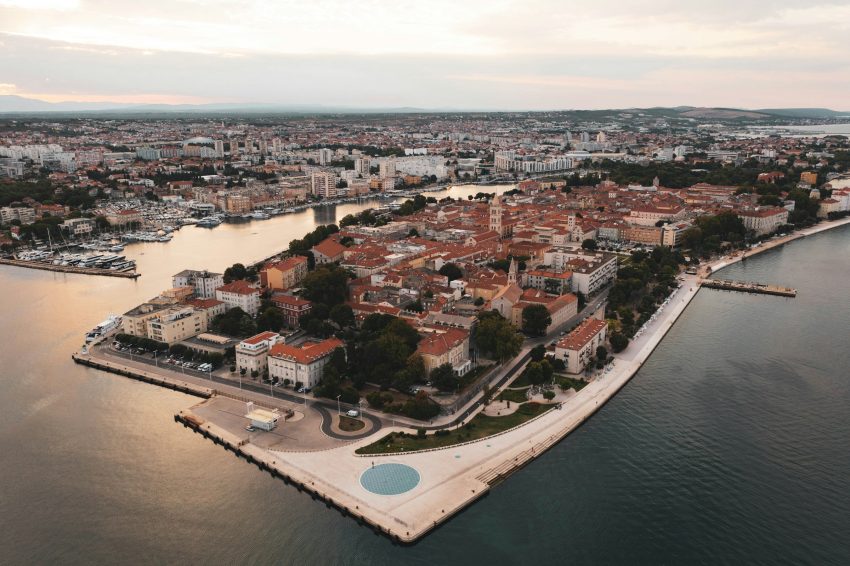
In more recent decades, Zadar has leaned into the waterfront as a defining “public room,” and the Promenade is where the city's past and present meet most naturally. The Sea Organ and Greeting to the Sun turned the edge of the Old Town into a modern landmark zone-artworks that rely on natural forces and draw people out at sunset. It's a fitting evolution for a city with deep maritime roots: the sea is no longer a threat at the walls, but a stage for Zadar's most memorable moments.
Where to Stay in Zadar
To make the most of visiting Zadar and this walking tour then you consider stay overnight at the centre. Staying on the Old Town peninsula puts you within minutes of the Roman Forum area, the church quarter, and the sunset waterfront, so you can start early, take breaks easily, and return at golden hour without thinking about transport. Good picks right in the historic core include Almayer Art & Heritage Hotel, Art Hotel Kalelarga, and Teatro Verdi Boutique Hotel.
If you want Old Town access but prefer being right on the edge of the peninsula (useful for arrivals, parking, and quick exits for day trips), the west end is a strong base, especially for reaching the Promenade, Sea Organ, and Greeting to the Sun at quieter times of day. Consider Hotel Bastion for a stay that’s close to the action while still feeling slightly tucked away.
For a beach-first stay with an easy hop into the centre, the Kolovare area is practical: you get sea air and a classic beach vibe, then you can walk or take a short ride to the start of the route. A reliable option here is Hotel Kolovare. If you’d rather be farther out in a quieter residential beach zone (handy in peak season), the Diklo/Borik side works well, with Hotel Mediteran as a good base for mixing downtime with Old Town sightseeing.
If your priority is a full resort feel-pools, wellness, and a more self-contained stay-then basing yourself just outside Zadar can make sense, especially if you're building the walking tour into a longer coastal trip. One well-known option in this category is Falkensteiner Hotel & Spa Iadera, which you can pair with a day (or evening) in the Old Town to follow the route and catch the waterfront installations at sunset.
Your Self-Guided Walking Tour of Zadar
Discover Zadar on foot with our walking tour map guiding you between each stop as you explore its gates, squares, Roman-era highlights, and the unforgettable waterfront. Because this is a self-guided walking tour, you can shape the day around your own pace-skip anything that doesn't grab you, loop back for a better photo angle, and build in coffee stops whenever you feel like it. The route works just as well as a straightforward checklist as it does a flexible framework for wandering, with the map keeping everything simple even when you decide to improvise.
1. Land Gate
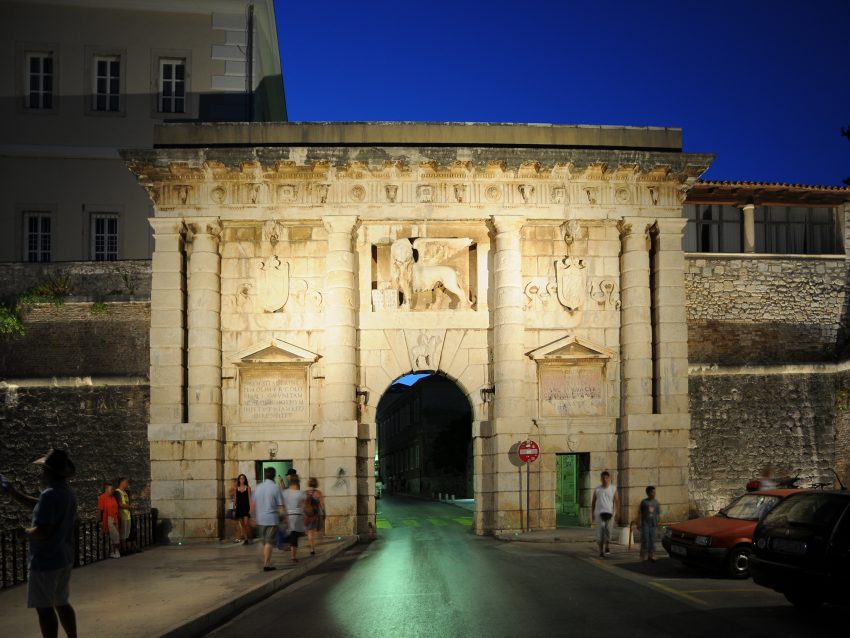
Zadar’s Land Gate is a monumental Renaissance entrance built when the city was part of the Venetian Republic, designed to project power as much as to control access. It replaced earlier medieval defenses and became the main ceremonial gateway on the landward side of the fortified peninsula. Look closely and you’ll spot Venetian symbolism, including the winged lion of St Mark, carved into the stonework.
Approaching from the modern city, the gate still frames the transition from newer streets into the older fabric of Zadar. The arch, side passages, and sculptural details make it easy to appreciate how fortifications were also civic architecture, meant to impress visitors arriving by road. The best views are from slightly off-center, where you can take in the depth of the opening and the defensive geometry around it.
When you visit, take time to examine the stone reliefs and the proportions of the façade rather than rushing straight through. It’s also worth looking back after you pass under the arch, because the perspective shifts and the composition reads differently in reverse. Nearby stretches of walls and embankments help you understand how the gate once fit into a larger defensive system.
Location: Foša - The Land Gate, Ul. Među bedemima, 23000, Zadar, Croatia | Hours: 24 Hours. | Price: Free.

2. Five Wells Square
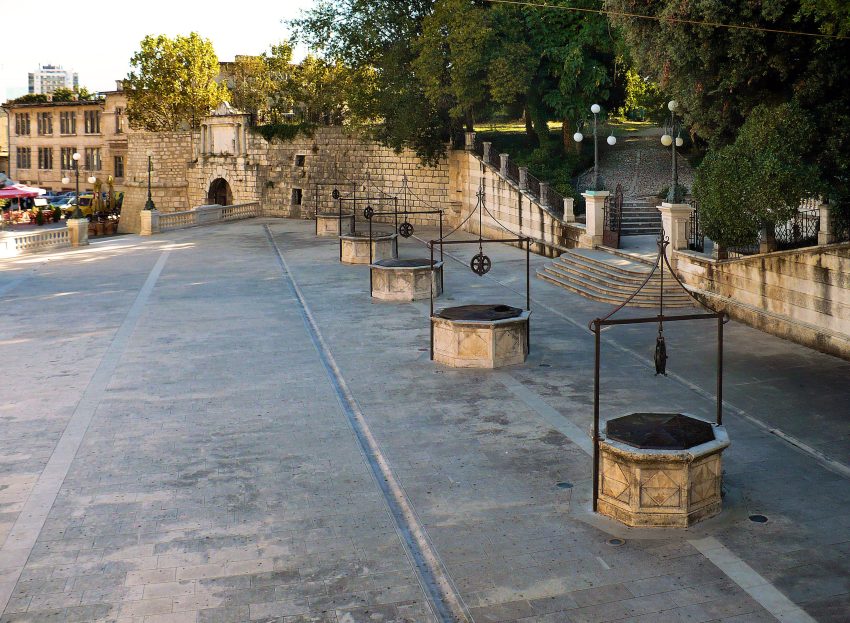
Five Wells Square developed as part of Zadar’s practical response to siege risk and water supply, pairing public space with essential infrastructure. The wells are tied to a large cistern system engineered to collect and store rainwater, a vital resource for a fortified city that could be cut off for long periods. The square’s name comes from the five aligned wellheads that once served residents daily.
Historically, this was not just a pretty plaza but a lifeline, and the surrounding stonework hints at the careful planning that went into making the area both functional and defensible. The setting beside the old walls gives the square a slightly elevated, transitional feel between the city and its fortifications. Over time, it became a calmer, civic space rather than purely utilitarian.
On site, focus on the line of wells themselves and the masonry around them, then take in the adjacent fortification elements that explain why water access mattered so much. The square is also a good place to pause and notice how Zadar’s public spaces often sit directly on top of earlier engineering. If you continue a little further, you’ll find viewpoints and paths that follow the line of the historic defenses.
Location: Trg pet bunara 1, 23000, Zadar, Croatia | Hours: 24 Hours. | Price: Free.
3. People’s Square
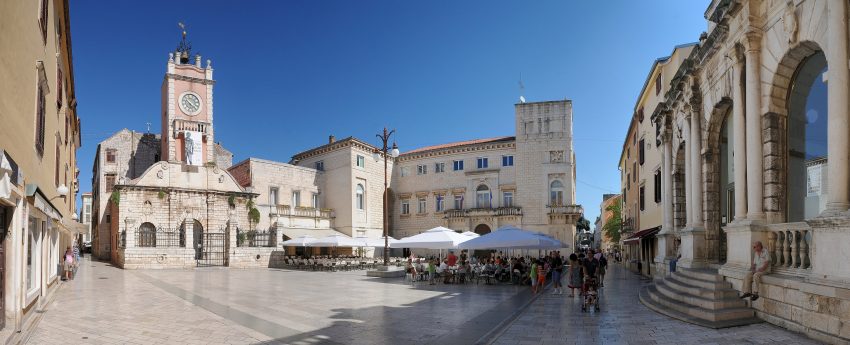
People’s Square is Zadar’s long-standing civic heart, shaped over centuries as political, administrative, and commercial life clustered in the same central space. Like many Dalmatian city squares, it reflects layers of governance and rebuilding, with architecture that ranges from older stone façades to later civic additions. The square’s role as a public meeting place has been remarkably continuous, even as the surrounding city changed hands and identities.
What makes it historically interesting is how it functions as a “living archive” of Zadar’s urban life: institutions around the square anchored authority, while shops and cafés kept it social and everyday. The scale is human, designed for foot traffic and conversation rather than grand processions. Its layout also helps you read how the old town’s street network funnels into shared communal space.
When you visit, look up as much as you look around: details on windows, coats of arms, and carved stone elements reveal status and patronage. Take time to view the square from multiple edges so you can see how the façades form an uneven but harmonious enclosure. If you step into nearby side streets, you’ll notice how quickly the atmosphere shifts from open civic space to intimate lanes.
Location: Narodni trg, 23000, Zadar, Croatia | Hours: 24 Hours. | Price: Free.
4. Archaeological Museum of Zadar
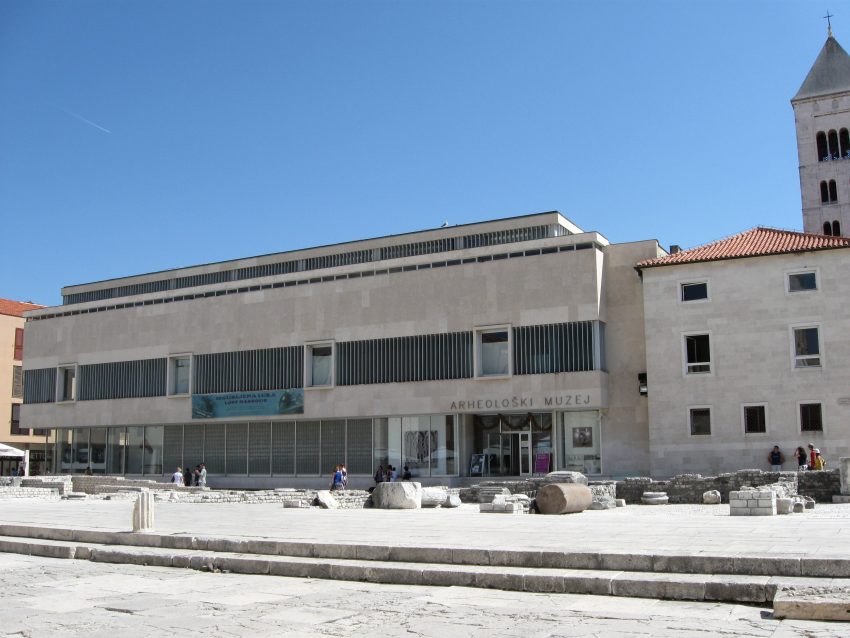
The Archaeological Museum of Zadar preserves material that helps explain the region’s deep timeline, from prehistoric finds through the Roman period and into later eras. Zadar’s position on the Adriatic made it a crossroads, and the museum’s collections reflect that mix of local development and wider Mediterranean influence. Its role has been especially important in a city where ancient remains are part of daily streetscape.
The museum provides context that outdoor ruins can’t always supply: inscriptions, sculpture fragments, everyday objects, and curated reconstructions turn scattered stones into narratives. You also get a clearer sense of continuity—how settlement, trade, religion, and governance evolved in the same urban footprint. For many visitors, it’s the bridge between what you see in the open air and what those remnants actually meant.
Inside, spend time with the Roman-era pieces, particularly carved stonework and inscriptions, because they connect directly to sites you’ll recognize nearby. Look for exhibits that explain local life rather than only monumental art—small objects often give the sharpest picture of how people lived. If you pace yourself, the museum is also a good reset before returning to the streets to spot details you might otherwise miss.
Location: Arheološki muzej, Trg opatice Čike 1, 23000, Zadar, Croatia | Hours: January 1 – March 31: Monday – Friday: 09:00–14:00; Saturday: 09:00–13:00. April 1 – April 30: Monday – Saturday: 09:00–15:00. May 1 – May 31: Monday – Saturday: 09:00–17:00. June 1 – June 30: Daily: 09:00–20:00. July 1 – August 31: Daily: 09:00–21:00. September 1 – September 30: Daily: 09:00–20:00. October 1 – October 15: Daily: 09:00–19:00. October 16 – October 31: Daily: 09:00–17:00. November 1 – December 31: Monday – Friday: 09:00–14:00; Saturday: 09:00–13:00. | Price: Adults and children (10+): €5; Students & seniors (groups): €2; Under 10: free. | Website
5. Church of St. Donatus
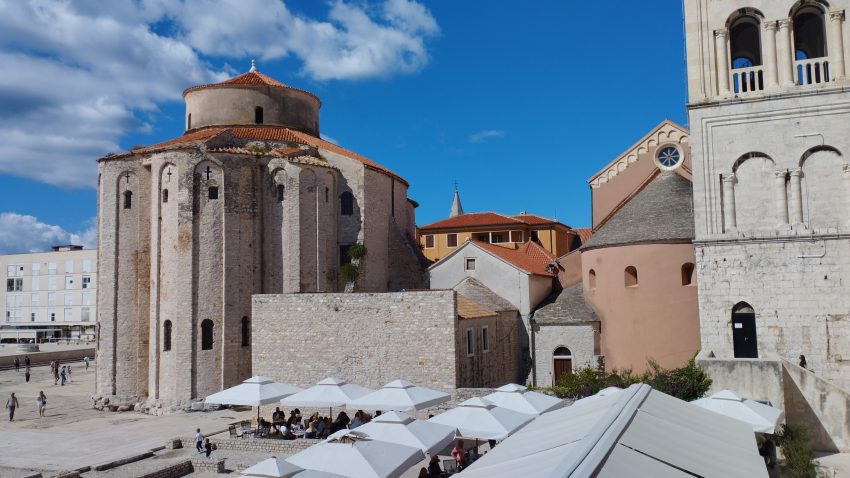
St. Donatus is one of Zadar’s most distinctive early medieval buildings, recognized for its powerful circular form and austere stone interior. It was built in a period when the city was reshaping itself after antiquity, and the church’s structure incorporates elements and materials connected to the Roman past around it. Over centuries, it has become an architectural emblem of Zadar’s ability to reuse and reframe earlier layers.
Historically, the church reflects both religious life and civic ambition, with its unusual layout and commanding presence beside ancient ruins. The simplicity of the interior is part of its impact: the heavy walls, rhythmic arcades, and concentrated geometry create a space that feels more sculpted than decorated. Its acoustics are also notable, a natural result of the building’s form and stone surfaces.
When you visit, walk slowly around the interior to feel how the space changes as you move—views open and close in deliberate, almost theatrical ways. Look for evidence of spolia, where older stone has been reused, because it links the building directly to the earlier cityscape. Outside, step back far enough to appreciate the church’s massing, especially how it sits in conversation with the Roman remains nearby.
Location: Grgura Mrganića, 23000, Zadar, Croatia | Hours: (Summer) April 1 – October 31; Daily: 09:00–17:00 (April 1 – May 31) & 09:00–19:00 (June 1 – July 12) & 09:00–21:00 (July 13 – August 31) & 09:00–19:00 (September 1 – October 15) & 09:00–17:00 (October 16 – October 31). (Winter) November 1 – March 31; Closed (open by prior arrangement). (Winter) January 1 – March 31; Closed (open by prior arrangement). | Price: Individual ticket: €5.00; Croatia pensioners: €3.50; Groups (students/pensioners): €3.00; Other groups: €4.00; Combined Archaeological Museum + St. Donatus: €10.00 (individual) or €6.00 (group); Free for children under 10 and some eligible groups. | Website
6. The Roman Forum
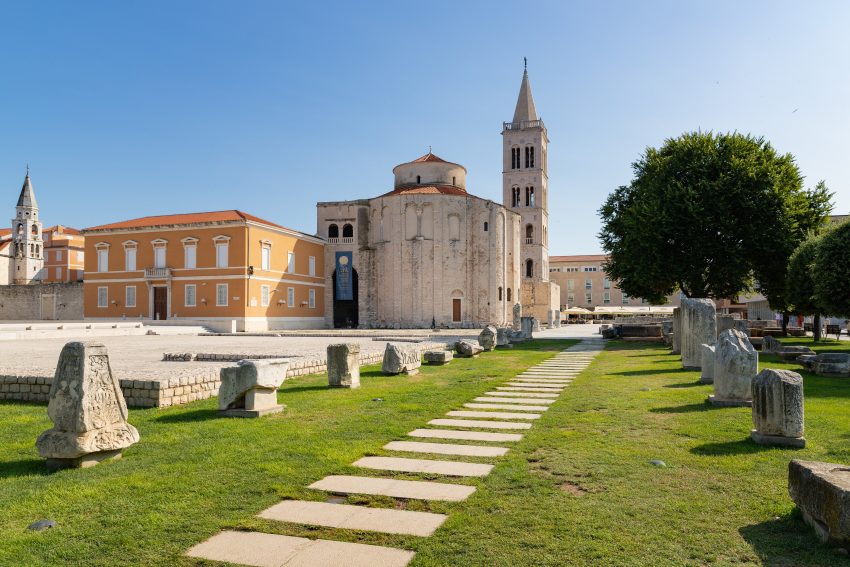
Zadar’s Roman Forum was the public core of the ancient city, where civic ceremonies, commerce, and administration unfolded in a formal monumental space. Its remains are a visible reminder that Zadar was integrated into the Roman world, with urban planning and public architecture intended to express order and authority. Even in fragmentary form, the forum anchors the old town’s sense of depth and continuity.
Over time, later buildings rose around and over it, which is why the forum feels embedded rather than isolated. That layering is part of the story: instead of being cleared away, the ancient center became a foundation—literal and symbolic—for what came next. The survival of the forum’s outlines helps you imagine how structured Roman public life was, even in a provincial coastal city.
On site, pay attention to the ground plan and the spacing more than individual stones, because the scale is what makes it legible. Look for surviving carved fragments and column bases that hint at the original grandeur without needing a full reconstruction. It’s also worth viewing the forum alongside nearby churches, because the juxtaposition shows how sacred and civic centers shifted over the centuries.
Location: 23000, Zadar, Croatia | Hours: 24 Hours. | Price: Free.
7. Zadar Cathedral
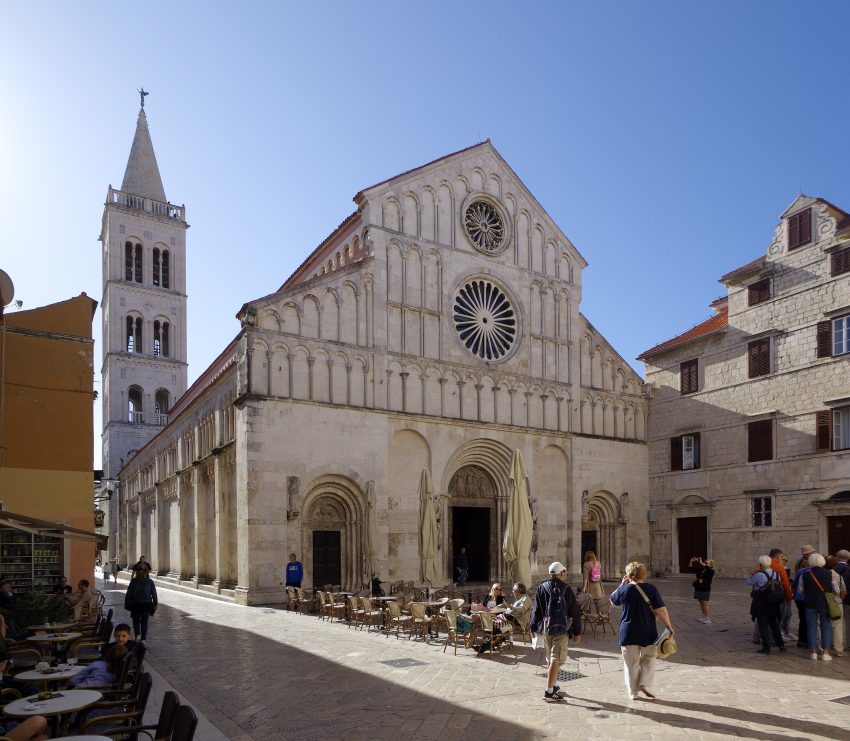
Zadar Cathedral is the city’s principal church and a key marker of Zadar’s medieval and later religious history. Its fabric reflects multiple phases of building and repair, shaped by changing tastes, resources, and the realities of coastal politics. As with many long-lived cathedrals, its significance comes as much from continuity and adaptation as from any single moment of construction.
Historically, the cathedral functioned as a spiritual center and a civic symbol, tied to the city’s identity through eras of foreign rule and local resilience. Elements of its architecture and interior fittings speak to the accumulated donations and restorations of generations. The building’s presence in the old town also shows how religious institutions claimed prime urban space, close to earlier civic landmarks.
When you visit, take time to look at the façade and the overall proportions before going inside, so you understand how it presents itself to the square and surrounding streets. Inside, focus on how the space is organized—nave, side aisles, and any chapels—because that structure tells you as much as decoration does. If the bell tower is accessible, it’s often one of the best ways to understand the tight relationship between Zadar’s dense old town and the open sea beyond.
Location: Trg Svete Stošije 2, 23000, Zadar, Croatia | Hours: Check official website. | Price: Free; donations appreciated. | Website
8. The Promenade
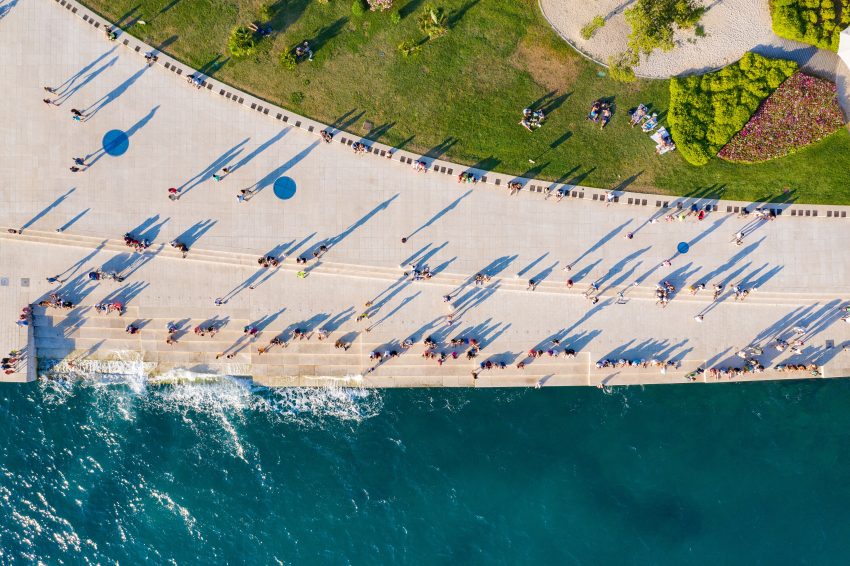
Zadar’s waterfront promenade is a modern civic space laid along the edge of the old town, but it sits in a setting defined by centuries of maritime life and fortification. The Adriatic frontage shaped Zadar’s economy, defense, and cultural outlook, and the promenade makes that relationship tangible in a way streets inland can’t. It’s the city’s “front porch,” facing sea routes that once brought trade, visitors, and threats.
While the promenade itself has evolved with contemporary planning, the experience it offers is rooted in older realities: the line of the coast, the views to the islands, and the sense of the old town as a protected peninsula. You can read the city’s priorities from the way the waterfront is engineered and maintained—part leisure space, part edge condition that must withstand weather and waves. In many ways, it’s where Zadar’s historical role as an Adriatic city feels most immediate.
When you’re there, focus on the shifting views as you move: the old town behind you, the open water ahead, and the changing light on stone façades. Stop at points where the sea wall is most visible to see how the boundary between land and water is constructed, not natural. It’s also a good place to notice how Zadar blends heritage and contemporary design without separating them into different districts.
Location: Bedemi zadarskih pobuna, 23000, Zadar, Croatia | Hours: 24 Hours. | Price: Free.
9. Sea Organ
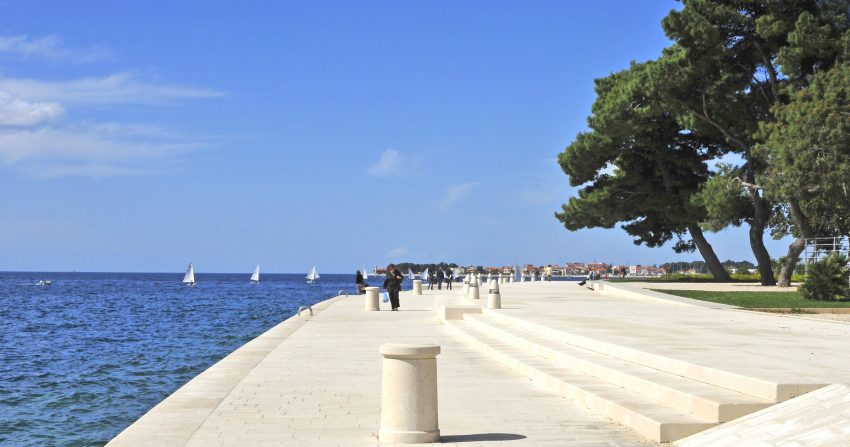
The Sea Organ is a contemporary installation that translates wave motion into sound, built into the waterfront steps of Zadar’s promenade. It represents a modern chapter in the city’s relationship with the sea, using engineering and design to make natural forces audible. Rather than being a museum piece, it’s an instrument the Adriatic “plays,” changing constantly with wind and swell.
Its significance is partly cultural: the Sea Organ helped define a new identity for the post-industrial waterfront as a public, sensory space. The design invites people to sit close to the water, reversing older defensive instincts that kept edges hard and unwelcoming. In a city layered with Roman and medieval remains, the Sea Organ shows that Zadar’s story didn’t stop—it keeps adding thoughtful new layers.
To experience it well, sit on the steps for a while and let the soundscape shift; the effect is subtle at first, then surprisingly immersive. Move along the steps to hear how tone and volume change from one section to another. Visiting at different sea conditions can feel like a completely different installation, because the “music” depends on the day.
Location: Obala kralja Petra Krešimira IV, 23000, Zadar, Croatia | Hours: 24 Hours. | Price: Free.
10. Greeting to the Sun
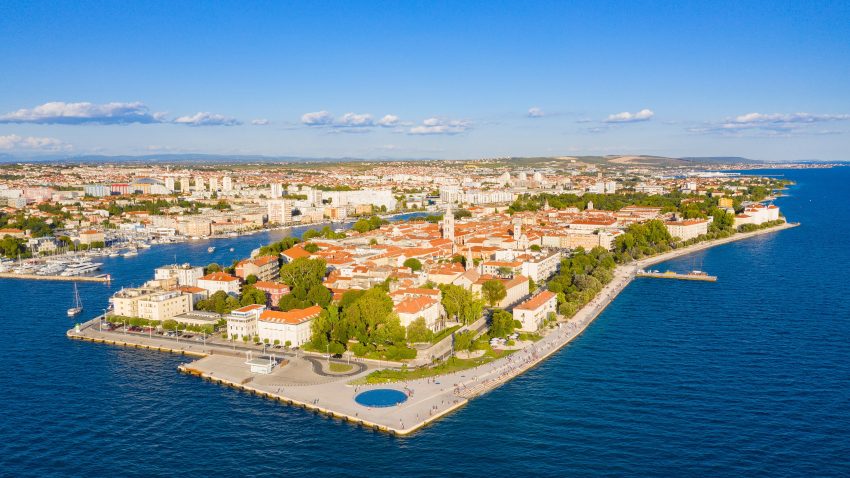
Greeting to the Sun is a modern circular installation composed of solar panels and lighting elements at the edge of Zadar’s waterfront. It was created as a counterpart to the Sea Organ, emphasizing light rather than sound and framing the city’s famous sunsets in a deliberate architectural gesture. By day it quietly gathers energy; by night it becomes a luminous public artwork.
Historically, its relevance lies in how it reimagines the waterfront as a civic stage, not just a boundary. Zadar has long been oriented toward the Adriatic, and this installation turns that orientation into an explicit experience—standing at the edge, looking outward, and then watching the space transform after dark. It’s also an example of contemporary design being placed directly into a heritage setting without trying to imitate the past.
When you visit, the simplest approach is to arrive before sunset and stay into the evening so you see the full transition. Step back far enough to appreciate the circle as a whole, then get closer to notice how people interact with it—walking across, pausing, taking photos, and using it as a meeting point. The best moments are often when the lights come alive and the waterfront around you shifts from sightseeing to everyday social life.
Location: Istarska obala, 23000, Zadar, Croatia | Hours: 24 Hours. | Price: Free.

Moira & Andy
Hey! We're Moira & Andy. From hiking the Camino to trips around Europe in Bert our campervan — we've been traveling together since retirement in 2020!
This website uses affiliate links which earn a small commission at no additional cost to you.
Walking Tour Summary
Distance: 3 km
Sites: 10