Self-Guided Walking Tour of Pula
This website uses affiliate links which earn a small commission at no additional cost to you.
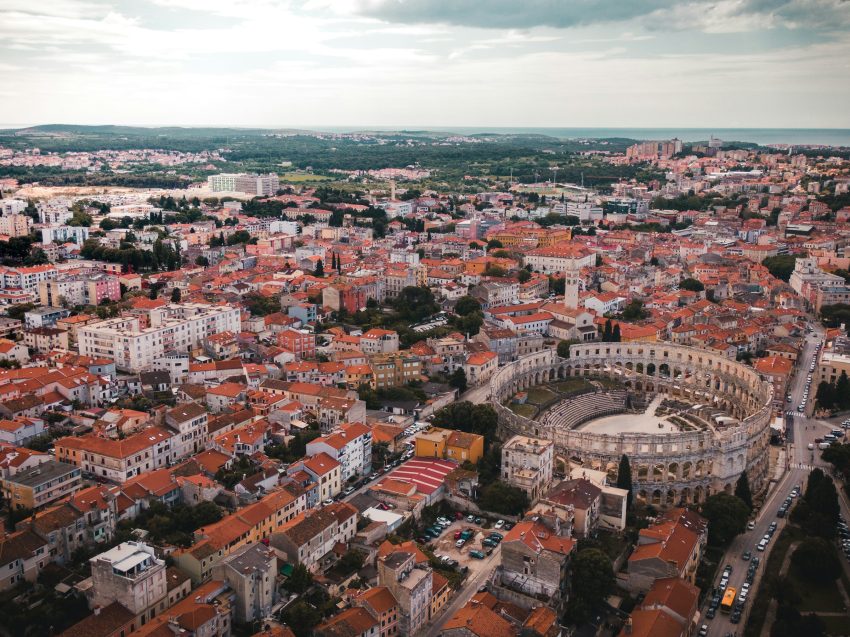
Pula is one of those cities where your “must-sees” are not tucked away in museums-they're part of the street plan. In a single walk you can move from grand Roman engineering to compact medieval lanes, with Austro-Hungarian details layered in between.
This route is built to help you tick off the best things to see in Pula without rushing. It links the headline sights with smaller, easy-to-miss stops that add texture, so you get a sense of how the city evolved over two thousand years.
Expect a walk that’s simple to follow, but full of variety: monumental stone arches, calm church interiors, panoramic lookouts, and squares that still function as the city’s living room. You can do it straight through, or stretch it out with gelato, a long lunch, and plenty of photo pauses.
Table of Contents
- How to get to Pula
- A Short History of Pula
- Pula Before Rome: Early Settlements and Strategic Coastlines
- Pula as Roman Pola: Monuments, Entertainment, and Imperial Identity
- Pula in Late Antiquity and Byzantium: Faith, Continuity, and Reuse
- Pula Through the Medieval and Venetian Centuries: Fortification and Civic Life
- Pula Under the Habsburgs and Into the Modern Era: A Working City, Then a Visitor City
- Where to Stay in Pula
- Your Self-Guided Walking Tour of Pula
How to get to Pula
By Air: Pula Airport is the most direct option, with seasonal international flights and year-round connections via major European hubs. From the airport, you can reach the centre by taxi or shuttle/bus services (check the latest schedules close to your travel date), and once you arrive, the Old Town is compact enough to explore largely on foot. For the best deals and a seamless booking experience, check out these flights to Pula on Booking.com.
By Train: Train travel to Pula is possible, but it's often slower and less direct than you might expect, with routing that depends on where you're starting from and the cross-border connections in play. If you like rail travel, it can work well when combined with a bigger Istria plan-use it as part of a multi-stop route rather than a quick point-to-point hop, and plan around transfer times. Train schedules and bookings can be found on Omio.
By Car: Driving is the easiest way to stay flexible in Istria, especially if you're combining Pula with beaches, hill towns, or day trips. Parking is the only real constraint-aim to leave the car outside the tightest Old Town streets and walk in, which also makes the start of this walking route smoother.
By Bus: Buses are a strong alternative if you’re coming from other Croatian cities or nearby regional hubs, with frequent services that usually arrive close to the centre. If you’re travelling in peak season, booking ahead can be worthwhile, and arriving earlier in the day gives you more breathing room before the Old Town gets busy.
How to get around the city: For this walking tour, your feet are the main “transport,” and that’s the point-Pula’s core sights are close together. Local buses and taxis are helpful for beach zones and resort areas (especially Verudela and nearby coves), but in the Old Town you’ll move faster by walking, with short climbs that are manageable in most comfortable shoes.
A Short History of Pula
Pula Before Rome: Early Settlements and Strategic Coastlines
Long before the city’s monumental stonework, Pula’s story was shaped by its natural advantages-sheltered waters, defensible high ground, and coastal trade routes. These early patterns set the logic for a town that would later become a serious Roman centre, with its main public spaces positioned where movement and commerce naturally converged.
Pula as Roman Pola: Monuments, Entertainment, and Imperial Identity
Rome transformed Pula into a statement city, and the Roman Amphitheater became the loudest expression of that ambition-built in the 1st century AD and still dominating the skyline today. The city's civic heart formed around Forum Square, where the Temple of Augustus anchored the public stage with imperial symbolism and ceremony. On the edges of the old town, gateways like the Gate of Hercules and the Twin Gates marked controlled entry points, while the Triumphal Arch of the Sergii turned a thoroughfare into a display of prestige and memory. Even leisure had architectural muscle: the Small Roman Theatre speaks to a city that expected performances, gatherings, and public life to be part of everyday urban rhythm.
Pula in Late Antiquity and Byzantium: Faith, Continuity, and Reuse
As the Roman world shifted, Pula’s fabric didn’t vanish-it adapted. The Chapel of Saint Maria Formose (St. Mary Formosa) reflects the 6th-century Byzantine-era layer, a reminder that sacred architecture rose directly atop earlier urban importance, reusing the city’s established gravitational pull. This era also echoes in quieter survivals like mosaics: the Floor Mosaic The Punishment of Dirce preserves a dramatic mythological scene and hints at the richly decorated Roman domestic world that once filled the spaces between today’s streets.
Pula Through the Medieval and Venetian Centuries: Fortification and Civic Life
Over time, priorities leaned toward defence and administration, and Pula's silhouette began to reflect that. Pula Castle embodies the fortified logic that came to define many Adriatic towns, positioning power on the high point and reshaping how the city related to the sea and to threat. Meanwhile, churches and monastic complexes continued to structure daily life: Pula Cathedral and the Franciscan Church and Monastery represent the steady presence of faith and community institutions, even as rulers and trade winds changed.
Pula Under the Habsburgs and Into the Modern Era: A Working City, Then a Visitor City
In later centuries, Pula’s identity was pulled between industry and heritage-an urban place with modern functions sitting beside ancient architecture that refused to be background scenery. Some historic elements shifted roles and meanings: the Communal Palace at Forum Square speaks to governance and civic continuity, while Roman landmarks like the Arena moved from ancient spectacle to modern icon, becoming the centrepiece of how visitors experience the city today.
Where to Stay in Pula
To make the most of visiting Pula and this walking tour then you consider stay overnight at the centre. The Old Town and the edges of the historic core are ideal if you want to start early, finish late, and dip in and out of sights without relying on transport. For a practical base near the Roman Amphitheater and easy walking access into the lanes and squares, look at Hotel Scaletta and Hotel Galija. If you prefer something similarly central with a boutique feel close to key landmarks, Hotel Amfiteatar is another strong option for walking-focused days.
If your priority is pairing the walking tour with beach time and a resort-style setup, base yourself on the Verudela Peninsula, then bus/taxi in for the tour and return to sea views afterwards. Park Plaza Histria Pula is well-placed for this style of trip, and Splendid Resort works well if you like apartment-style flexibility while staying close to the coast. For a quieter, boutique-leaning seaside base in Pješčana Uvala, Boutique Hotel Valsabbion gives you an easy escape valve after a day of stone streets and busy squares.
Your Self-Guided Walking Tour of Pula
Discover Pula on foot with our walking tour map guiding you between each stop as you explore its Roman landmarks, Old Town streets, and waterfront atmosphere. As this is a self guided walking tour, you are free to skip places, and take coffee stops when ever you want!
1. Pula Cathedral
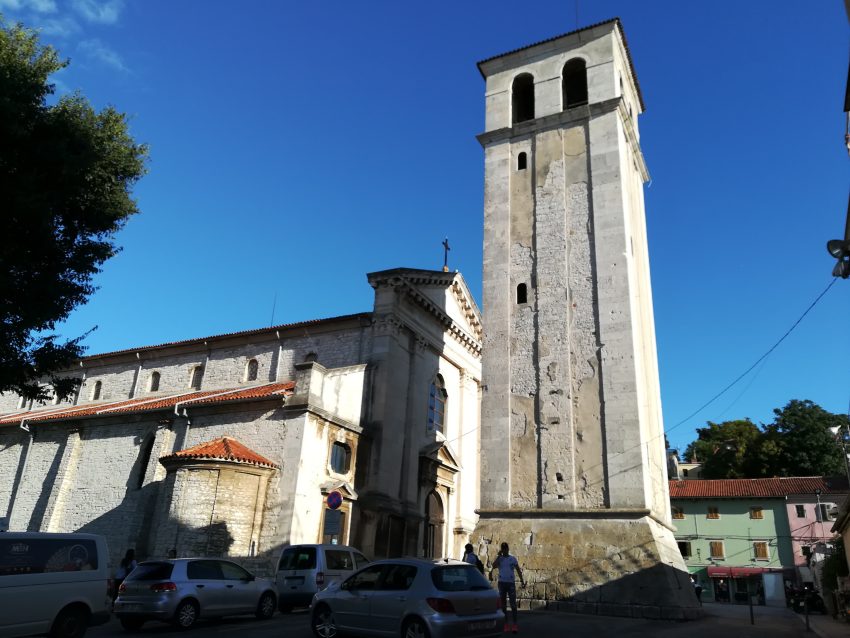
Pula Cathedral, formally dedicated to the Assumption of the Blessed Virgin Mary, sits on a site used for worship since Roman times, with the first Christian structures developing in late antiquity. The cathedral’s fabric reflects centuries of rebuilding and expansion, so it’s best understood as a layered church rather than a single-period monument. One of its most evocative survivals is the presence of early Christian floor mosaic fragments near the altar area, pointing to the richness of the 5th–6th century decorative program. The building also carries modern damage-and-repair history, including impacts from World War II and subsequent restoration. When you’re there, spend time in the quieter interior: look for the surviving mosaic sections and try to read the shifts in masonry and structure that reveal different construction phases. Outside, note its position at the foot of the hill below the fortress—another example of how Pula’s sacred, civic, and military layers sit tightly together. It’s a good place to reset your sense of time after the dramatic Roman sites.
Location: Trg Svetog Tome 2, 52100, Pula, Croatia | Hours: Open all year round (visiting times vary; access may be limited during services). | Price: Free; donations appreciated.

2. Pula Castle
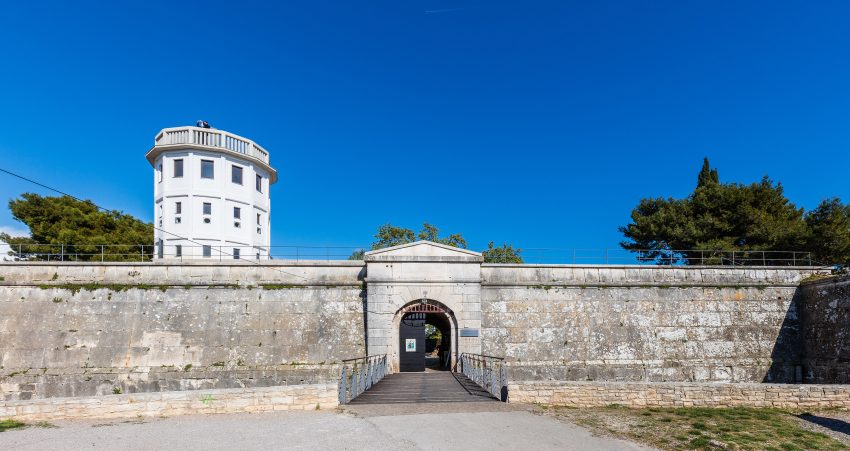
Pula’s hilltop fortress, commonly referred to as Kaštel, is a major product of the Venetian military era, built in the 17th century to strengthen coastal defenses. Its star-fort character reflects early modern engineering designed to resist artillery, turning the city’s central hill into a controlled defensive platform. Today the fortress is also a cultural container: it houses the Historical and Maritime Museum of Istria, using the fort’s rooms and corridors to frame the region’s long timeline. That “timeline inside a fortress” feel is part of the experience—you move through a building created for war while absorbing layers of local history. What to see is partly the museum, but equally the views. From the ramparts you get a clear read on Pula’s geography: the old town clustered below, the harbor beyond, and the Roman Arena standing out as a landmark in the urban fabric. If you want one panoramic stop that ties the city together, this is it.
Location: Gradinski uspon 10, 52100, Pula, Croatia | Hours: (Summer) May 1 – September 30: 08:00–21:00. (Winter) October 1 – April 30: 09:00–17:00. | Price: Adults: €6; Children (5–16): €3; Students & retirees (65+): €3; Groups (10+): €5; Under 5 & visitors with disabilities: free. | Website
3. Forum Square and Communal Palace
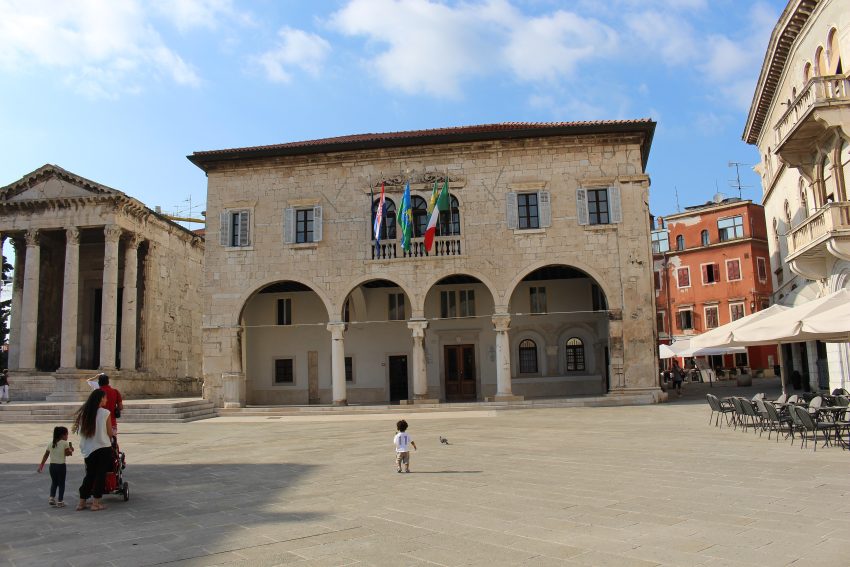
Pula’s Forum sits on the footprint of the Roman colony’s civic heart, where major public buildings and temples once defined the square. In the Middle Ages it remained the city’s main gathering place, and the focus shifted from imperial cult temples to municipal government. The Communal Palace (City Hall) rose here in the late 13th century, built partly over earlier structures and repeatedly remodeled over the centuries. What you see today is a layered façade: Gothic core, then later Renaissance and Baroque changes, with further 19th–20th century alterations. One of the most interesting details is how the palace incorporates reused Roman masonry, a visible reminder that this square never stopped being Pula’s administrative center. When you’re there, treat the Forum as an “open-air timeline.” Stand back to read the square as a composition: the Temple of Augustus on one side and the palace on the other, with café terraces filling the space between. In the evening, the lighting makes the stonework and architectural seams easier to pick out.
Location: Forum 3, 52100, Pula, Croatia | Hours: 24 Hours. | Price: Free.
4. Temple of Augustus
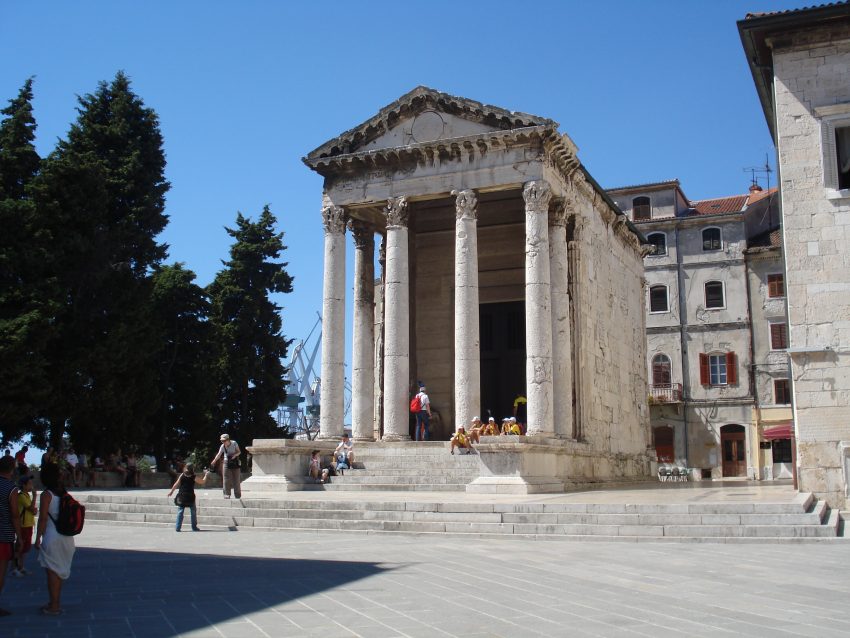
The Temple of Augustus is one of Pula’s best-preserved Roman monuments, built in the late 1st century BC to early 1st century AD and dedicated to Roma and Emperor Augustus. Its survival is partly thanks to reuse over time: after antiquity it served variously as a church and later other practical functions before becoming a museum-like space for stone monuments. The building’s classical form is still legible: a raised podium, a columned porch, and carefully proportioned stonework that signals how prominent the imperial cult was in this Adriatic port city. It also has a “scarred and repaired” modern chapter—damage during World War II and postwar reconstruction—so what you’re seeing is both ancient fabric and careful restoration. On site, focus on the exterior first: the columns, capitals, and the overall geometry that reads cleanly even if you’re not an architecture specialist. Then step inside (when open) to see the lapidarium-style displays of Roman stone fragments and inscriptions. The best viewpoint is from across the Forum, where you can frame the temple against the broader civic square.
Location: Forum b.b, 52100, Pula, Croatia | Hours: (Summer) April 1 – September 30; Daily: 08:00–19:30. (Winter) October 1 – March 31; Daily: 09:00–19:00. | Price: Adults: €2.00; Pupils/Students: €1.00. | Website
5. Franciscan Church and Monastery
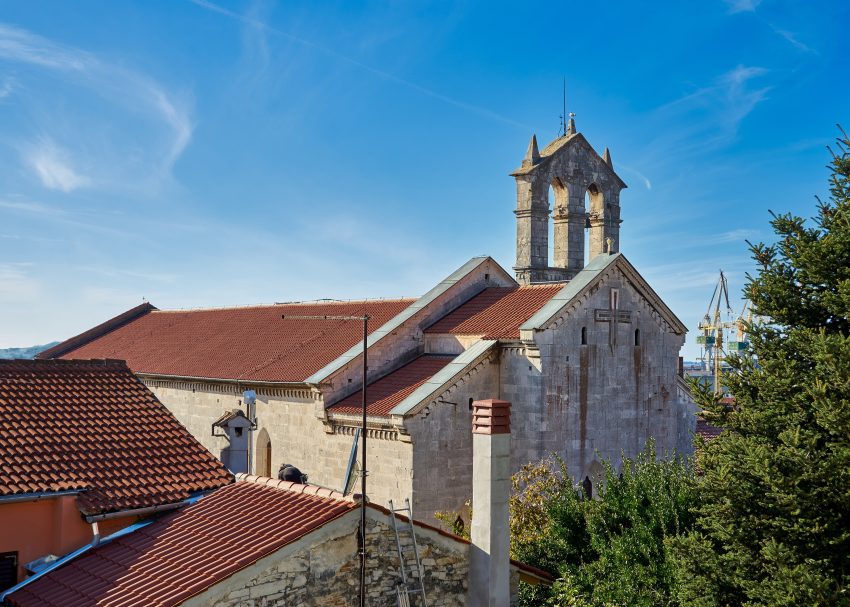
Pula’s Franciscan complex is rooted in the city’s medieval period, with the church built in the early 14th century as the order established itself in town. Architecturally it blends late Romanesque solidity with Gothic elements, reflecting both monastic practicality and the stylistic shifts of the era. The layout follows a classic monastic logic: a restrained church space paired with a cloister and the functional rooms that supported a community of friars. Its location—between the Forum area and the hilltop fortress—also makes sense historically, sitting close to civic life but slightly removed from it. When you visit, the cloister is often the most atmospheric feature: a quieter, enclosed space that contrasts with the busier old town streets. Inside the church, look for the interplay of plain surfaces and selective ornament, and notice how the building’s simplicity is part of its identity. Even if you only do a short stop, it’s a strong counterpoint to Pula’s grand Roman monuments.
Location: Uspon Svetog Franje Asiškog 9, 52100, Pula, Croatia | Hours: Daily: 08:00–19:00. | Price: Adults: €1.33; Children & students: free (with prior notice).
6. Floor Mosaic The Punishment of Dirce
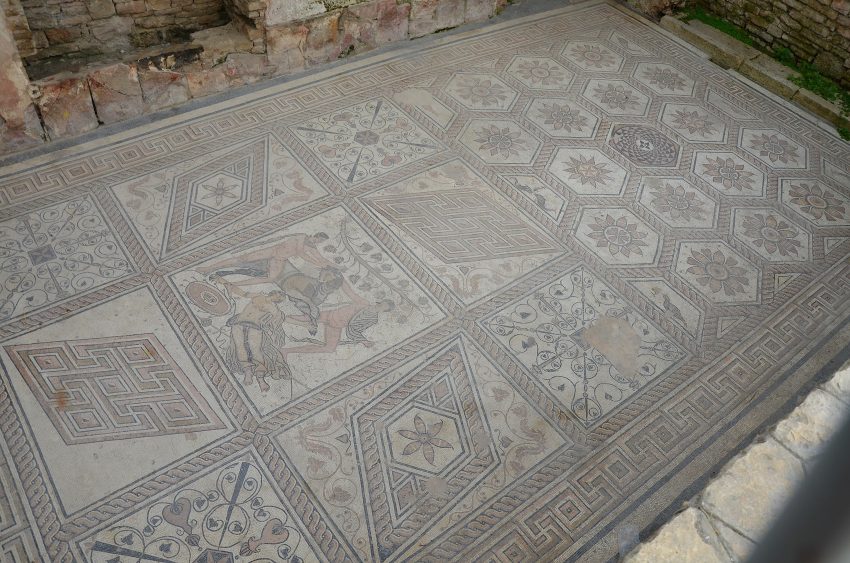
This mosaic is a preserved section of a larger Roman floor composition, dating to around the 3rd century AD, and it depicts a dramatic mythological scene: the punishment of Dirce. The mosaic came to light after World War II bombing revealed Roman-era remains beneath later buildings near the area around St. Maria Formosa. What makes it compelling is how vividly it translates a story into stone tesserae—figures, movement, and narrative tension all conveyed through tiny pieces of colored material. It’s also a reminder that much of Roman Pula still lies below the modern city, occasionally reappearing when construction or destruction exposes older layers. On site, look for craftsmanship rather than sheer scale: line work, shading, and the way the scene is framed within the broader floor pattern. Because it’s an outdoor in-situ display, viewing conditions matter—angle, glare, and the protective structure can change what details you’ll notice. It’s worth a careful pause, even if you don’t spend long there.
Location: Ul. Sergijevaca 18, 52100, Pula, Croatia | Hours: 24 Hours. | Price: Free. | Website
7. Chapel of Saint Maria Formose
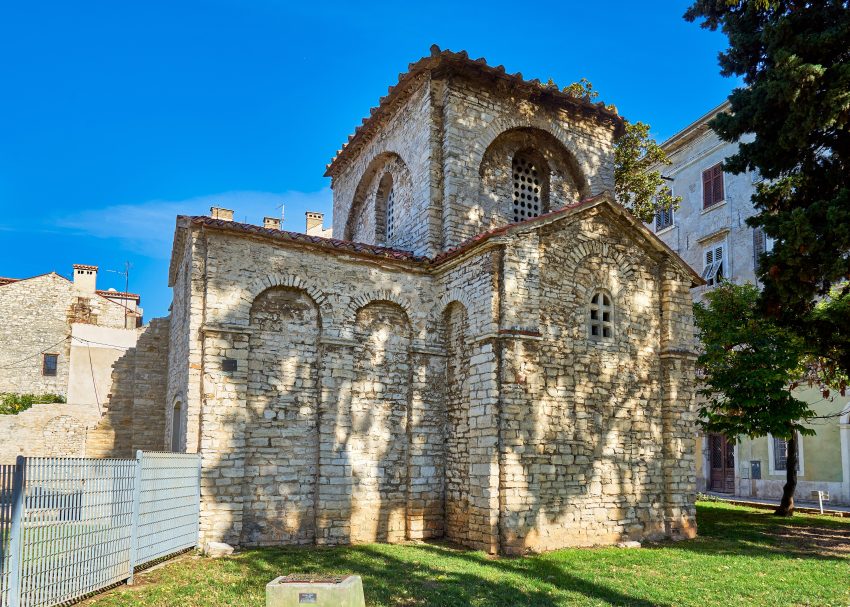
This small chapel is the surviving piece of a much larger 6th-century religious complex, tied to the Byzantine-era presence on the northern Adriatic. It was built in a style associated with major centers like Ravenna, and it’s notable precisely because so little Byzantine architecture remains in Pula today. Over time the broader abbey complex fell away and was dismantled, leaving this chapel as a kind of architectural fragment preserved by circumstance. Historical accounts emphasize that the original church was richly decorated, including mosaics, with surviving pieces now held in local collections rather than all remaining in situ. When you visit, go in with the right expectations: it’s compact, but it rewards slow looking. Pay attention to proportions, stonework, and the overall plan—details that hint at the scale and ambition of the vanished basilica. If you’re also seeing nearby Roman remains, this stop is useful for understanding how Pula’s story jumps from imperial Rome to early Christianity and Byzantium.
Location: Flaciusova ul., 52100, Pula, Croatia | Hours: Check official website. | Price: Free; donations appreciated.
8. Triumphal Arch of the Sergii
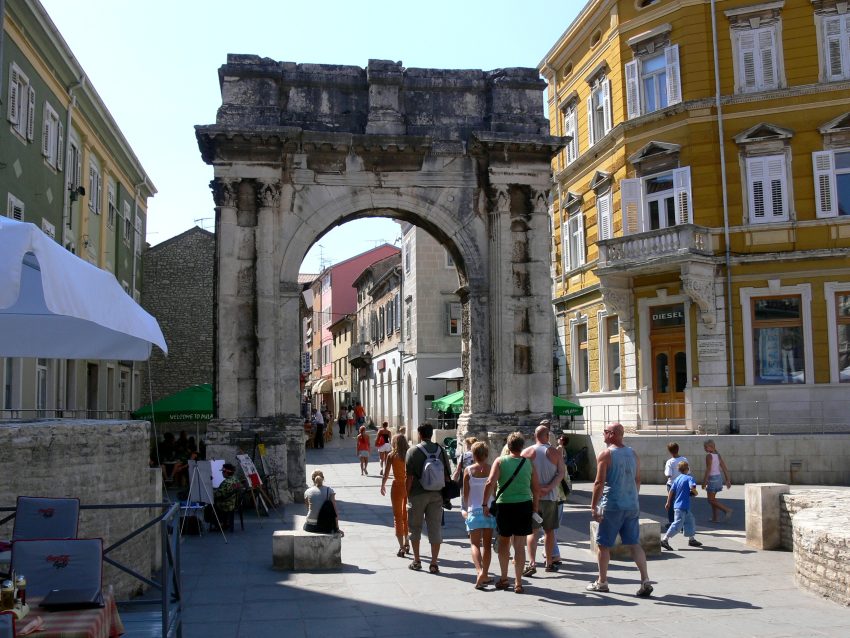
The Arch of the Sergii was erected around 29–27 BC, right at the transition from the late Republic to the early Augustan era. It commemorates members of the Sergii family, a powerful local lineage in Roman Pula, and it originally stood in relation to a city gate area rather than being a freestanding “monument in a plaza.” Stylistically, it’s a showpiece: crisp stone carving, a confident command of Roman architectural language, and the kind of civic self-promotion elite families funded across the empire. Even if you don’t know the names behind it, the message is clear—status, loyalty, and public visibility set in stone. When you’re there, look closely at the decorative surfaces and how the arch reads from different angles as you approach. It’s also one of Pula’s best “urban ruins” because it sits right in the flow of the modern city, so you can watch contemporary life pass through a space shaped by Roman commemoration. If you want a single Roman monument that feels fully integrated into the street scene, this is the one.
Location: Flanatička ul. 2, 52100, Pula, Croatia | Hours: 24 Hours. | Price: Free.
9. Small Roman Theatre
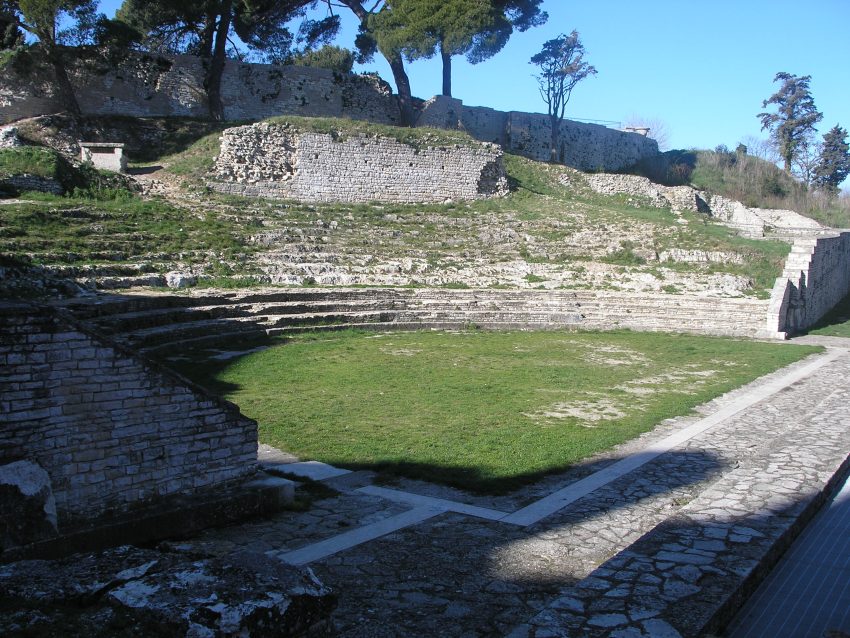
Pula’s Small Roman Theatre dates to the 1st century AD and sits on the slope below the Kaštel fortress, within the area that was inside the ancient city. In Roman times, Pula had more than one theater space for public events, and this smaller one served performances for a substantial audience by ancient standards. What survives today is enough to read the basic theater logic: seating tiers oriented toward a performance area, shaped by the hillside. Its story is also partly about rediscovery and adaptation—archaeological work and restoration have helped define what can be used, visited, and preserved in a modern city. When you visit, focus on the setting as much as the stones. The relationship between the theater, the hill, and the fortress above helps you visualize how Roman civic life and later military architecture occupied the same terrain. It’s not as visually overwhelming as the Arena, but it’s excellent for imagining everyday cultural life in the colony.
Location: Herculov prolaz 1, 52100, Pula, Croatia | Hours: Check official website. | Price: Check official website. | Website
10. Gate of Hercules
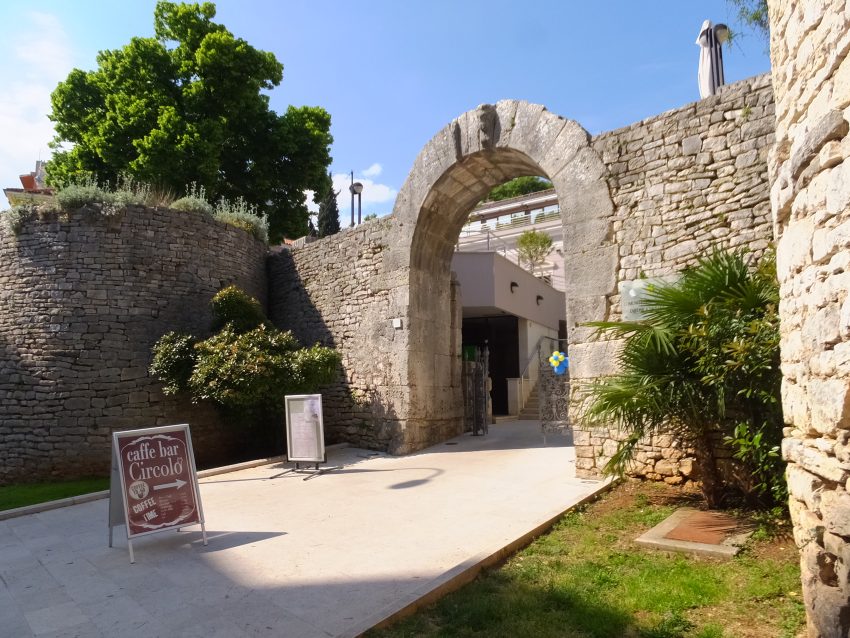
The Gate of Hercules is traditionally considered one of Pula’s oldest surviving Roman gates, associated with the city’s early colonial phase. Its defining feature is the faint carving of Hercules’ head and his club near the top—weathered, but still readable once you know where to look. The gate also preserves traces of an important (though damaged) inscription, and local heritage sources link it to Roman officials connected with the colony’s foundation. Even in its simplicity—rougher stone blocks and restrained decoration—it communicates the functional side of Roman urban infrastructure. On site, the best approach is close-range looking. Spend a moment picking out the carved club and the worn facial features, then step back to understand how modest gates could still carry symbolic messaging. Because it sits among later urban fabric, it’s a good example of how Roman Pula is stitched directly into the living city.
Location: Giardini 5, 52100, Pula, Croatia | Hours: 24 Hours. | Price: Free.
11. Twin Gates
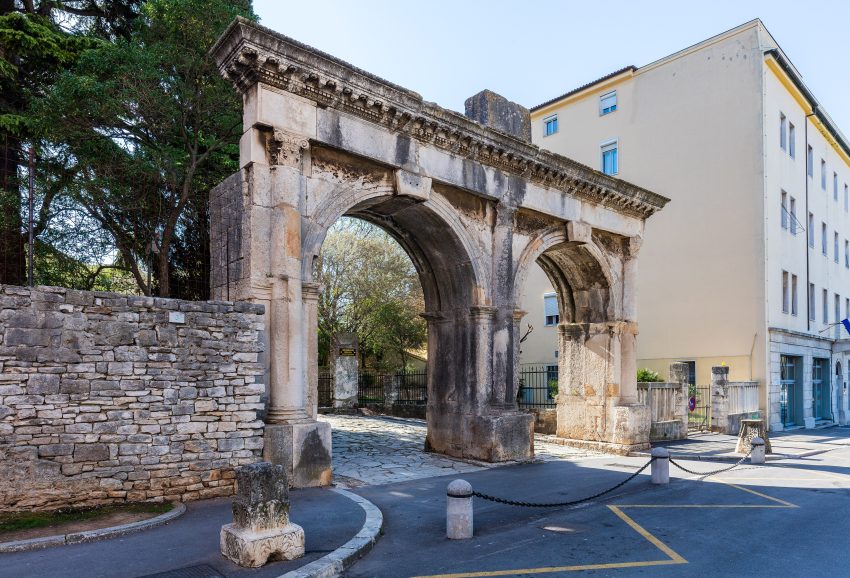
The Twin Gates (Porta Gemina) are a surviving Roman city gate from the late 2nd century, once part of the fortified wall circuit that enclosed ancient Pula. In the Middle Ages, sections of the gate and walls were buried and later re-exposed, which is why the monument can feel both “ancient” and “recently revealed.” Architecturally, the double-arched form is the headline feature, with pilasters and decorative elements that hint at the status of Pula as a well-funded Roman colony. The gate is also associated with later-added inscriptions and stones placed there after discovery, reflecting how cities curate their own ruins over time. When you visit, treat it as a threshold rather than a standalone “big sight.” Walk through and look back to see how the two arches frame movement, then scan the stone for surviving details like pilasters and relief elements. It’s also a useful anchor point for understanding where the Roman walls ran and how the old city was organized.
Location: Carrarina ul. 8, 52100, Pula, Croatia | Hours: 24 Hours. | Price: Free.
12. Roman Amphitheater
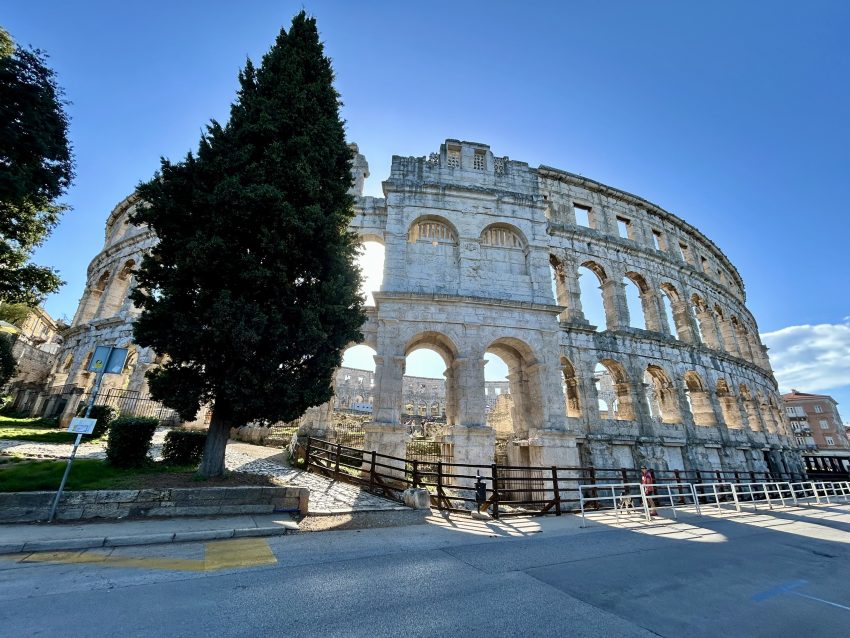
Pula’s Roman amphitheater, the Arena, was constructed from the late 1st century BC into the 1st century AD, associated with the reigns of Augustus through the Flavian period. It’s renowned for retaining an unusually complete circuit of outer walls, making it one of the most intact large amphitheaters you can visit. In Roman life, this was a venue for mass spectacle—gladiatorial contests and staged hunts—built to accommodate a huge audience relative to the city’s size. Over later centuries it lost its original purpose and was reused in various ways, which is a common story for Roman entertainment architecture across Europe. What to see goes beyond the postcard exterior. Walk the perimeter to appreciate how the structure changes with the slope of the site, then pay attention to the internal circulation: gates, passages, and the sense of engineered crowd movement. If you access the lower areas, the subterranean system helps you imagine how animals, fighters, and equipment were managed out of sight.
Location: Flavijevska ul., 52100, Pula, Croatia | Hours: Daily: 08:00–20:00. | Price: Adults: €10; Children/pupils/students: €5; Children under 5: free. | Website

Moira & Andy
Hey! We're Moira & Andy. From hiking the Camino to trips around Europe in Bert our campervan — we've been traveling together since retirement in 2020!
This website uses affiliate links which earn a small commission at no additional cost to you.
Walking Tour Summary
Distance: 3 km
Sites: 12