Self-Guided Walking Tour of Girona (2026)
This website uses affiliate links which earn a small commission at no additional cost to you.
Girona is made for walking: a compact historic core, a dramatic hilltop Old Town, and a riverfront that keeps pulling you back to the views. In a single day on foot you can move from Roman-era foundations to medieval lanes, cross bridges lined with colorful facades, and climb to panoramic viewpoints that explain the city's geography at a glance. A self-guided route works especially well here because you can slow down in the most atmospheric streets and speed up where the terrain is steeper.
This walking tour is structured to feel logical and scenic, not like a checklist. You will thread through the Barri Vell, take in the cathedral and its grand stairway, and build in time for the walls so you can enjoy Girona's best outlooks without backtracking. Along the way you will naturally cover many of the best things to see in Girona, including the riverside viewpoints, the Jewish Quarter's quiet passageways, and the city's most memorable medieval corners.
Expect a mix of landmark moments and smaller details: carved stone doorways, shaded courtyards, and sudden glimpses of the Onyar houses between arches. If you start early you will have the lanes largely to yourself, while a late-afternoon start can be timed for golden light along the river and a relaxed finish with tapas. Either way, Girona rewards curiosity, and this walk is designed to help you experience the city's atmosphere as much as its headline sights.
How to Get to Girona
By Air: The most convenient airport for Girona is Girona-Costa Brava Airport (GRO), which is closest to the city and often served by seasonal and low-cost routes; from the terminal you can typically reach central Girona by bus or taxi, usually within about 25-35 minutes depending on traffic and schedules. Barcelona El Prat (BCN) is the main international gateway for Catalonia and can be a better choice for long-haul or year-round flight options, with onward travel to Girona by train or car generally taking around 1-1.5 hours. If you are building a wider Catalonia itinerary, flying into Barcelona and continuing by rail is often the simplest all-round plan. For the best deals and a seamless booking experience, check out these flights to Girona on Booking.com.
By Train: Girona is exceptionally well connected by rail, and for many travelers it is the easiest and fastest way to arrive, particularly from Barcelona. High-speed services link Barcelona to Girona in well under an hour, and longer-distance services can connect onward toward Figueres, the French border, and other major cities, making Girona a practical stop on a broader Spain-France route. Girona's main station is walkable to parts of the centre and a short taxi/bus ride to the Barri Vell, which is useful if you are staying inside the historic core where streets can be steep or cobbled. Train schedules and bookings can be found on Omio.
By Car: Driving to Girona is straightforward via the AP-7 motorway corridor and surrounding regional roads, and it can be especially useful if you plan day trips into the Costa Brava, the Garrotxa volcanic zone, or small medieval villages where public transport is limited. The main consideration is parking: the Barri Vell is not designed for through-traffic, so it is usually best to use a hotel with parking or aim for public car parks on the edge of the historic centre and walk in. If your main goal is the walking tour, you will likely want to park once and explore on foot, using the car mainly for arrival/departure and excursions. If you are looking to rent a car in Spain I recommend having a look at Discover Cars, first, as they compare prices and review multiple car rental agencies for you.
By Bus: Buses provide a budget-friendly alternative, with regular services linking Girona to Barcelona and other towns across Catalonia, and they can be useful when train times are inconvenient. The bus station is adjacent to or very close to the main rail station, so onward connections are simple, and you can usually reach the Old Town quickly by local bus or taxi. If you are traveling with lighter luggage, arriving by bus is generally smooth, though rail is often faster for the core Barcelona-Girona journey.
Where to Stay in Girona
To make the most of visiting Girona and this walking tour, consider staying overnight in the centre so you can start early, take breaks easily, and enjoy the Old Town once the day-trippers thin out. For the most immersive experience, base yourself in Barri Vell (the Old Town), where the lanes, cathedral steps, and river viewpoints are right outside your door, and the evenings feel especially atmospheric after sunset. Two strong options in this area are Hotel Històric for an intimate, characterful stay close to the cathedral, and Hotel Museu Llegendes de Girona for a boutique base at the edge of the medieval core with quick access to key sights.
If you want the same walkability with a slightly more open, café-and-plaza feel, look at Mercadal and the streets along the river opposite the Old Town, which make it easy to dip into Barri Vell while keeping you close to dining and the classic bridge views. Hotel Nord 1901 is a polished, central choice that puts you a short stroll from both the river and the Old Town lanes, while Hotel Ciutat de Girona is similarly well-placed for a practical, walking-first stay with quick access to the tour’s early stops.
For the most convenient logistics (especially if you are arriving by train, want straightforward taxi access, or prefer wider streets and easier parking), Eixample is a strong base that still keeps the Old Town within an easy walk. Hotel Gran Ultonia works well if you want a comfortable, full-service option close to the centre, while Hotel Carlemany Girona is a reliable pick near the station area, ideal for an efficient start and finish to the walking route.
Your Self-Guided Walking Tour of Girona
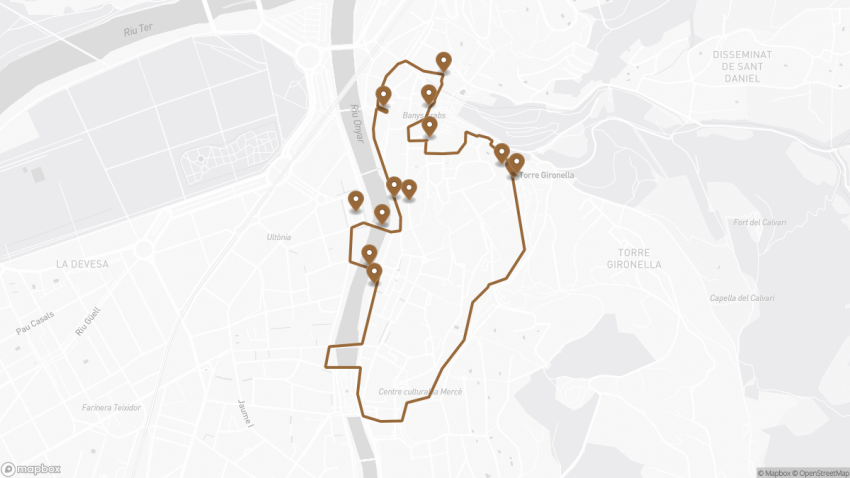
Discover Girona on foot with our interactive walking tour map guiding you between each pinned stop. With its medieval walls, riverside bridges, narrow Jewish Quarter lanes, and elegant civic squares this walking tour traces the city's layered past-from the Cathedral and the Roman and medieval fortifications to the atmospheric streets of the Barri Vell-blending Catalan character with landmark viewpoints, hidden courtyards, and skyline panoramas, all within a compact city shaped by frontier history, river trade, and centuries of strategic defence.
1. Plaza de la Independencia

Plaça de la Independència is Girona’s best-known 19th-century civic square, defined by a neat rectangular plan and continuous neoclassical arcades that give it a deliberately “European” sense of order. It sits in the Mercadal district and works as a natural gathering space, with terraces that fill quickly in the late afternoon and evening.
The square’s name and symbolism link directly to Girona’s resistance during the Peninsular War. At its centre stands the Monument to the Defenders of Girona, inaugurated in 1894 to commemorate the city’s 1809 defenders, created by sculptor Antoni Parera.
What to see is the full architectural “room” effect: stand at one corner to take in the arcades as a continuous frame, then move toward the monument to read the square’s commemorative purpose. The arcades also create excellent sightlines for photography, especially when the light falls under the arches and the cafés are active.
Location: Pl. de la Independència, 17001 Girona, Spain | Hours: 24 Hours. | Price: Free. | Website
2. Pont de les Peixateries Velles
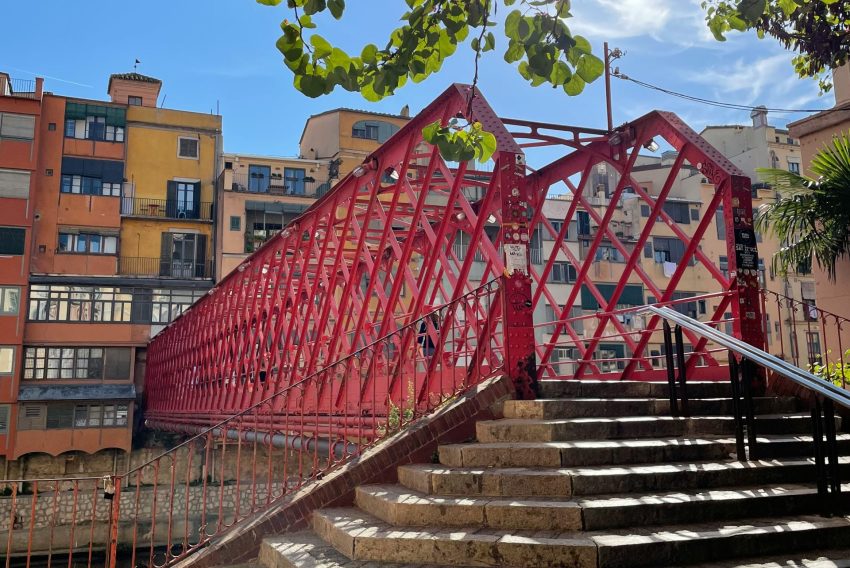
Pont de les Peixateries Velles is Girona’s iconic red iron bridge over the Onyar, often referred to as the Eiffel Bridge because it was built in 1877 by Gustave Eiffel’s workshop. Its latticework and industrial precision stand out against the older stone and stucco of the old town, making it one of the city’s most recognizable pieces of infrastructure.
Historically, the bridge reflects Girona’s late 19th-century modernization and the need to connect the historic centre with the Mercadal side of the city across the river. It has been strengthened and restored over time, which is typical for working metal structures that remain in constant use.
What to see is the view up and down the Onyar: pause at mid-span and look toward the coloured river houses, with church towers and the cathedral rising behind. The bridge is also at its best when you treat it as a viewpoint rather than a crossing, using the iron framing to “compose” the river scene.
Location: Pont de les Peixateries Velles, Girona, Spain | Hours: 24 Hours. | Price: Free.
3. Rambla de la Libertad
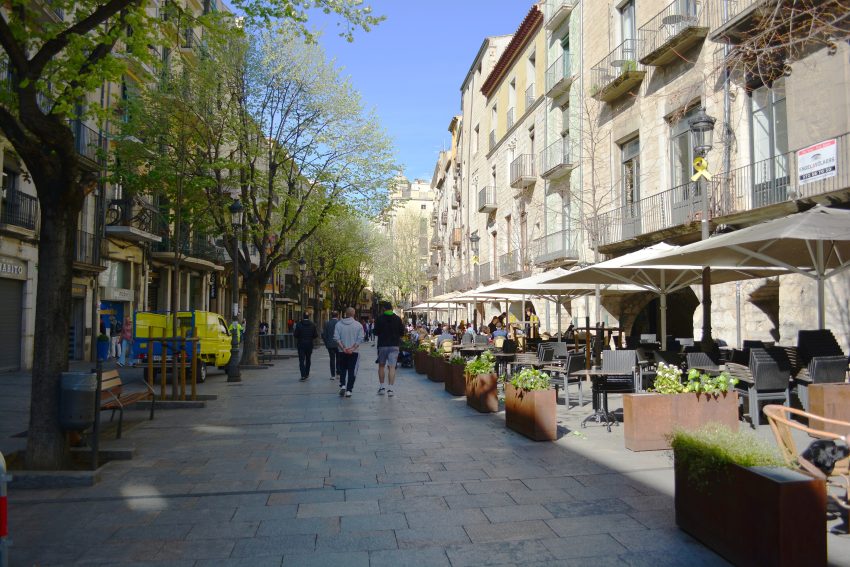
Rambla de la Llibertat is Girona’s classic promenade, a broad street lined with arcades, shops, and cafés that has long functioned as a commercial spine of the old city. It is one of the most atmospheric places to slow down and observe how Girona’s daily life moves through a historic setting.
The Rambla’s present-day layout dates to 1885, when municipal works widened and regularized the space to create a more continuous avenue, while preserving older buildings and arcaded elements. That blend of older fabric with 19th-century re-planning is part of what gives the street its distinctive rhythm and proportions.
What to see is the architecture at ground level and above: the shade and sequence of arches, the façades that hint at older Girona behind the storefronts, and the small landmarks along the way such as Casa Norat’s modernist frontage. It also provides a straightforward link to the Onyar bridges, including the red iron span nearby.
Location: Rambla de la Llibertat, 17004 Girona, Spain | Hours: 24 Hours. | Price: Free. | Website

4. Onyar River Colored Houses
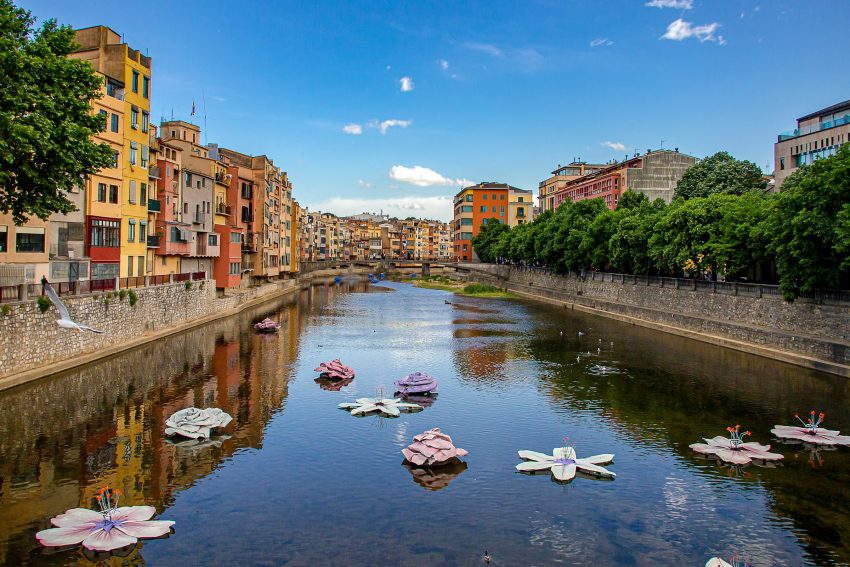
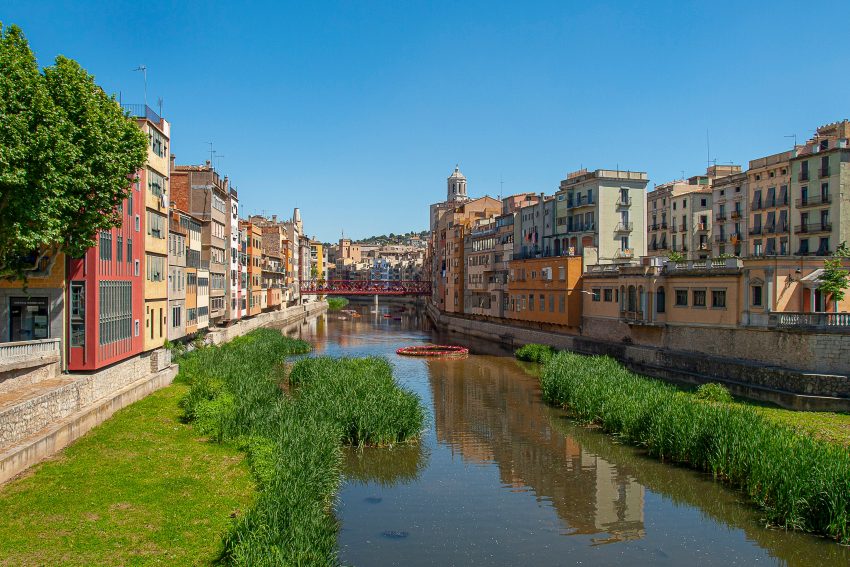
The coloured houses of the Onyar are Girona’s signature postcard image: tall, tightly packed façades that appear to hang over the river, with a skyline of spires and domes rising behind. They were not designed as a scenic set-piece; they are the result of dense historic building along the river edge, where space was limited and the city grew within constraints.
Their appearance today is partly the product of restoration. The riverfront façades deteriorated during the 20th century, and major rehabilitation and repainting programs, including work in the early 1980s, helped re-establish the coherent, colourful riverside identity people now associate with Girona.
What to see is the full river composition: find a bridge viewpoint where the façades, reflections, and background landmarks align, then look closer at how irregular the buildings are in height, alignment, and window patterns. That visual “messiness” is the history—incremental building and rebuilding over centuries rather than a single planned development.
Location: Rambla de la Llibertat, 23, 17004 Girona, Spain | Hours: 24 Hours. | Price: Free. | Website
5. Jewish History Museum
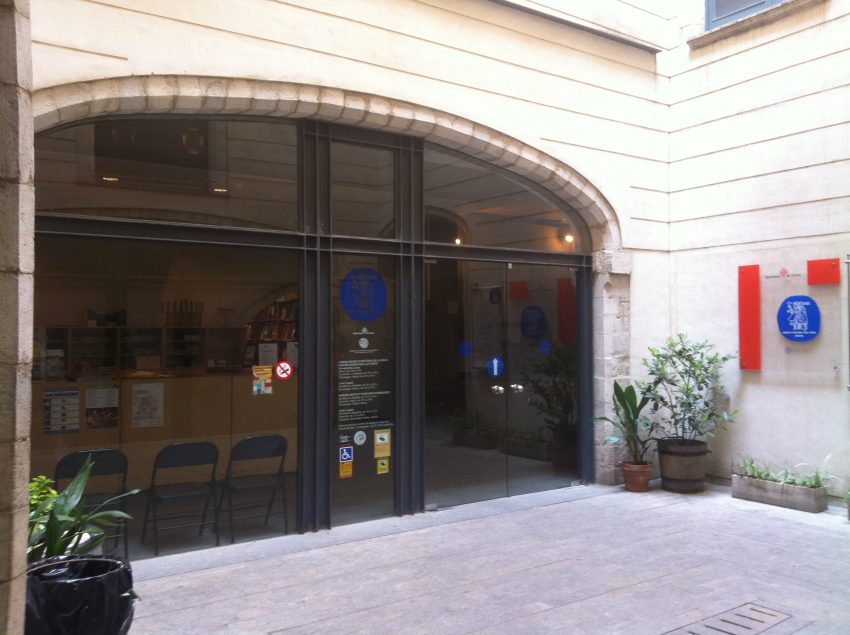
The Jewish History Museum is Girona’s key institution for understanding the city’s medieval Jewish quarter, known locally as the Call. Its core purpose is to preserve and interpret the history of Jewish communities in Catalonia, with an emphasis on the medieval period and Girona’s local evidence, objects, and memory.
The museum’s setting matters because the Call is one of Girona’s most evocative historic environments: narrow lanes, tight plots, and a street pattern that retains an older logic. The museum helps you translate that atmosphere into a historical narrative, clarifying what community life looked like and how it fit into the wider city.
What to see is the way the museum uses Girona-specific material to ground larger themes. Focus on objects and explanations tied directly to local Jewish life and the Call itself, then step back outside with a sharper eye for how the urban form preserves traces of that past.
Location: Museu d'Història dels Jueus Carrer de la Força, 8 17004 Girona Spain | Hours: (Summer) July – August: Tuesday – Saturday: 10:00–19:00; Monday, Sunday & public holidays: 10:00–14:00. (Winter) September – June: Tuesday – Saturday: 10:00–18:00; Monday, Sunday & public holidays: 10:00–14:00. Open on 24 December & 31 December: 10:00–14:00. Closed on 01 January, 06 January, 25 December & 26 December. | Price: €4 standard; €2 reduced; free entry for under 14s and selected passes/groups. | Website
6. Casa Masó
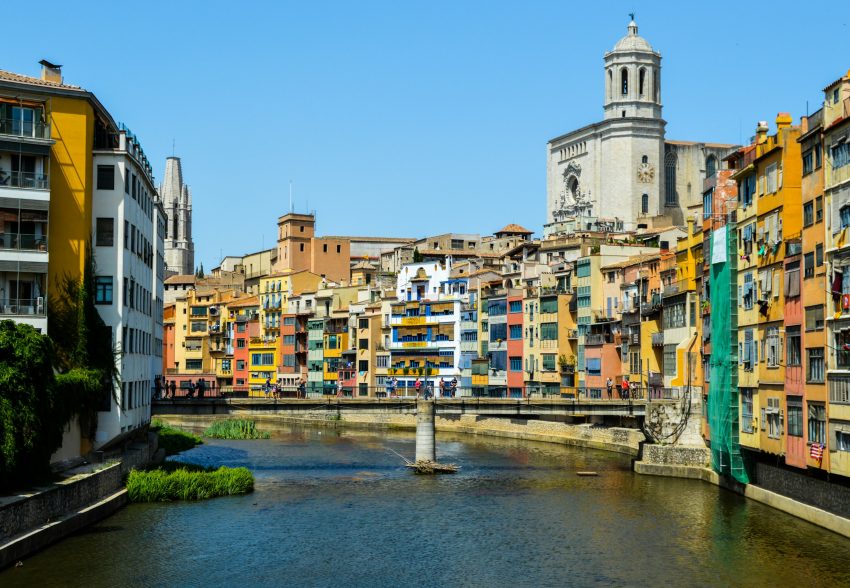
Casa Masó is a house museum on the Onyar and the birthplace of architect Rafael Masó, a key figure in Catalan Noucentisme. It is notable not only for its design but also because it is the only one of the famous Onyar river houses open to the public, making it the most direct way to experience Girona’s riverfront architecture from the inside.
The building reflects both family history and architectural intent. Casa Masó is the result of joining multiple older dwellings, with Rafael Masó’s renovations in the early 20th century unifying the interior and refining the public-facing identity of the house; it is often presented as a symbol of Noucentisme’s disciplined elegance and civic-minded modernity.
What to see is the preserved interior character and the river outlook. Look for period furniture and decorative choices that communicate Noucentista taste, then pay attention to how the house frames the Onyar and the city beyond—those views explain why this stretch of Girona feels so visually distinctive from the bridges.
Location: Carrer de les Ballesteries, 29, 17004 Girona, Spain | Hours: Tuesday – Saturday: Guided visits at agreed times (advance reservation required). Closed on Sunday, Monday. Closed on local and national bank holidays. | Price: Adults: €10; Carnet Jove: €7; Reduced (50%): €5; Under 16: free (with an adult). | Website
7. Basilica de Sant Feliu

The Basilica of Sant Feliu is one of Girona’s most important churches and a defining element of the Barri Vell skyline. It has deep roots in the city’s early Christian history and is often described as Girona’s first cathedral before the cathedral complex took over that role, which immediately elevates its significance beyond “another old church.”
Architecturally, Sant Feliu is most associated with its Gothic character and its remarkably slender bell tower, developed across the 14th to 16th centuries. The building also preserves important early stonework and funerary material, including notable sarcophagi that underscore how long the site has held civic and religious importance.
What to see is the tower’s profile from outside and the interior’s key artworks and monuments. Give attention to the sarcophagi and the overall spatial feel, then step back into the surrounding streets to appreciate how Sant Feliu and the cathedral together create Girona’s most recognizable historic skyline.
Location: Carrer Trasfigueres, 4, 17004 Girona, Spain | Hours: Monday – Saturday: 10:00–18:00. Sunday: 13:00–18:00. | Price: Cathedral + Basílica de Sant Feliu: Adults: €7.50; Reduced: €5; Youth: €1.50 (includes audio guide). Free for children under 7 and Girona natives/residents. | Website
8. Museo de Arqueologia de Cataluna
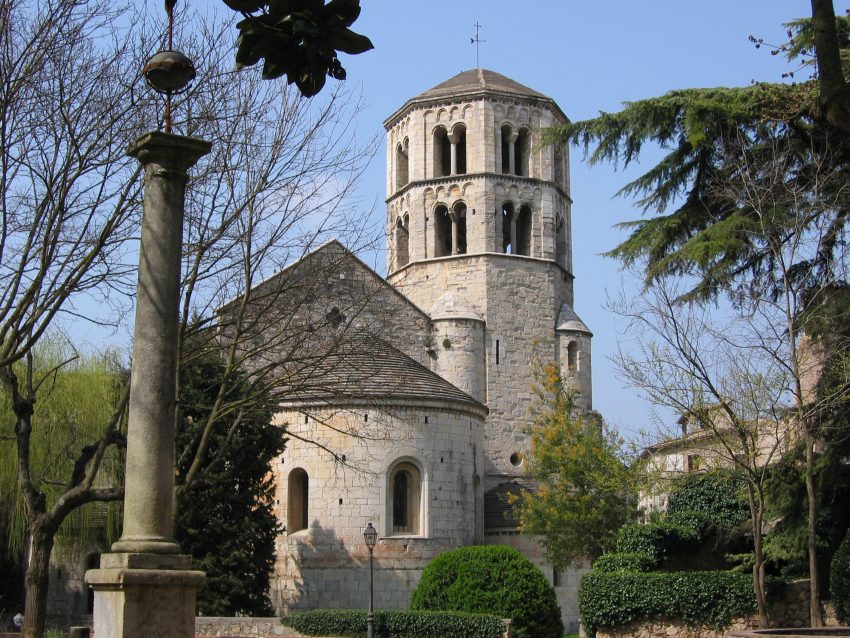
The Museu d’Arqueologia de Catalunya in Girona is housed in the former Benedictine monastery of Sant Pere de Galligants, one of the city’s most important Romanesque complexes. The monastery’s reuse as a museum site has a long lineage: it was already being used for museum purposes in the 19th century, and today it serves as the Girona branch of the Museum of Archaeology of Catalonia.
The museum’s strength is regional continuity. Its collections assemble archaeological material from the Girona area spanning prehistory through the Middle Ages, which helps you understand Girona not as a single “medieval moment” but as a settlement shaped by repeated phases of occupation, belief, trade, and defense.
What to see is both the container and the content: the Romanesque church and cloister architecture of Sant Pere de Galligants, plus selected collection highlights that connect most directly to Girona’s local timeline. Even if you are not a specialist, the setting alone communicates how older sacred spaces can become guardians of long-term civic memory.
Location: Carrer de Santa Llúcia, 8, 17007 Girona, Spain | Hours: (Summer) May 1 – September 30; Tuesday – Saturday: 10:00–19:00. Sunday: 10:00–14:00. Closed on Monday. (Winter) October 1 – April 30; Tuesday – Saturday: 10:00–18:00. Sunday: 10:00–14:00. Closed on Monday. | Price: Adults: €6; Reduced: €4. | Website
9. Banos Arabes

The Arab Baths are a 12th-century bath complex that survives as one of Girona’s most distinctive medieval sites, despite the “Arab” label reflecting architectural influence rather than a simple cultural origin story. The first mention of public baths on this site dates to 1194, placing it firmly within Girona’s medieval urban life.
Their history includes damage and rebuilding. The complex was partially destroyed during the 1285 siege and subsequently rebuilt in the 1290s under royal commission, which is a useful reminder that public facilities were valuable enough to restore, not discard, even during turbulent periods.
What to see is the sequence of rooms and the logic of medieval bathing: changing spaces, warm and hot areas, and the architectural details that make the complex memorable, especially the vaulted forms and the way light enters interior spaces. Move slowly and read the structure as a piece of everyday history, not merely a “pretty ruin.”
Location: Carrer del Rei Ferran el Catòlic, s/n, 17004 Girona, Spain | Hours: Monday – Saturday: 10:00–18:00. Sunday: 10:00–14:00. Closed on January 1, January 6, December 24, December 25, December 26. | Price: Adults: €3; Over 65: €2; Reduced: €1; Under 8: free. | Website
10. Catedral de Girona
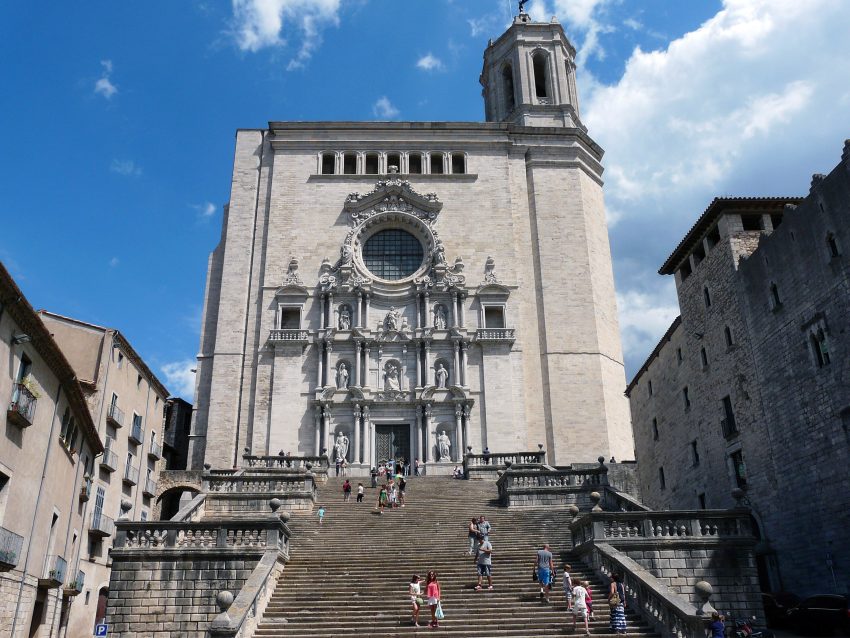
Girona Cathedral, dedicated to Saint Mary, is the city’s dominant monument, set above the old town with a powerful sense of elevation and ceremony. Construction began in the Romanesque era and continued through Gothic and later phases, producing a complex that reflects centuries of ambition rather than a single stylistic moment.
One architectural fact defines the interior experience: the cathedral’s nave is exceptionally wide and is widely cited as the widest Gothic nave in the world, which changes how the space feels compared with more typical multi-aisle Gothic churches. Remnants of the earlier Romanesque cathedral survive, notably in elements such as the cloister and bell tower, anchoring the later grandeur in older fabric.
What to see includes the exterior setting and the interior scale. Spend time on the approach and the way the cathedral commands surrounding streets, then step inside to register the breadth of the nave and the quieter, older atmosphere of the cloister areas if accessible. The contrast between the monumental public face and the more intimate historic elements is the cathedral’s real payoff
Location: Pl. de la Catedral, s/n, 17004 Girona, Spain | Hours: (Summer) June 15 – September 15; Monday – Friday: 10:00–19:00; Saturday: 10:00–20:00; Sunday: 12:00–19:00. (Winter) November 1 – March 14; Monday – Saturday: 10:00–17:00; Sunday: 12:00–17:00. | Price: Adults: €7.50; Pensioners & students: €5.00; Under 16: €1.50; Under 8: free. | Website
11. Passeig De La Muralla
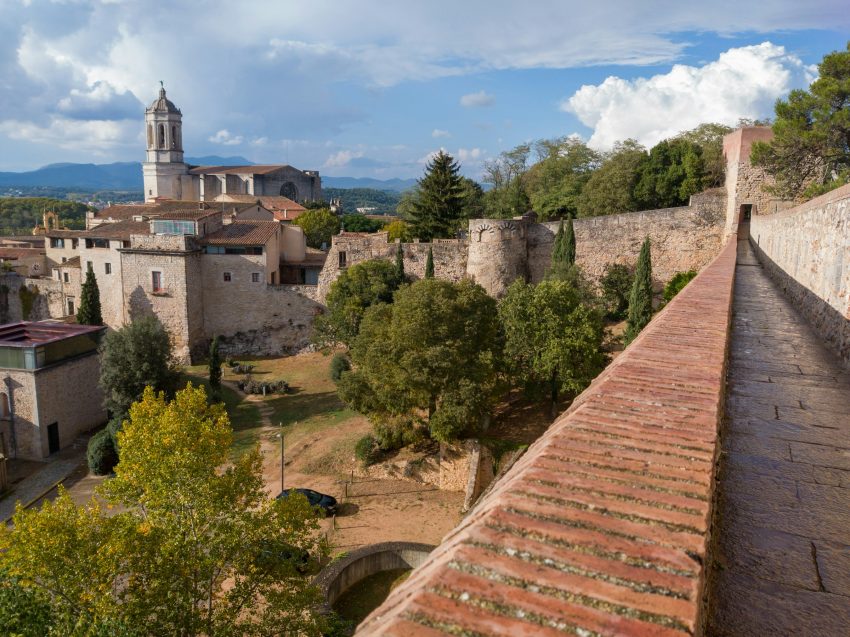
Passeig de la Muralla is Girona’s walkable city wall system, where Roman foundations and medieval expansions converge into one of the clearest “city-from-above” experiences in Catalonia. It is not a single continuous wall from one era, but a layered fortification history that shows how Girona defended itself, expanded, and later opened parts of its perimeter to civic use.
Parts of the walls date to the medieval period, including major 14th-century works, while other sections were lost during later urban expansion, particularly as the city grew beyond its historic boundary. That mixture of surviving towers, rebuilt segments, and missing stretches is itself historically meaningful: it reflects the constant trade-off between defense, growth, and modernization.
What to see is the sequence of viewpoints and towers. Aim to stop at several high points rather than rushing the length, because the views change: cathedral and old town rooflines, the Onyar corridor, and the Jewish quarter geometry become easier to read from different angles. It is one of Girona’s most effective places to understand the city’s shape in a single, coherent glance.
Location: Carrer dels Alemanys, 20, 17004 Girona, Spain | Hours: (September – May) Daily: 08:00–21:00. (June – August) Daily: 08:00–23:00. | Price: Free. | Website
12. Jardins dels Alemanys

Jardins dels Alemanys is one of Girona’s quiet, leafy breaks from the city’s stone-and-steps intensity, tucked along the old defensive line near the cathedral and the city walls. The name nods to the area’s long military associations: this hillside and its approaches were shaped by centuries of fortification and conflict, including the periods when Girona’s defenses were reinforced, attacked, and rebuilt as the city guarded a strategic route between the Iberian interior and the French border. Today, the mood is entirely different—calm, shaded, and slightly elevated—so you feel you’re standing inside the city’s history while getting a pause from it.
What makes the gardens memorable is their setting rather than formal landscaping. You’ll find pines and Mediterranean greenery, stone paths and small terraces, and a sense of being suspended between the medieval core and the outer slopes. The gardens connect naturally with Girona’s iconic stone architecture: from here you’re close to the cathedral precinct, the old wall walk, and the steep lanes that define the historic quarter, yet the trees soften the sound and heat. It’s an ideal place to notice details you might miss when you’re rushing—old masonry, changing rooflines, and glimpses of towers through branches.
For things to do, treat Jardins dels Alemanys as a reset point on a walking day. Come mid-morning for softer light or late afternoon when the heat drops, sit for a while, and then continue along the nearby stretches of the city walls for some of Girona’s best viewpoints. Photographers will like the mix of shade and stone textures, and anyone exploring on foot will appreciate how the gardens break up the climb between major sights. If you’re visiting in peak season, it’s also a smart stop to step out of the busiest lanes, drink some water, and re-enter the Old Town feeling refreshed rather than rushed.
Location: Jardins dels Alemanys, Carrer de la Muralla, Girona, Spain | Hours: (Summer) 1 June – 31 August: Daily: 08:00–23:00. (Winter) 1 September – 31 May: Daily: 08:00–21:00. | Price: Free | Website
13. Torre Gironella
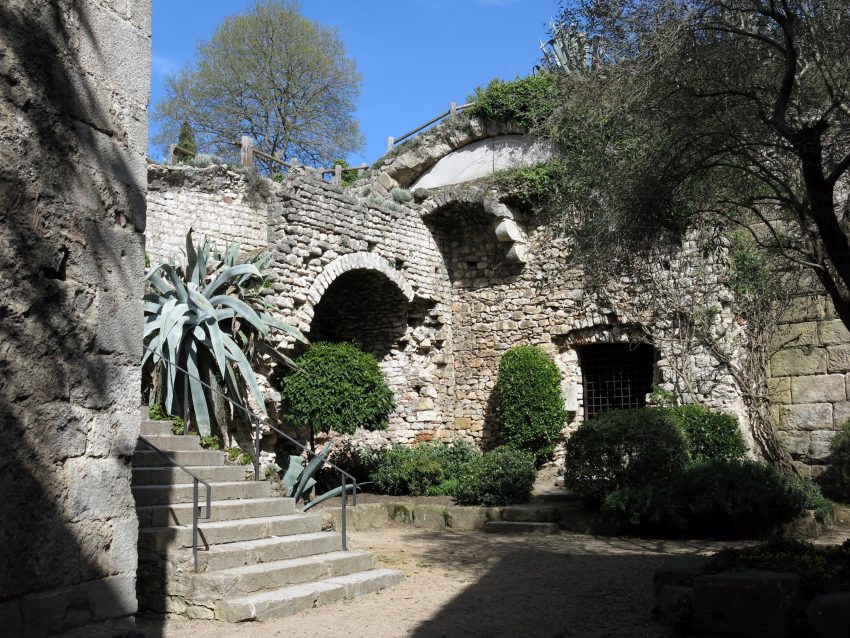
Torre Gironella sits on the highest part of Girona’s old fortified precinct, a place where the city’s defensive story is easiest to read in the landscape. The tower and its surrounding fortifications trace back to the medieval period, when Girona’s upper hill was the natural point to command approaches from the north and protect the cathedral-side ridge. Over centuries of conflict in this border region, the stronghold was reinforced and altered, most dramatically during the early 19th-century Peninsular War, when Girona endured devastating sieges and large parts of the defensive complex were damaged or left in ruins. What remains today feels like a sober, atmospheric reminder that Girona’s beauty has always been tied to its strategic position.
Visiting Torre Gironella is less about walking through an intact “castle” and more about experiencing a layered ruin with exceptional views. You’ll see thick stone walls, fragments of towers and ramparts, and a sense of how the fortification once stitched together the upper edge of the Old Town. The setting is dramatic: stonework emerging from greenery, sudden lookouts, and the city dropping away below you. Even if you’re not focused on military history, the place makes the geography of Girona instantly clear—why the city grew where it did, and how the hilltop controlled movement along the valley routes.
For things to do, come here as part of a slow circuit of the old walls and upper quarter rather than a standalone stop. The best experience is to wander, pause at viewpoints, and imagine the defensive line continuing along the ridge. It’s a strong spot for panoramic photos over the rooftops and toward the surrounding countryside, and it pairs naturally with nearby highlights like the wall walk and the cathedral area. If you time it for late afternoon, the light tends to be kinder on the stone and the city below, and you’ll get a quieter, more reflective Girona than the busy lanes down in the core.
Location: Carrer de la Muralla, 17004 Girona, Spain | Hours: (September – May) Daily: 08:00–21:00. (June – August) Daily: 08:00–23:00. | Price: Free. | Website

Moira & Andy
Hey! We're Moira & Andy. From hiking the Camino to trips around Europe in Bert our campervan — we've been traveling together since retirement in 2020!
This website uses affiliate links which earn a small commission at no additional cost to you.
Walking Tour Summary
Distance: 3 km
Sites: 13
Walking Tour Map