Self-Guided Walking Tour of Annecy (2026)
This website uses affiliate links which earn a small commission at no additional cost to you.
Annecy is made for exploring on foot. Its old town is compact, scenic, and threaded with canals that turn simple walks into postcard moments, while the lakefront opens into wide promenades and mountain views that feel surprisingly alpine for a small city. A self-guided route lets you move at your own pace-lingering on bridges, ducking into arcaded lanes, and stopping whenever a terrace or viewpoint looks too good to pass up.
This walking tour links the medieval and Renaissance heart of Annecy with its most atmospheric waterside corners, building from lively squares and market streets toward quieter canal paths and the lake. Along the way you'll pass landmark architecture, shaded quays, and elevated vantage points that put the city's layout into context. It is an efficient way to cover the best things to see in Annecy without turning the day into a checklist.
What makes Annecy especially satisfying is the variety packed into a short distance: stone gateways and pastel façades, waterways and gardens, and easy detours for museums, bakeries, or a quick swim in warmer months. By the time you reach the lakeside, you'll have a clear sense of how the old town's history connects to the modern promenade culture that defines the city today. With a flexible loop, you can keep it brisk in a couple of hours or stretch it into a full day with stops.
How to Get to Annecy
By Air: Annecy does not have a major commercial airport, so most visitors fly into Geneva Airport (GVA) or Lyon Saint-Exupéry Airport (LYS). Geneva is often the most convenient for international arrivals, with a short cross-border transfer into France, while Lyon can be a good option if you are continuing deeper into the Rhône-Alpes. From either airport, you can connect onward by train, coach/shuttle, or a private transfer depending on your budget and timing, and it is generally straightforward to arrive in Annecy without needing a car. For the best deals and a seamless booking experience, check out these flights to Annecy on Booking.com.
By Train: Annecy is well connected by rail, making the train one of the easiest and most predictable ways to arrive. Services typically link Annecy with hubs such as Lyon and Geneva, and there are also direct or one-change options from larger French cities depending on the season and timetable. The station sits close to the old town and canals, so you can often drop your bags and start walking within minutes, which is ideal for a self-guided itinerary. You can use SNCF Connect to check schedules, compare routes, and purchase tickets for National (SNCF ) and regional trains (TER). For a more streamlined experience, we recommend using Omio, which allows you to easily compare prices, schedules, and book tickets for both National and Regional travel across all of Europe, all in one place.
By Car: Driving to Annecy is simple if you are touring the region, but parking in and around the old town can be limited and expensive, especially in peak season and on weekends. The approach roads are scenic, and having a car is useful for lake circuits and nearby villages, but for the town itself you will likely prefer to park once and walk. If you are staying centrally, consider choosing accommodation with included parking or using a peripheral car park and entering the historic centre on foot. If you are looking to rent a car in France I recommend having a look at Discover Cars, first, as they compare prices and review multiple car rental agencies for you.
By Bus: Long-distance coaches can be a cost-effective alternative, particularly from Geneva, Lyon, or other regional cities, and they sometimes run at times that suit flight arrivals better than trains. The trade-off is that buses can be slower and more sensitive to traffic, especially around peak travel periods. If you are travelling on a budget or your schedule lines up neatly, it can be a practical way to arrive close to the centre without dealing with parking. [bus]
Where to Stay in Annecy
To make the most of visiting Annecy and this walking tour then you consider stay overnight at the centre. If you base yourself around the Old Town (Vieille Ville) you can start early before the day-trippers arrive, step straight into the canals and arcaded streets, and return easily for a break between sights. This is the most atmospheric area, but rooms can book out quickly in peak season, so it suits travelers who want to be in the middle of the scenery and do almost everything on foot. Good, walkable options here or on the Old Town edge include Palace de Menthon and Hôtel du Château.
If you want central convenience with a slightly calmer feel, look at the Station/Old Town fringe around the train station and the main shopping streets. You still have an easy walk into the historic centre and lakefront, but you gain quicker arrivals/departures and more choice at mid-range price points, which can be helpful if you are connecting by rail. This area works well if your plan is to walk the tour, then take day trips without moving accommodation. Consider Best Western Plus Hotel Carlton Annecy or Novotel Annecy Centre Atria for reliable comfort close to the route start points.
For lakeside views and a more “holiday” atmosphere, the Lakefront and Albigny/Impérial Palace area is ideal. You can begin or end your walk with the promenade, parks, and beaches, and it is especially appealing in warmer months when you will likely spend extra time by the water. The trade-off is that it can be a touch farther from the tight lanes of the Old Town, but it remains comfortably walkable and feels more spacious and restful in the evenings. Strong picks here include Impérial Palace and Rivage Hôtel & Spa Annecy.
A Short History of Annecy
Annecy grew from a strategic lakeside settlement into a fortified medieval town shaped by the rival powers of the Genevois and Savoy regions. The clearest symbol of that early authority is Château d'Annecy, built and expanded between the 12th and 16th centuries, which served as the residence of the Counts of Geneva and later the Dukes of Genevois-Nemours. Below the ramparts, the canal-side Palais de l'Isle preserves the town's administrative past: its oldest parts date from the 12th century, and across the centuries it functioned as a lordly residence, courthouse, mint, and prison-roles that reflect how governance and commerce were concentrated in the old town's tight waterways.
Annecy's religious architecture also maps its rise in regional importance. Église St. Maurice , the oldest church in town, began in 1422 as a Dominican convent chapel sponsored by Cardinal Jean-Allarmet de Brogny, and it later grew with chapels funded by local noble families and guilds. Annecy Cathedral was erected at the beginning of the 16th century by Jacques Rossel as a chapel for a Franciscan priory, and it was raised to cathedral status in 1822, reinforcing Annecy's position as a diocesan centre. Nearby, Église Saint-Francois was built on its present site in 1614, reflecting the Counter-Reformation era and Annecy's strong Catholic identity in a period when the wider region was marked by confessional change.
By the 19th and early 20th centuries, Annecy's identity broadened from fortified town to leisure city, with the lakefront becoming its public “front room.” Jardins de l'Europe took shape as an English-style landscape garden designed in 1863 by Henri Porreaux, creating a formal green link between the old town and the water. The elegant Pont des Amours followed, built to the plans of municipal architect Gaspard Fraüf and inaugurated on 9 June 1907, connecting the gardens to Le Pâquier, the wide lakeside esplanade whose name recalls its medieval use as grazing land and which tradition links to a 1613 donation by Count Bernard VI of Menthon. Together with the arcaded Rue Sainte-Claire , whose Renaissance-era covered walkways date largely from the 16th and 17th centuries, these spaces show how Annecy evolved into a walkable city built as much for strolling as for defence.
Your Self-Guided Walking Tour of Annecy
Discover Annecy on foot with our walking tour map guiding you between each stop as you weave through its canal-laced Old Town, arcaded medieval streets, and lakefront promenades framed by Alpine views. This walking tour traces the city's layered past and easygoing outdoor culture, from the Château d'Annecy and the storybook Palais de l'Isle to Rue Sainte-Claire's covered lanes, lively markets, and the broad greens of Le Pâquier, tying together historic landmarks, waterside viewpoints, and the prettiest corners of a city shaped by the lake.
1. Hotel de Ville
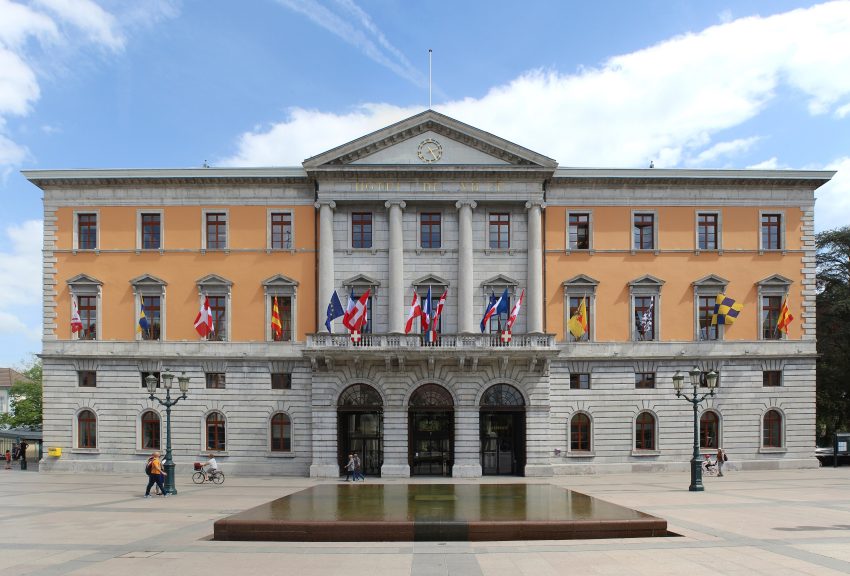
On a walking tour, Annecy’s Hotel de Ville is best approached as a civic “set piece” on the Esplanade de l’Hôtel de Ville, where the town’s administrative life meets the open-air rhythm of the centre. It is a useful waypoint between the Old Town lanes and the more open lakefront spaces, and it also helps you read Annecy beyond postcards: this is where decisions, ceremonies, and public life have been anchored for generations.
Annecy’s first town hall stood closer to the old parish core, beside the Notre-Dame-de-Liesse church on what is now around Rue Notre-Dame. That earlier building was originally constructed as a hospital and then repurposed for municipal use in 1770, with a design noted for features such as a grand exterior stair, ironwork balconies, and a pediment with an oculus; period visitors even remarked on a wrought-iron trout motif linked to the city’s coat of arms. As the town’s needs grew in the 19th century (during the Kingdom of Sardinia era), a larger neoclassical Hôtel de Ville was commissioned, designed by architect François Justin and completed in 1851, with a deliberately symmetrical ashlar-stone façade and an Ionic portico that signals institutional authority at a glance.
The building retained its prominence after Savoy was annexed to France in 1860, and the setting in front of it has continued to evolve, including a 1995 redesign of the square and water feature by Jean-Michel Wilmotte. A major interruption came on 14 November 2019, when an electrical fault caused a severe fire that damaged the upper floors and roof; the long-term restoration (associated with architect Pierre-Louis Faloci) has been planned as a major conservation-and-modernisation project, with timelines publicly discussed around work starting in 2025 and completion targeted for 2027. For your tour, treat it as an exterior architecture stop and a context marker for Annecy’s modern civic identity, rather than an interior visit.
Location: Espl. de l'Hôtel de ville, 74000 Annecy, France | Hours: Monday – Friday: 08:30–17:30. | Price: Free. | Website

2. Eglise Saint-Francois
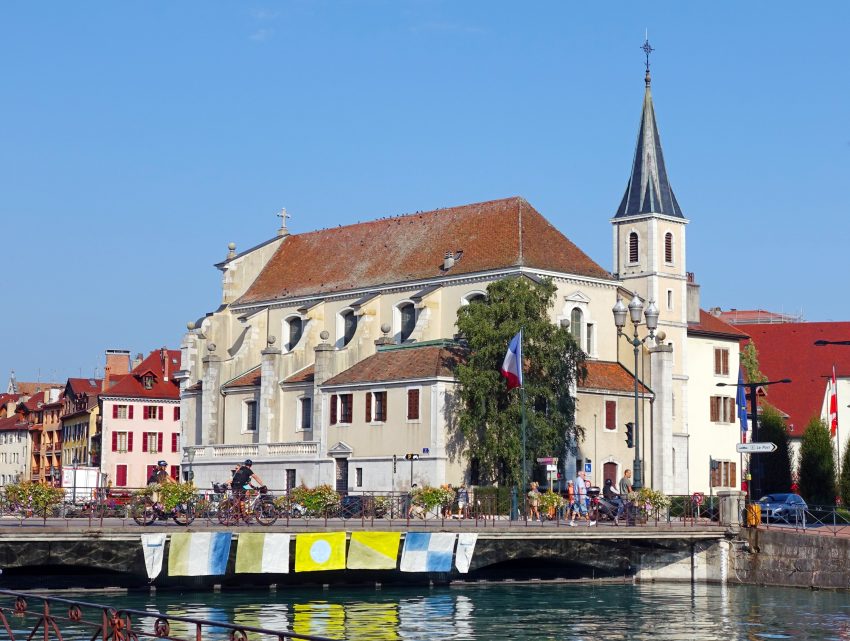
Eglise Saint-François offers a quieter, more local-feeling stop, and that contrast is valuable in a tour that can otherwise become a sequence of “pretty” views. The church sits within the lived-in fabric of Annecy, so arriving here feels less like entering a set piece and more like encountering a functioning part of the town’s daily rhythm. It is an ideal place to slow down and let the historic centre feel real rather than curated.
Architecturally, it is worth paying attention to the building’s modesty and the way its interior prioritises calm. You may notice how the light falls differently than in the cathedral, and how the atmosphere encourages a brief, unhurried visit rather than a rushed checklist. These quieter churches are often where you pick up on the subtler layers of a place—how it has been used, revisited, and reinterpreted across generations.
On your route, this stop works well as a transition between canal-watching and lakefront strolling. If you have already done the most photographed corners, Saint-François helps rebalance the experience with something more contemplative. From here, you can thread back toward the busier lanes with a fresh perspective, noticing details you might otherwise overlook.
Location: 1 Pl. Saint-François de Sales, 74000 Annecy, France | Hours: Daily: 09:00–19:00. | Price: Free; donations appreciated. | Website
3. Palais de l'Isle

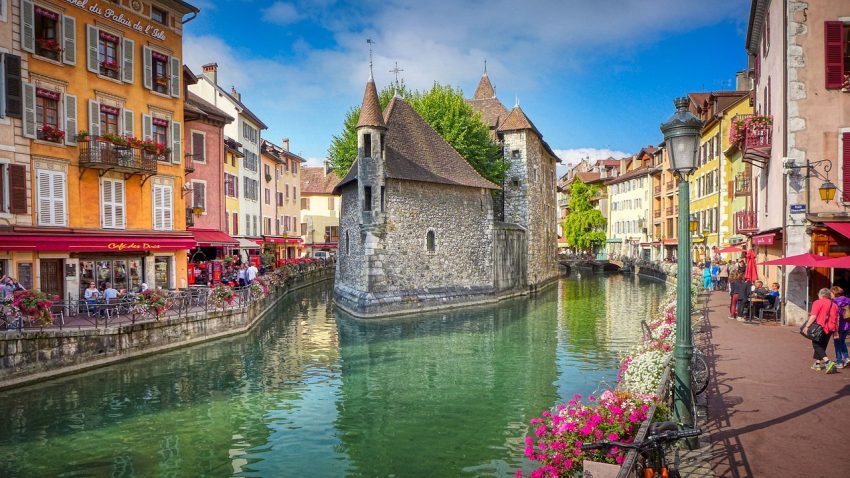
Palais de l’Isle is Annecy’s most iconic building, and it earns that status the moment you see it anchored in the canal like a stone ship. On a walking tour, it functions as both a visual highlight and an orientation point, because many of the prettiest canal views radiate from the bridges around it. The best approach is to arrive via a narrow lane so the building appears suddenly, framed by water and railings.
Spend time walking a small loop around it rather than treating it as a single photo stop. Each angle tells a different story: the pointed end feels almost nautical, while the side façades reveal how tightly the old town was built around waterways and commerce. If you visit when light is changing—early morning or late afternoon—the stone textures and reflections become even more dramatic.
Once you have your fill of the canals, use Palais de l’Isle as the pivot toward either the uphill streets or the lakefront. It naturally sits at the seam between the old town’s medieval density and the more open spaces that follow. If you are pacing your tour, this is also a smart place for a short pause, because nearby benches and café terraces make it easy to stop without losing momentum.
Location: 3 Pass. de l'Île, 74000 Annecy, France | Hours: (Summer) June 1 – September 30; Wednesday – Monday: 10:30–18:00. Closed on Tuesday. (Winter) October 1 – May 31; Wednesday – Monday: 10:00–12:30 & 14:00–17:30. Closed on Tuesday. | Price: Adults: €4 (June 1 – June 30 & September 1 – December 31) / €5 (July 1 – August 31); Children: €2 / €2.50; Under 12: free. | Website
4. Basilique de la Visitation

The Basilique de la Visitation is the “must see” you feel before you even reach it: it dominates Annecy’s skyline from its elevated position on the Crêt du Maure, and it is visible from many points along the lakefront and Old Town. On a walking tour, it works best as a deliberate climb—either a standalone detour for sweeping viewpoints or a finale after the flatter canal-and-lake circuit. The ascent is part of the experience, because the city gradually opens beneath you, and the basilica’s scale becomes more impressive the closer you get.
Unlike Annecy’s medieval core, the basilica is a 20th-century monument. The project is tied to the Order of the Visitation, founded in 1610 by Saint Francis de Sales and Saint Jeanne de Chantal, and the basilica also functions as a spiritual focal point for that tradition. Construction was begun in the early 20th century and the building was completed in 1930, based on plans associated with architect Alfred-Henri Recoura, with a crypt designed by Henri Adé beneath the nave. Inside, the tone is late-19th/early-20th-century in character, with a broad semicircular-arched vault and stained glass that narrates episodes from the lives of the two saints.
This is also a landmark for its vertical presence: the bell tower rises to roughly 275 feet (about 72 metres) and is topped by a prominent cross, and the tower contains a full carillon of 38 bells. The largest bell, Marie-Françoise, is often singled out for its weight and presence, and when the bells are active they reinforce the basilica’s role as a citywide signal point. For walking-tour planning, aim for clear weather if possible so the viewpoint pays off, and allow time to pause both outside (for the panorama) and inside (for the calmer, devotional atmosphere and the saints’ tombs).
Location: 11 Av. de la Visitation, 74000 Annecy, France | Hours: Monday – Friday: 07:15–18:30. Saturday: 07:15–12:00 & 14:00–18:30. Sunday: 09:00–18:00. | Price: Free | Website
5. Château d'Annecy

Perched above the old town, Château d’Annecy is the natural place to start if you want immediate context for the city’s layout. The climb rewards you with expanding views over the rooftops, the canal grid, and Lake Annecy beyond, so it is worth timing this stop for clear weather if you can. Even if you do not go inside, the approach alone sets the tone for Annecy as a town shaped by both defence and trade.
Architecturally, the château is a patchwork of eras, which is part of its appeal on a walking tour: you can read the evolution from medieval stronghold to later residential use in its towers, walls, and courtyards. Take a slow circuit around the exterior first, then step inside with an eye for how the building frames views outward, almost like a deliberate promenade. It is one of the best spots in town for photographs that feel distinctly “Annecy,” because the skyline and lake share the frame.
From here, the descent into the old town becomes a satisfying transition from panoramic to intimate. Pick a route that funnels you toward the canal quarter so you can watch the city change scale from broad vistas to narrow lanes. If your tour is busy later in the day, this is also a strong morning stop, when the climb is cooler and the light is softer over the lake.
Location: Pl. du Château, 74000 Annecy, France | Hours: (Summer) June 1 – September 30; Daily: 10:30–18:00. (Winter) October 1 – May 31; Monday, Wednesday – Sunday: 10:00–12:30 & 14:00–17:30. Closed on Tuesday. | Price: Adults: €6.50 (July–August: €7); Reduced: €3.50 (July–August: €4); Under 12: free. | Website
6. Porte Sainte-Claire

Porte Sainte-Claire is one of the most satisfying “threshold” moments on a walking tour of Annecy: you step through the old gateway and the city immediately tightens into arcaded lanes, canal-side corners, and the hum of the historic centre. A surviving remnant of Annecy’s former fortifications, the gate once helped control access into the medieval town and marked a key entry point on the approach from the surrounding routes, when walls and gates regulated movement and trade. Today it is a quick stop with real atmosphere—pause for a photo looking back through the arch toward Place Sainte-Claire, then continue along Rue Sainte-Claire or peel uphill toward the château for a natural old-town-to-viewpoint detour.
Location: Porte Sainte Claire, Rue Sainte-Claire, Annecy, France | Hours: 24 Hours | Price: Free | Website
7. Rue Sainte-Claire
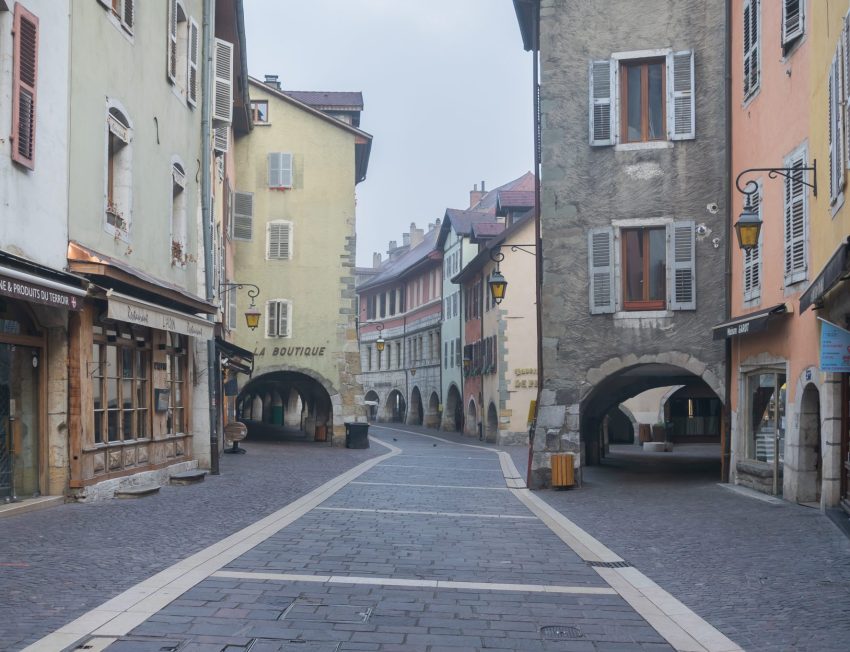
Rue Sainte-Claire is one of the most atmospheric stretches in Annecy because it combines everyday life with historic form. Its arcades create a sheltered corridor that feels inviting in any weather, and the street naturally draws you along the old town’s commercial spine. On a walking tour, it works as both a landmark and a connector, linking small squares, canal crossings, and side streets that invite detours.
The arcaded architecture is the main event here: look up at the repeated arches and the way shopfronts and façades sit in tight rhythm. You’ll notice how the street encourages strolling rather than rushing, with bakeries, small boutiques, and cafés filling the ground level. If you want to experience the street at its best, pass through twice—once in the morning when deliveries and locals set the pace, and again later when it becomes a social promenade.
Because it is central, Rue Sainte-Claire is also practical: it is a good place to schedule a brief pause without derailing your route. Step into an arcade recess to watch the flow of people, or take a short side turn toward the canals for a quieter contrast. If you are walking during peak season, treat it as a slow zone and enjoy it as a scene rather than a shortcut.
Location: Rue Sainte-Claire, 74000 Annecy, France | Hours: 24 Hours. | Price: Free.
8. Pont Morens
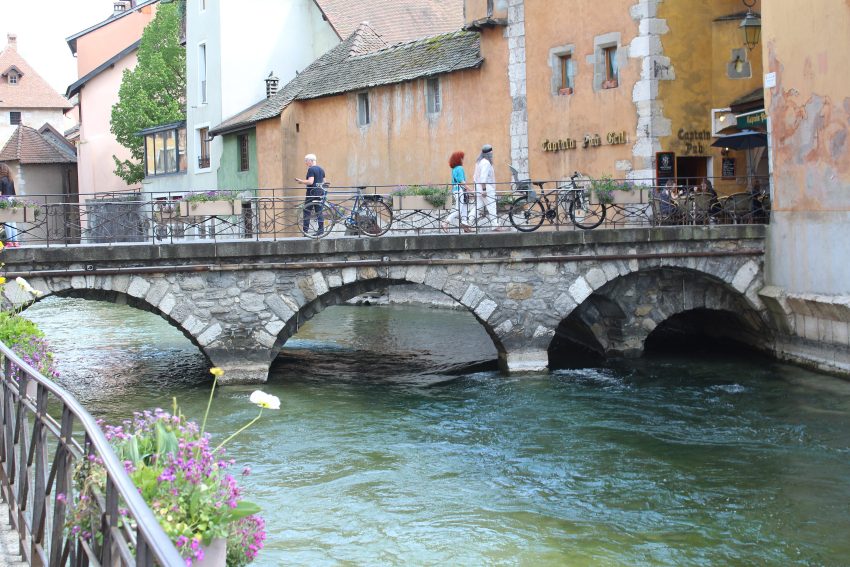
Pont Morens is one of those small, quietly photogenic canal crossings that rewards a brief, unhurried stop. On a walking tour, treat it as a “slow bridge”: step onto it, look both ways along the waterline, and take in how the façades, railings, and reflections compress Annecy into a tight, storybook scene. It is particularly effective as a short reset between busier lanes, because the view is naturally framed and encourages you to pause without needing a long detour.
For the best experience, approach from the old-town side at a relaxed pace, then turn back once you’ve crossed so you can see the canal receding behind you. Early morning and late afternoon tend to give the cleanest light and the most readable reflections; midday can be brighter but still works if you angle for texture in the stonework and water. If you are walking a loop, use Pont Morens as a natural pivot point to decide whether to continue along the canals toward the iconic viewpoints or peel off into the quieter backstreets for a calmer stretch before returning to the lakefront.
Location: Rue du Pont Morens, 74000 Annecy, France | Hours: 24 Hours. | Price: Free.
9. Annecy Cathedral
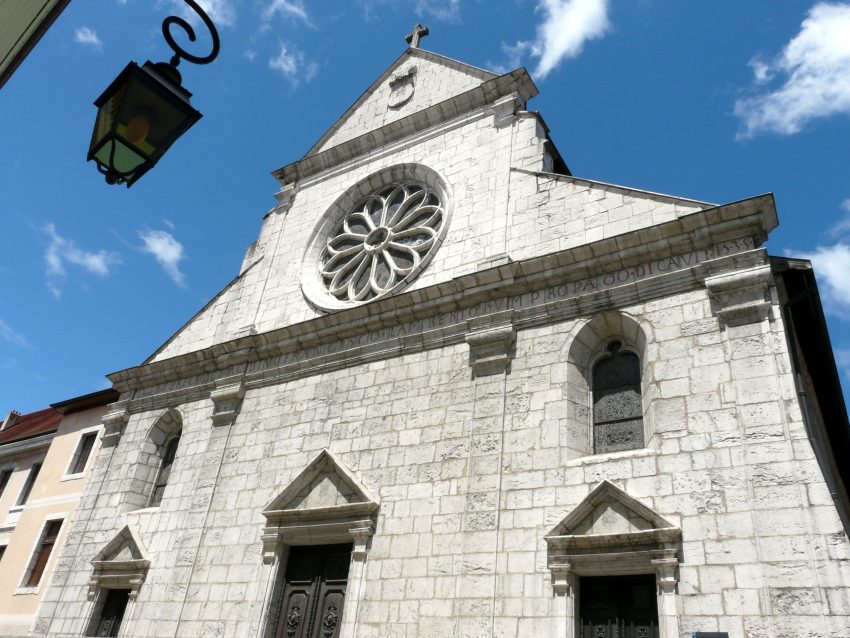
Annecy Cathedral (Cathédrale Saint-Pierre) is easy to miss if you are expecting a grand, open square, which is exactly why it makes a satisfying walking-tour stop. It sits a little apart from the canal bustle, offering a calmer pocket of the old town. Arriving here feels like stepping into a more reflective Annecy, where the pace drops and the streets narrow.
Inside, the cathedral’s atmosphere is defined by restrained elegance rather than excessive ornament. This is a place to notice proportions, light, and the gentle shift in acoustics as you move from street noise to interior hush. Even a short visit can reset your day, especially if your tour includes busier stops like the canal crossings and lakefront.
From the cathedral, you can stitch your route back toward the most photogenic waterways in minutes. Consider using this stop as a midpoint on the old-town circuit, balancing the visual intensity of canals and shopfronts with a quieter interior. It also pairs well with nearby churches, letting you compare styles and the different roles these buildings played in Annecy’s civic and spiritual life.
Location: 8 Rue Jean-Jacques Rousseau, 74000 Annecy, France | Hours: Daily: 09:00–18:00. | Price: Free; donations appreciated. | Website
10. Le Pâquier
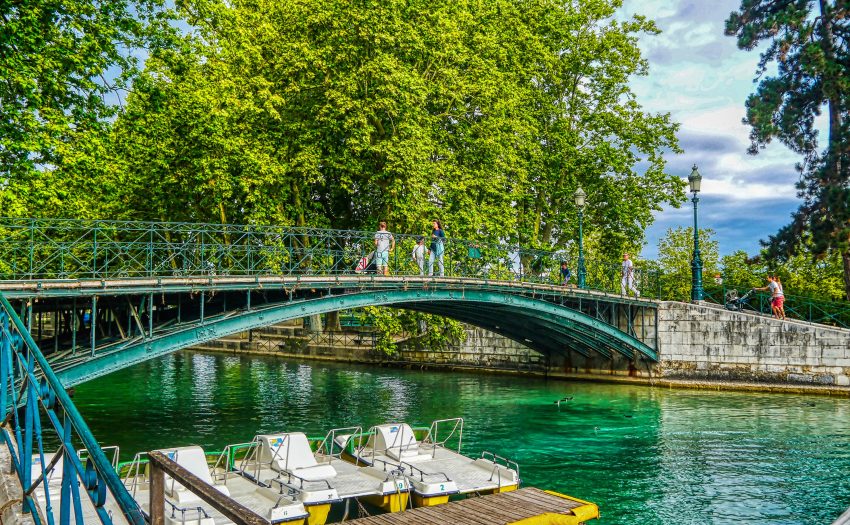
Le Pâquier is Annecy’s great open green, and it changes the feel of the city the moment you step onto it. After the density of the old town, this broad esplanade gives you space, sky, and uninterrupted views toward the lake and mountains. On a walking tour, it is the place where Annecy feels less like a medieval town and more like a resort city built for outdoor life.
The best way to experience Le Pâquier is to walk it as a long, relaxed line, letting your gaze alternate between the water and the skyline. It is also where you will see Annecy’s daily rituals: morning jogs, picnics, people reading on the grass, and families using it as a meeting ground before heading to the lakeside paths. If you have time, it is worth sitting here briefly, because the stop deepens your sense of place more than another quick landmark tick.
Logistically, Le Pâquier is an excellent end point for your route. You can finish with an unhurried promenade, choose a terrace nearby, or continue along the lake toward quieter stretches if you want to extend your walk. If the old town felt busy, this is where the day often softens, giving you a spacious finale that balances the tour’s earlier detail and texture.
Location: Av. d'Albigny, 74000 Annecy, France | Hours: 24 Hours. | Price: Free.
11. Pont des Amours
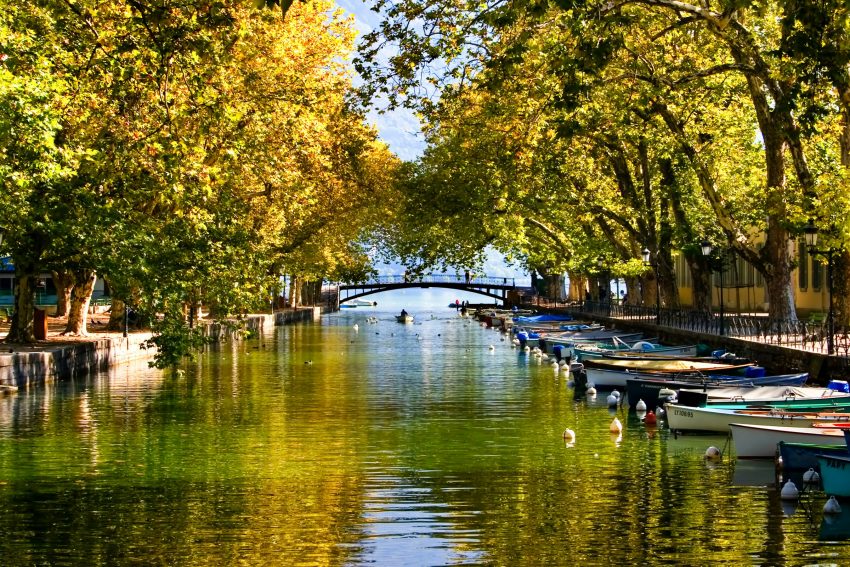
Pont des Amours is a short crossing, but it is one of the most memorable “moments” in an Annecy walk because it concentrates views in every direction. From the bridge you can look back into the canal-like outflow, across the gardens, and out toward the lake, all within a few steps. That visual range makes it a natural pause point, and in peak season you will see nearly everyone stopping for the same reason.
To enjoy it properly, do not just cross once and move on. Step to one side, take in the framing, then cross and look back from the opposite end, where the perspective shifts and the scene often becomes more symmetrical. If you are travelling with someone, this is one of the easiest places to capture a classic Annecy photo without needing to plan it.
As a routing tool, the bridge marks a clean transition: on one side, the composed greenery of Jardins de l’Europe; on the other, the more open lakefront spaces that invite longer strolling. If your tour includes a loop, this is also a convenient “turning point” that lets you decide whether to continue lakeside or head back into the old town’s lanes.
Location: Pont des Amours, 74000 Annecy, France | Hours: 24 Hours. | Price: Free.
12. Jardins de l'Europe

Jardins de l’Europe is where Annecy’s old-town compactness opens into a more expansive lakeside mood. The gardens are designed for lingering, with shaded paths, lawns, and mature trees creating a gentle buffer between the historic centre and the water. On a walking tour, it is the ideal place to slow your pace and let the setting do some of the work.
The appeal here is not a single monument but the overall composition: greenery, lake views, and glimpses back toward the town. Walk the perimeter paths first, then drift inward toward benches and viewpoints where you can watch the movement of boats, cyclists, and families. It is also one of the easiest places to feel the Alpine setting, because the horizon opens and the mountains start to frame the scene.
Use the gardens strategically. If you are touring in summer, this is a smart stop for shade and recovery before you continue across the bridge and along the promenade. If you are here in cooler months, the gardens can be brisk but beautifully clear, with crisp views across the lake. Either way, it is the calm hinge between the old town and the lakefront highlights.
Location: Quai Napoléon III, 74000 Annecy, France | Hours: 24 Hours. | Price: Free.
13. Claude Louis Berthollet

The statue of Claude-Louis Berthollet in Annecy is a worthwhile lakeside pause on a walking tour, quietly honoring the Savoyard-French chemist whose work helped shape modern chemistry and who is often associated with pioneering chlorine-based bleaching. You’ll find it in the Jardins de l’Europe, a leafy park right on the edge of Lake Annecy, where the promenade opens to wide views across the water and the mountains beyond. It is an easy stop to fold in as you transition between the Old Town and the lakefront circuit: take a minute to read the dedication, then continue on toward Pont des Amours or Le Pâquier, using the gardens as a calm reset point before the next cluster of sights.
Location: 1 Espl. de l'Hôtel de ville, 74000 Annecy, France | Hours: 24 Hours. | Price: Free
14. Eglise St. Maurice
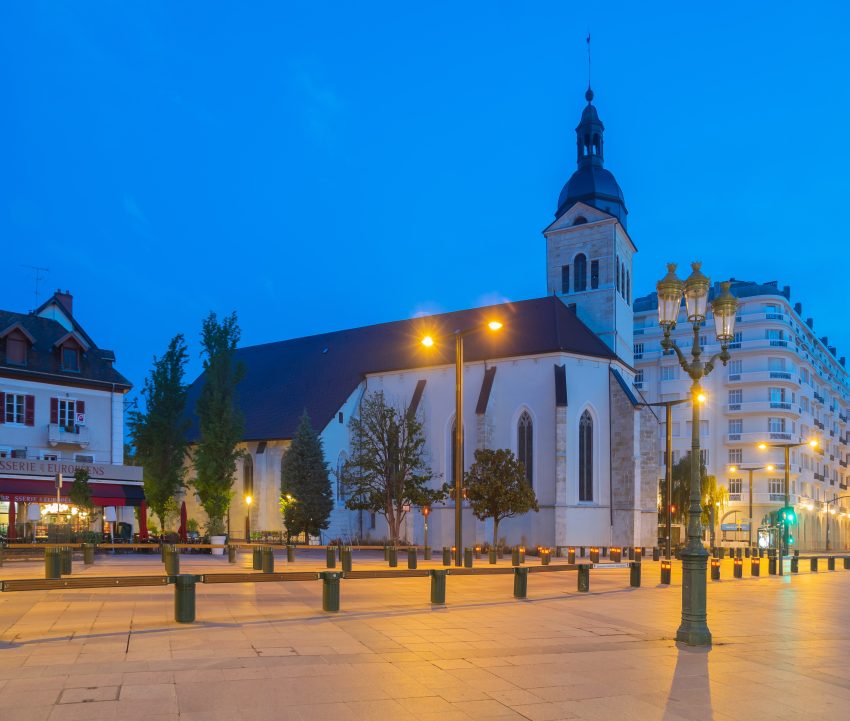
Saint Maurice is often described as Annecy’s oldest church, and whether you come for history or atmosphere, it is one of the most rewarding interior stops in the old town. The exterior blends into its surroundings more than you might expect, which makes stepping inside feel like discovering a hidden room in the city. On a walking tour, it is a strong counterpoint to the bright canal scenes outside.
Inside, look for the sense of continuity: the building’s form and chapels reflect centuries of community patronage and evolving religious life. Even if you are not deeply interested in ecclesiastical architecture, you can appreciate how the space was designed to hold a crowd, focus attention, and create a reflective pause in the middle of a busy commercial town. The quiet here tends to be genuine, especially outside peak service times.
Because it is centrally placed, Saint Maurice can be used to shape your tour’s cadence. Consider visiting after a dense sequence of bridges and lanes, when you need a change of sensory register. When you step back outside, the old town will feel sharper—the water brighter, the stonework more textured—because you have given your eyes and ears a reset.
Location: Rue Saint-Maurice, 74000 Annecy, France | Hours: 24 Hours | Price: Free; donations appreciated.
15. Église Notre-Dame-de-Liesse
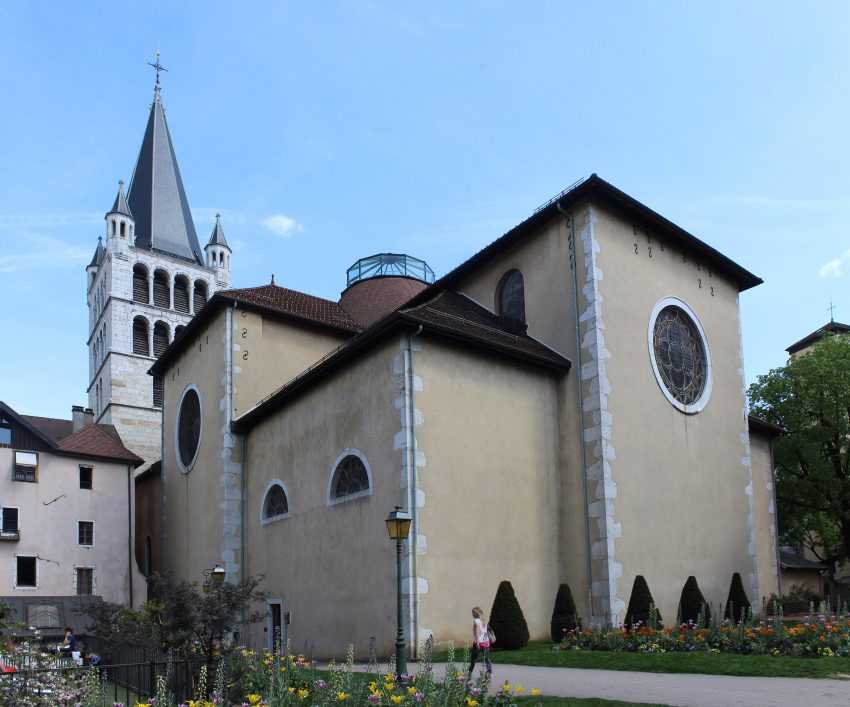
Église Notre-Dame-de-Liesse is a strong stop on an Annecy walking tour because it sits slightly back from the canal spectacle, offering a quieter, more “local” pocket of the centre. The church is easy to fold into your route as you move between the Old Town lanes and the more open civic spaces, and it provides a useful contrast to Annecy’s postcard viewpoints: here, the emphasis is on community life and continuity rather than scenery. Take a moment outside to notice how the church anchors its small square and how the surrounding streets funnel foot traffic past it.
Inside, Notre-Dame-de-Liesse works best as a brief, reflective visit. The atmosphere tends to be calm, with softer light and a more intimate scale than some of the city’s headline monuments, making it a good mid-tour reset if the canals feel busy. When you leave, continue on foot toward Rue Sainte-Claire or the Hôtel de Ville area depending on your route, using the church as a transition point between the dense historic core and the more spacious parts of the centre.
Location: Passage Notre Dame, 74000 Annecy, France | Hours: Daily: 09:00–18:00. | Price: Free; donations appreciated. | Website

Moira & Andy
Hey! We're Moira & Andy. From hiking the Camino to trips around Europe in Bert our campervan — we've been traveling together since retirement in 2020!
This website uses affiliate links which earn a small commission at no additional cost to you.
Walking Tour Summary
Distance: 3 km
Sites: 15