Wat Phnom, Phnom Penh
Buddhist Temple in Phnom Penh
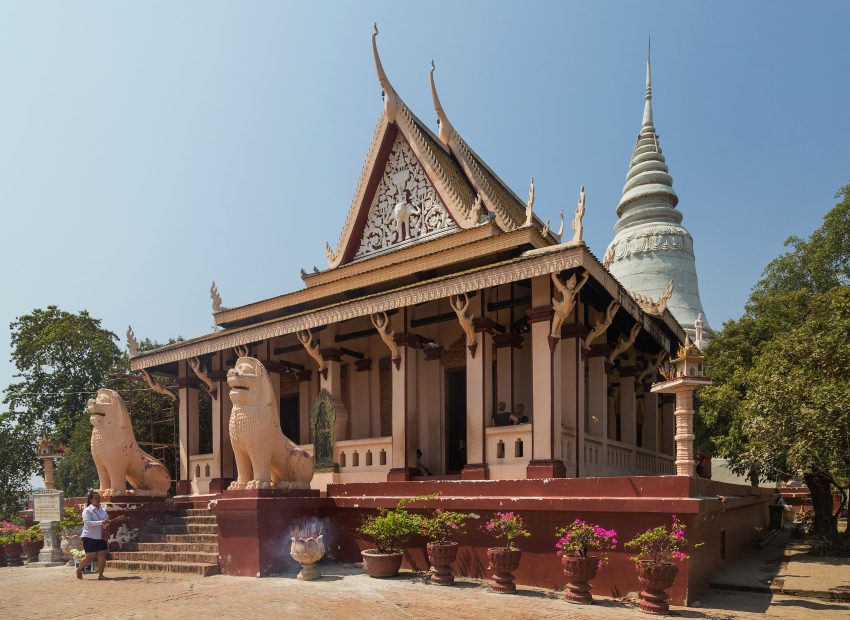
Wat Phnom rises 27 metres above Phnom Penh on a tree-covered hill, its gleaming stupa and prayer hall visible from the surrounding streets. According to legend, the city itself began here in 1372, when a wealthy widow named Lady Penh discovered sacred Buddhist statues hidden in a koki tree floating on the Tonle Sap River. She built a small shrine on the hill to house them, and over time a settlement grew at its base that eventually became Phnom Penh, making this truly one of the must-see places in Phnom Penh if you want to trace the city's story back to its roots.
Over the centuries the temple has been rebuilt and restored many times, but it still preserves a recognisably traditional Khmer character, with colourful naga balustrades, guardian lions and murals depicting scenes from the Buddha's life and Jataka tales. The central stupa is believed to hold the ashes of King Ponhea Yat, the 15th century ruler who moved the capital here, tying monarchy, myth and religion together in one compact site. Today, locals come to Wat Phnom to pray for good fortune or success in exams and business, while visitors climb the steps for a blend of spiritual atmosphere and hilltop views that make it a highlight of any walking tour of Phnom Penh.
History and Significance of Wat Phnom
Wat Phnom's origin story is central to Phnom Penh's identity. The legend tells of Lady Penh discovering four Buddha statues (and sometimes additional objects) inside a hollow koki tree drifting in the river. Seeing this as a powerful sign, she had a small shrine built on a natural hill to house them, and people began to settle around this sacred spot. The name “Phnom Penh” - literally “Penh's Hill” - reflects this origin, cementing the temple's link with the city's birth.
Historically, the site has been renewed several times, with major reconstructions recorded in 1434, 1806, 1894 and 1926. Each rebuilding responded to decay, flood damage or changing tastes, but the core idea of a hilltop sanctuary remained unchanged. The current layout, with its central stupa, vihara and surrounding shrines, shows influences from different periods layered together, yet the overall impression is still unmistakably Khmer. The central stupa is said to contain the ashes of King Ponhea Yat, who moved the capital to Phnom Penh in the 15th century, reinforcing the temple's status as both a religious focus and a royal memorial.
Wat Phnom has also served as a barometer of the city's fortunes. Through colonial times, wars and the Khmer Rouge period, the temple has remained active, though sometimes damaged or neglected. In recent decades, restoration work and renewed devotion have brought it back into focus as a key place of worship, a New Year pilgrimage site and a landmark integrated into the daily lives of Phnom Penh residents. Standing on the hill, you feel both the weight of legend and the continuity of practice that keeps this story alive.
Things to See and Do in Wat Phnom
Your visit to Wat Phnom usually begins at the foot of the hill, where grand staircases guarded by lions and naga balustrades lead up through shady trees. As you climb, you pass small shrines and offerings, with the sounds of traffic fading behind you. Take your time to look back occasionally; even halfway up, the view over the surrounding streets gives you a sense of how this modest hill once dominated the landscape.
At the top, the main vihara (prayer hall) and the central stupa form the heart of the complex. Remove your shoes before entering the vihara and step quietly inside. Here you will find a large seated Buddha surrounded by candles, incense and offerings, with vibrant murals covering the walls and ceiling. Many of these paintings illustrate episodes from the Buddha’s life and moral tales from the Jataka stories, giving you a visual introduction to Buddhist teaching. Sit for a few minutes on the floor and simply observe the flow of worshippers bringing flowers, lighting incense or seeking blessings from monks.
Outside, circle the central stupa and take in the surrounding smaller stupas and memorials. These often commemorate important figures or families and add texture to the site's history. The hilltop also offers views over parts of Phnom Penh, with glimpses of the Tonle Sap and surrounding boulevards through the trees. Depending on the time of day, you may see vendors selling incense, flowers and caged birds (which some visitors choose to release for good luck, though animal welfare concerns mean you may prefer to admire from a distance). The mix of legend, living faith and city views makes Wat Phnom a compact but rewarding stop.
How to Get to Wat Phnom
Most international travellers arrive in Cambodia via Phnom Penh International Airport, which lies to the west of the city centre and connects easily to downtown by taxi, tuk-tuk or ride-hailing services. For the best deals and a seamless booking experience, check out these flights to Phnom Penh on Booking.com.
Within Cambodia, Phnom Penh links to other major towns by road and a small number of rail routes, but in practice most visitors arrive from cities like Siem Reap or Sihanoukville by bus or minivan, then switch to local transport in the capital.Train schedules and bookings can be found on Omio. Once in Phnom Penh, Wat Phnom is a well-known landmark at the northern end of the riverside area; any tuk-tuk or taxi driver will recognise the name and can take you directly to the base of the hill.
If you are travelling by car, Wat Phnom sits at a busy roundabout at the northern end of central Phnom Penh, with access from major roads converging near the riverside. Parking is usually along nearby streets or in small informal lots; many visitors ask their driver to drop them at the entrance and pick them up later after they have explored the temple and surrounding park.
Practical Tips on Visiting the Wat Phnom
- Suggested tips: Treat Wat Phnom as both a viewpoint and a place of worship; allow time to climb slowly, sit quietly in the vihara and walk a full circuit of the hill to appreciate all sides of the site.
- Best time to visit: Early morning or late afternoon offers cooler temperatures, softer light on the temple and hill, and a better chance to see local worshippers; evenings around Buddhist holidays can be especially atmospheric.
- Entrance fee: Foreign visitors pay a small entrance fee
- Opening hours: Usually open daily during daylight hours
- How long to spend: Plan 30-60 minutes to climb the hill, visit the main hall and stupa, and enjoy the views; stay longer if you want to observe rituals or simply sit in the shaded park.
- Accessibility: The ascent involves stairs and sloping paths, which can be challenging for visitors with mobility issues; there is no lift, so those with limited mobility may prefer to stay around the base area.
- Facilities: Basic vendors near the entrance sell drinks, snacks and offerings; for cafés, restaurants and ATMs, head to the nearby riverside or central city streets a short walk or tuk-tuk ride away.
- Photography tip: Capture the temple and stupa framed by trees from halfway up the stairs, then take wider shots from below the hill to include the full height; be discreet when photographing people at prayer.
- Guided tours: Wat Phnom is often included in city tours that also visit the Royal Palace and National Museum; a guide can help unpack the founding legend, the story of King Ponhea Yat and the symbolism in the murals.
- Nearby food options: After your visit, walk or ride a short distance to the riverside or Central Market area, where you will find everything from street food to sit-down restaurants.
Where to Stay close to the Wat Phnom
Staying near Wat Phnom puts you at the northern edge of central Phnom Penh, close to both the riverside and key downtown sights. A classic riverside option within a short tuk-tuk ride or even a walk of the temple is Hotel Cambodiana, which offers river views and easy access to Wat Phnom, the Royal Palace and National Museum. Travellers looking for something a little more upscale with resort-style comforts might choose Raffles Hotel Le Royal, a historic property not far from the temple that makes a comfortable base between sightseeing sessions. For a more boutique feel in the central city, SUN & MOON Urban Hotel gives you modern rooms and a rooftop bar, with quick tuk-tuk connections to Wat Phnom, Central Market and the riverside.
Is Wat Phnom Worth Visiting
Wat Phnom is definitely worth visiting if you want to connect the modern city of Phnom Penh with its legendary beginnings. The combination of Lady Penh's founding story, the stupa said to hold King Ponhea Yat's ashes, centuries of reconstruction and its ongoing role as an active place of worship make the temple much more than just a viewpoint. From the top of the hill you see the city spread out around the very spot where its story is said to have begun, making Wat Phnom one of the must-see places in Phnom Penh for travellers interested in history, faith and urban life.
What Other Travellers Say...

Wat Phnom Daun Penh sits atop a small hill in central Phnom Penh surrounded by a shaded park, short stairs lead up past large naga (snake) balustrades to a complex of shrine buildings, a stupa and pagoda where visitors can admire many sculptures and enjoy city views; entry for foreign visitors is a modest US$1 paid in cash at the eastern ticket office, there's a craft centre with locally made souvenirs, toilets and food stalls nearby, and the grounds are popular with locals in the evenings for strolling and socializing.


FAQs for Visiting Wat Phnom
Nearby Attractions to the Wat Phnom
- Riverside promenade and Sisowath Quay: A lively riverfront strip just south of the temple, ideal for walks, cafés and sunset views over the Tonle Sap and Mekong.
- Central Market (Phsar Thmey): Phnom Penh's Art Deco market hall, perfect for combining temple time with shopping and people watching.
- National Museum of Cambodia: Home to an outstanding collection of Khmer art and sculpture, offering deeper context to Cambodia's religious heritage.
- Royal Palace and Silver Pagoda: The ceremonial and spiritual heart of the monarchy, a short tuk-tuk ride away and a natural pairing with Wat Phnom.
- Wat Ounalom: The headquarters of Cambodian Buddhism on the riverside, giving you another perspective on the city's spiritual life within easy reach of Wat Phnom.
The Wat Phnom appears in our Complete Guide to Visiting Phnom Penh!

Moira & Andy
Hey! We're Moira & Andy. From hiking the Camino to trips around Europe in Bert our campervan — we've been traveling together since retirement in 2020!
This website uses affiliate links which may earn a commission at no additional cost to you!
Planning Your Visit
Usually open daily during daylight hours
Foreign visitors pay a small entrance fee
Nearby Attractions
- Phnom Penh Night Market (0.5) km
Market - Sisowath Quay (0.8) km
Walk - Central Market (Phsar Thmey) (0.8) km
Market - Wat Ounalom (1.1) km
Buddhist Temple - National Museum of Cambodia (1.3) km
Museum - Royal Palace of Cambodia (1.6) km
Palace - Independence Monument (2.3) km
Monument - Wat Langka (2.3) km
Buddhist Temple - Tuol Sleng Genocide Museum (3.1) km
Museum - Russian Market (Phsar Toul Tum Poung) (4.0) km
Market