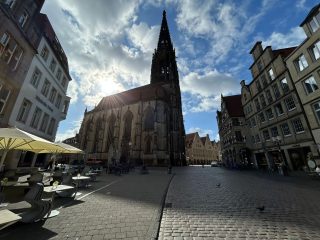
Stadtmuseum Münster
Museum in Münster

Tucked inside the historic Palais Wiedebusch in the Old Town, the Stadtmuseum Münster is where the city finally sits down and tells its story. From medieval trade and religious power to wartime destruction and post-war rebuilding, the museum pulls together objects, models, films, and photographs to show how Münster became the city you walk through today. It is one of the best places to visit in Münster if you want to understand what lies behind the pretty façades of Prinzipalmarkt and the spires of St. Paulus Dom.
Rather than focusing on a single era, the museum invites you to wander through centuries of daily life: workshops and guilds, schools and homes, festivals and protests, all presented in atmospheric galleries. Because it is centrally located in the Old Town, the Stadtmuseum is a great place to visit on a walking tour of Münster, especially if you like matching what you see in the streets with the stories and objects that shaped them.
Table of Contents
- History and Significance of the Stadtmuseum Münster
- Things to See and Do in the Stadtmuseum Münster
- How to Get to the Stadtmuseum Münster
- Practical Tips on Visiting the Stadtmuseum Münster
- Where to Stay close to the Stadtmuseum Münster
- Is the Stadtmuseum Münster Worth Visiting?
- FAQs for Visiting Stadtmuseum Münster
- Nearby Attractions to the Stadtmuseum Münster
History and Significance of the Stadtmuseum Münster
Housed in the Palais Wiedebusch, the Stadtmuseum Münster traces the city's development from its early days as a medieval trading and pilgrimage centre to its current role as a university city with a rich cultural scene. The building itself already anchors you in the historic centre, and the museum uses that location to full effect, constantly linking exhibits to nearby streets, squares, and landmarks.
The museum’s mission is broad but clear: to show how political decisions, economic shifts, and social change have shaped the daily lives of Münster’s inhabitants. It pays close attention to Münster’s role as a religious and administrative hub, its importance in regional trade, and its place in European history through events like the Peace of Westphalia. At the same time, it does not shy away from darker chapters, including the impact of World War II and the city’s subsequent reconstruction.
By combining artefacts, models, and multimedia installations, the Stadtmuseum moves beyond a static “cabinet of curiosities” and becomes a narrative space. Visitors are encouraged to see churches, townhouses, and modern shopping streets not as isolated sights, but as layers in a continuing story. That context is what makes the museum such a useful stop, whether you are in Münster for a day or exploring the city in more depth.
Things to See and Do in the Stadtmuseum Münster
Inside the Stadtmuseum, themed galleries guide you through different periods and aspects of city life. You will find period rooms furnished to evoke domestic interiors from various centuries, giving a tactile sense of how people lived, worked, and decorated their homes. Objects like tools, clothing, and household items anchor the exhibits in everyday reality rather than just big political events.
Models and reconstructions are a particular highlight. Detailed city models show Münster at different points in its history, allowing you to trace the development of major landmarks such as St. Paulus Dom, Prinzipalmarkt, and Lambertikirche. You can see how the Old Town grew, where fortifications once stood, and how wartime damage reshaped the urban fabric. For many visitors, these models provide an “aha” moment that makes walking through the city afterwards much more meaningful.
The museum’s collection of paintings, prints, and photographs adds another dimension, documenting how streets and buildings have changed-or stayed surprisingly consistent-over time. Rotating temporary exhibitions introduce focused themes, from specific neighbourhoods and historical figures to contemporary topics, so even repeat visitors can discover something new. Families will appreciate interactive elements and child-friendly explanations that make complex history accessible without oversimplifying it.
How to Get to the Stadtmuseum Münster
The Stadtmuseum Münster is located in the Old Town, in the historic Palais Wiedebusch, just a short walk from Prinzipalmarkt, Erbdrostenhof, and Domplatz, making it easy to slot into almost any central walking route. The nearest major gateway is Münster Osnabrück International Airport, with onward travel into the city centre by bus, shuttle, or taxi taking around 30 minutes. For the best deals and a seamless booking experience, check out these flights to Münster on Booking.com.
If you are arriving by train, Münster (Westf) Hauptbahnhof is well connected to regional and long-distance routes.Train schedules and bookings can be found on Omio. From the station, you can either walk into the Old Town in about 15-20 minutes or hop on a short bus ride toward the centre; from there, clear signposting and pedestrian-friendly streets lead you to the museum.
Travelling by car, follow signs for the Innenstadt and use one of the public car parks on the edge of the Old Town, as central streets around the museum are best explored on foot.If you are looking to rent a car in Germany I recommend having a look at Discover Cars, first, as they compare prices and review multiple car rental agencies for you. From the car park, it is only a few minutes’ walk through the compact historic core to reach the Stadtmuseum, which you can combine easily with nearby churches, squares, and Baroque palaces.
Practical Tips on Visiting the Stadtmuseum Münster
- Suggested tips: Start your day at the Stadtmuseum to get a historical overview, then head out into the Old Town and see how many of the places from the exhibits you can spot in real life.
- Best time to visit: Mornings or early afternoons on weekdays tend to be quieter, giving you more space to linger at the city models, films, and interactive displays.
- Entrance fee: Free
- Opening hours: Tuesday to Friday: 10:00 – 18:00; Saturday, Sunday, and public holidays: 11:00 – 18:00. Closed on Mondays
- Official website: https://www.stadt-muenster.de/museum/aktuelles
- How long to spend: Plan for 60-90 minutes for a first visit; history lovers or those exploring temporary exhibitions in depth may easily spend two hours or more.
- Accessibility: The museum is generally well equipped with lifts and accessible routes, but visitors with reduced mobility should confirm details on arrival or via the website.
- Facilities: Expect a reception area, cloakroom or lockers, toilets, and often a small shop or information point; nearby cafés in the Old Town offer plenty of options for food and drink.
- Photography tip: Look for vantage points over the city models and interesting juxtapositions of old photographs with current views seen through windows or from nearby streets.
- Guided tours: Ask about guided tours or audio guides, which can be especially helpful for understanding more complex periods such as the Anabaptist uprising or post-war reconstruction.
- Nearby food options: Step outside into the surrounding streets for bakeries, cafés, and restaurants; it is easy to find a spot for coffee or lunch within a few minutes’ walk.
Where to Stay close to the Stadtmuseum Münster
Staying near the Stadtmuseum Münster puts you right in the heart of the Old Town, with easy access to Prinzipalmarkt, Domplatz, and Baroque highlights like Erbdrostenhof. A convenient choice is Stadthotel Münster, offering modern comforts within walking distance of the museum and most major sights. For a more design-focused option a little outside the immediate centre, Factory Hotel combines industrial character with good bus and bike connections into the Old Town. If you prefer to be close to Münster (Westf) Hauptbahnhof while still having an easy stroll to the Stadtmuseum, Hotel Kaiserhof makes a solid, comfortable base.
Is the Stadtmuseum Münster Worth Visiting?
Stadtmuseum Münster is absolutely worth visiting, especially if you like to understand the stories behind the places you see. It ties together the city's churches, squares, palaces, and post-war architecture into one coherent narrative, making every subsequent step through the Old Town feel richer. By showing how trade, religion, education, and politics shaped daily life, the museum turns Münster from a collection of pretty façades into a living, evolving city, and that makes it one of the must-see places in Münster for curious travellers.
What Other Travellers Say...

Stadtmuseum Münster, at Salzstraße 28, offers a free, visitor-friendly look at the city's past with interactive displays, multi-level permanent exhibits connected by a winding staircase, and rotating temporary shows; visitors note engaging dioramas and a gift shop, limited English/signage translations are available in a few languages so most displays are understandable, and while some areas feel slightly outdated or have a confusing layout the museum is praised as worth a visit for those interested in local history.


FAQs for Visiting Stadtmuseum Münster
Nearby Attractions to the Stadtmuseum Münster
- Erbdrostenhof: Schlaun's elegant Baroque palace on Salzstraße, showcasing 18th-century aristocratic architecture just a short walk away.
- Prinzipalmarkt: Münster's historic arcade-lined main street with gabled houses, shops, and cafés at the heart of the Old Town.
- St. Paulus Dom (Münster Cathedral): The city's Romanesque-Gothic cathedral on Domplatz, known for its impressive interior and astronomical clock.
- Historical City Hall of Münster: Gothic city hall on Prinzipalmarkt, where part of the Peace of Westphalia was signed in 1648.
- Clemens Church (Clemenskirche): A beautiful Baroque church designed by Johann Conrad Schlaun, adding another layer to the city’s architectural story.
The Stadtmuseum Münster appears in our Complete Guide to Visiting Münster!

Moira & Andy
Hey! We're Moira & Andy. From hiking the Camino to trips around Europe in Bert our campervan — we've been traveling together since retirement in 2020!
This website uses affiliate links which may earn a commission at no additional cost to you!
Planning Your Visit
Tuesday to Friday: 10:00 - 18:00; Saturday, Sunday, and public holidays: 11:00 - 18:00. Closed on Mondays
Free
Nearby Attractions
- Erbdrostenhof (0.1) km
Historic Building - City Hall of Münster (0.3) km
Town Hall - Krameramtshaus (0.3) km
Historic Building - Prinzipalmarkt (0.4) km
Square - Lambertikirche (0.4) km
Church - Pablo Picasso Museum (0.5) km
Museum - Münster Cathedral (0.6) km
Cathedral - Kiepenkerl Denkmal (0.6) km
Statue - Westphalian State Museum of Art and Cultural History (0.6) km
Museum - Promenade (0.6) km
City Walls