Santa Maria della Spina, Pisa
Church in Pisa
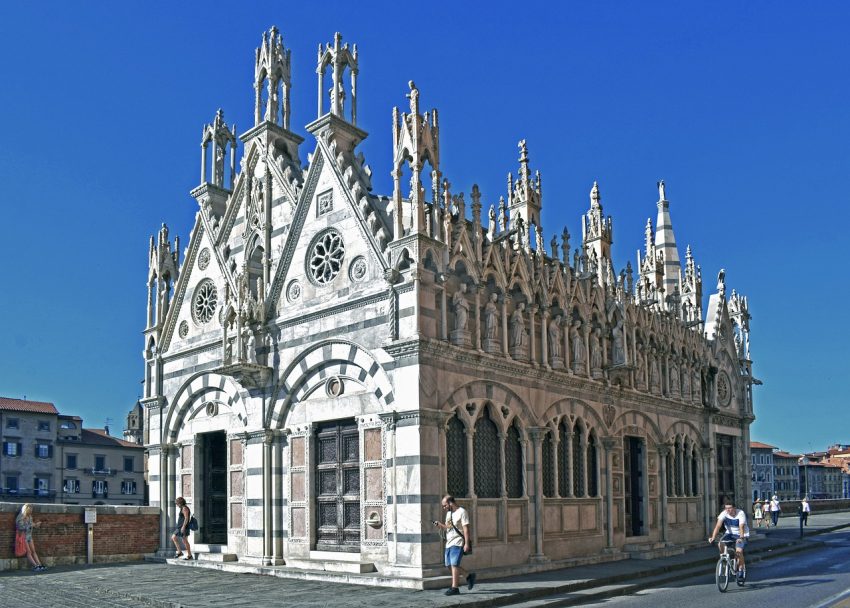
Perched on the left bank of the Arno, the Church of Santa Maria della Spina is one of Pisa's most enchanting small churches, a lace-like Gothic jewel that looks almost too delicate for its urban setting. Originally a tiny riverside oratory built right down on the water's edge, it suffered serious foundation damage over the centuries, and in 1871 it was carefully dismantled and rebuilt stone by stone at a slightly higher level, preserving its extraordinary decoration while protecting it from further erosion. Today, it feels like a miniature cathedral squeezed between river and road, and it has become one of the must-see places in Pisa for travellers who enjoy quieter, more intimate landmarks.
The church takes its name from a revered relic, a thorn believed to come from Christ's crown of thorns, brought to Pisa from the Holy Land. Its west front is richly articulated with two doorways and three sharp gables crowned by small rose windows, while the south side presents a row of arches framing doors and windows, above which niches shelter statues of Christ and the Apostles. Many of the finest original sculptures, including the Madonna del Latte, have been moved to the Museo Nazionale to save them from pollution, and replaced by copies on the exterior and inside the church. Step inside today and you will often find temporary art exhibitions occupying the space, a highlight of any walking tour of Pisa that follows the Arno and dips into the city's lesser-known corners.
Table of Contents
- History and Significance of the Church of Santa Maria della Spina
- Things to See and Do in the Church of Santa Maria della Spina
- How to Get to the Church of Santa Maria della Spina
- Practical Tips on Visiting the Church of Santa Maria della Spina
- Where to Stay close to the Church of Santa Maria della Spina
- Is the Church of Santa Maria della Spina Worth Visiting
- FAQs for Visiting the Church of Santa Maria della Spina
- Nearby Attractions to the Church of Santa Maria della Spina
History and Significance of the Church of Santa Maria della Spina
Santa Maria della Spina began life as a modest riverside oratory, built directly on the Arno's embankment in the Middle Ages. Pisa's prosperity as a maritime republic brought both wealth and a desire to display devotion, and the acquisition of a thorn from Christ's crown gave the church special status; the “spina” in its name refers to this relic, which drew pilgrims and underlined the city's spiritual prestige. Over the following centuries, the oratory was expanded and embellished, eventually becoming the richly decorated Gothic structure you see today, bristling with pinnacles, gables and sculpted figures.
By the 19th century, however, its dramatic position right on the river had become a structural liability. Flooding and ground movement undermined its foundations, and engineers feared for its survival. In 1871, a decision was made to dismantle the church stone by stone and rebuild it slightly higher and further from the water. This ambitious move preserved the overall form and decoration, even if some scholars still debate minor changes in proportion and placement. What matters for most visitors is that the church survived at all, a rare example of a Gothic shrine rescued and reassembled rather than lost.
The sculptural programme has also evolved. Many of the most delicate originals - statues from the external tabernacles and the much-loved Madonna del Latte - were transferred to the Museo Nazionale to shield them from modern atmospheric pollution. Copies now occupy their former positions on the church, allowing you to appreciate the design as a whole while the true masterpieces rest in safer conditions. This combination of in situ replicas and museum-kept originals means Santa Maria della Spina plays a double role in Pisa's story: a living urban landmark on the riverbank, and a gateway to its sculptural heritage preserved in museum galleries.
Things to See and Do in the Church of Santa Maria della Spina
Begin outside, taking your time to walk around the small footprint of the church and study its facades up close. On the west front, look at the two doorways and three gables, each capped with a tiny rose window; the layering of arches, pinnacles and crockets gives the impression of a stone reliquary enlarged to human scale. Along the south side, the rhythm of arches over doors and windows is broken by niches higher up that contain statues of Christ and the Apostles, their silhouettes standing out against the sky when viewed from across the river. Because the church is so small, you can really appreciate the craftsmanship in the tracery and sculpted details without needing binoculars.
Step inside to see how this miniature Gothic shell has been adapted in the present day. The interior is relatively simple compared with the exterior, but it often hosts temporary art exhibitions that make an interesting contrast with the historical shell. Look for the replica of the Madonna del Latte, a tender depiction of the Virgin nursing the Christ Child that echoes the original now housed in the Museo Nazionale. Even without a permanent collection, the space feels special: the sense of being within a jewel box overlooking the Arno gives exhibitions a unique atmosphere.
After your visit, it is worth walking a little way along the river to see the church in context, especially from the opposite bank. From there, Santa Maria della Spina appears almost toy-like against the larger backdrop of Pisa's palazzi and bridges, yet its elaborate silhouette immediately draws the eye. Pairing a stop here with a detour to the Museo Nazionale to see some of the original sculptures creates a satisfying loop that connects architecture, devotion and conservation in a very tangible way.
How to Get to the Church of Santa Maria della Spina
Most visitors reach Pisa via Pisa International Airport Galileo Galilei, a short distance from the city centre and linked by local buses, tram connections, trains and taxis; from there, it is straightforward to continue towards the Arno and the left bank where Santa Maria della Spina stands. For the best deals and a seamless booking experience, check out these flights to Pisa on Booking.com.
Within Italy, you can travel by train to Pisa Centrale, which has frequent connections to and from Florence, Lucca, Livorno and other Tuscan towns; from the station, it is about a 15-20 minute walk to the church, heading towards the river and then following the left bank, or you can take a local bus or taxi that drops you close to the Lungarni. Use Omnio to easily compare schedules, book train tickets, and find the best prices all in one place for a hassle-free journey across Italy.
If you are travelling by car, follow the main routes such as the A12 or the Florence-Pisa highways into the city, park in one of the signposted car parks on the edge of the historic centre and then walk down to the Arno, where you can follow the riverside Lungarno to reach the church on the left bank. If you are looking to rent a car in Italy I recommend having a look at Discover Cars, first, as they compare prices and review multiple car rental agencies for you.
Practical Tips on Visiting the Church of Santa Maria della Spina
- Suggested tips: Combine your visit with a stroll along the Arno and, if possible, a stop at the Museo Nazionale to see original sculptures that once adorned the church.
- Best time to visit: Late afternoon or early evening offers beautiful light on the marble facades and reflections in the river, while mornings are usually quieter.
- Entrance fee: Free
- Opening hours: Open only on special occasions or exhibitions
- How long to spend: Around 20-30 minutes is usually enough to see the exterior and interior, longer if there is an art exhibition you want to explore in detail.
- Accessibility: The church is small and close to street level, but there may be a step or threshold at the entrance; the surrounding Lungarno pavements are generally flat but can be uneven in places.
- Facilities: There are no extensive facilities inside; for restrooms, cafés and shops, use the nearby streets along the river and towards the city centre.
- Photography tip: Cross to the opposite bank of the Arno for full-facade shots and river reflections, then move close to capture details of gables, rose windows and statuary.
- Guided tours: Some city walking tours include Santa Maria della Spina as part of a riverside route; joining one can help place the church within Pisa's broader medieval and religious history.
- Nearby food options: The Lungarni and streets leading back towards the centre are lined with cafés, gelato shops and trattorias, ideal for a drink or meal after your visit.
Where to Stay close to the Church of Santa Maria della Spina
For easy access to Santa Maria della Spina and the Arno riverfront, consider staying near the central Lungarni or station area. A convenient option is NH Pisa, just across from Pisa Centrale and within a pleasant walk of the church along the river. If you prefer to be closer to the historic core while still near the Arno, Hotel Bologna Pisa offers a comfortable base between the station and the old town, making it simple to stroll to the riverside and the church. Travellers keen to stay near the Piazza dei Miracoli but still visit Santa Maria della Spina on foot or by a short taxi ride might choose Grand Hotel Duomo, close to the Leaning Tower and cathedral yet within reach of the Arno embankments.
Is the Church of Santa Maria della Spina Worth Visiting
The Church of Santa Maria della Spina is absolutely worth seeking out, especially if you enjoy smaller, characterful sites as much as grand monuments. Its intricate Gothic decoration, riverside setting and unusual history of being dismantled and rebuilt give it a personality all of its own, quite different from the larger buildings on the Piazza dei Miracoli. Even a short stop to walk around the exterior, step inside and then view it from across the river adds a memorable layer to your time in Pisa. For many visitors, it becomes one of the top sights in Pisa precisely because it feels like a hidden jewel rather than a crowded landmark.
What Other Travellers Say...

Chiesa di Santa Maria della Spina is a small, ornate Gothic church of white marble tucked on the south bank of the Arno in Pisa; visitors praise its intricate façade, statues and decorated ceiling and often note how it seems to perch on the river's edge, especially striking at night. Once associated with a thorn from Christ's crown, it no longer functions as a parish church but now hosts art exhibitions and displays religious artwork, with an open interior rather than pews; some visitors find the mix of modern exhibits and a sacred setting unexpected. Entrance is reported free by visitors and the building is admired as a well‑preserved example of Gothic architecture despite its compact size.


FAQs for Visiting the Church of Santa Maria della Spina
Nearby Attractions to the Church of Santa Maria della Spina
- Lungarni of Pisa: The scenic riverfront streets along the Arno, ideal for a relaxed walk before or after your visit.
- Corso Italia: One of Pisa's main shopping streets, linking the station area to the river with plenty of cafés, boutiques and everyday local life.
- Piazza dei Miracoli: Home to the Leaning Tower, cathedral, baptistery and Camposanto, reachable on foot or by bus from the church.
- Museo Nazionale di San Matteo: An important art museum where many original sculptures and artworks from Pisan churches, including Santa Maria della Spina, are preserved.
- Tuttomondo by Keith Haring: The colourful modern mural on the rear wall of Sant'Antonio Abate, near Pisa Centrale, offering a striking contemporary contrast to the city's Gothic and Romanesque heritage.
The Santa Maria della Spina appears in our Complete Guide to Visiting Pisa!

Moira & Andy
Hey! We're Moira & Andy. From hiking the Camino to trips around Europe in Bert our campervan — we've been traveling together since retirement in 2020!
This website uses affiliate links which may earn a commission at no additional cost to you!
Planning Your Visit
Open only on special occasions or exhibitions
Free
Nearby Attractions
- Lungarni of Pisa (0.1) km
- Palazzo Blu (0.3) km
Gallery and Palace - Museum of the Ancient Ships (0.3) km
Historic Building and Museum - Logge di Banchi (0.4) km
Historic Building - Corso Italia (0.4) km
Street - Murale Tuttomondo (0.5) km
Historic Site - Torre Guelfa (0.5) km
Tower - Orto Botanico dell’Università di Pisa (0.5) km
Gardens - Borgo Stretto (0.5) km
Street - Piazza Vittorio Emanuele II (0.5) km
Square