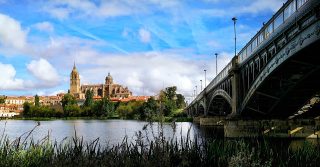
Salamanca Puente Romano
Bridge in Salamanca

The Puente Romano de Salamanca is the city's most atmospheric crossing of the River Tormes, linking the historic centre to the riverside paths in a way that feels timeless rather than touristic. It's a long, slightly uneven ribbon of stone with a steady rhythm of arches, and the moment you step onto it you get that classic Salamanca perspective: the water below, the open sky, and the cathedral skyline rising in the distance. It's one of the top sights in Salamanca because it's both a monument and a simple pleasure-just a walk, with a big payoff.
What I like most is how naturally it fits into a walking tour of Salamanca. You can wander down from the old town, cross at a relaxed pace, and then loop back along the river for a different angle on the city's façades and towers. The bridge feels especially good at golden hour, when the stone warms up and the view back toward the Old and New Cathedrals turns into the kind of scene you'll remember long after the trip.
Table of Contents
- History and Significance of the Puente Romano de Salamanca
- Things to See and Do in the Puente Romano de Salamanca
- How to Get to the Puente Romano de Salamanca
- Practical Tips on Visiting the Puente Romano de Salamanca
- Where to Stay Close to the Puente Romano de Salamanca
- Is the Puente Romano de Salamanca Worth Visiting?
- For Different Travelers
- FAQs for Visiting Puente Romano de Salamanca
- Nearby Attractions to the Puente Romano de Salamanca
History and Significance of the Puente Romano de Salamanca
The bridge is generally dated to the Roman period, often placed in the 1st century CE, when Salamanca sat on key routes through western Iberia.Its position matters: it spans one of the broad stretches of the Tormes on solid rock, making it a strategic and reliable crossing that shaped how people entered and left the city for centuries.
Structurally, it’s an impressive piece of engineering even if you only read it visually. The bridge is about 176 metres long and roughly 3.7 metres wide, built on 26 round arches supported by robust piers. Only the section closest to the city preserves most of the original Roman work, while other arches were rebuilt after damage and flooding over the centuries.
It also forms part of the historic Vía de la Plata (often translated as the Silver Route), the long north-south corridor that connected Mérida and Astorga and helped tie Salamanca into wider trade and travel networks. At the city end of the bridge, the iconic stone bull (a verraco, linked to pre-Roman Vetton culture) reinforces how layered Salamanca's history is-Roman infrastructure, medieval city, and older symbols all in the same frame.
Things to See and Do in the Puente Romano de Salamanca
First, do the simple thing: walk it end to end, slowly. The best way to appreciate the bridge is to feel its length and rhythm-arches repeating, river movement below, and the city’s skyline shifting as you go. If you cross once and then cross back later, you’ll notice how the light completely changes the mood.
Pause near the city side to look back at the cathedral cluster. The Puente Romano is one of the most reliable places in Salamanca for that “postcard angle” where the Old and New Cathedrals sit beautifully above the riverbank, especially when the sun drops and the stone turns warmer.
Before you leave the city end, look for the bull statue at the approach. It's easy to treat as a quick photo, but it's also a great “story marker” that reminds you the bridge is not just Roman-it's part of a much older cultural landscape that Salamanca inherited and reinterpreted over time.
How to Get to the Puente Romano de Salamanca
Most international visitors fly into Madrid-Barajas Airport (MAD) and continue to Salamanca by train or long-distance bus; Salamanca Airport (SLM) exists but typically has more limited options than Madrid. For the best deals and a seamless booking experience, check out these flights to Salamanca on Booking.com.
From Madrid, trains run to Salamanca (station: Salamanca), and from there it's an easy taxi ride or a walk into the historic centre and down toward the river. Train schedules and bookings can be found on Omio.
Intercity buses also connect Madrid and other nearby cities to Salamanca and can be convenient if you want a simple city-centre arrival without switching stations.
If you’re driving, aim to park on the edges of the historic centre or near the riverside and then approach on foot, since the old-town streets are better for walking than navigating by car. If you are looking to rent a car in Spain I recommend having a look at Discover Cars, first, as they compare prices and review multiple car rental agencies for you.
Practical Tips on Visiting the Puente Romano de Salamanca
- Entrance fee: Free
- Opening hours: 24 Hour
- Official website: https://www.turismocastillayleon.com/en/heritage-culture/bridges/roman-bridge-salamanca
- Best time to visit: Late afternoon into sunset is ideal for cathedral views and warm light, while early morning feels quieter and more local.
- How long to spend: Allow 30-60 minutes if you want a relaxed crossing plus time for photos and a riverside loop.
- Accessibility: The surface can be uneven and may feel challenging for wheels or limited mobility, so a slow pace and sturdy footwear help.
- Facilities: There are no facilities on the bridge itself, so plan cafés and restrooms in the old town before or after your walk.
Where to Stay Close to the Puente Romano de Salamanca
For a culture-heavy itinerary, stay in the Old Town near Plaza Mayor and the cathedral/university quarter so you can walk everywhere and dip back to your hotel easily; if your priorities are river walks, views, and a calmer base, the area around the Tormes and the Parador side can feel more spacious while still staying close to the centre.
For a scenic stay with strong viewpoints and an easy walk down toward the bridge, Parador de Salamanca is a standout. If you want a modern, comfortable base within easy walking distance of the historic core and the riverside routes, Eurostars Las Claras is a practical choice. For a stylish stay that keeps you close to the old-town lanes that lead naturally toward the river, Soho Boutique Salamanca works well.
Is the Puente Romano de Salamanca Worth Visiting?
Yes, because it’s one of those rare landmarks that doesn’t require “doing” anything to be rewarding. You get history underfoot, open air, and one of Salamanca’s best skyline views in a single, unforced experience, and it’s just as satisfying for a quick detour as it is for a longer riverside wander.
It’s also a great pacing tool in your itinerary. If you’ve spent the day in museums and monumental interiors, the bridge resets your mood-space, water, and perspective-before you head back into the tight streets for dinner.
What Other Travellers Say...

Puente Romano de Salamanca is a centuries‑old stone bridge spanning the Tormes River that's easy to walk across and offers picturesque views back toward Salamanca's skyline and cathedral; visitors praise it as a peaceful, photogenic spot ideal for a morning stroll or sunset and note a triangular phone holder at the far end that helps capture the best angles.


For Different Travelers
Families with Kids
This is an easy win for families because it’s outdoors, flexible, and naturally engaging. Kids tend to enjoy the sense of “crossing into the city,” the repeating arches, and the simple mission of spotting the bull statue at the entrance.
To keep it smooth, pair the bridge with a riverside stroll where kids can move freely, then head back into the old town for a snack stop. It’s a low-stress way to mix history with fresh air.
Couples & Romantic Getaways
For couples, the bridge is one of Salamanca’s best atmosphere walks, especially near sunset when the skyline becomes cinematic. It’s a simple plan that feels like a moment: stroll, stop for photos, and then drift back into the old town for tapas without needing a formal itinerary.
If you want something quieter, go early in the morning when the city feels calmer and the river is at its most reflective. The experience is less about “seeing a sight” and more about sharing Salamanca’s mood.
Budget Travelers
The Puente Romano is perfect for budget travel because it's free, iconic, and genuinely memorable. You can build a full, satisfying segment of your day around it: bridge crossing, river loop, skyline photos, and then an easy walk back through the old town.
It also complements paid visits well. If you’re spending on one major interior (like the cathedral complex), the bridge is the best kind of counterbalance-high impact with zero extra cost.
FAQs for Visiting Puente Romano de Salamanca
Getting There
Tickets & Entry
Visiting Experience
Tours, Context & Itineraries
Photography
Accessibility & Facilities
Food & Breaks Nearby
Safety & Timing
Nearby Attractions to the Puente Romano de Salamanca
- Cathedral of Salamanca: The Old and New Cathedrals side by side, creating the city's most dramatic monumental cluster.
- Convento de San Esteban: A monumental Dominican convent with an impressive façade and a calmer interior atmosphere.
- Casa Lis: A striking Art Nouveau and Art Deco museum in a beautiful riverside building, ideal for a change of style from stone monuments.
- Huerto de Calixto y Melibea: A small hillside garden with viewpoints that give you a quieter perspective over the old town.
- Plaza Mayor: Salamanca's grand central square, perfect for evening energy, people-watching, and tapas.
The Salamanca Puente Romano appears in our Complete Guide to Visiting Salamanca!

Moira & Andy
Hey! We're Moira & Andy. From hiking the Camino to trips around Europe in Bert our campervan — we've been traveling together since retirement in 2020!
This website uses affiliate links which may earn a commission at no additional cost to you!
Planning Your Visit
24 Hour
Free
Nearby Attractions
- Museum of Automotive History (0.3) km
- Archivo General de la Guerra Civil Española (0.3) km
Archive, Historic Site and Museum - Museo Art Nouveau y Art Déco - Casa Lis (0.4) km
Attraction, Historic Building and Museum - Escuelas Menores de la Universidad de Salamanca (0.4) km
Courtyard, Historic Building and Historic Site - Huerto de Calixto y Melibea (0.4) km
Gardens, Park and Viewing Point - Unamuno House Museum (0.4) km
- Salamanca University (0.5) km
Historic Building - Museo de Salamanca (0.5) km
Historic Building, Historic Site and Museum - Catedral Viejo y Nueva (0.5) km
Cathedral - Salamanca University Hospital (0.5) km
Attraction, Historic Building and Notable Building