Porte de la Cadène, Saint-Émilion
City Gate in Saint-Émilion
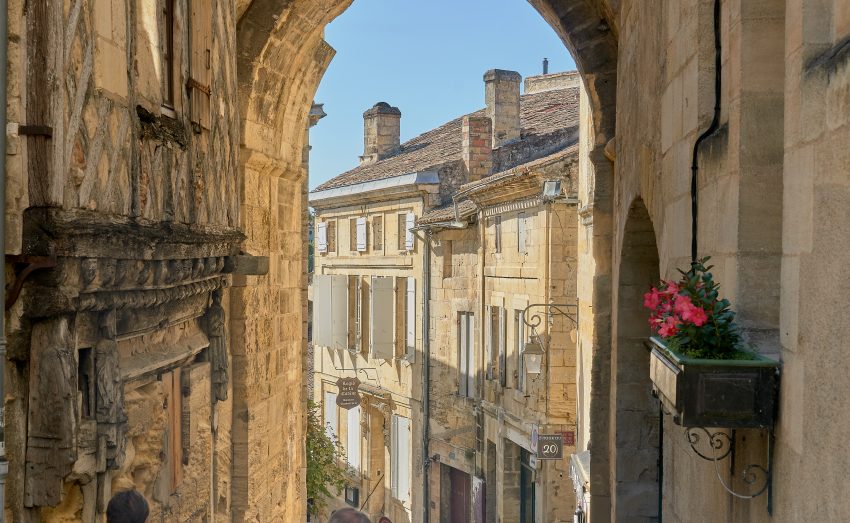
The Porte de la Cadène is one of those Saint-Émilion details you can easily miss if you're focused on tastings and viewpoints-until you're suddenly standing beneath a Gothic arch that feels like a doorway between two different versions of the town. Set on Rue de la Cadène, it's a natural pause point on a walking tour of Saint-Émilion, where the slope of the streets and the shift in atmosphere still hint at the historic divide between the upper religious quarter and the lower secular area. In a town packed with headline monuments, this spot is one of the things to see in Saint-Émilion because it's small, photogenic, and loaded with quiet meaning.
What makes the stop even better is what sits beside it: the Maison de la Cadène, the last timber-framed house in Saint-Émilion. Its carved wooden details, mullioned windows, and polygonal tower give you a rare glimpse of domestic architecture that survived when most medieval housing didn't, and it adds a human, lived-in layer to the town's grander stone landmarks. This is the kind of place that rewards a slow look-stand back for the full composition, then move closer and let the details do the storytelling.
Table of Contents
- History and Significance of the Porte de la Cadène
- Things to See and Do in the Porte de la Cadène
- How to Get to the Porte de la Cadène
- Practical Tips on Visiting the Porte de la Cadène
- Where to Stay Close to the Porte de la Cadène
- Is the Porte de la Cadène Worth Visiting?
- For Different Travelers
- FAQs for Visiting Porte de la Cadène
- Nearby Attractions to the Porte de la Cadène
History and Significance of the Porte de la Cadène
The Porte de la Cadène is generally associated with the medieval period, and it stands out because it isn't one of the better-known Romanesque gates linked to Saint-Émilion's outer walls. Instead, it reads like a more internal threshold-an architectural marker that makes sense in a town where geography shaped society, with higher ground carrying religious and institutional power and the lower streets belonging more to everyday commerce.
Its name is part of the intrigue. “Cadène” is often linked to the idea of a chain, which fits the long-standing story that a physical chain once reinforced the boundary between the two parts of town. There’s also a more personal historical explanation tied to a medieval owner’s name, which is a useful reminder that place names often preserve private histories as much as public ones.
Next to the arch, the Maison de la Cadène deepens the significance of the site. As the last timber-framed house in Saint-Émilion, it acts like a surviving fragment of an older streetscape, and its Renaissance-era flourishes suggest a town that didn't just endure the Middle Ages but continued to adapt, absorb influences, and display prosperity through architecture.
Things to See and Do in the Porte de la Cadène
Begin with the simplest ritual: walk through the arch slowly and look back. From certain angles, the Porte de la Cadène frames the street like a stage set, and you can feel how it would have signaled entry into a different quarter of town, even without any visible barrier today.
Then shift your attention to the Maison de la Cadène. Look for the timber framing and decorative carvings, and pay special attention to the polygonal tower-an unusual feature that hints at the building’s status and the way Saint-Émilion’s homes evolved over time. If you enjoy architectural details, this is a perfect stop to practice “slow travel”: fewer steps, more noticing.
Finally, treat it as a connector rather than a standalone sight. Rue de la Cadène is a lovely lane to follow toward other monuments, so this stop works best as part of a compact mini-route where you move from gateways and streetscapes to bigger churches, viewpoints, and cellars.
How to Get to the Porte de la Cadène
Most visitors arrive via Bordeaux-Mérignac Airport (BOD). For the best deals and a seamless booking experience, check out these flights to Saint-Émilion on Booking.com. From Bordeaux, you'll typically continue toward Saint-Émilion and then finish on foot once you're in the historic centre.
The nearest rail stop is Saint-Émilion station, usually reached via Bordeaux Saint-Jean. You can use SNCF Connect to check schedules, compare routes, and purchase tickets for National (SNCF ) and regional trains (TER). For a more streamlined experience, we recommend using Omio, which allows you to easily compare prices, schedules, and book tickets for both National and Regional travel across all of Europe, all in one place. From the station, you can walk uphill into town or take a short taxi ride if you want to save energy for exploring the lanes.
Local buses and shuttles can help with regional connections, but within Saint-Émilion itself, walking is the most efficient way to reach the gate and nearby monuments.
If you’re driving, plan to park outside the tight medieval core and walk in, because the centre is better experienced on foot. If you are looking to rent a car in France I recommend having a look at Discover Cars, first, as they compare prices and review multiple car rental agencies for you.
Practical Tips on Visiting the Porte de la Cadène
- Entrance fee: Free
- Opening hours: Always accessible (outdoor landmark)
- Official website: https://www.saint-emilion-tourisme.com/en/explorer/les-incontournables/les-12-monuments/la-porte-et-la-maison-de-la-cadene
- Best time to visit: Early morning is ideal for photos and a calmer atmosphere, while late afternoon gives the stone and timber warmer tones.
- How long to spend: 10-20 minutes is enough for a proper look and photos, or longer if you’re lingering to notice carvings and architectural details.
- Accessibility: The area is generally walkable, but expect uneven cobbles and slopes typical of Saint-Émilion’s medieval streets.
- Facilities: There are no dedicated facilities at the gate itself, so plan cafés and rest stops around the nearby main lanes.
Where to Stay Close to the Porte de la Cadène
For a culture-heavy itinerary, base yourself inside Saint-Émilion’s medieval centre so you can walk to the main monuments and enjoy the town after day-trippers leave; if your priority is vineyard time and quieter evenings, stay just outside the historic core for easier access to wine estates and more space.
For a central, classic base with immediate access to the lanes around the gate, Hôtel Palais Cardinal is well placed for an easy, walk-everywhere stay. If you like a smaller, characterful option right in the medieval fabric, Auberge de la Commanderie keeps you close to the town’s monuments and viewpoints. For a guesthouse feel near the centre that suits slower mornings and relaxed pacing, Les Chambres d'Ovaline is a comfortable choice.
Is the Porte de la Cadène Worth Visiting?
Yes, especially because it's effortless to include and adds a lot of texture to your walk through town. It's not a “ticketed highlight,” but it's exactly the kind of small landmark that makes Saint-Émilion feel like a living medieval place rather than a checklist of famous sites.
It’s most rewarding if you enjoy architecture and street-level history. Pairing the gate with the Maison de la Cadène turns a quick glance into a memorable moment of “how the town worked,” socially and physically, across centuries.
What Other Travellers Say...

Porte de la Cadène, located at 526 Rue de la Cadène in Saint-Émilion, is a charming historic doorway set in the village's attractive streets; visitors note its wooden door dating from the 15th–16th century and recommend strolling the lanes to discover similar sights, taking care on slippery paving and avoiding the busiest July–August crowds while favoring nearby wine producers for fair-priced bottles.


For Different Travelers
Families with Kids
This is a low-stress stop for families because it’s quick, outdoors, and naturally curiosity-friendly. Kids often enjoy the idea of a “gateway” and the hunt for carvings and details on the timber-framed house.
If you’re traveling with a stroller, the main challenge is the cobbles and slopes rather than the site itself. Keep it short, then reward everyone with a nearby snack stop to keep momentum high.
Couples & Romantic Getaways
For couples, the Porte de la Cadène is a perfect small pause that feels intimate and atmospheric, especially early or late in the day when the lane is quieter. It's also a great photo stop that captures the “medieval lane” mood without needing a formal viewpoint climb.
Use it as a gentle connector between bigger moments-gate, cloister, tasting, sunset stroll-so your day feels like a sequence of scenes rather than a series of queues.
Budget Travelers
This is one of the easiest wins in Saint-Émilion: free, central, and genuinely interesting if you like history in small doses. It also helps you build a strong self-guided day where the best moments come from walking and noticing, not paying for every stop.
Make it part of a budget-friendly loop that mixes free streetscapes and viewpoints with one paid experience you care about most, like a cellar tour or a single special tasting.
FAQs for Visiting Porte de la Cadène
Getting There
Tickets & Entry
Visiting Experience
Tours, Context & Itineraries
Photography
Accessibility & Facilities
Food & Breaks Nearby
Safety & Timing
Nearby Attractions to the Porte de la Cadène
- Collegiate Church of Saint-Émilion and Cloister: A major medieval church complex with a peaceful courtyard that's perfect for a slower-paced stop.
- Monolithic Church of Saint-Émilion: The town's most dramatic underground monument, carved from limestone and packed with atmosphere.
- Cloître des Cordeliers: A serene cloister setting that combines history with a distinctly Saint-Émilion food-and-wine vibe.
- Tour du Roy: A medieval keep you can climb for panoramic views over rooftops and vineyards.
- Les Grandes Murailles viewpoint: A scenic edge-of-town walk with open vistas and classic photo angles over the vines.
The Porte de la Cadène appears in our Complete Guide to Visiting Saint-Émilion!

Moira & Andy
Hey! We're Moira & Andy. From hiking the Camino to trips around Europe in Bert our campervan — we've been traveling together since retirement in 2020!
This website uses affiliate links which may earn a commission at no additional cost to you!
Planning Your Visit
Always accessible (outdoor landmark)
Free
Nearby Attractions
- Cloître des Cordeliers (0.1) km
Convent - Place de l’Église Monolithe (0.1) km
Square - Bell Tower of the Monolithic Church (0.1) km
Tower - Mairie de Saint-Émilion (0.1) km
Town Hall - Monolithic Church of Saint-Émilion (0.1) km
Church - Hermitage of Saint Emilion (0.1) km
Religious Building - Chapelle de la Trinité (0.1) km
Church - Collegiate Church of Saint-Émilion (0.1) km
Church - Logis de Malet (0.2) km
Historic Building - Washhouses of Saint-Émilion (0.2) km
Historic Site