Piazza del Santo, Padova
Square in Padova
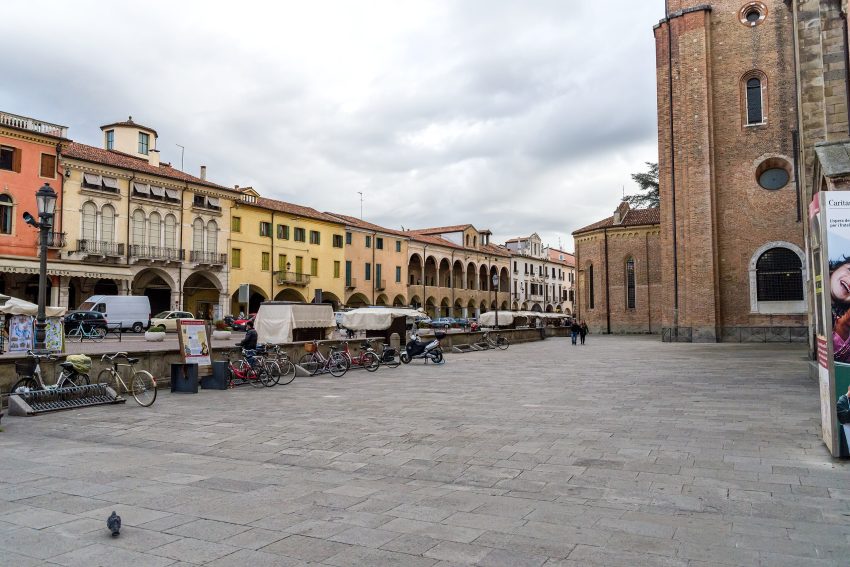
Piazza del Santo is one of the best places to visit in Padua if you want to feel the city's spiritual and artistic heart in a single glance. Spread out in front of the Basilica di Sant'Antonio, this large square is framed by café terraces and restaurants where you can sit with a coffee or aperitivo while the basilica's domes and spires dominate the skyline. The atmosphere is a blend of pilgrimage and everyday life: friars, visitors, students and locals constantly crossing the square as bells ring and street life hums along.
At its edge stands Donatello's famous equestrian statue of the Venetian commander Gattamelata, the first monumental bronze equestrian monument since Roman times and a powerful symbol of Padua's role in the early Renaissance. Around the square, smaller treasures wait to be discovered: the Museo Antoniano holds the basilica's art collection, the Scuola di Sant'Antonio is lined with frescoes of the saint's miracles, and the Oratorio San Giorgio hides more frescoes by Altichieri and Avanzi. Together, they make Piazza del Santo a highlight of any walking tour of Padua.
Table of Contents
- History and Significance of Piazza del Santo
- Things to See and Do in the Piazza del Santo
- How to Get to the Piazza del Santo
- Practical Tips on Visiting the Piazza del Santo
- Where to Stay close to the Piazza del Santo
- Is the Piazza del Santo Worth Visiting
- FAQs for Visiting Piazza del Santo
- Nearby Attractions to the Piazza del Santo
History and Significance of Piazza del Santo
Piazza del Santo grew up around the Basilica di Sant'Antonio, one of Italy's most important pilgrimage churches. As devotion to Saint Anthony increased from the 13th century onwards, Padua needed a space that could hold large crowds of worshippers on feast days and processions, and the square in front of the basilica evolved into a grand forecourt. Over time, buildings around the edges became guesthouses, shops and later cafés and restaurants, supporting both pilgrims and the local community.
The presence of Donatello’s Gattamelata, cast in the mid-15th century, underlines how closely Padua’s artistic and civic histories are tied to this space. This was the first monumental equestrian bronze to be erected since antiquity, and it announced that Padua was at the forefront of the new Renaissance spirit while still loyal to the Venetian Republic that controlled the city. The statue’s position in front of the basilica, rather than in a secular piazza, shows how faith, politics and art intersected here.
The square's significance deepened as neighbouring buildings gained new roles. The Museo Antoniano became the guardian of the basilica's art and relics, preserving centuries of devotion in paintings, sculptures and liturgical objects. The Scuola di Sant'Antonio, home to frescoes of the saint's miracles, and the Oratorio San Giorgio, with their cycle of frescoes by Altichieri and Avanzi, turned the area into an open-air gateway to some of Padua's most important 14th-century painting. Today, Piazza del Santo sits at the centre of a cluster of sites that collectively tell the story of Padua's religious, artistic and civic identity.
Things to See and Do in the Piazza del Santo
Start by walking slowly across the square to absorb the full façade of the Basilica di Sant'Antonio. The domes and campanili give it an almost Byzantine silhouette, and from the open space of the piazza you have room to step back and appreciate the layers of brickwork, arches and statues. Spend a little time people-watching from one of the cafés: it is easy to lose track of time as you watch processions of pilgrims, tour groups and locals weave in and out of the basilica doors.
Next, make your way to the equestrian statue of Gattamelata. Take a lap around the base to appreciate the detail, from the commander's armour to the horse's dynamic pose. Knowing that this work revived a form of sculpture not seen on such a scale since ancient Rome makes it even more impressive, and it is a good moment to reflect on how often Padua appears at key turning points in art history.
From the piazza you can visit the Museo Antoniano, which houses the basilica's art collection, including paintings, sculptures and objects connected to the cult of Saint Anthony. Then climb to the upper level of the Scuola di Sant'Antonio to view the 17 frescoes depicting his miracles, heavily restored but still vivid in their storytelling. Just next door, step into the Oratorio San Giorgio to see further frescoes by Altichieri and Avanzi, a quiet space where you can stand close to some of the city's most important 14th-century paintings. When you emerge back into Piazza del Santo, the square will feel different, as you now understand how much art and history is concentrated around this one open space.
How to Get to the Piazza del Santo
Piazza del Santo is located just southeast of Padua's historic centre, in front of the Basilica di Sant'Antonio, and is easy to reach once you are in the city. The nearest major airport is Venice Marco Polo, with Treviso Airport also serving many low-cost flights into the region; from both, you can reach Padua by bus, shuttle or train via Mestre or Venice before continuing on foot or by local transport to the square. For the best deals and a seamless booking experience, check out these flights to Padova on Booking.com.
By train, take a regional or high-speed service to Padova railway station, which sits on the main Venice-Milan and Venice-Bologna lines. Use Omnio to easily compare schedules, book train tickets, and find the best prices all in one place for a hassle-free journey across Italy. From the station, you can walk to Piazza del Santo in around 20-25 minutes through the historic centre, or take the tram towards Prato della Valle and walk the final stretch along Via Belludi, which leads directly to the basilica and the piazza.
If you are travelling by car, Padua is close to the A4 and A13 motorways, with clearly marked exits into the city. If you are looking to rent a car in Italy I recommend having a look at Discover Cars, first, as they compare prices and review multiple car rental agencies for you. Park in one of the car parks around the edge of the old town or near Prato della Valle, then continue on foot through the historic streets to reach Piazza del Santo; once you are in the centre, walking is the most convenient way to get around.
Practical Tips on Visiting the Piazza del Santo
- Suggested tips: Combine time in the square with a full visit inside the basilica, Museo Antoniano, Scuola di Sant’Antonio and Oratorio San Giorgio so you appreciate both the open-air atmosphere and the rich art behind the doors.
- Best time to visit: Early morning and late afternoon are ideal for softer light on the basilica façade and fewer crowds; evenings can be especially atmospheric when the square quietens and the church is illuminated.
- Entrance fee: Piazza del Santo is free to enter; the basilica is free, while some adjoining museums and chapels may charge a small entrance fee or request a donation.
- Opening hours: The square is accessible at all times; the basilica, Museo Antoniano, Scuola di Sant’Antonio and Oratorio San Giorgio each have their own visiting hours, usually posted on site.
- How long to spend: Allow at least 1-2 hours to enjoy the square and explore the basilica and one or two neighbouring sites; art lovers may want half a day to take in all the frescoes and collections.
- Accessibility: The piazza itself is flat and generally accessible; access to some chapels and upper floors (such as in the Scuola di Sant’Antonio) may involve steps, so check locally if mobility is a concern.
- Facilities: You will find plenty of cafés, restaurants and souvenir shops around the square, plus nearby public restrooms or facilities inside museum areas.
- Photography tip: Capture wide shots of the basilica from the far side of the square, then move closer to frame Gattamelata against the church façade; early morning gives you softer light and fewer people in the frame.
- Guided tours: Consider joining a guided tour that covers the basilica complex and nearby frescoed oratories to understand the stories behind the artworks and the life of Saint Anthony.
- Nearby food options: Take advantage of the terrace cafés and trattorie directly on the square or wander a few streets away for slightly quieter spots favoured by locals and students.
Where to Stay close to the Piazza del Santo
Staying near Piazza del Santo is ideal if you want to experience the basilica and its square at different times of day, from early-morning calm to evening serenity after most day-trippers have gone. Directly overlooking the basilica, Hotel Donatello offers simple, comfortable rooms and unbeatable proximity to the piazza. Just a short walk away along Via Belludi, Hotel Belludi 37 provides a boutique feel with stylish rooms, making it easy to stroll between Piazza del Santo, Prato della Valle and the historic centre. Another convenient nearby option is Hotel Al Santo, which gives you quick access to the basilica complex while still being within comfortable walking distance of other major sights.
Is the Piazza del Santo Worth Visiting
Piazza del Santo is absolutely worth visiting, even if you have only a short time in Padua. It brings together several of the city's key experiences in one place: the grandeur of the Basilica di Sant'Antonio, the artistic legacy of Donatello's Gattamelata, the intimacy of frescoed chapels, and the simple pleasure of sitting at an outdoor café watching the flow of pilgrims and locals. Few squares manage to feel both like an international pilgrimage site and a neighbourhood meeting point, but Piazza del Santo does exactly that.
With important museums and oratories just steps away, you can easily build an itinerary around the square that moves between open-air people-watching and quiet moments in front of centuries-old frescoes. For many travellers, this mix of devotion, art, history and everyday life makes Piazza del Santo one of the must-see places in Padua and a spot they find themselves returning to more than once during their stay.
What Other Travellers Say...

The Basilica of St. Anthony on Piazza del Santo is a vast Catholic church topped by Byzantine-style domes, with a Romanesque exterior and richly decorated Byzantine interior; visitors praise its solemn, moving atmosphere, numerous chapels and artworks, notable tomb and altar area housing St. Anthony's relics (and other saints' relics), free entry, evening lighting that suits a night visit, and opportunities for quiet prayer and occasional personal blessings.


FAQs for Visiting Piazza del Santo
Nearby Attractions to the Piazza del Santo
- Basilica di Sant'Antonio: Padua's most famous church and major pilgrimage site, towering over the piazza with its multiple domes and richly decorated interior.
- Orto Botanico di Padova: The university botanical garden, a UNESCO World Heritage Site and peaceful green space just a short walk from the square.
- Prato della Valle: One of Europe's largest squares, with a central island, statues and encircling canal, ideal for a stroll before or after visiting the basilica area.
- Museum of the History of Medicine of Padua (MUSME): An interactive museum in the former San Francesco hospital, exploring centuries of medical science and Padua's role in it.
- Palazzo della Ragione and the market squares: The vast medieval hall and the bustling markets of Piazza delle Erbe and Piazza dei Frutti, offering a vivid taste of Padua's civic and commercial life.
The Piazza del Santo appears in our Complete Guide to Visiting Padova!

Moira & Andy
Hey! We're Moira & Andy. From hiking the Camino to trips around Europe in Bert our campervan — we've been traveling together since retirement in 2020!
This website uses affiliate links which may earn a commission at no additional cost to you!
Planning Your Visit
The square is accessible at all times; the basilica, Museo Antoniano, Scuola di Sant’Antonio and Oratorio San Giorgio each have their own visiting hours, usually posted on site.
Piazza del Santo is free to enter; the basilica is free, while some adjoining museums and chapels may charge a small entrance fee or request a donation.
Nearby Attractions
- Basilica di Sant'Antonio (0.1) km
Basilica - Orto Botanico (0.2) km
Gardens - MUSME - Museum of the History of Medicine (0.4) km
Museum - Prato della Valle (0.4) km
Square - Palazzo Bo (0.6) km
Historic Building and Palace - Cafe Pedrocchi (0.7) km
Historic Building - Palazzo della Ragione (0.7) km
Historic Building and Market - Piazza dei Signori (0.8) km
Square - Duomo di Padova (0.8) km
Cathedral - Torre dell'Orologio (0.9) km
Tower