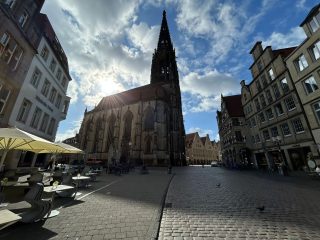
Münster Cathedral
Cathedral in Münster

St. Paulus Dom, better known to many visitors as Münster Cathedral, is one of the top attractions in Münster and the building that immediately anchors you in the city. Its twin towers, massive stone walls, and blend of Romanesque solidity with Gothic elegance make it impossible to miss as you step onto Domplatz. From the outside, the cathedral feels both fortress-like and intricate, with carved portals, tracery windows, and sculpted details that reward a slow, lingering look.
Step inside and the mood shifts from monumental to contemplative. High vaults draw your eyes upward, coloured light from stained glass washes across the floor, and chapels and side aisles invite you to wander quietly at your own pace. Add in the famous astronomical clock, centuries of sacred art, and the constant rhythm of services and concerts, and it becomes clear why St. Paulus Dom is a highlight of any walking tour of Münster.
Table of Contents
History and Significance of St. Paulus Dom
St. Paulus Dom stands on a site that has seen Christian worship for many centuries, but the present cathedral was largely constructed in the 13th century, replacing an earlier church. This medieval rebuilding gave Münster a new episcopal seat that combined Romanesque massing with Gothic height and light, reflecting the changing architectural tastes of the time. Over the years, fires, wars, and shifting liturgical needs have all left their mark, leading to restorations that layered new details onto the old core.
The cathedral’s exterior tells much of this story in stone. Rounded arches and thick walls recall its Romanesque roots, while pointed windows, traceries, and sculptural flourishes speak of the Gothic desire for verticality and ornament. Later additions and repairs, especially after wartime damage, have kept the building in use while respecting its historic appearance, making the Dom a living document of Münster’s resilience.
Beyond architecture, St. Paulus Dom has long been a centre of spiritual and civic life. As the seat of the bishop, it has hosted major religious ceremonies, processions, and moments of collective memory. Inside, tombs, memorials, and votive offerings trace centuries of local devotion and power, while the cathedral's ongoing role in worship and music keeps it firmly rooted in the present.
Things to See and Do in St. Paulus Dom
Inside the cathedral, give yourself time to soak up the overall atmosphere before diving into specific highlights. The first impression of the nave-with its high, ribbed vaults and rhythmic columns-is powerful, especially when beams of light filter in through the stained glass. Side chapels and altars, each with their own sculptures, paintings, and devotional objects, reward slow exploration; some visitors light a candle or sit quietly for a few minutes of reflection.
One of the most unmissable features is the astronomical clock, a masterpiece of Renaissance engineering and artistry dating back to the 16th century. More than just a timepiece, it tracks the phases of the moon, the positions of the sun and stars, and religious feast days, all framed by richly painted figures and symbolic motifs. Try to time your visit to coincide with one of its daily displays, when moving figures and chimes bring it vividly to life.
Elsewhere in the cathedral, look for the Bishops’ Gallery, choir stalls, and carefully carved wooden furnishings that reveal the craftsmanship of earlier centuries. Sculptures and paintings-some solemn, some richly decorative-reflect different periods of religious art, from medieval piety to Baroque drama. Even small details, like the stonework around doorways or the iron fittings on old doors, add to the sense that this is not just a monumental building but a place shaped by countless hands over time.
How to Get to St. Paulus Dom
St. Paulus Dom sits on Domplatz in the very heart of Münster, making it easy to reach once you are in the city. The nearest major gateway is Münster Osnabrück International Airport, with flights from selected European destinations and good onward connections by bus or taxi into the city centre. For the best deals and a seamless booking experience, check out these flights to Münster on Booking.com. Larger airports such as Düsseldorf or Cologne/Bonn can also serve as entry points, followed by train connections to Münster.
Münster is exceptionally well connected by rail, and arriving by train is one of the most convenient ways to reach the cathedral.Train schedules and bookings can be found on Omio. From Münster (Westf) Hauptbahnhof, it is about a 15-20 minute walk through the compact centre, or a short ride on local buses that stop close to Domplatz. The walk itself is pleasant, taking you past shops, historic buildings, and bike-filled streets that give Münster its distinctive student-city vibe.
If you are travelling by car, follow signs for the Innenstadt (city centre) and look for public car parks around the edge of the Old Town, as driving directly onto Domplatz is generally restricted.If you are looking to rent a car in Germany I recommend having a look at Discover Cars, first, as they compare prices and review multiple car rental agencies for you. Once parked, you can easily walk to the cathedral in a few minutes, using church towers as your landmark. Cyclists will find Münster particularly friendly, with bike lanes and parking stands making it simple to include St. Paulus Dom as a stop on a two-wheeled tour of the city.
Practical Tips on Visiting St. Paulus Dom
- Suggested tips: Step in more than once if you can-visit during a quiet daytime moment and again when an organ rehearsal or evening light changes the mood of the nave.
- Best time to visit: Mornings are often calmer and ideal for photography; late afternoon can be beautiful too, especially when the light through the stained glass becomes richer.
- Entrance fee: Free
- Opening hours: Weekdays: 6:30 a.m. to 7:00 p.m. Sundays and public holidays: 6:30 a.m. to 7:00 p.m.
- Official website: https://www.paulusdom.de/
- How long to spend: Allow 45-90 minutes to appreciate the interior, chapels, and astronomical clock without rushing; longer if you join a guided tour or attend a service or concert.
- Accessibility: Main entrances and central areas are relatively accessible, but some chapels, galleries, or any tower climbs may involve steps and uneven floors.
- Facilities: Basic facilities include information points and sometimes a small shop or leaflet stand; cafés, toilets, and additional services are available around Domplatz and the nearby streets.
- Photography tip: If permitted, avoid flash and bring a camera that handles low light; wide-angle shots capture the full height of the nave, while close-ups of the clock and stained glass reveal intricate details.
- Guided tours: Check for scheduled tours or audio guides, which are invaluable for understanding the astronomical clock, historical episodes, and the symbolism hidden in the art and architecture.
- Nearby food options: Domplatz and the surrounding Old Town are full of bakeries, traditional restaurants, and cosy cafés where you can warm up with coffee and cake after your visit.
Where to Stay close to St. Paulus Dom
Staying near St. Paulus Dom puts you right at the centre of Münster's historic core, with most major sights and plenty of cafés and shops just a short stroll away. A comfortable, central option is Stadthotel Münster, which offers modern rooms within walking distance of Domplatz and the Prinzipalmarkt. For a slightly more upscale feel, Factory Hotel sits in a redeveloped industrial complex with distinctive design and good transport links into the centre. If you prefer a smaller, classic-style stay close to the Old Town, Hotel Kaiserhof gives you easy access to both the Hauptbahnhof and the cathedral area.
Is St. Paulus Dom Worth Visiting?
St. Paulus Dom is absolutely worth visiting, even if you only have a short time in Münster. It is not just an impressive church, but a compact summary of the city's spiritual, artistic, and architectural history, all gathered under one roof and framed by the lively bustle of Domplatz outside. From the soaring interior and richly detailed chapels to the extraordinary astronomical clock, the cathedral offers depth and beauty at every turn, making it one of the must-see places in Münster for first-time visitors and repeat travellers alike.
What Other Travellers Say...

St.-Paulus-Dom on Dompl. 28 in Münster is a medieval Romanesque cathedral notable for its unusual astronomical clock that runs counter-clockwise; visitors describe it as beautiful and praise the experience.


FAQs for Visiting St. Paulus Dom
Nearby Attractions to St. Paulus Dom
- Prinzipalmarkt: Münster's historic main street, lined with gabled houses, arcades, and shops, just a short walk from Domplatz.
- Lamberti Church (Lambertikirche): A striking Gothic church with a famous tower and a powerful connection to the city's Reformation and Anabaptist history.
- City Hall of Münster (Rathaus): A beautiful Gothic building where the Peace of Westphalia was negotiated, now featuring historic halls and exhibitions.
- Überwasserkirche: A picturesque church just across the Aa River, offering a quieter, atmospheric counterpoint to the cathedral.
- Lake Aasee: A large urban lake southwest of the centre, ideal for a stroll, boat trip, or relaxed break after exploring the Old Town and cathedral.
The Münster Cathedral appears in our Complete Guide to Visiting Münster!

Moira & Andy
Hey! We're Moira & Andy. From hiking the Camino to trips around Europe in Bert our campervan — we've been traveling together since retirement in 2020!
This website uses affiliate links which may earn a commission at no additional cost to you!
Planning Your Visit
Weekdays: 6:30 a.m. to 7:00 p.m.
Sundays and public holidays: 6:30 a.m. to 7:00 p.m.
Free
Nearby Attractions
- Kiepenkerl Denkmal (0.1) km
Statue - Prinzipalmarkt (0.2) km
Square - Westphalian State Museum of Art and Cultural History (0.2) km
Museum - Lambertikirche (0.2) km
Church - Überwasserkirche (0.2) km
Church - Krameramtshaus (0.3) km
Historic Building - City Hall of Münster (0.3) km
Town Hall - Pablo Picasso Museum (0.3) km
Museum - Buddenturm (0.4) km
Tower - Erbdrostenhof (0.5) km
Historic Building