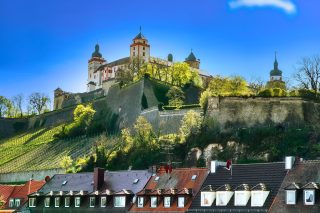
Marienberg Fortress, Würzburg
Castle in Würzburg

Marienberg Fortress is the landmark you keep spotting from almost everywhere in Würzburg: a vast hilltop complex of walls, bastions, towers, and courtyards that looks built to last forever. Perched above the Main River, it's both a historic seat of power and a superb viewpoint, with the kind of sweeping panorama that makes you understand the city's layout in one glance.
As a visitor, it's easy to treat it as a simple “castle stop,” but it's more rewarding if you see it as one of the top sights in Würzburg with multiple layers: a defensive ring you can walk, pockets of calm in the gardens, and museum spaces that add depth beyond the views. It also works naturally as a highlight on a walking tour of Würzburg, especially if you like routes that climb for a payoff.
Table of Contents
- History and Significance of the Marienberg Fortress
- Things to See and Do in the Marienberg Fortress
- How to Get to the Marienberg Fortress
- Practical Tips on Visiting the Marienberg Fortress
- Where to Stay Close to the Marienberg Fortress
- Is the Marienberg Fortress Worth Visiting?
- For Different Travelers
- FAQs for Visiting Marienberg Fortress
- Nearby Attractions to the Marienberg Fortress
History and Significance of the Marienberg Fortress
The fortress began taking its recognisable form in the late 12th century, when a major castle was built on the Marienberg hill and then expanded over centuries into a powerful symbol of Würzburg’s Prince-Bishops. Those rulers shaped the city and the wider Franconian region for generations, and the fortress became both their strategic stronghold and their statement of authority.
What makes Marienberg especially interesting is how clearly you can see change over time. Late medieval elements sit alongside Renaissance additions, and later fortifications wrap the complex in that unmistakable bastioned silhouette. Even without a guide, the sheer scale of the outer defenses tells you this was built to impress as much as to protect.
World War II left the fortress heavily damaged, and post-war reconstruction was a long project-an important part of why the site feels both ancient and carefully renewed. Today it stands as a reminder of Würzburg’s resilience, and as a living piece of the city’s identity rather than a relic set apart from daily life.
Things to See and Do in the Marienberg Fortress
Start with the viewpoints around the outer walls, because they give you instant context: the Main River bends, the Old Town clusters, and key landmarks (like the bridges and church towers) align into a map you can actually read. If you’re short on time, this “walk the viewpoints” approach delivers maximum impact with minimal planning.
Next, slow down in the courtyards and gardens, where the fortress shifts from dramatic to surprisingly peaceful. The Princes’ Garden is a lovely pause point when you want a calmer, more reflective moment between wall-walking and museum interiors, especially on warm days.
If you enjoy museums, plan to include the Museum für Franken within the complex, which adds art and regional history to the visit and makes the fortress feel like a full half-day destination rather than a single photo stop. If you prefer story and structure, consider the official fortress tour, which helps connect what you’re seeing to the big events and personalities that shaped the site.
How to Get to the Marienberg Fortress
The nearest major airports are Frankfurt Airport (FRA) and Nuremberg Airport (NUE). For the best deals and a seamless booking experience, check out these flights to Würzburg on Booking.com.
Würzburg Hauptbahnhof is the main station, with frequent long-distance connections that make arriving by rail straightforward, and you can build the fortress into your first afternoon in the city. Train schedules and bookings can be found on Omio.
From the Old Town, the classic approach is to walk via the Alte Mainbrücke (Old Main Bridge) and climb up toward the fortress for increasingly good views as you go. If you want to save your legs, seasonal local buses run up toward the “Festung” area, which can be a smart choice on hot days or when you're short on time.
If you’re driving, use the fortress parking area (paid) or a central car park and treat the final stretch as a short walk, since the access roads and pedestrian sections are easier to manage that way. If you are looking to rent a car in Germany I recommend having a look at Discover Cars, first, as they compare prices and review multiple car rental agencies for you.
Practical Tips on Visiting the Marienberg Fortress
- Entrance fee: Free for the outdoor areas; fortress tour tickets: €4 (regular) / €3 (reduced), under 18s free.
- Opening hours: (Summer) April – October; Tuesday – Sunday: 09:00–18:00. (Winter) November – March; Tuesday – Sunday: 10:00–16:30. Closed on Monday. Closed on 1 January, Shrove Tuesday, 24 December, 25 December & 31 December.
- Official website: https://www.schloesser.bayern.de/englisch/palace/objects/wu_fest.htm
- Best time to visit: Go earlier in the day for clearer viewpoints and a calmer walk along the walls, then stay into late afternoon if you want warmer light over the Old Town.
- How long to spend: Allow 2-3 hours for viewpoints, courtyards, and gardens, or 3-5 hours if you also want a museum visit and a guided tour.
- Accessibility: Expect steep approaches, uneven surfaces, and lots of steps in certain areas; if mobility is limited, focus on the most accessible viewpoints and plan transport up rather than walking.
- Facilities: You’ll find basic visitor services on-site seasonally, but the best range of cafés and rest stops is back down in the Old Town near the river and main squares.
Where to Stay Close to the Marienberg Fortress
For a culture-heavy itinerary, the best base is Würzburg’s Altstadt near the Main River and the central squares, so you can walk to major sights and choose when to tackle the fortress climb rather than commuting across town.
For a reliable, well-connected stay that keeps you close to the riverfront and an easy walk into the centre, consider Maritim Hotel Würzburg. If you want a classic, central hotel feel right by the Old Town shopping and sightseeing lanes, Hotel Würzburger Hof is a strong base. For a modern, good-value option in a very central position, Motel One Würzburg works well for walkability and easy transport access.
Is the Marienberg Fortress Worth Visiting?
Yes, and it's worth doing properly rather than as a quick dash. The combination of scale, history, and viewpoints is hard to beat, and it gives you the “big picture” of Würzburg in a way that street-level sightseeing can't.
It’s especially rewarding if you enjoy places that feel like a layered landscape rather than a single building. Even with partial closures or construction phases, the outer areas and viewpoints alone usually justify the trip up the hill.
What Other Travellers Say...

Marienberg Fortress, a reconstructed 13th-century stronghold set above Würzburg, houses art and history exhibits and is surrounded by formal terrace gardens and vineyards that make for a scenic stroll; visitors praise the climb from the river or old town for rewarding views, recommend walking rather than parking, and note that much of the interior is currently closed for long-term renovations with guided tours available (sometimes only in German) and limited on-site refreshments from a kiosk.


For Different Travelers
Families with Kids
For families, the fortress works best as a mini-adventure: a clear goal (reach the walls), a reward (the view), and plenty of space to move around. Kids often enjoy the sense of “real castle defenses,” especially when you frame it as exploring ramps, gates, and lookout points.
Keep the museum part optional unless you know your group enjoys indoor exhibits. A good strategy is to do the viewpoints first, then decide on a shorter museum stop or a snack break depending on everyone’s energy.
Couples & Romantic Getaways
For couples, Marienberg is one of the best “shared wow” moments in the city because the view feels genuinely cinematic. Arrive mid-to-late afternoon, walk the viewpoints slowly, and let the skyline do the work before heading back down for dinner by the river.
If you like a quieter mood, aim for a weekday and linger in the gardens. It’s a simple way to balance Würzburg’s baroque grandeur with a more peaceful, scenic experience.
Budget Travelers
Budget travelers will appreciate that the outdoor areas and viewpoints deliver a lot without requiring a ticket. If you want to spend, put your money into one focused add-on-either a guided tour for context or a museum visit-rather than trying to do everything.
Bring water and treat the walk up as part of the experience, especially if you’re already exploring the river and bridges. It’s a satisfying “pay nothing, see everything” kind of route if you plan your day around it.
History Buffs
History buffs should plan extra time here, because the fortress is essentially Würzburg’s political and military story written in stone. The layers-from medieval power base to later fortification and wartime damage-make it a case study in how European cities defended themselves and rebuilt afterward.
If you’re the kind of visitor who likes details, an official tour or museum stop is where the site really clicks. It turns impressive walls into a narrative: who built them, why they mattered, and how the city’s identity changed around them.
FAQs for Visiting Marienberg Fortress
Getting There
Tickets & Entry
Visiting Experience
Tours, Context & Itineraries
Photography
Accessibility & Facilities
Food & Breaks Nearby
Safety & Timing
Nearby Attractions to the Marienberg Fortress
- Würzburg Residence: A UNESCO-listed baroque palace with grand rooms and formal gardens that define the city's most elegant side.
- Alte Mainbrücke (Old Main Bridge): The classic spot for fortress views, river atmosphere, and an easy pause with a drink.
- Würzburg Cathedral (Kiliansdom): A major landmark church that anchors the Old Town and adds a strong historical counterpoint to the fortress.
- Käppele (Wallfahrtskirche Mariä Heimsuchung): A hillside pilgrimage church with beautiful views and a scenic walk for those who like climbing routes.
- Juliusspital: A historic institution with a strong local wine tradition, ideal for a cultural stop that ends in a tasting or relaxed meal.
The Marienberg Fortress appears in our Complete Guide to Visiting Würzburg!

Moira & Andy
Hey! We're Moira & Andy. From hiking the Camino to trips around Europe in Bert our campervan — we've been traveling together since retirement in 2020!
This website uses affiliate links which may earn a commission at no additional cost to you!
Planning Your Visit
(Summer) April - October; Tuesday - Sunday: 09:00-18:00.
(Winter) November - March; Tuesday - Sunday: 10:00-16:30.
Closed on Monday.
Closed on 1 January, Shrove Tuesday, 24 December, 25 December & 31 December.
Free for the outdoor areas; fortress tour tickets: €4 (regular) / €3 (reduced), under 18s free.
Nearby Attractions
- Alte Mainbrücke (Old Main Bridge) (0.6) km
Bridge - The Little Chapel: Kappele Würzburg (0.6) km
Church - Rathaus Würzburg (0.7) km
Town Hall - Alter Kranen (0.8) km
Historic Site - Marienkapelle, Würzburg (0.9) km
Church - Neumünster Würzburg (0.9) km
Church - Würzburg Cathedral (1.0) km
Cathedral - Weingut Juliusspital (1.3) km
Vinyard - Würzburg Court Gardens (Hofgarten) (1.3) km
Gardens - Martin von Wagner Museum (1.4) km
Museum