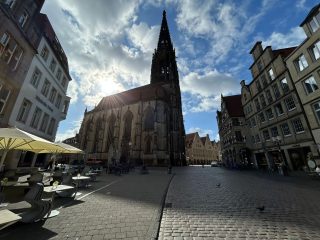
Lübeck Town Hall
Town Hall in Lübeck

Lübeck Town Hall (Lübecker Rathaus) is one of the top attractions in Lübeck and a building that perfectly sums up the city's Hanseatic confidence. Rising over the Markt in a striking mix of dark Brick Gothic gables, perforated turrets, and later Renaissance and Baroque additions, it feels both monumental and deeply rooted in the city's medieval past. This was the nerve centre of Lübeck's power as a Free Imperial City and leading member of the Hanseatic League, where decisions about trade, law, and governance shaped the fortunes of merchants across northern Europe.
Today, the town hall still houses the city's administration, making it one of the oldest continuously used town halls in Germany. That living function is part of its charm: you're not just visiting a museum, but stepping into a building that has never stopped working. Guided tours take you through richly decorated halls, courtrooms, and council chambers where carved wood, murals, and coats of arms create a vivid timeline of Lübeck's changing fortunes. It's a highlight of any walking tour of Lübeck and a place where the city's history feels close enough to touch.
Table of Contents
- History and Significance of the Lübeck Town Hall
- Things to See and Do in the Lübeck Town Hall
- How to Get to the Lübeck Town Hall
- Practical Tips on Visiting the Lübeck Town Hall
- Where to Stay close to the Lübeck Town Hall
- Is the Lübeck Town Hall Worth Visiting?
- FAQs for Visiting Lübeck Town Hall
- Nearby Attractions to the Lübeck Town Hall
History and Significance of the Lübeck Town Hall
Construction of Lübeck Town Hall began in the 13th century, at a time when the city was rapidly rising to prominence as a Hanseatic powerhouse. The original Gothic core reflected Lübeck's ambition: a large, prestigious building overlooking the market square, announcing the city's status to visiting traders and envoys. As centuries passed and tastes changed, new wings, façades, and interior elements were added in Renaissance and Baroque styles, turning the Rathaus into a layered architectural record of the city's evolution.
The building’s elaborate front, with its dark brick gables and perforated turrets, was designed to impress as much as to administer. Facing the bustling Markt, it made the town council’s presence visible in everyday life, with important proclamations, markets, and civic events unfolding in its shadow. Inside, the council chambers and audience halls were where trade agreements were negotiated, legal disputes settled, and policies set for Lübeck’s far-reaching Hanseatic networks.
Lübeck’s status as a Free Imperial City gave it considerable autonomy, and the town hall became the physical expression of that independence. Even when political circumstances shifted and the Hanseatic League declined, the Rathaus remained the administrative heart of the city. Restoration and conservation over the 19th and 20th centuries helped safeguard its intricate façades and interiors, ensuring that today’s visitors can still read the city’s story in stone, wood, and brick.
Things to See and Do in the Lübeck Town Hall
A visit to Lübeck Town Hall usually starts outside on the Markt, where you can fully appreciate the complexity of its main façade. Take time to notice the tall, dark brick wall punctured by circular openings, the pointed gables, and the contrast between medieval brickwork and later, lighter stone elements. From here, you can also see how the Rathaus is woven into the fabric of the old town, flanked by gabled merchant houses, church towers, and the daily bustle of market life.
Inside, guided tours lead you through a sequence of historically rich rooms. The audience hall, once used for legal proceedings, is especially atmospheric, with preserved legal texts, coats of arms, and period furnishings that hint at how seriously law and order were taken in this trading city. Other rooms may include council chambers where policies were debated, richly panelled halls, and stairways lined with paintings and carvings that celebrate Lübeck’s ruling families and alliances.
As you walk through, pay attention to the details: carved wooden benches worn smooth by centuries of use, painted ceilings, inscriptions, and contrasting architectural styles from different eras. These elements make the town hall not just a pretty building but one of the must-see places in Lübeck for anyone interested in how politics, trade, and civic pride shaped the city. When your tour ends, step back into the Markt and look up at the façade again-it's easier to appreciate what lies behind those brick walls once you've seen the rooms inside.
How to Get to the Lübeck Town Hall
Most international visitors arrive via Hamburg Airport, which has extensive European and some long-haul connections; from there, regular trains and regional services run to Lübeck, and it's a short walk from Lübeck Hauptbahnhof into the old town and the Markt where the town hall stands. For the best deals and a seamless booking experience, check out these flights to Lübeck on Booking.com.
If you're travelling by train, you'll arrive at Lübeck Hauptbahnhof; from the station, it's about a 15-20 minute walk into the old town, or you can take a local bus towards the city centre and get off near the Markt, just steps from the Rathaus. Train schedules and bookings can be found on Omio.
For those arriving by car, Lübeck is easily reached via the A1 motorway, with well-signposted exits for the city and several parking areas around the edge of the old town; once parked, you can stroll into the centre and find the town hall directly on the Markt. If you are looking to rent a car in Germany I recommend having a look at Discover Cars, first, as they compare prices and review multiple car rental agencies for you.
Practical Tips on Visiting the Lübeck Town Hall
- Suggested tips: Join a guided tour to access the most interesting interior rooms and get context on Lübeck’s political and economic history.
- Best time to visit: Late morning or mid-afternoon on weekdays, when the Markt is lively but not packed and tours are less crowded.
- Entrance fee: Adults: €4
- Opening hours: Monday: 10:00 – 16:00; Tuesday – Wednesday: 9:00 – 16:00; Thursday: 9:00 – 18:00; Friday: 9:00 – 16:00; Saturday & Sunday: Closed
- Official website: https://www.luebeck.de
- How long to spend: Plan around 1-1.5 hours for a tour and some time on the Markt to admire and photograph the façades.
- Accessibility: Some areas of this historic building include stairs and uneven floors; check current accessibility information if you have reduced mobility.
- Facilities: Public facilities are available nearby around the Markt, along with shops and cafés; the town hall itself is primarily an administrative building.
- Photography tip: Capture the full façade from across the Markt, then move closer to focus on the perforated turrets, brick patterns, and coats of arms.
- Guided tours: Regular guided tours (often in German, sometimes with multilingual support) explain the history, functions, and symbolism of key rooms.
- Nearby food options: The surrounding streets and square are lined with cafés, bakeries, and restaurants-ideal for a break before or after your visit.
Where to Stay close to the Lübeck Town Hall
If you’d like to stay right in the heart of the old town, ATLANTIC Hotel Lübeck offers modern comfort just a short walk from the Markt and the Rathaus, making it easy to explore the main sights on foot.
For riverside views and quick access to both the historic centre and the Salzspeicher, Radisson Blu Senator Hotel is a great option, only a few minutes’ stroll from the town hall over the bridges into the old town.
Travellers arriving by car or train might appreciate Park Inn by Radisson Lübeck, which sits near the Trave and offers convenient access to parking, the station, and an easy walk into the city centre and Rathaus area.
Is the Lübeck Town Hall Worth Visiting?
Lübeck Town Hall is absolutely worth visiting, especially if you're drawn to places where architecture and history overlap in every corridor. From the outside, its dramatic Brick Gothic gables and ornate details tell you that this was once a very powerful city; from the inside, its council chambers, courtrooms, and ceremonial halls reveal how that power was exercised. As a living seat of government and a beautifully preserved monument to Lübeck's Hanseatic past, it offers a rich, layered experience that goes far beyond a simple photo stop.
What Other Travellers Say...

Stadtverwaltung Hansestadt Lübeck at Breite Str. 62 sits on a lively market square where a striking town hall combines dark Gothic masonry with bright Renaissance arcades and freestone details; visitors praise its dramatic façades, decorative balcony and towers, the impressive interior Audience Hall, and the heraldic embellishments in the walls. Guided tours are offered for a fee at set times (typically in German), and the square often hosts markets, cafés, flower stalls and street performers, making the site feel both historic and alive.


FAQs for Visiting Lübeck Town Hall
Nearby Attractions to the Lübeck Town Hall
- Holstentor - The iconic Brick Gothic city gate and symbol of Lübeck's medieval defences, a short walk from the Markt.
- Salzspeicher - Historic salt warehouses along the Trave River that once stored Lüneburg salt bound for Baltic trade.
- Marienkirche (St. Mary's Church) - A towering Brick Gothic church just behind the town hall, showcasing Lübeck's Hanseatic wealth and ambition.
- Lübeck Old Town (Altstadt) - The UNESCO-listed island of medieval streets, gabled houses, and churches that surrounds the Rathaus.
- European Hansemuseum - A modern museum exploring the history of the Hanseatic League and Lübeck's leading role in northern European trade.
The Lübeck Town Hall appears in our Complete Guide to Visiting Lübeck!

Moira & Andy
Hey! We're Moira & Andy. From hiking the Camino to trips around Europe in Bert our campervan — we've been traveling together since retirement in 2020!
This website uses affiliate links which may earn a commission at no additional cost to you!
Planning Your Visit
Monday: 10:00 - 16:00; Tuesday - Wednesday: 9:00 - 16:00; Thursday: 9:00 - 18:00; Friday: 9:00 - 16:00; Saturday & Sunday: Closed
Adults: €4
Nearby Attractions
- Café Niederegger (0.0) km
Historic Building - Lübeck’s Old Market Square (Marktplatz) (0.0) km
Market - Devil Statue at St. Marien-Kirche (0.1) km
Sculpture - St. Marien-Kirche (0.1) km
Church - St. Peter’s Church (St. Petri-Kirche) (0.2) km
Church - Salzspeicher (0.4) km
Historic Building - Holstentor (0.4) km
City Gate - St. Annen Museum (0.5) km
Museum - Schiffergesellschaft (0.5) km
Historic Building - Half-Tower (Halbenturm) in Lübeck (0.6) km
Historic Building