Kornmarkt, Lucerne
Square in Lucerne
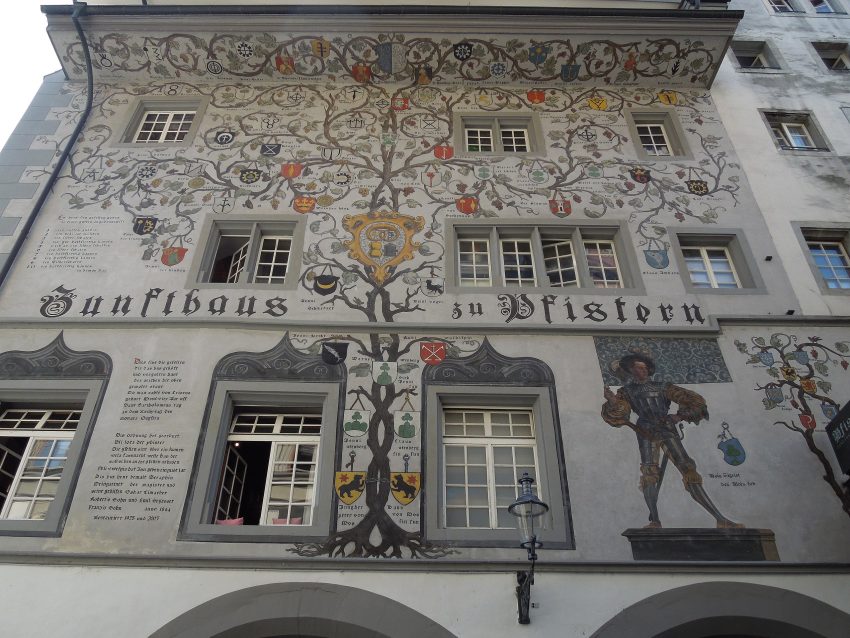
Kornmarkt is one of those Old Town squares where you can almost hear the echo of merchants' voices if you pause for a moment. From 1356 until the late 1800s, this plaza was the bustling centre of Lucerne's grain trade, with sacks of wheat and rye changing hands under the watchful gaze of the town hall and its tower. Today, the square feels calmer, framed by painted façades and arcades, but it remains one of the top attractions in Lucerne if you want to understand how commerce, power, and everyday life were once concentrated in a single public space.
Dominating one side of Kornmarkt is the Furren Tower, a 41-metre-high medieval structure that once served as both watchtower and dungeon, and that still keeps time for the city with a historic clock face that has no minute hand but does have a moon-phase indicator. Attached to it is Lucerne's town hall, the Rathaus, where the city council meets beneath a roofline that combines the look of a traditional Swiss farm with Renaissance details. Together, the plaza, tower, and town hall are a highlight of any walking tour of Lucerne, and an easy place to linger as you move between the riverfront and the upper Old Town squares.
Table of Contents
History and Significance of the Kornmarkt and Furren Tower
Kornmarkt’s story begins with grain. From the mid-14th century onwards, this was the place where farmers, merchants, and millers met to trade cereal crops that would feed the town and its hinterland. The ground floor of the town hall was dedicated to this purpose, functioning as a covered grain exchange where prices were set, deals were struck, and supplies were monitored. For more than five centuries, the rhythms of sowing, harvesting, and trading were reflected in the bustle of this square, making it a vital barometer of prosperity and scarcity.
Rising above the square, the Furren Tower is a reminder that markets needed protection as well as space. This 41-metre tower once formed part of Lucerne's Gothic town hall complex and served multiple roles: lookout post, fire watch, and even dungeon. Long before professional fire and police departments existed, a night watchman occupied the tower, patrolling the streets between rounds. Every hour, he returned to the tower, rang the bell, and called out the time with a formula along the lines of “this is the lookout,” reassuring sleeping citizens that the town was under watch. The tradition of night watchmen in Lucerne ended in the early 1900s, though a symbolic night watch still survives elsewhere in Switzerland, such as in Lausanne.
The tower’s clock is almost a character in its own right. Evidence suggests that a clock has been installed here since the early 1400s, with a notable upgrade in the 1500s that introduced a weight wheel and escapement wheel: the weight wheel turned once per hour and drove the single hour hand. Later additions added mechanisms for the quarter-hour and hour strikes, but the clock still has no minute hand. Instead, it offers a moon hand that shows lunar phases - waxing, waning, half, and full - connecting the practical business of timekeeping with the cycles of nature that governed agriculture and river traffic.
Things to See and Do in the Kornmarkt
The best way to start is simply to stand in the middle of Kornmarkt and let your eyes travel around the square. Try to imagine the scene when grain was sold here: carts rattling over cobbles, sacks piled high, and merchants calling out prices under the arches of the town hall. Knowing that this was once the grain market makes the name “Kornmarkt” (grain market) feel less abstract and more like a direct link to the daily bread of medieval Lucerne.
Next, look up at the Furren Tower. Its height and solid masonry make it easy to see how it once acted as both lookout and symbol of authority. The clock face is an intriguing detail; see if you can spot the absence of a minute hand and the presence of the moon-phase indicator. Thinking about how people once set their day by this single hand and the regular bell strikes adds an extra layer to your appreciation of the Old Town’s soundscape.
Turn your attention to the Rathaus. Its architecture is a fascinating mixture: a broad, sheltering roof reminiscent of a Swiss farmhouse sitting above a building shaped by Renaissance proportions. On the left-hand side of the façade, two Corinthian columns support statues representing justice and moderation, virtues that were central to the decisions made inside. On the opposite end of the building, look for the two iron bars fixed to the wall. These are old measuring standards: one represents the “Ell,” roughly the distance from elbow to fingertip (around 60 centimetres), and the other the “Fuss,” a foot-length that historically varied between about 23 and 40 centimetres. These fixed measures helped keep trade fair and gave merchants a shared reference in an era before standardised units.
How to Get to the Kornmarkt
Most international visitors will arrive in Lucerne via Zurich Airport (ZRH), which offers the widest range of European and long-haul connections and serves as the main gateway to central Switzerland. For the best deals and a seamless booking experience, check out these flights to Lucerne on Booking.com. From the airport, frequent trains run directly to Lucerne or via Zurich HB, usually taking around one to one and a quarter hours and dropping you a short walk from the Old Town.Train schedules and bookings can be found on Omio.
From Lucerne's main railway station, reaching Kornmarkt is straightforward on foot. Exit towards the lake, cross the Reuss via the Kapellbrücke or Seebrücke, and then follow the narrow streets uphill into the Old Town; Kornmarkt is just a few minutes beyond Kapellplatz, close to the river but slightly set back in a calm pocket of the historic centre.Train schedules and bookings can be found on Omio. The route is well signposted, and part of the pleasure lies in letting yourself be drawn along by frescoed façades and the curve of the lanes.
If you're arriving by car, Lucerne is connected to the rest of Switzerland by the A2 and A14 motorways, with several multi-storey car parks near the station and along the edge of the Old Town. Because Kornmarkt itself sits in a pedestrian area, the simplest approach is to park in one of these garages and explore on foot. This not only avoids the stress of driving in narrow streets but also gives you space to appreciate how the square fits into the wider fabric of medieval Lucerne.
Practical Tips on Visiting the Kornmarkt
- Suggested tips: Take time to circle the square, looking up at the tower, clock, and town hall details; imagining Kornmarkt filled with grain sacks and traders makes the space feel much more alive.
- Best time to visit: Early morning or early evening offer a quieter, more atmospheric experience, with softer light for photos and fewer crowds than the middle of the day.
- Entrance fee: Free — Kornmarkt is a public square, and viewing the tower and Rathaus exterior costs nothing.
- Opening hours: The square is accessible at all times; access to the Rathaus interior depends on council business, events, and occasional tours.
- Official website: https://www.luzern.com
- How long to spend: Plan around 20-30 minutes to explore the square, study the tower and façade details, and take photos; history lovers may linger longer, especially if combining it with nearby squares and museums.
- Accessibility: Kornmarkt is paved and generally level, though some surrounding lanes are cobbled and uneven; most visitors with mobility challenges can still enjoy the main views with a little care.
- Facilities: There are no dedicated facilities in the square itself, but cafés, shops, and public toilets are available within a short walk in the Old Town.
- Photography tip: Try shooting Furren Tower from low angles to emphasise its height, and frame the Rathaus façade to include the iron measuring bars and Corinthian-column statues in a single composition.
- Guided tours: Many Old Town walking tours include Kornmarkt, explaining its grain-market past, the role of the tower and night watchman, and the symbolism of the Rathaus architecture; joining one can add real depth to your visit.
- Nearby food options: The streets around Kornmarkt are packed with cafés, bakeries, and restaurants, making it easy to pair your visit with a coffee, snack, or leisurely meal in a historic setting.
Where to Stay close to the Kornmarkt
If you’d like to stay right in the heart of the Old Town, Hotel des Balances is a classic choice. Located just a short stroll from Kornmarkt and overlooking the Reuss, it puts you within easy reach of the Rathaus, Furren Tower, and neighbouring squares, while offering elegant rooms and a riverside terrace.
Another excellent option nearby is Altstadt Hotel Krone Luzern, which sits on one of Lucerne's most picturesque squares. From here, Kornmarkt is only a minute or two away on foot, so you can drop by at different times of day to see how the light and atmosphere change without straying far from your base.
For travellers who prefer a slightly quieter but still central location, Boutique Hotel Weisses Kreuz offers a cosy stay in a narrow Old Town lane close to Kornmarkt. It's a great option if you want to step out of your door and be among medieval façades in seconds, while still sleeping in a more tucked-away corner once the day-trippers go home.
Is the Kornmarkt Worth Visiting?
Kornmarkt is absolutely worth adding to your Lucerne itinerary, especially if you enjoy places where history is written into the stones and proportions of everyday spaces. The square might seem modest at first glance, but once you know it was the grain market for more than 500 years, watched over by a tower that measured the hours and protected the town, it becomes much more evocative. Standing here, with the Rathaus at your side and the Furren Tower rising above, gives you a richer sense of how trade, timekeeping, and governance once came together in the heart of the city.
What Other Travellers Say...

Kornschütte, at Kornmarkt 3 in Luzern's old town, is a picturesque historic venue a short walk from the train station and near the Chapel Bridge; visitors praise its central location, scenic clock tower views on clear days, and its suitability for medium to large events, with shops and restaurants nearby, while inside it often hosts art exhibitions in an elegant, peaceful setting.


FAQs for Visiting Kornmarkt
Nearby Attractions to the Kornmarkt
- Weinmarkt - Neighbouring historic square once used as a fish and wine market, with the colourful Fritschi Fountain and strong guild history.
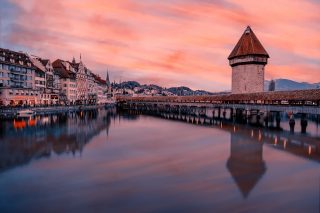
- Kapellbrücke (Chapel Bridge) - Lucerne's iconic covered wooden bridge with its water tower and painted panels, just a short walk downhill towards the river.
- Jesuit Church - A beautiful Baroque church along the Reuss, offering a striking contrast to the more austere medieval and Renaissance architecture around Kornmarkt.
- History Museum Lucerne - Located nearby on Pfistergasse, this museum uses theatrical tours and interactive displays to bring the cultural history of Lucerne and the lake region to life.
- Spreuerbrücke - Another historic covered bridge decorated with Danse Macabre paintings, a pleasant walk along the river from Kornmarkt and a good companion stop to the History Museum.
The Kornmarkt appears in our Complete Guide to Visiting Lucerne!

Moira & Andy
Hey! We're Moira & Andy. From hiking the Camino to trips around Europe in Bert our campervan — we've been traveling together since retirement in 2020!
This website uses affiliate links which may earn a commission at no additional cost to you!
Planning Your Visit
The square is accessible at all times; access to the Rathaus interior depends on council business, events, and occasional tours.
Free - Kornmarkt is a public square, and viewing the tower and Rathaus exterior costs nothing.
Nearby Attractions
- Lucerne Town Hall (0.0) km
Town Hall - Hirschenplatz (0.0) km
Square - Weinmarkt (0.1) km
Square - Chapel Bridge and Water Tower (0.1) km
Bridge - Jesuitenkirche (0.2) km
Church - Fritschi Fountain (0.2) km
Fountain - Peter's Chapel (0.2) km
Church - Ritterscher Palace (0.2) km
Palace - Museum Rosengart Collection (0.3) km
Arts Venue - Museggmauer (Musegg Wall) (0.3) km
City Gate and City Walls