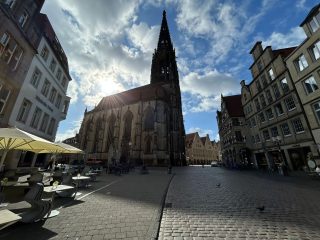
Kiepenkerl Denkmal, Münster
Statue in Münster

In the lively heart of Münster's Old Town, surrounded by cobbled lanes, cafés, and historic façades, the Kiepenkerl Denkmal stands as a charming tribute to the region's traveling merchants. These Kiepenkerle once roamed the Münsterland countryside with large wicker baskets, bringing eggs, dairy products, salt, and news from rural farms into the city. Today, the life-sized bronze figure captures that spirit perfectly: a humble yet dignified character who helped knit together town and country long before supermarkets and smartphones.
Unveiled in 1953, the current statue by sculptor Albert Mazzotti Jr. recreates an earlier monument from 1896 and has become one of the top sights in Münster for anyone curious about local traditions. Dressed in his blue smock, red neckerchief, and cap, with walking stick, whistle, and the famous “Kiepe” on his back, the Kiepenkerl is more than a photogenic figure: he symbolises resilience, continuity, and the human side of everyday trade. The statue's central location makes it a great place to visit on a walking tour of Münster, especially if you want a break from churches and museums in favour of something more down-to-earth.
Table of Contents
- History and Significance of the Kiepenkerl Denkmal
- Things to See and Do at the Kiepenkerl Denkmal
- How to Get to the Kiepenkerl Denkmal
- Practical Tips on Visiting the Kiepenkerl Denkmal
- Where to Stay close to the Kiepenkerl Denkmal
- Is the Kiepenkerl Denkmal Worth Visiting?
- FAQs for Visiting Kiepenkerl Denkmal
- Nearby Attractions to the Kiepenkerl Denkmal
History and Significance of the Kiepenkerl Denkmal
The Kiepenkerl Denkmal honours the itinerant peddlers who were once vital to Münsterland's economy and social life. Long before modern logistics, these merchants carried goods in their wicker baskets from farm to city, supplying households with essentials and passing on news and stories from village to village. They were traders, messengers, and social connectors all in one, and their presence in the marketplace was a familiar part of everyday life for centuries.
The first monument to the Kiepenkerl was created in 1896 by sculptor August Schmiemann. Made of plaster with a copper plating, it celebrated a figure that was already fading from daily reality but firmly rooted in local memory. Remarkably, the original statue survived Allied bombing in 1943, only to be destroyed later during the liberation of Münster when a US tank accidentally crushed it. This dramatic twist added a new layer of loss and resilience to the story of the Kiepenkerl.
In 1953, the city unveiled a new bronze statue by Albert Mazzotti Jr., designed as a faithful recreation of Schmiemann’s original figure. This replacement not only restored a much-loved landmark, but also preserved the memory of the Kiepenkerle for future generations. Today, the Denkmal stands as a symbol of Münster’s close relationship with its rural surroundings, a reminder that the city’s prosperity has always been intertwined with the farms and villages of the wider Münsterland.
Things to See and Do at the Kiepenkerl Denkmal
The statue itself is the star, and it is worth taking a moment to walk all the way around it. Look closely at the details of the Kiepenkerl’s outfit: the folds of his blue linen smock, the set of his cap, the knot of his red neckerchief. Notice the sturdy walking stick and the whistle in his hand, tools of a trader who spent long days on the road. The wicker basket on his back-the “Kiepe”-is carefully rendered, a reminder of the literal and metaphorical weight these merchants carried.
The Kiepenkerl is also one of those statues that invites interaction. Visitors often pose beside him, mimicking his stance or pretending to help carry the basket, making this a fun photo stop as well as a historical one. Around the statue, the Old Town’s cafés and restaurants give you an easy excuse to linger: grab a seat on a terrace and imagine what this spot might have looked like when real Kiepenkerle criss-crossed the square with goods and gossip.
Because of its central location, the Denkmal fits naturally into a wider exploration of the Old Town. From here, you can easily stroll to Prinzipalmarkt, St. Lamberti Church, or the cathedral, using the statue as a friendly waypoint. If you are collecting local stories as well as sights, the Kiepenkerl offers a perfect anecdote about everyday working people who shaped the city just as much as its bishops and merchants.
How to Get to the Kiepenkerl Denkmal
The Kiepenkerl Denkmal is located in Münster's Old Town, within easy walking distance of Prinzipalmarkt, St. Lamberti Church, and other central landmarks. Most international visitors arrive via Münster Osnabrück International Airport, from where buses, shuttles, or taxis connect to the city centre in roughly half an hour. For the best deals and a seamless booking experience, check out these flights to Münster on Booking.com.
If you are arriving by train, Münster (Westf) Hauptbahnhof is the main rail hub with frequent regional and long-distance connections.Train schedules and bookings can be found on Omio. From the station, you can walk into the historic centre in about 15-20 minutes or take a short bus ride toward Domplatz or Prinzipalmarkt. Once in the Old Town, simply follow the narrow streets and arcades; the statue is well signposted and close to popular restaurants and cafés that share its name.
Travelling by car, follow signs to the Innenstadt and use one of the public car parks around the edge of the Old Town, as the central streets are best explored on foot.If you are looking to rent a car in Germany I recommend having a look at Discover Cars, first, as they compare prices and review multiple car rental agencies for you. After parking, stroll toward Prinzipalmarkt and then into the surrounding lanes, where you will soon come across the Kiepenkerl standing at his post in the middle of the pedestrian area.
Practical Tips on Visiting the Kiepenkerl Denkmal
- Suggested tips: Plan a short pause by the statue as part of your Old Town wander-use it as a meeting point or a place to grab a quick photo and people-watch.
- Best time to visit: Daytime and early evening are ideal; in the morning you will find quieter streets, while later in the day the cafés and terraces bring extra atmosphere.
- Entrance fee: Free; the statue is a public monument in an open square.
- Opening hours: Accessible at all times as an outdoor landmark, though best enjoyed during daylight or early evening.
- How long to spend: Around 10-20 minutes is plenty to admire the statue, read any nearby information, and take photos, longer if you stay for a drink or meal nearby.
- Accessibility: The surrounding area is mostly flat and pedestrian-friendly, making it easy to reach for visitors with reduced mobility, though cobblestones may be slightly uneven.
- Facilities: While there are no facilities at the statue itself, numerous cafés, restaurants, and shops in the immediate area provide seating, toilets, and refreshments.
- Photography tip: Step back to capture the Kiepenkerl framed by Old Town buildings, then move in close for details of the basket, clothing, and facial expression. Evening light or festive decorations at certain times of year add extra charm.
- Guided tours: Many city walking tours include a stop at the Kiepenkerl, using it to explain rural-urban ties and everyday life in historic Münster.
- Nearby food options: You will find several eateries right by the statue, plus plenty more around Prinzipalmarkt and the adjoining streets, making this an easy place to combine sightseeing with a meal.
Where to Stay close to the Kiepenkerl Denkmal
Staying near the Kiepenkerl Denkmal puts you right in the middle of Münster's Old Town, with cafés, shops, and major sights just a short stroll away. A comfortable and central option is Stadthotel Münster, which offers modern rooms within easy walking distance of the statue, Prinzipalmarkt, and the cathedral. If you prefer a stylish base in a converted industrial setting, Factory Hotel combines design-focused interiors with good bus and bike links into the centre. For a classic hotel close to both the Hauptbahnhof and the historic core, Hotel Kaiserhof makes a solid choice, allowing you to walk to the Kiepenkerl and other key landmarks in around 15 minutes.
Is the Kiepenkerl Denkmal Worth Visiting?
The Kiepenkerl Denkmal is definitely worth visiting, especially if you enjoy places that capture the everyday side of history rather than just grand events. In a single bronze figure, it tells a story about trade, rural life, and the human connections that kept Münster supplied and informed for generations. Its survival, destruction, and later recreation also echo the city's broader experience of wartime loss and post-war rebuilding. As a result, it is one of the things to do in Münster that feels both light-hearted and meaningful-a quick stop that adds real texture to your understanding of the city.
What Other Travellers Say...

Kiepenkerl-Denkmal at Bergstraße 3 in Münster is described by visitors as a cozy, atmospheric spot where you can enjoy traditional German food outdoors; reviewers praise attentive, friendly service and recommend dishes like potato soup and bratwurst, note pleasant sunny-day vibes, and mention a lively Christmas market nearby with a wide variety of stalls and treats.


FAQs for Visiting Kiepenkerl Denkmal
Nearby Attractions to the Kiepenkerl Denkmal
- Prinzipalmarkt: Münster's historic arcade-lined main street with gabled houses, shops, and cafés at the heart of the Old Town.
- Historical City Hall of Münster: A Gothic city hall on Prinzipalmarkt, famous as one of the sites where the Peace of Westphalia was signed in 1648.
- St. Lamberti Church (Lambertikirche): A striking Gothic church nearby, known for its tower and the Anabaptist cages hanging high above the square.
- St. Paulus Dom (Münster Cathedral): The city's main Romanesque-Gothic cathedral on Domplatz, with an impressive interior and astronomical clock.
- Pablo Picasso Museum Münster: An intimate museum dedicated to Picasso's graphic works, just a short walk away in the Old Town.
The Kiepenkerl Denkmal appears in our Complete Guide to Visiting Münster!

Moira & Andy
Hey! We're Moira & Andy. From hiking the Camino to trips around Europe in Bert our campervan — we've been traveling together since retirement in 2020!
This website uses affiliate links which may earn a commission at no additional cost to you!
Planning Your Visit
Accessible at all times as an outdoor landmark, though best enjoyed during daylight or early evening.
Free; the statue is a public monument in an open square.
Nearby Attractions
- Münster Cathedral (0.1) km
Cathedral - Lambertikirche (0.2) km
Church - Überwasserkirche (0.2) km
Church - Prinzipalmarkt (0.3) km
Square - Krameramtshaus (0.3) km
Historic Building - Buddenturm (0.3) km
Tower - Westphalian State Museum of Art and Cultural History (0.3) km
Museum - City Hall of Münster (0.4) km
Town Hall - Pablo Picasso Museum (0.5) km
Museum - Zwinger (0.5) km
City Walls