Hung Mieu Temple, Hue
Historic Building in Hue
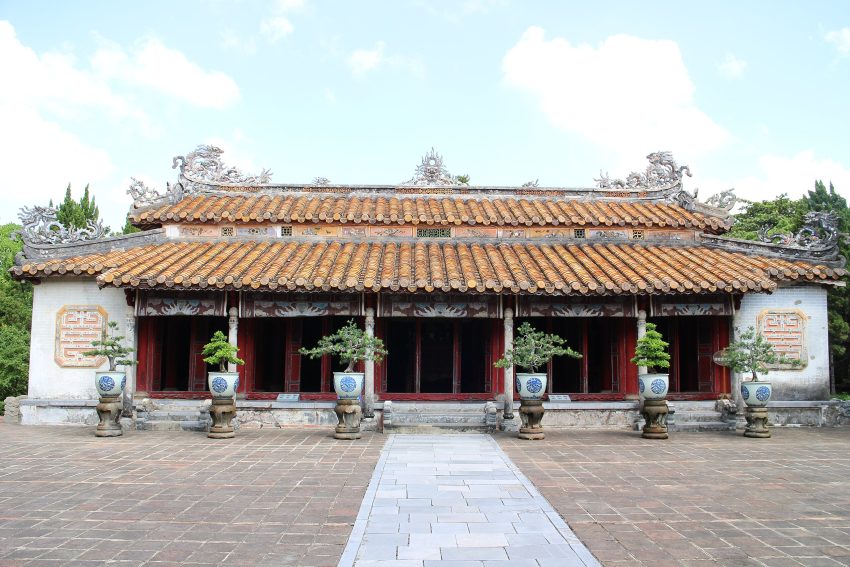
Hung Mieu Temple, constructed in 1821 by Emperor Minh Mang, stands as a graceful and historically rich shrine within the Imperial City of Hue. Dedicated to the emperor's grandparents, the temple embodies the Confucian emphasis on filial piety and ancestral reverence. Its beautifully carved rooflines, refined layout, and serene courtyards make it one of the top attractions in Hue.
The temple complex, heavily damaged by fire in 1947, has been thoughtfully restored, allowing visitors to appreciate its original sophistication once again. Among its most striking features are the dramatic stone dragons that guard the paved courtyard, their sculptural presence lending an air of strength and spiritual protection. The complex also includes Hung To Mieu, a smaller temple honoring the parents of Emperor Gia Long, adding depth to the site’s ancestral significance.
Table of Contents
- History and Significance of Hung Mieu Temple
- Things to See and Do in Hung Mieu Temple
- How to Get to Hung Mieu Temple
- Practical Tips on Visiting Hung Mieu Temple
- Where to Stay close to Hung Mieu Temple
- Is Hung Mieu Temple Worth Visiting?
- FAQs for Visiting Hung Mieu Temple
- Nearby Attractions to Hung Mieu Temple
History and Significance of Hung Mieu Temple
When Emperor Minh Mang ordered the construction of Hung Mieu Temple in 1821, he sought to honor his grandparents with the dignity and respect befitting imperial ancestors. As with many Nguyen-era structures, the temple adhered to Confucian principles that emphasized lineage, loyalty, and the continuation of family tradition. Its architecture and placement within the Imperial City reflect the importance of maintaining strong ancestral connections within the royal household.
The temple’s destruction during the 1947 fire was a significant cultural loss, but extensive restoration efforts have returned Hung Mieu to its original splendor. Craftsmen recreated the intricate roof carvings, enameled decorations, and elegant timber framing, ensuring that the artistry of the Nguyen Dynasty shines through in every detail. The restored structure now stands as a testament to both historical continuity and the skill of modern preservation.
Hung To Mieu, accessible through a gate on the north side of the courtyard, further enriches the complex. Built in 1804 and later reconstructed, this smaller temple is dedicated to the parents of Emperor Gia Long, founder of the dynasty. Together, Hung Mieu and Hung To Mieu form a meaningful architectural ensemble that illuminates the genealogical foundations of the Nguyen emperors.
Things to See and Do in Hung Mieu Temple
Visitors entering the spacious courtyard will immediately notice the imposing stone dragons that flank the approach to the temple. Their bold forms resemble protective gargoyles, creating a dramatic introduction to the shrine. These stone guardians remain among the most memorable features of Hung Mieu.
Exploring the temple’s restored architecture reveals elegant roof carvings, carefully crafted timberwork, and traditional patterns that reflect the artistic sophistication of the Nguyen Dynasty. The quiet interior, with its ancestral altars, invites contemplation and provides a sense of connection to the imperial lineage.
The small walled enclosure to the north offers a peaceful detour into Hung To Mieu Temple. This secondary shrine, though simpler in scale, holds deep historical meaning as the memorial site for Emperor Gia Long's parents. Its inclusion underscores the importance of family heritage within the Nguyen court.
How to Get to Hung Mieu Temple
Phu Bai International Airport is the nearest airport to Hue and lies roughly 16 kilometres to the south of the city centre. For the best deals and a seamless booking experience, check out these flights to Hue on Booking.com. Its domestic connections make reaching Hue straightforward for most travellers.
Hue Railway Station provides regular services to major cities including Da Nang, Hanoi, and Ho Chi Minh City. Train schedules and bookings can be found on Omio. From the station, the Imperial City is only a short taxi or ride-hailing journey away.
Travelling by car is convenient, with designated parking found outside the main Citadel entrances. Once inside the Imperial Enclosure, well-marked paths lead toward the temple complex.
Practical Tips on Visiting Hung Mieu Temple
- Suggested tips: Take time to study the intricate roof carvings and stone dragons, as they represent some of the finest artistry in the Imperial City.
- Best time to visit: Early morning or late afternoon for cooler temperatures and softer light.
- Entrance fee: Included in the Imperial City ticket.
- Opening hours: Around 8:00-17:30, varying with the season.
- Official website: https://www.hueworldheritage.org.vn
- How long to spend: Approximately 20-40 minutes, depending on interest.
- Accessibility: Generally accessible, though some uneven surfaces may require care.
- Facilities: Restrooms and snack stalls are available elsewhere within the Imperial City.
- Photography tip: Capture the stone dragons at an angle that highlights their imposing silhouettes.
- Guided tours: Many tours include Hung Mieu as part of the ancestral temple circuit.
- Nearby food options: Cafés and restaurants can be found just outside the Citadel walls.
Where to Stay close to Hung Mieu Temple
For convenient access to the Imperial City, visitors may choose from several excellent hotels nearby. The elegant Azerai La Residence provides refined riverside accommodation with easy access to historic sites. Those seeking boutique comfort might enjoy Le Domaine de Cocodo, a peaceful retreat within reach of the Citadel. Another appealing option is Villa Hue, offering charm and convenience in a restful garden setting.
Is Hung Mieu Temple Worth Visiting?
Hung Mieu Temple is definitely worth visiting for travellers interested in the Nguyen Dynasty's ancestral traditions and architectural artistry. Its serene courtyard, striking stone dragons, and beautifully restored structures make it one of Hue's more atmospheric shrines. Combined with the adjacent Hung To Mieu Temple, the site offers meaningful insight into the imperial lineage and cultural values of Vietnam's last royal dynasty.
What Other Travellers Say...

The To Temple is a large, colorful walled complex in Hue's Imperial City featuring the three-tiered Hien Lam Pavilion on the south side and the solemn To Mieu Temple across a courtyard, which houses shrines to each Nguyen emperor; the courtyard also displays the Nine Dynastic Urns, massive ceremonial bronzes dedicated to the emperors, and a northern gate leads to the smaller Hung To Mieu area, a reconstructed temple honoring the founder's parents—visitors note the site has been well restored, can feel extensive rather than overwhelmingly impressive, and may be busiest during guided tours or ceremonies.


FAQs for Visiting Hung Mieu Temple
Nearby Attractions to Hung Mieu Temple
- The Mieu Temple: The main dynastic ancestral shrine of the Nguyen emperors.
- Hien Lam Pavilion: A towering three-story memorial within the temple complex.
- Thai Hoa Palace: The ceremonial throne hall of the Nguyen Dynasty.
- Nine Holy Cannons: Monumental bronze works near the Flag Tower.
- Purple Forbidden City: Former private residence of the Nguyen emperors.
The Hung Mieu Temple appears in our Complete Guide to Visiting Hue!

Moira & Andy
Hey! We're Moira & Andy. From hiking the Camino to trips around Europe in Bert our campervan — we've been traveling together since retirement in 2020!
This website uses affiliate links which may earn a commission at no additional cost to you!
Planning Your Visit
Nearby Attractions
- Mieu Temple (0.0) km
Historic Building - Hien Lam Pavilion (0.1) km
Historic Building - Dien Tho Residence (0.2) km
Historic Building - Thai Hoa Palace (0.3) km
Palace - Halls of the Mandarins (0.3) km
Historic Building - Meridian Gate (0.3) km
City Gate - Forbidden Purple City (0.3) km
Historic Building - Cung Truong Sanh (0.3) km
Historic Building - Nhat Thanh Lau (0.4) km
Historic Building - The Royal Theatre (0.4) km
Historic Building