Exeter Guildhall
Historic Building in Exeter
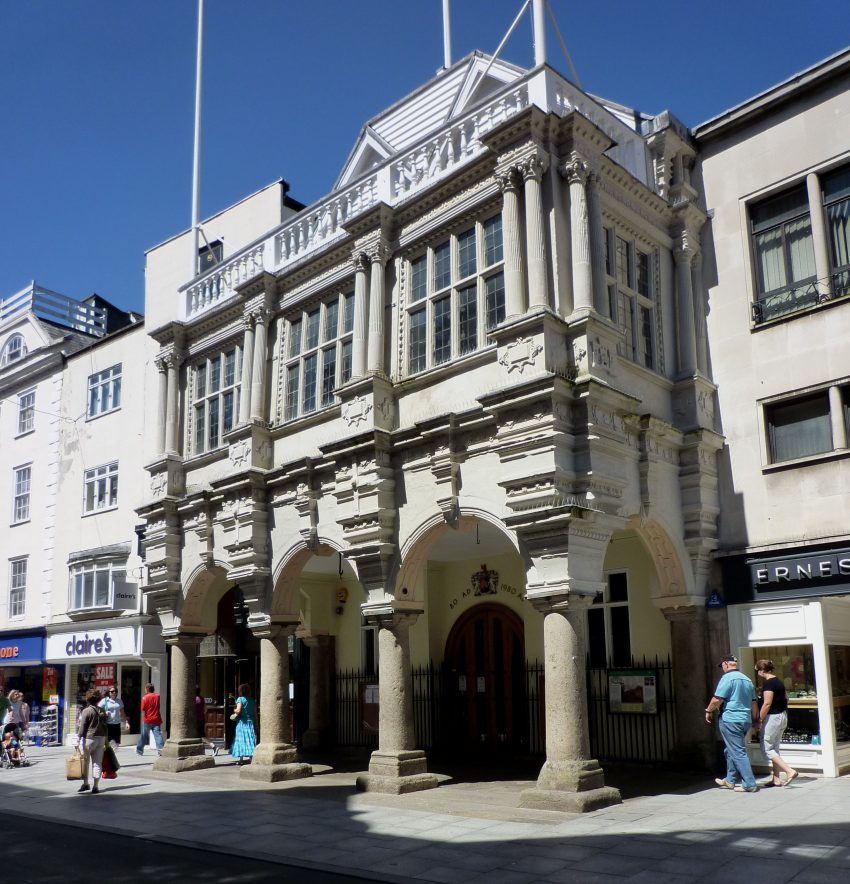
Exeter Guildhall is one of the most distinguished civic buildings in the country, standing proudly on Exeter High Street as a symbol of authority, ceremony, and community. With origins reaching back as far as the 12th century-and a confirmed presence from the 14th century onward-it has a strong claim to being the oldest municipal building in England still in use. Its richly carved frontage, medieval structure, and centuries of civic history make it one of the top attractions in Exeter for visitors fascinated by historic governance and architecture.
The Guildhall's role has shaped everything from medieval guild meetings to mayoral banquets, criminal trials, and royal proclamations. Its distinctive Italianate frontage, added in the 1590s, juts out over the pavement in spectacular style, while the interior weaves together medieval timber, Victorian restoration, and ceremonial splendour. It remains a highlight of any walking tour of Exeter, giving travellers a window into the city's long civic life.
Table of Contents
- History and Significance of Exeter Guildhall
- Things to See and Do in Exeter Guildhall
- How to Get to Exeter Guildhall
- Practical Tips on Visiting Exeter Guildhall
- Where to Stay close to Exeter Guildhall
- Add a Is Exeter Guildhall Worth Visiting?
- FAQs for Visiting Exeter Guildhall
- Nearby Attractions to Exeter Guildhall
History and Significance of Exeter Guildhall
The earliest phases of Exeter Guildhall may date back to the late 12th century, with documentary evidence confirming a guild in Exeter by 1000 AD. The present building's main structure was erected between 1468 and 1470, forming the council chamber that still stands today. This chamber, with its magnificent arch-braced roof and carved corbels shaped as grotesque animals, embodies the power and dignity of late medieval civic government.
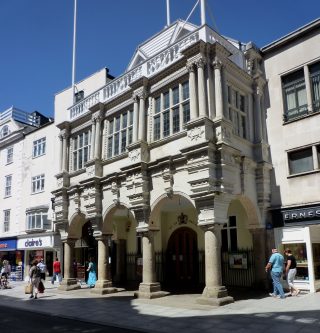
The hall’s most recognisable feature-the elaborate Renaissance-style façade-was added between 1593 and 1596. Described by architectural historian Nikolaus Pevsner as “as picturesque as it is barbarous,” the façade includes a projecting portico from 1594, supported by four granite columns topped with richly carved Beer stone corbels. The upper floor, also faced in Beer stone, displays elegant strapwork and beautifully framed mullioned and transomed windows. Renovation work has revealed that the exterior was once painted cream with red and blue details, and the pillars gilded, making it even more striking than today.
Across its long history, the Guildhall has been the scene of many significant events. In 1685, Judge Jeffreys held part of the Bloody Assizes here after the Monmouth Rebellion. The hall also hosted civic trials, banquets, and proclamations for centuries. Its Grade I listing and scheduled monument status reflect its exceptional importance to Exeter and to England's civic heritage.
Things to See and Do in Exeter Guildhall
The council chamber is the heart of any visit, showcasing original 15th-century roof timbers and Victorian-era restoration. Visitors can admire the carved corbels that support the main trusses, the grand stained glass, and the historic furnishings added during the 19th-century overhaul. A large chandelier made by Thomas Pyke of Bridgwater in 1789 still hangs from the centre of the roof, adding to the hall’s stately atmosphere.
The Tudor panelling, heavily restored in the 1880s, surrounds the chamber with warm, intricate woodwork. Above the fireplace sits a bust of Queen Victoria by sculptor Henry Hugh Armstead, part of the Victorian embellishments that became integral to the hall’s ceremonial identity. Beneath the chamber lies the early 14th-century cellar-once a prison known as the “pytt of the Guyldhall”-while the 16th-century women’s prison at the rear remained in use until 1887.
The iconic Renaissance portico on High Street is also a highlight. Once sheltering the city stocks, it now frames the elaborately carved oak door of 1593 by Nicholas Baggett. This richly decorated entrance sets the tone for the centuries of civic ritual that unfold within, making the Guildhall one of the where to go in Exeter for history enthusiasts.
How to Get to Exeter Guildhall
Exeter Guildhall stands directly on the High Street, in the heart of the city centre. The nearest airports are Exeter Airport and Bristol Airport, both offering accessible regional and international connections. For the best deals and a seamless booking experience, check out these flights to Exeter on Booking.com.
Exeter Central railway station is just a short walk away, while Exeter St David's provides additional rail links from London, Bristol, the Midlands, and the South West. Both stations make accessing the Guildhall straightforward for train travellers. Train schedules and bookings can be found on Omio.
Travelling by car is convenient, with multiple city-centre car parks close to the High Street and Princesshay. From there, it’s only a few minutes’ walk to reach the Guildhall’s striking portico.
Practical Tips on Visiting Exeter Guildhall
- Best time to visit Exeter Guildhall: Check ahead for open days or guided tours; quieter weekdays offer a more relaxed visit.
- Entrance fee in Euros: Varies; many open days and events are free or low cost.
- Opening hours: Open on selected days or during civic events-verify schedules before visiting.
- Official website: Information available on Exeter City Council and Guildhall heritage pages.
- How long to spend: Around 30-45 minutes is ideal for exploring the chamber and façade.
- Accessibility: The main chamber is accessible, though some historic areas have steps or narrow passages.
- Facilities: Nearby shops, cafés, and public toilets on the High Street.
- Photography tip: Capture the portico from across the High Street to frame the entire façade.
- Guided tours: Available on selected dates; often included in heritage open days.
- Nearby food options: Numerous cafés, restaurants, and pubs line the High Street and nearby Gandy Street.
Where to Stay close to Exeter Guildhall
Exeter’s compact city centre offers excellent accommodation close to the Guildhall. A refined and historic option is Mercure Exeter Rougemont Hotel, perfect for combining your visit with the city’s gardens and museums. For boutique comfort and peaceful surroundings, Hotel du Vin Exeter provides elegant rooms within walking distance of the High Street. Travellers who prefer a modern, convenient base can choose Leonardo Hotel Exeter, offering reliable comfort close to shops, restaurants, and historic attractions.
Add a Is Exeter Guildhall Worth Visiting?
Yes, Exeter Guildhall is absolutely worth visiting. Its extraordinary age, rich architectural details, and ongoing civic role make it one of the things to do in Exeter for history lovers. Whether admiring the façade, exploring the council chamber, or learning about its long political and judicial history, the Guildhall offers a rewarding insight into the city's civic identity.
What Other Travellers Say...

Exeter Historic Guildhall on High Street is a free-to-enter, Grade I listed hall tucked among shops where visitors step into an atmospheric interior featuring a carved oak door, a large central space with side seating bearing nameplates, a notable stained-glass window and chandelier, and visible timber beams in the restored Judges' Room; staff or volunteers often provide informal guides who point out curiosities (including a covered “monkey” carving), though opening can be limited so check times before you go and note it may be closed for private events.


FAQs for Visiting Exeter Guildhall
Nearby Attractions to Exeter Guildhall
- Exeter Cathedral - A stunning Gothic cathedral just a short walk away.
- Royal Albert Memorial Museum - The city's main museum with extensive collections.
- St Stephen’s Church - A peaceful historic church on the High Street.
- Underground Passages - Britain's only medieval water system of its kind.
- Exeter Phoenix - A vibrant arts centre with exhibitions and performances.
The Exeter Guildhall appears in our Complete Guide to Visiting Exeter!

Moira & Andy
Hey! We're Moira & Andy. From hiking the Camino to trips around Europe in Bert our campervan — we've been traveling together since retirement in 2020!
This website uses affiliate links which may earn a commission at no additional cost to you!
Planning Your Visit
The historic Guildhall remains very much a working building and is in frequent use for Mayoral functions, Council Meetings, Private hire, Weddings, etc. See website for more details.
Nearby Attractions
- Exeter Cathedral (0.2) km
Cathedral - Exeter City Wall (0.2) km
City Gate and City Walls - Royal Albert Memorial Museum (0.2) km
Museum - St Nicholas Priory (0.3) km
Historic Building, Historic Site and Museum - Exeter Castle (Rougemont Castle) (0.3) km
Castle - Northernhay Gardens (0.3) km
Park - Athelstan’s Tower (0.4) km
Tower - Tuckers Hall (0.4) km
Historic Building - Underground Passages (0.4) km
Museum and Tunnel - Cricklepit Mill (0.5) km
Mill