Burgh by Sands, Carlisle
Village in Carlisle
Burgh by Sands is one of the top sights in Carlisle's wider Solway region, a village where Roman history, medieval conflict, and royal legend blend into a landscape shaped by marshes, tides, and ancient roads. Set near the Solway Firth, the settlement has been continuously occupied since the time of the Roman fort of Aballava, one of Hadrian's Wall's western strongpoints. After the fall of Roman Britain in 410 AD, the stones of the Wall lived on in the village's churches, manors, barns, and farmhouses-textures of history still visible today.
This peaceful rural community is also forever tied to the powerful medieval king Edward I, known as “Longshanks” or “The Hammer of the Scots.” He died on Burgh Marsh in 1307 while preparing to lead one more campaign against Scotland. Today visitors can follow stories of Roman soldiers, medieval monks, Anglo-Saxon stone carvers, and Border Reivers who once terrorised the area. With its evocative church, marsh monument, and layers of myth-including whispers of Avalon-this spot is a highlight of any walking tour of Carlisle and the Solway frontier.
Table of Contents
History and Significance of Burgh by Sands
Burgh by Sands sits on the site of the Roman fort Aballava, part of the Hadrian's Wall frontier system. Aballava's name is thought to mean “place of apples,” perhaps linked to the fertile lands nearby. When Roman rule ended, the fort's stone became a quarry for centuries, supplying building materials for the emerging medieval village. St Michael's Church, manor houses, and local farms still carry Roman masonry within their walls.
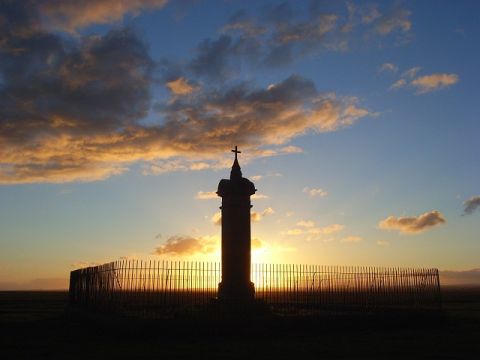
The village rose to national prominence in 1307 when King Edward I, already ill, arrived here with his army while planning a renewed campaign against Robert the Bruce. Camping on the marshes that allowed low-tide crossings into Scotland, he died on 7 July. His body rested inside St Michael’s Church before being taken to Westminster Abbey. A monument erected on the marsh in 1685-and replaced in 1803-marks the place where he died. In 2007, on the 700th anniversary of the king’s death, a statue of Edward I was unveiled in the village.
St Michael’s Church itself is a treasure of early medieval architecture. Built in the 12th century, likely on earlier foundations, it contains Anglo-Saxon carvings in the undercroft-mythical beasts and symbols echoing early Christian artistry. In the 14th century, continuous border warfare prompted villagers to fortify the church: its west tower served as refuge from Scottish raids, while the east tower protected the priest. Later, during the 16th-century era of the Border Reivers, the region was ravaged by raiding families from both sides of the frontier.
Further adding to the village's lore is the suggestion-though tenuous-that Burgh by Sands may be linked to Avalon of Arthurian legend. Geoffrey of Monmouth described Avalon as a land rich in apples, and the Roman name Aballava shares a linguistic connection. Some even suggest Excalibur was forged here, blending myth with archaeology in a place already rich with stories.
Things to See and Do in Burgh by Sands
Begin at St Michael’s Church, where centuries of history converge. Its fortified towers, Anglo-Saxon carvings, and Roman masonry make it one of the area’s most fascinating historic buildings. Inside, you can imagine the community taking refuge during raids or gathering in quieter times to worship.
A walk out to Burgh Marsh leads you to the Edward I monument, standing alone in the landscape where the king died. Surrounded by wide skies, tides, and distant views of Scotland, it is a deeply atmospheric place that captures the frontier spirit of the region.
Exploring the village itself reveals more medieval and later structures built from Hadrian's Wall stone. For walkers, the Hadrian's Wall Path passes through the area, offering scenic routes across fields, along the marsh, and through historic farmland rich with archaeological remains.
How to Get to Burgh by Sands
Burgh by Sands lies west of Carlisle near the Solway Firth. Visitors travelling by air typically arrive via Newcastle International Airport before continuing to Carlisle by train or road. For the best deals and a seamless booking experience, check out these flights to Carlisle on Booking.com.
Carlisle Railway Station connects to major UK cities, and from there Burgh by Sands can be reached by local bus, taxi, or bicycle along the Hadrian's Wall cycle route. Train schedules and bookings can be found on Omio. Travelling by car is straightforward via the A689 or Bowness-on-Solway road, with parking available in the village.
Practical Tips on Visiting Burgh by Sands
- Best time to visit Burgh by Sands: Daylight hours and fair weather for marsh walks.
- Entrance fee in Euros: Free; the church and village are open-access.
- Opening hours: Church hours vary; marsh and village open at all times.
- Official website: See local tourism or parish pages for details.
- How long to spend: 1 to 2 hours depending on walks and interest in history.
- Accessibility: Marsh paths may be uneven or muddy; church access varies.
- Facilities: Limited services in the village; more options in Carlisle.
- Photography tip: Capture the Edward I monument at sunrise or sunset for dramatic silhouettes.
- Guided tours: Some Hadrian's Wall walks include Burgh by Sands.
- Nearby food options: Pubs in nearby villages; cafés and restaurants in Carlisle.
Where to Stay close to Burgh by Sands
Staying nearby provides easy access to the Solway Coast and Roman frontier. Choose The Halston for a comfortable city base close to local history. For a village atmosphere near the Wall, The Kings Arms offers cosy accommodation. Another option is Pinegrove Hotel, providing convenient access to both Carlisle and the surrounding countryside.
Is Burgh by Sands Worth Visiting?
Absolutely. Burgh by Sands offers a compelling blend of Roman archaeology, medieval fortification, royal history, and evocative marshland scenery. From the story of King Edward I to the enduring legacy of Hadrian's Wall, the village captures the complex history of the Anglo-Scottish frontier. It is an excellent stop for walkers, history enthusiasts, and anyone exploring the Solway region.
What Other Travellers Say...
Reviews Summary
Burgh by Sands is a village in the Carlisle CA5 area of the UK, offering a quiet, rural feel typical of small English settlements.
FAQs for Visiting Burgh by Sands
Nearby Attractions to Burgh by Sands
- Drumburgh Castle: A fortified pele tower built with Roman stone.
- Port Carlisle: A historic 19th-century canal port on the Solway Coast.
- Bowness-on-Solway: Western end of Hadrian's Wall with estuary views.
- Rickerby Park: Riverside parkland near Carlisle with scenic walking paths.
- Carlisle Castle: A major medieval stronghold with centuries of border history.
The Burgh by Sands appears in our Complete Guide to Visiting Carlisle!

Moira & Andy
Hey! We're Moira & Andy. From hiking the Camino to trips around Europe in Bert our campervan — we've been traveling together since retirement in 2020!
This website uses affiliate links which may earn a commission at no additional cost to you!
Nearby Attractions
- Drumburgh Castle (6.2) km
Castle - Cumbria Museum of Military Life (7.5) km
Museum - Carlisle Castle (7.5) km
Castle - Tullie House (7.6) km
Gallery and Museum - Carlisle Cathedral (7.8) km
Cathedral - Guildhall Museum (7.9) km
Historic Building - Rickerby Park Tower (8.9) km
Tower - Port Carlisle (8.9) km
Village - St Michael's Church (10.9) km
Church - Solway Junction Railway (12.0) km
Historic Site