Bich Dong Pagoda, Ninh Binh (Tam Coc)
Buddhist Temple in Ninh Binh (Tam Coc)
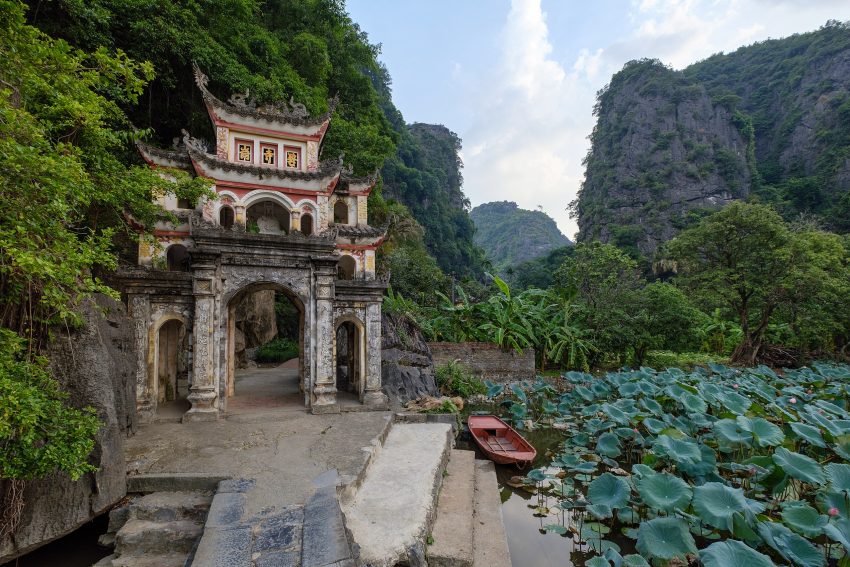
Tucked into the limestone cliffs of Ngu Nhac Mountain, Bich Dong Pagoda is one of the things to do in Ninh Binh that perfectly blends spirituality, scenery and gentle adventure. This centuries-old temple complex, spread across three levels on the mountainside, offers a peaceful escape where you can burn incense, listen to the echo of temple bells and gaze out over rice paddies and karst peaks. It feels both intimate and monumental: small shrines tucked into caves, great rock faces rising above you and views that suddenly open up as you climb.
Ninh Binh is often celebrated for its river landscapes and boat rides, but its ancient pagodas reveal another side of the region. Bich Dong Pagoda, with its Lower, Middle and Upper temples, hidden caves and legends of healing ponds, is a great place to visit on a walking tour of Ninh Binh, especially if you combine it with nearby Tam Coc. The journey here is part of the charm: a short ride or walk from town through villages, rice fields and karst outcrops, before you cross the little stone bridge and step into a quieter world.
Table of Contents
- History and Significance of Bich Dong Pagoda
- Things to See and Do in Bich Dong Pagoda
- How to Get to Bich Dong Pagoda
- Practical Tips on Visiting the Bich Dong Pagoda
- Where to Stay close to the Bich Dong Pagoda
- Is the Bich Dong Pagoda Worth Visiting?
- FAQs for Visiting Bich Dong Pagoda
- Nearby Attractions to the Bich Dong Pagoda
History and Significance of Bich Dong Pagoda
Bich Dong Pagoda’s origins go back to 1428, during the reign of Emperor Ly Thai To, when a small temple was first established on the slopes of Ngu Nhac Mountain. At that time it was a modest hillside sanctuary, serving local worshippers who came to offer incense and prayers amid the rock formations and forest. Over the centuries, as Buddhism continued to shape Vietnamese spiritual life, the site’s importance grew and more structures were added to the mountain.
In 1705, two monks, Tri Kien and Tri The, rediscovered and transformed the original temple into the three-tiered complex you see today. They created Ha Pagoda (Lower Pagoda) at the foot of the mountain, Trung Pagoda (Middle Pagoda) halfway up and Thuong Pagoda (Upper Pagoda) near the summit, weaving caves and natural rock chambers into the architecture. Their work also included casting a large bronze bell and carving statues and reliefs in the caves, turning the mountain into a living mandala of shrines, steps and sacred spaces that pilgrims could move through in stages.
When Lord Trinh Sam visited in 1774, he was so taken by the view and atmosphere that he gave the pagoda its current name: Bich Dong, meaning “Green Pearl Cave”. The name captures both the lush, green surroundings and the sense of the temple complex as a hidden jewel in the mountains. Today, Bich Dong Pagoda still functions as an active place of worship as well as a cultural relic, drawing both local pilgrims and international visitors who come to experience a slice of traditional Vietnamese Buddhism in a spectacular setting.
Things to See and Do in Bich Dong Pagoda
The approach to Bich Dong is one of its most photogenic moments. You cross a small stone bridge over a lotus pond towards the foot of the mountain, the pagoda roofs peeking out from behind karst cliffs. This gentle, almost cinematic entrance sets the tone for the rest of the visit and invites you to slow down, lower your voice and step into a more contemplative rhythm.
Ha Pagoda (Lower Pagoda) sits at the base of the mountain and is the first stop on your climb. This two-storey structure has ten tiled roofs and five rooms supported by ironwood beams and crossbraces. Inside, the air is thick with incense and the soft glow of candles. A striking four-metre-tall monolithic stone pillar and an altar lined with Buddha statues give the space a sense of weight and age. It is a good place to pause, light incense if you wish and observe local worship practices respectfully.
From Ha Pagoda, about 120 stone steps lead you up the mountainside to Trung Pagoda (Middle Pagoda). Built partly against the cliff and partly inside a cave, this level feels more mysterious. Traditional Vietnamese tiled roofs and walls decorated with Chinese characters frame the entrance; inside, rock chambers hold figures of fairies, little boys, dragons, turtles and Buddha. The bronze bell cast by the two monks in 1707 hangs here in the dim light, its engravings picked out when the sun slips in at the right angle. The transition from open courtyard to shadowy cave makes this section particularly atmospheric.
Climb another 40 steep steps from the rear of Trung Pagoda and you reach Thuong Pagoda (Upper Pagoda), perched high on the mountain. This small complex has a forecourt, a stone altar outside and an inner room dedicated to Bodhisattva. The views from here, over rivers, rice fields and the karst landscape, are some of the best in the area. Beside the pagoda lies Cam Lo pond, traditionally believed to have healing properties; even if you do not buy into the legend, the quiet water and surrounding rock give the spot a special stillness.
A few steps beyond Trung Pagoda is Dark Cave (often called Bich Dong Cave), reached by climbing about 21 additional steps. At the entrance, Buddha statues and the presence of the large bronze bell create a deeply sacred feel. As you move further inside, you will see embossed images and rock formations that look like carved paintings on the cave walls. Light and shadow play across the surfaces, making this part of the visit feel like stepping into a natural temple carved by time itself.
Xuyen Thuy Cave adds a different dimension. This semicircular tunnel runs around 350 metres through the base of the massif from east to west, with an average width of around six metres and a broader, fifteen-metre section at its widest point. You can access it via the waterway at the rear of the mountain, opposite the main road to the pagodas. Gliding along this low, echoing passage by boat, with rock overhead and reflections in the water below, reinforces the sense that Bich Dong is as much about caves and elements as it is about built structures. Taken together, all these layers make Bich Dong Pagoda one of the best places to visit in Ninh Binh if you want a blend of spirituality, history and distinctive landscape.
How to Get to Bich Dong Pagoda
The nearest major gateway is Hanoi, whose Noi Bai International Airport handles most international and domestic flights into northern Vietnam. For the best deals and a seamless booking experience, check out these flights to Ninh Binh (Tam Coc) on Booking.com. From Hanoi city centre, you first need to travel to Ninh Binh Province before continuing on to the Tam Coc - Bich Dong area.
By train, you can take a north-south Reunification Line service from Hanoi to Ninh Binh, a journey of about 2 to 2.5 hours depending on the train.Train schedules and bookings can be found on Omio. Tickets from Hanoi start at roughly 110,000 VND for basic seats, with higher classes costing more; from Ninh Binh station it is about a ten-minute car or taxi ride to Tam Coc.
If you prefer buses, a range of operators run from Hanoi to Ninh Binh and Tam Coc, with journey times similar to the train and ticket prices typically between 70,000 and 210,000 VND depending on comfort level and departure point. Many travellers book through their hotel or a reputable agency to keep things simple.
For maximum flexibility, especially if you are already in Ninh Binh or Tam Coc, you can travel by motorbike, private car or taxi. From Tam Coc it is only a few kilometres to Bich Dong Pagoda, a journey of around ten minutes by car, scooter or bicycle along quiet rural roads. Many guesthouses rent bicycles and motorbikes, or you can opt to walk to enjoy the countryside views if the weather is kind.
Practical Tips on Visiting the Bich Dong Pagoda
- Suggested tips: Bring water, a small pack and any essentials you might need, as there are only a few stalls and shops near the entrance to the pagoda complex.
- Best time to visit: April to June and October to December offer pleasant weather and lush landscapes; January to March is popular with local pilgrims during spring festivals.
- How long to spend: Allow at least 1.5-3 hours to climb through all three pagodas, explore the caves and take your time with photos and quiet moments of reflection.
- Accessibility: Expect many stone steps, uneven paths and cave floors; Bich Dong Pagoda is not suitable for visitors with significant mobility issues, though the lower approach and Ha Pagoda area are gentler.
- Facilities: Basic toilets and a few small vendors are usually available near the entrance, but there are limited services higher up the mountain, so plan accordingly.
- Photography tip: Early morning brings softer light on the pagoda roofs and lotus pond, while later in the day the views from Thuong Pagoda and cave entrances showcase the karst landscape beautifully.
- Guided tours: Consider joining a local guide or Tam Coc tour that includes Bich Dong, Xuyen Thuy Cave and nearby temples; they can help you understand the symbolism, history and legends behind what you see.
- Nearby food options: Tam Coc and Ninh Binh towns have plenty of restaurants, cafés and homestays where you can eat before or after your visit, with everything from simple local dishes to more international menus.
Where to Stay close to the Bich Dong Pagoda
Staying in or around Tam Coc puts you just a short ride or walk from Bich Dong Pagoda and makes it easy to combine temple visits with boat trips and countryside cycling. For a peaceful retreat amid rice paddies and karst cliffs, Tam Coc Garden Resort offers a boutique, nature-focused stay with lush gardens and a pool. A little closer to the heart of Tam Coc, Tam Coc Rice Fields Resort combines comfortable bungalows with sweeping views of the surrounding mountains. If you prefer to base yourself in Ninh Binh city with easy access to train and bus links while still being within a short drive of Bich Dong, The Reed Hotel provides a modern, well-equipped base.
Is the Bich Dong Pagoda Worth Visiting?
If you are drawn to places where landscape and spirituality mesh, Bich Dong Pagoda is absolutely worth adding to your Ninh Binh itinerary. The combination of lotus ponds, stone bridges, mountain steps, cave shrines and panoramic views makes it feel very different from a single temple or a simple viewpoint. It is easy to visit from Tam Coc, yet once you start climbing, the noise drops away and the atmosphere turns surprisingly serene. For many travellers, the mix of quiet worshippers, incense smoke and karst cliffs makes this temple complex one of the must-see places in Ninh Binh, especially when paired with a nearby boat ride or countryside cycle.
What Other Travellers Say...

Bich Dong Pagoda sits tucked into a mountainside near Tam Coc and offers tiered temple buildings reached via a short climb and a passage through a cave; visitors praise the scenic views, peaceful atmosphere, lotus ponds and surrounding greenery, and note you can encounter monks and locals praying or selling small souvenirs. Entry is free and there are low-cost parking or bicycle parking options (some visitors advise negotiating or parking at a nearby restaurant to avoid informal fees); the steps can be slippery in wet weather. The site is easy to reach by local rides and makes a tranquil cultural stop with lovely mountain and countryside vistas.


FAQs for Visiting Bich Dong Pagoda
Nearby Attractions to the Bich Dong Pagoda
- Tam Coc Boat Tour: Scenic sampan rides along a river flanked by rice fields and karst cliffs, often described as “Ha Long Bay on land.”
- Thai Vi Temple: A tranquil temple complex in the rice fields near Tam Coc, associated with the Tran Dynasty and surrounded by dramatic limestone peaks.
- Mua Caves Viewpoint (Hang Mua): A steep climb of around 500 steps to panoramic viewpoints over Tam Coc and the surrounding countryside.
- Xuan Thuy Nature Reserve and Van Long Wetland: Peaceful wetland areas ideal for quiet boat trips and birdwatching away from the busier Tam Coc routes.
- Hoa Lu Ancient Capital: The former capital of Dai Co Viet, with historic temples, gateways and karst-backed scenery offering insight into early Vietnamese state history.
The Bich Dong Pagoda appears in our Complete Guide to Visiting Ninh Binh (Tam Coc)!

Moira & Andy
Hey! We're Moira & Andy. From hiking the Camino to trips around Europe in Bert our campervan — we've been traveling together since retirement in 2020!
This website uses affiliate links which may earn a commission at no additional cost to you!
Planning Your Visit
To visit Bich Dong Pagoda, you need to buy a ticket to the Tam Coc – Bich Dong tourism complex, which costs VND 250,000 per adult and VND 120,000 per child.
Nearby Attractions
- Thai Vi Temple (1.7) km
Hindu Temple - Tam Coc (2.3) km
Cave and River - Mua Caves Viewpoint (2.6) km
Cave and Viewing Point - Trang An Caves (4.0) km
River - Am Tien Pagoda Cave (6.9) km
Lake and Pagoda - Hoa Lu Ancient Capital (7.5) km
Historic Building - Bai Dinh Pagoda (8.3) km
Buddhist Temple - Cuc Phuong National Park (33.9) km
National Park - Perfume Pagoda (47.9) km
Buddhist Temple - Museum of Vietnamese Women (89.9) km
Museum