Battistero di Bergamo
Historic Building and Religious Building in Bergamo
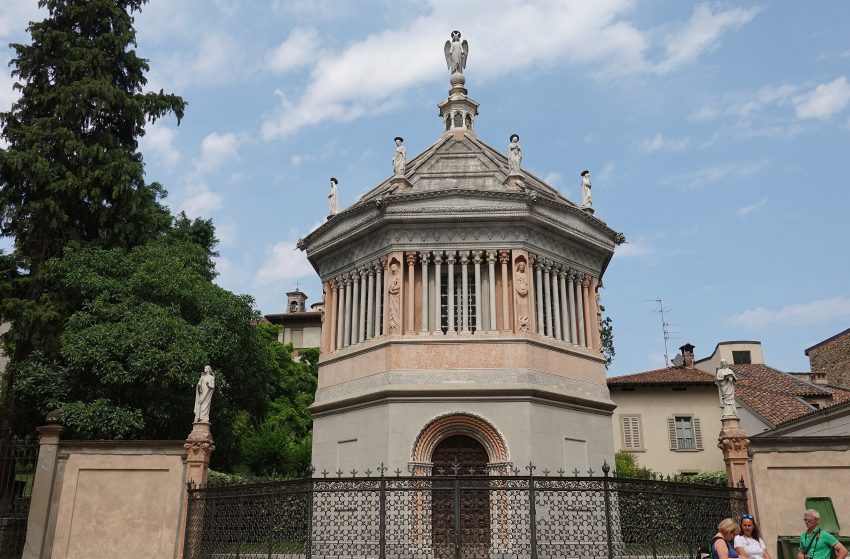
Battistero di Bergamo stands on the western edge of Piazza del Duomo in Bergamo Alta, where it sits beside the Basilica di Santa Maria Maggiore and the Colleoni Chapel. It is a small baptistry and one of the oldest religious buildings in the square, known for its octagonal plan, marble surfaces, and Gothic detailing.
Visitors usually come for the sculptural work rather than for size or grandeur. The exterior is marked by statues and refined stone decoration, while the interior centers on the baptismal font and carved reliefs. It suits travelers interested in medieval architecture, religious art, or a short stop between larger monuments. The space is quiet, compact, and easy to take in without a long visit.
History and Significance of the Battistero di Bergamo
The Battistero di Bergamo was first built in 1340 inside the Basilica di Santa Maria Maggiore by the sculptor Giovanni da Campione, one of the leading artists of Lombard Gothic architecture. It served as the place of baptism for the citizens of Bergamo for centuries. However, its history is one of constant movement-mirroring the city's own dynamic past. In 1661, the baptistry was dismantled and removed from the basilica, later reassembled in different locations, often with modifications that altered its original appearance.
Between 1898 and 1899, the structure was reconstructed in its current form and relocated to its present site in Piazza del Duomo, just beside the Colleoni Chapel. During this final reassembly, the architect Giacomo Bianconi oversaw its restoration in a neo-Gothic style, giving it the harmonious elegance that visitors see today. Despite these changes, the core elements of Giovanni da Campione's 14th-century design-its octagonal shape and sculptural decoration-remain intact, making the baptistry a bridge between medieval craftsmanship and later revivalist artistry.
The baptistry's survival through centuries of dismantling and restoration makes it not just an architectural relic but also a symbol of Bergamo's devotion to preserving its heritage. It stands today as one of the top attractions in Bergamo Alta, quietly echoing the city's long religious and artistic traditions.
Things to See and Do in the Battistero di Bergamo
Though modest in scale, the Battistero di Bergamo reveals extraordinary artistic detail. Its exterior features a domed roof crowned by statues of eight Christian virtues-Faith, Hope, Charity, Fortitude, Justice, Prudence, Temperance, and Patience-each sculpted in the refined Gothic style. The pink and white marble, combined with its octagonal symmetry, creates a luminous, balanced form that contrasts beautifully with the more elaborate façade of the nearby Colleoni Chapel.
Inside, the focal point is the marble baptismal font, encircled by bas-reliefs depicting key scenes from the life of Christ, all carved by Giovanni da Campione in the 14th century. These intricate works blend narrative clarity with symbolic depth, illustrating moments such as the Nativity, Baptism of Christ, and Resurrection. Even a brief visit reveals the masterful combination of religious meaning and artistic skill that defines Lombard Gothic sculpture. The baptistry’s quiet interior provides a moment of reflection amid the grandeur of Bergamo’s cathedral square.
How to Get There
The Battistero di Bergamo is located in Piazza del Duomo, at the heart of Bergamo Alta, directly adjacent to the Basilica di Santa Maria Maggiore and the Colleoni Chapel. Bergamo's train station, located in the lower city, offers excellent connections to Milan, Lecco, and Brescia. Use Omnio to easily compare schedules, book train tickets, and find the best prices all in one place for a hassle-free journey across Italy. To reach Bergamo Alta (the upper city) from the train station, take ATB bus line 1. This bus departs from the station every ten minutes and connects directly to the lower funicular station. From the upper funicular station at Piazza Mercato delle Scarpe, it's a short uphill walk through Via Gombito to Piazza del Duomo.
Drivers can park at Piazza della Cittadella or Parcheggio Mercato del Fieno, both within easy walking distance. If you are looking to rent a car in Italy I recommend having a look at Discover Cars, first, as they compare prices and review multiple car rental agencies for you.
Practical Tips on Visiting the Battistero di Bergamo
- Best time to visit the Battistero di Bergamo: Morning or early afternoon for soft light and fewer crowds.
- Entrance fee in Euros: Free entry.
- Opening hours: Generally open daily, 9:00-12:30 and 14:00-17:30; may vary seasonally.
- Official website: www.visitbergamo.net
- How long to spend: 15-30 minutes is sufficient to appreciate its details and surroundings.
- Accessibility: Fully accessible; ground-level entrance.
- Facilities: Nearby restrooms and cafés in Piazza Vecchia and Via Colleoni.
- Photography tip: Frame the baptistry with the Colleoni Chapel and Santa Maria Maggiore for dramatic compositions.
- Guided tours: Included in many Bergamo Alta architectural or religious walking tours.
- Nearby food options: Try Caffè del Tasso or Al Donizetti for coffee or lunch nearby.
Is the Battistero di Bergamo Worth Visiting?
Yes, absolutely. The Battistero di Bergamo is a masterpiece of Lombard Gothic art and a serene counterpoint to the grandeur of its neighboring churches. Its rich sculptural decoration and symbolic architecture make it one of the best places to visit in Bergamo Alta. For travelers who enjoy exploring intimate spaces filled with history and craftsmanship, it's a highlight of any walking tour of Bergamo.
What Other Travellers Say...
Battistero, in the small piazza at Piazza Duomo 8 in Bergamo Alta, is an octagonal 14th-century baptistery noted for its compact, expressive interior and richly detailed exterior: visitors describe a black marble base, two-tone columns and an elegant loggia with red Veronese marble columns, bas-reliefs on the baptismal font depicting scenes from Jesus' life, and eight exterior statues representing virtues or beatitudes; it's occasionally used for ceremonies, can be visited with a ticket to the diocesan museum, and at times is closed to general tourists, so availability to peer inside can be limited but rewarding when possible.





FAQs for Visiting the Battistero di Bergamo
The Battistero di Bergamo appears in our Complete Guide to Visiting Bergamo!

Moira & Andy
Hey! We're Moira & Andy. From hiking the Camino to trips around Europe in Bert our campervan — we've been traveling together since retirement in 2020!
This website uses affiliate links which may earn a commission at no additional cost to you!
Planning Your Visit
Nearby Attractions
- Cappella Colleoni (0) km
Church - Torre del Campanone (0) km
Tower - Basilica di Santa Maria Maggiore (0) km
Church - Palazzo della Ragione (0) km
Historic Building and Palace - Palazzo del Podestà (0) km
Museum and Palace - Bergamo Cathedral (0.1) km
Cathedral - Tempietto di Santa Croce (0.1) km
Church - Piazza del Duomo (0.1) km
Square - Piazza Vecchia (0.1) km
Square - Torre di Gombito (0.1) km
Tower