Arch of Augustus, Rimini
Historic Site in Rimini
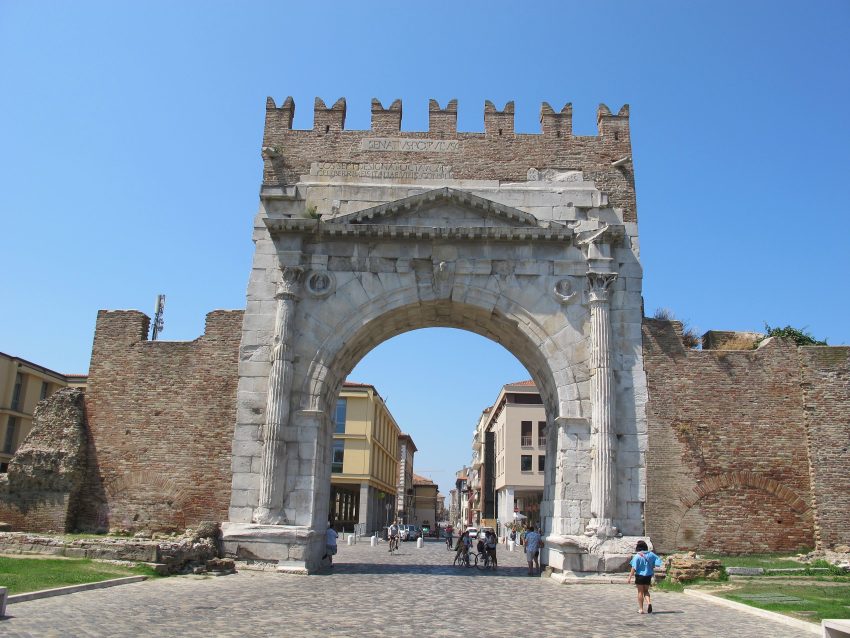
The Arco di Augusto sits at the southern edge of Rimini's historic centre, where modern streets still follow the bones of Roman planning. Built in 27 BC to honour Caesar Octavian Augustus, it marks the old entrance point of the Via Flaminia-the road that once linked Rimini to Rome-so you're standing in the exact spot where travellers arrived to the city nearly two millennia ago. It's one of the top attractions in Rimini, and because it's outdoors and always part of the city's daily rhythm, you can drop by for five minutes or linger as the light changes across the stone.
What makes the arch feel special is how open and confident it looks: a single wide passage (the fornix) that was never designed to be shut with doors, a deliberate statement of peace after years of civil conflict. Look up and you'll spot the divine figures in round clipei and the crisp classical detailing that once carried strong political messaging about Rome and Augustus. It's also a highlight of any walking tour of Rimini, because it neatly connects the Roman story with the medieval and Renaissance layers you'll see as you wander deeper into town.
Table of Contents
- History and Significance of the Arco di Augusto
- Things to See and Do in the Arco di Augusto
- How to Get to the Arco di Augusto
- Practical Tips on Visiting the Arco di Augusto
- Where to Stay close to the Arco di Augusto
- Is the Arco di Augusto Worth Visiting?
- For Different Travelers
- FAQs for Visiting Arco di Augusto
- Nearby Attractions to the Arco di Augusto
History and Significance of the Arco di Augusto
The Arco di Augusto is widely regarded as the oldest surviving Roman triumphal arch, and it's easy to see why it still commands attention: it's monumental without being heavy, and it was positioned to be unavoidable for anyone entering the city from the Roman road. Constructed in 27 BC, it celebrated Augustus at a time when the empire was consolidating power and shaping public messages through architecture, inscriptions, and carefully chosen iconography.
The decorative scheme is packed with symbolism. On the outward-facing side you'll find Jupiter, signalling imperial authority, and Apollo-closely associated with Augustus-shown with attributes that hint at music and prophecy. On the city-facing side, Neptune and the personification of Rome underline dominion over sea and land, a strong message for a port-adjacent city on a strategic route. Even smaller details, like the ox heads on the sides, reinforce Rimini's status as a Roman colony and the civic pride that came with it.
The arch you see today also carries later history. When the surrounding area was cleared in the late 1930s, it became clear the monument functioned as an urban gate, flanked by city walls. The original attic-likely intended for an imperial statue-was lost, probably due to earthquakes, and the medieval battlements that remain give the upper profile a slightly fortified look that tells you this structure stayed relevant long after Rome.
Things to See and Do in the Arco di Augusto
Start with the overall proportions: the opening is unusually broad, and standing beneath it gives you a real sense of how this was meant to impress arriving travellers. Step back to take in the Istrian stone, then move closer and scan the carvings-this is one of those monuments where a slow, deliberate look reveals far more than a quick photo.
Spend a few minutes identifying the figures in the clipei and noticing how the arch is “two-faced” in the best way, with different divine pairings aimed at different audiences. If you enjoy reading cities through their street layouts, use the arch as a practical compass point: it's a natural start or finish for exploring Roman Rimini, and it pairs well with a gentle walk towards the historic core for piazzas, churches, and small museums.
If you’re visiting in the evening, come back after dinner. The lighting tends to flatter the stonework, and the surrounding green space makes it feel calmer than you’d expect from such a central monument-perfect for a slower, more atmospheric visit.
How to Get to the Arco di Augusto
The closest airport is Federico Fellini International Airport (Rimini), and it's a short trip into the centre by taxi, rideshare, or local bus depending on the season. For the best deals and a seamless booking experience, check out these flights to Rimini on Booking.com. For more flight options, Bologna's airport is a common alternative, with straightforward onward connections to Rimini by rail or coach.
Arriving by train is one of the easiest choices: Rimini Railway Station is walkable from the arch, and the route is simple enough that it works well even if it's your first time in the city. Use Omnio to easily compare schedules, book train tickets, and find the best prices all in one place for a hassle-free journey across Italy. If you’re carrying luggage, a quick taxi or local bus hop can save time, but many travellers find the walk a good first “orientation lap” of the centre.
If you’re driving, aim for parking areas on the edge of the historic centre and walk in, as the core can have restricted-traffic zones and limited spaces. If you are looking to rent a car in Italy I recommend having a look at Discover Cars, first, as they compare prices and review multiple car rental agencies for you. Local buses and taxis also run frequently through central Rimini, so it's easy to include the arch as a stop between other sights without planning your whole day around it.
Practical Tips on Visiting the Arco di Augusto
- Entrance fee: Free
- Opening hours: 24 Hours
- Best time to visit: Early morning for quiet photos, or late afternoon into evening when the light softens and the area feels more relaxed.
- How long to spend: Plan 15-30 minutes for a proper look and photos, or longer if you’re using it as the starting point for a wider Roman-history walk.
- Accessibility: The monument is outdoors on flat ground, and most visitors can view it comfortably, though nearby paving can be uneven in places.
- Facilities: There aren’t visitor facilities at the arch itself, but you’ll find cafés, benches, and amenities within a short walk in the surrounding streets.
Where to Stay close to the Arco di Augusto
If you want to be close enough to stroll to the arch in minutes, staying in or near Rimini’s historic centre is the most convenient choice-especially if you plan to explore on foot and dip into cafés between sights. A stylish, central option is DuoMo hotel, which puts you within easy walking distance of the arch and the main piazzas while keeping you surrounded by the city’s best evening atmosphere.
For a practical base with excellent transport connections, Hotel Card International is a strong pick near the station, making day trips simple while still keeping the Arco di Augusto within walking range. If you prefer to mix sightseeing with a little seaside time, Mercure Rimini Artis offers a comfortable coastal stay that still lets you reach the historic centre without hassle.
Is the Arco di Augusto Worth Visiting?
Yes-because it's not a “museum stop” that needs scheduling, it's a living landmark you can weave into almost any day in Rimini. The arch rewards both quick visits and slower ones: you can snap a classic photo in minutes, or spend longer noticing the symbolism and how the monument frames the city's Roman-to-medieval layers.
It's also one of those places that improves your sense of the city. Once you've seen where the Roman road entered Rimini, the rest of the historic centre starts to feel more legible, and the walk between major sights becomes part of the experience rather than just the space in between.
What Other Travellers Say...

Arco di Augusto stands at the end of Corso d'Augusto as the city's ancient gateway; visitors note its role as an imposing freestanding arch that marks the eastern entrance to Rimini's old centre and connects to a linear park toward the coast. The site is easy to walk around with shops, cafés and a nearby garden; it makes a pleasant stop on a mapped walking route of Roman monuments and sometimes hosts a local market where you can find inexpensive clothing. The monument's carved details and classical columns give it a strong presence as you pass between the historic centre and the modern city.


For Different Travelers
Families with Kids
Kids often enjoy the simple scale-and-story appeal here: it’s a giant ancient gateway you can walk under, and it’s easy to turn the carvings into a quick “spot the gods” game. Because it’s outdoors and flexible, it works well as a low-effort stop between snacks, gelato, and playground breaks.
To keep it fun, pair the arch with a short loop to another nearby landmark so it feels like a mini adventure rather than a single photo stop. Early in the day is usually best for families, when pavements are less busy and you can linger without feeling in anyone’s way.
Couples & Romantic Getaways
The Arco di Augusto is ideal for a gentle, atmospheric stroll, especially if you visit in softer late-day light and then wander into the old town for an aperitivo. It has that classic “we're in Italy” feeling without needing tickets, queues, or a strict plan.
For couples who like photography, the arch gives you clean lines and strong symmetry, and it’s easy to build a simple date-night route around it. Combine it with a slow walk through the historic streets and a dinner reservation nearby, and it becomes a natural, unforced highlight.
Budget Travelers
This is a high-value stop because it’s outdoors, central, and easy to enjoy without spending anything beyond what you choose on food or transport. It also works perfectly as a navigation anchor, helping you plan efficient walking routes that cut down on paid transport.
If you’re keeping costs down, use the arch as a starting point for a self-guided Roman-and-old-town walk, then take breaks in bakeries or casual cafés rather than sitting down for full meals. Visiting early or later in the day can also help you avoid peak crowds and get better photos without waiting.
FAQs for Visiting Arco di Augusto
Nearby Attractions to the Arco di Augusto
- Tempio Malatestiano: Rimini's striking Renaissance cathedral, with an exterior that feels like a monument in its own right.
- Piazza Cavour: The city's main historic square, ideal for people-watching and soaking up Rimini's civic heart.
- Castel Sismondo: A fortress linked to the Malatesta family, offering a dramatic look at Rimini's medieval power.
- Ponte di Tiberio: An exceptionally well-preserved Roman bridge that makes a perfect pairing with the arch for history lovers.
- Domus del Chirurgo: A compact but fascinating archaeological site showcasing Roman-era remains and discoveries in the centre.
The Arch of Augustus appears in our Complete Guide to Visiting Rimini!

Moira & Andy
Hey! We're Moira & Andy. From hiking the Camino to trips around Europe in Bert our campervan — we've been traveling together since retirement in 2020!
This website uses affiliate links which may earn a commission at no additional cost to you!
Planning Your Visit
24 Hours
Free
Nearby Attractions
- Tempio Malatestiano (0.3) km
Church - Piazza Tre Martiri (0.3) km
Historic Site and Square - Porta Montanara di Rimini (0.5) km
City Gate - Rimini Roman Amphitheatre (0.5) km
Amphitheatre - Piazza Cavour (0.6) km
Square - Palazzo Garampi (0.6) km
Palace - Domus del Chirurgo (0.6) km
Historic Site - Palazzo del Fulgor (0.7) km
Museum - Castel Sismondo (0.7) km
Castle and Museum - Museo della Città di Rimini (0.7) km
Historic Building and Museum