Self-Guided Walking Tour of Trogir (+ Maps!)
This website uses affiliate links which earn a small commission at no additional cost to you.
Trogir is compact, atmospheric, and made for walking: a tight medieval street plan, big-set-piece landmarks, and constant glimpses of the sea. This route focuses on the Old Town core, where the best things to see in Trogir sit close together and the detours are half the fun.
You’ll move between monumental architecture and everyday corners-stone lanes that suddenly open onto a sunlit square, a quiet cloister a minute from the promenade, and viewpoints that make you stop without planning to. The map helps you keep a clean flow, but the city rewards wandering.
Because it’s a short-distance town, you can pace it exactly how you like. Do the headline sights first, loop back for details later, and build in gelato or coffee whenever the mood hits-Trogir’s walkability makes the day feel effortless.
Table of Contents
- How to get to Trogir
- A Short History of Trogir
- Trogir in Antiquity and Early Urban Life
- Trogir in the Medieval City-State Era
- Trogir and the Cathedral City Identity
- Trogir Under Venetian Influence and Coastal Defense
- Trogir’s Renaissance Prosperity in Palaces and Craft
- Trogir’s Sacred Corners and Local Devotion
- Trogir’s Gates, Waterfront, and the Living Old Town
- Where to Stay in Trogir
- Your Self-Guided Walking Tour of Trogir
How to get to Trogir
By Air: The closest airport is Split Airport (SPU), only a short hop from town. From the terminal, you can use public buses that stop at/near the airport and run toward Trogir, or take a taxi/ride-share for the simplest door-to-door option if you've got bags or you're arriving late. For the best deals and a seamless booking experience, check out these flights to Trogir on Booking.com.
By Train: Trogir doesn't have its own railway station, so the usual approach is to take the train to Split and then continue by road. From Split, you can connect onward by local bus, shuttle, or taxi depending on season and how direct you want the transfer to be. Train schedules and bookings can be found on Omio.
By Car: Driving is straightforward, but the Old Town itself is not car-friendly, so plan to park outside the historic core and walk in over the bridge. If you’re visiting on a day trip, arriving early helps you avoid the tightest parking crunch and gives you a calmer start before the streets fill up.
By Bus: If you're coming from nearby coastal towns, regional buses are often the easiest option, dropping you close enough to walk into the centre. Once you're in Trogir, getting around is best done on foot-within the Old Town you'll move faster walking than trying to navigate short drives, one-way lanes, and parking.
A Short History of Trogir
Trogir in Antiquity and Early Urban Life
Long before the photogenic stone lanes became a tourist magnet, Trogir’s appeal was its position for trade and maritime movement. The town developed as a compact, defensible settlement that could thrive on exchange, craft, and seafaring connections-foundations that still shape the Old Town’s tight layout and purposeful streets.
Trogir in the Medieval City-State Era
As Trogir matured, civic and religious power concentrated into a walkable core of public buildings and churches. The Trogir Main Square became the stage set for authority and ceremony, surrounded by the working architecture of governance-Knežev dvor and Gradska loža-where decisions, announcements, and daily administration anchored town life.
Trogir and the Cathedral City Identity
Trogir's defining medieval project was its cathedral complex, which grew over centuries and signaled both prestige and continuity. Trogir Cathedral and Bell Tower dominate the square not just visually but historically: a long, multi-phase build that reflects changing styles, patrons, and ambitions as the town's identity strengthened around monumental sacred architecture.
Trogir Under Venetian Influence and Coastal Defense
Trogir’s stonework also tells a story of shifting power along the Adriatic. Venetian rule left a strong imprint on the town’s urban fabric and its defensive posture, most dramatically at Kula Kamerlengo, built as a hard statement of control and protection at the edge of the Old Town. That maritime-facing strength pairs naturally with Trogirska riva, where the city’s relationship with the sea becomes the everyday foreground of the historic skyline.
Trogir’s Renaissance Prosperity in Palaces and Craft
Periods of stability and wealth show up in the refined domestic architecture of the Old Town. Palaca Cipiko is a standout for how it turns prosperity into street-level detail-carved stone, carefully proportioned openings, and a sense that civic pride extended beyond churches into elite residences. Nearby, the urban ensemble around the main square reads like a curated collection of styles layered over time, with each generation adding and adapting rather than replacing.
Trogir’s Sacred Corners and Local Devotion
Beyond the headline cathedral, Trogir’s spirituality is also written into quieter sites. Kapela Sv. Ivan Trogirski (linked to the cult of a local bishop-saint) adds a more intimate layer of devotion within the same compact centre, while Saint Dominic Monastery reflects the role of monastic communities in shaping education, worship, and the intellectual life of the town. These places are part of why the Old Town feels lived-in rather than staged-faith and daily life have shared the same streets for centuries.
Trogir’s Gates, Waterfront, and the Living Old Town
Entry points like Sjeverna Vog are more than photo stops: they mark the boundary between the modern approach and the historic maze, a threshold you can feel as the streets narrow and the stone closes in around you. Today, the Old Town’s UNESCO status is essentially recognition of how well these layers have survived together-cathedral, palaces, civic buildings, monasteries, gates, and fortifications forming a coherent whole you can read while walking.
Where to Stay in Trogir
To make the most of visiting Trogir and this walking tour then you consider stay overnight at the centre. In the Old Town itself you'll be able to start early (or stay out late) and still be a few minutes from the main square and the waterfront. This is the best choice if you want maximum atmosphere and minimal logistics, especially if you plan to take lots of photos at quieter hours. Consider XII Century Heritage Hotel for a true historic-core base, Heritage Hotel Pasike for a classic Old Town stay, or Tragos Lemon Tree if you like being tucked into the lanes but close to the main square.
If you prefer a little more space, easier parking, and a quick walk or short taxi into the centre, look at the areas just outside the Old Town and toward the bridges (including the approach road and nearby waterfront strips). This suits travelers arriving by car, families, or anyone who wants a quieter sleep without losing convenience. A strong option here is Brown Beach House Hotel & Spa, which keeps you close enough to walk to the Old Town while feeling more like a resort-style base.
For a longer, calmer stay (and often better value), Seget Donji is a practical nearby base with coastal hotels and straightforward access back into Trogir for the walking route. It's ideal if you're combining the Old Town with beach time or you want a pool-focused stay. Good picks include Hotel Medena, Hotel Rotondo, and Hotel Ola - Adults Only.
Your Self-Guided Walking Tour of Trogir
Discover Trogir on foot with our walking tour map guiding you from gate to square, from cathedral heights to seaside forts, as you explore its layered Old Town at your own pace. Because this is a self-guided walking tour, you can skip any stop that doesn't interest you, linger where the light is best, and take coffee breaks whenever you want-Trogir is small enough that the day always stays easy and flexible.
1. Saint Dominic Monastery
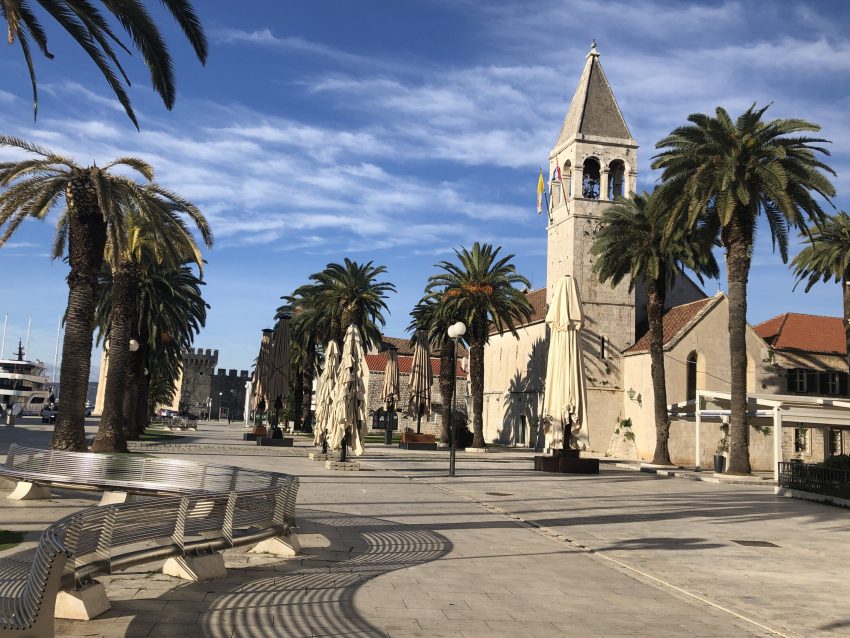
The Dominican monastery and church of St Dominic in Trogir were founded in the 13th century, with the church completed later in the medieval period (commonly described as reaching completion in the later 14th century). The complex’s later history includes wartime damage and subsequent restoration campaigns in the 20th century, which is part of why different areas can feel uneven in age and finish. As a Dominican house, it belongs to the broader story of mendicant orders taking root in Adriatic towns, shaping education, preaching, and urban religious life outside the cathedral chapter. The monastery’s cloister is often dated to the mid-15th century in descriptions of the site, aligning with a period of architectural refinement under strong Venetian cultural gravity. What to see depends on access, but the best approach is to look for the medieval structure and the cloister atmosphere, then note any surviving historic details in stone carving and layout. Even when parts have been repaired, the complex still conveys the quieter, inward-looking rhythm that monastic sites bring to a town otherwise dominated by public squares and façades.
Location: Obala bana Berislavića 17, 21220, Trogir, Croatia | Hours: (Summer) April: 09:30–20:00; May: 09:30–21:00; June: 09:30–22:30; July: 09:30–22:30; August: 09:30–22:30; September: 09:30–21:00; October: 09:30–21:00. | Price: €2. | Website

2. Trogirska Riva
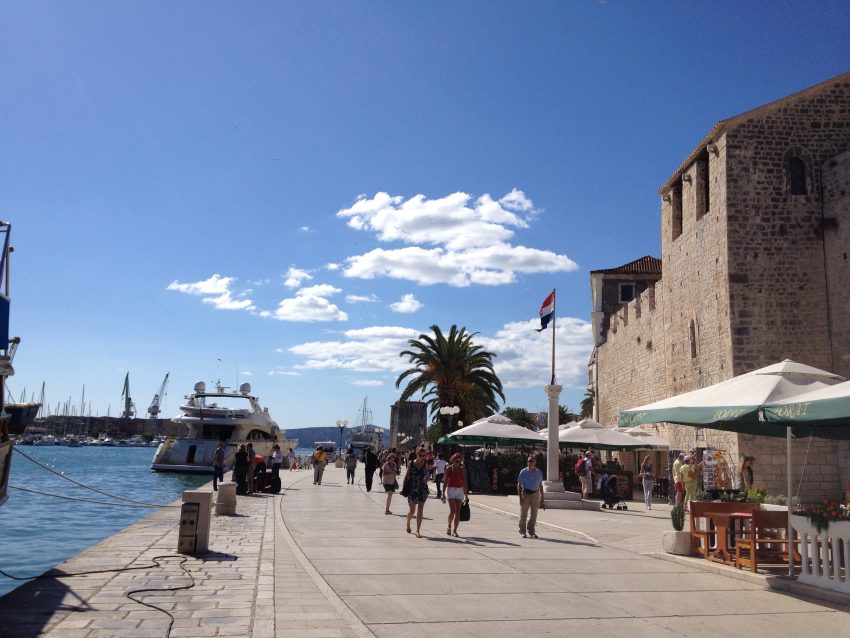
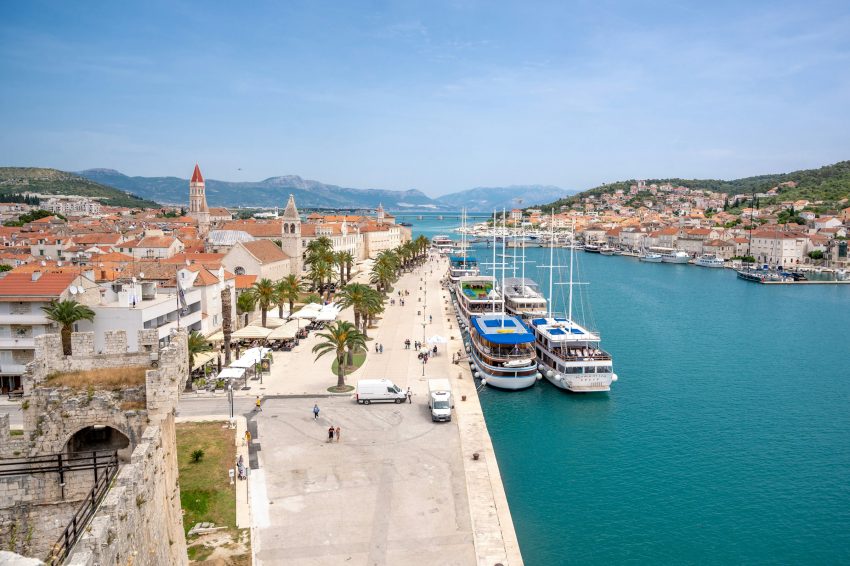
Trogir’s Riva is the waterfront promenade along the edge of the old town, where the city opens out to the harbour. Modern life happens here, but the setting is inseparable from the historic fabric: you’re walking the perimeter of a dense medieval core with views toward the fortifications and the sea-lanes that shaped Trogir’s fortunes. The history in this strip of waterfront is mostly maritime and strategic rather than “one building, one date.” Trogir’s prosperity depended on seaborne trade and on controlling access through channels and harbour spaces, which is why major defensive works like Kamerlengo sit at the water’s edge nearby. What to see is the panorama: boats in the harbour, the old town’s stone façades, and how the skyline is punctuated by the cathedral bell tower. It’s also one of the best places to understand the town’s geography at a glance, because the relationship between island-like old town, bridges, and water becomes obvious.
Location: Obala bana Berislavića 11, 21220, Trogir, Croatia | Hours: 24 Hours. | Price: Free.
3. Knezev Dvor
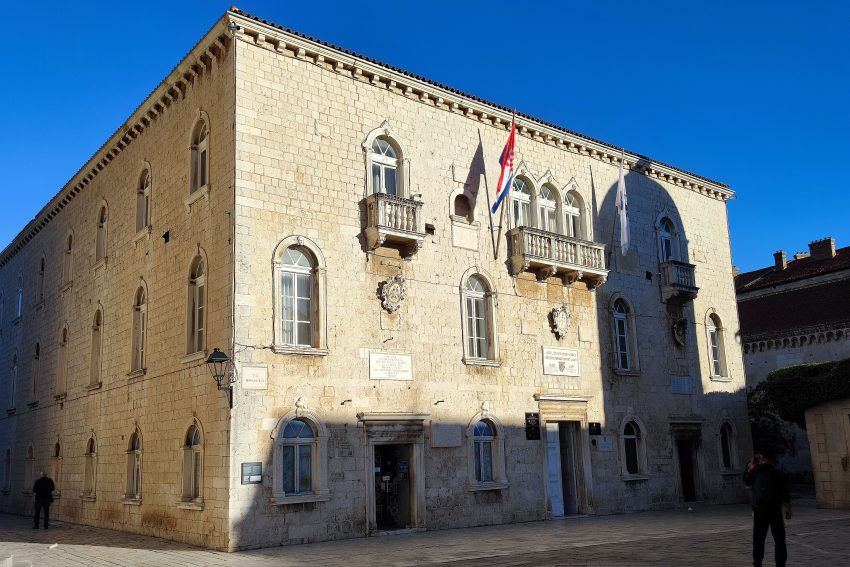
In Trogir, Knežev dvor commonly refers to the civic building beside the cathedral that functions as the town hall complex, part of the historic administrative core of the old town. UNESCO specifically notes the Town Hall near the cathedral as one of Trogir’s fine public buildings, dating to the 14th and 15th centuries, later restored while retaining key historic character. This is the sort of place that tells you how the town governed itself: the setting is formal but compact, reflecting a medieval city where political power sat cheek-by-jowl with religious authority. Visitor descriptions consistently highlight the Gothic courtyard as a defining feature, with coats of arms and stone details that read like a roll-call of prominent local families and outside rulers. What to see is primarily in the courtyard: the monumental staircase, the carved well-head, and the heraldic stonework. Even a brief look gives you a strong sense of civic identity and how Trogir’s elite presented themselves in public space.
Location: Trg Ivana Pavla II 1, 21220, Trogir, Croatia | Hours: Check official website. | Price: Free. | Website
4. Gradska Loza Trogir
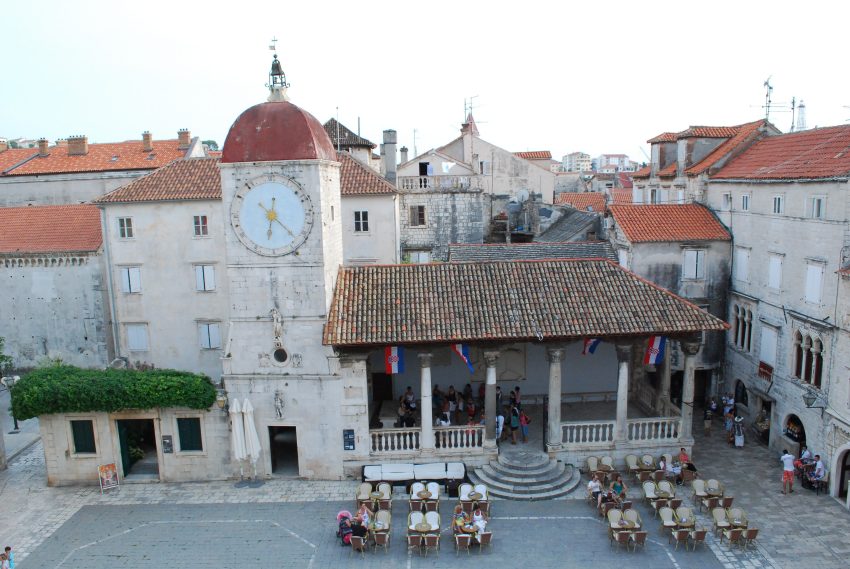
The City Loggia (Gradska Loža) sits on the main square as a classic Adriatic civic structure: open-sided, public-facing, and historically tied to law and ceremony. Sources describing it for travelers emphasize its role as a courtroom in Renaissance times and date the loggia’s prominent surviving form to the 15th century. Its history is closely connected to Venetian-era civic culture, where justice and public announcements were staged in deliberately visible settings. Accounts of the loggia’s fabric also point to significant reshaping and embellishment in the 15th century, aligning it with broader patterns of Renaissance urban renewal in the region. What to see is the setting as much as any single object: the loggia’s proportions, the relationship to the clock tower, and the way it frames the square’s daily life. Pause underneath and imagine the acoustics and crowds when verdicts, decrees, and formal gatherings would have been conducted in full view.
Location: Trg Ivana Pavla II 7, 21220, Trogir, Croatia | Hours: 24 Hours. | Price: Free.
5. Trogir Main Square
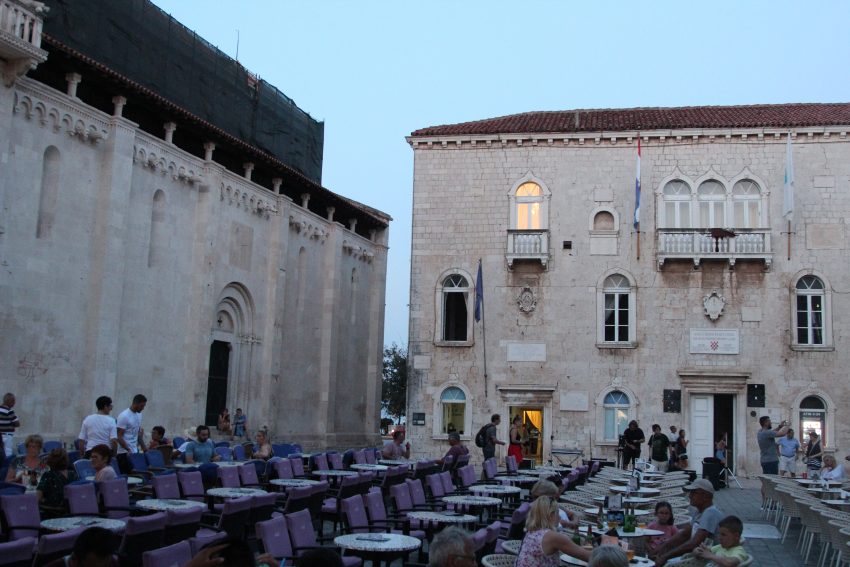
Trogir’s main square is Trg Ivana Pavla II (John Paul II Square), the town’s central civic stage and the natural focal point of the UNESCO-listed old town. For centuries, the most important religious and public buildings clustered here, so the square reads like an index of Trogir’s wealth and political life. Historically, this is where authority was performed in public: church ceremony at the cathedral, administration at the town hall, and civic business around the loggia and clock tower. The concentration of major monuments on one small square is part of why Trogir feels so “complete” as a preserved historic ensemble. When you’re there, take a slow circuit and read the façades rather than rushing inside. The cathedral, town hall, and loggia sit almost shoulder-to-shoulder, so you can compare styles and periods just by turning your head.
Location: Trg Ivana Pavla II 1, 21220, Trogir, Croatia | Hours: 24 Hours. | Price: Free.
6. Trogir Cathedral and Bell Tower
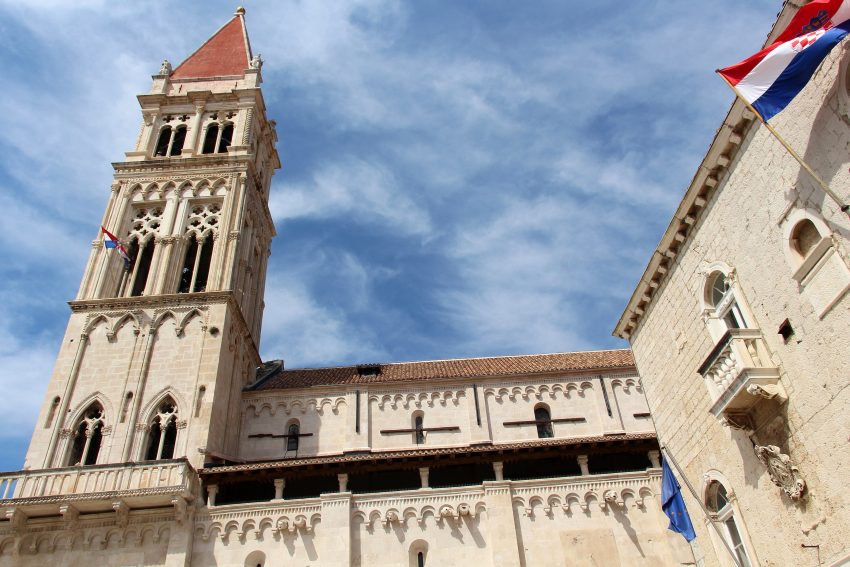
The Cathedral of St Lawrence (St Lovro) is Trogir’s standout monument, with construction beginning in the early 13th century and later phases continuing for centuries. Its architecture layers Romanesque and Gothic elements with later additions, reflecting long-term building campaigns rather than a single moment in time. One of the defining historic artworks is the main west portal by Master Radovan, a major work of Croatian medieval sculpture, signed and dated to 1240. The portal’s carved program is a key “don’t miss” detail even if you only spend a short time in the complex. The bell tower is part of the same story of incremental growth: its stages show different stylistic phases as it rose over time, with later Renaissance and other elements visible as you look upward. If you go up, the reward is both close-up views of the tower’s sculptural details and a clear sense of how the cathedral dominates the old town’s skyline.
Location: Trg Ivana Pavla II, 21220, Trogir, Croatia | Hours: Check official website. | Price: Check official website.
7. Palaca Cipiko
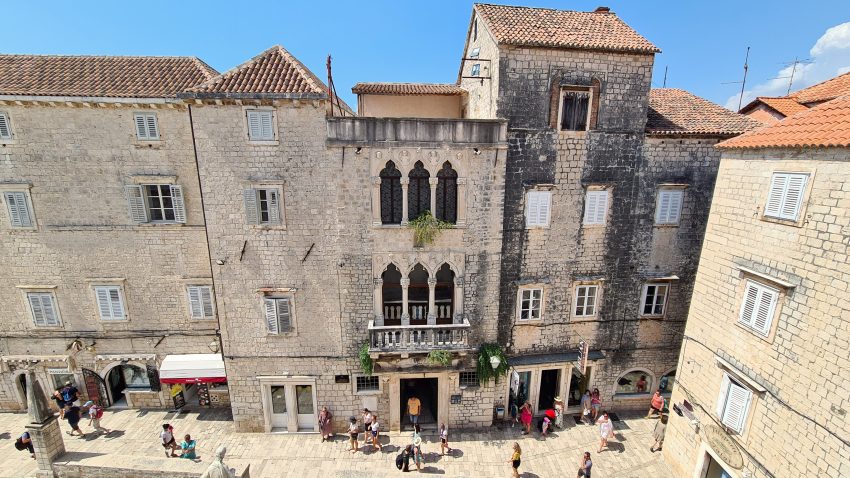
Cipiko Palace sits right on the main square opposite the cathedral, linked to the prominent Cipiko family and Trogir’s patrician culture. It’s not a single “one-era” building: its fabric and details reflect changes and expansions across centuries, which is typical for elite urban residences in long-lived Adriatic towns. Architecturally, it’s noted for a blend of Gothic, Romanesque, and Renaissance features, which you can read in window shapes, carved stone elements, and the overall composition of the façade. The palace’s position facing the cathedral also says something about social hierarchy: the great families wanted their homes anchored to the town’s most symbolic space. What to see here is mostly exterior-focused unless a specific part is open during your visit. Spend time on the stone carving and proportions, then step back to take in how the palace, cathedral, and civic buildings form an intentional “power triangle” around the square.
Location: Croatia, Radovanov trg 10, 21220, Trogir, Croatia | Hours: 24 Hours. | Price: Free.
8. Kapela Sv. Ivan Trogirski
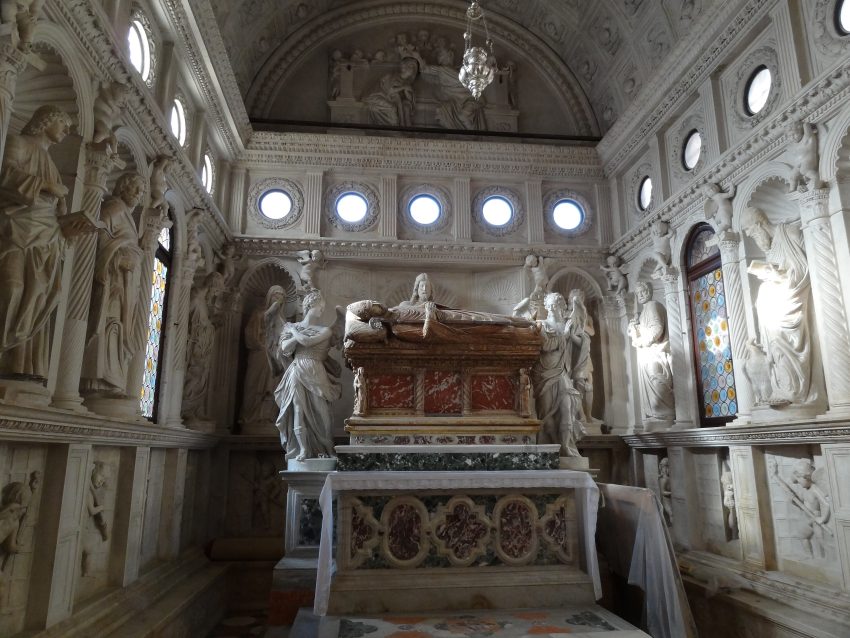
The Chapel of St John of Trogir (Ivan Orsini) is one of the cathedral complex’s most celebrated Renaissance interiors, created through work associated with leading sculptors and builders active in Venetian Dalmatia. It is strongly linked with Niccolò di Giovanni Fiorentino, with collaboration and sculptural contributions attributed in scholarship and heritage documentation to figures including Andrea Alessi. Historically, the chapel is bound to the cult and memory of St John of Trogir, and it functions as a high-status funerary and reliquary space within the cathedral. Sources describing the site for visitors emphasize its 15th-century character and its rich sculptural program, including the saint’s tomb/reliquary focus. What to see is the sculpture: look for the coherence of the carved decoration and the way Renaissance forms are used to create a self-contained “ideal” space. Even if you’re not reading every detail, the chapel’s calm geometry and dense stonework make it feel distinct from the older medieval parts of the cathedral.
Location: 21220, Trogir, Croatia | Hours: Monday – Sunday: 10:00–14:00. | Price: Adults: €6.
9. Sjeverna Vog
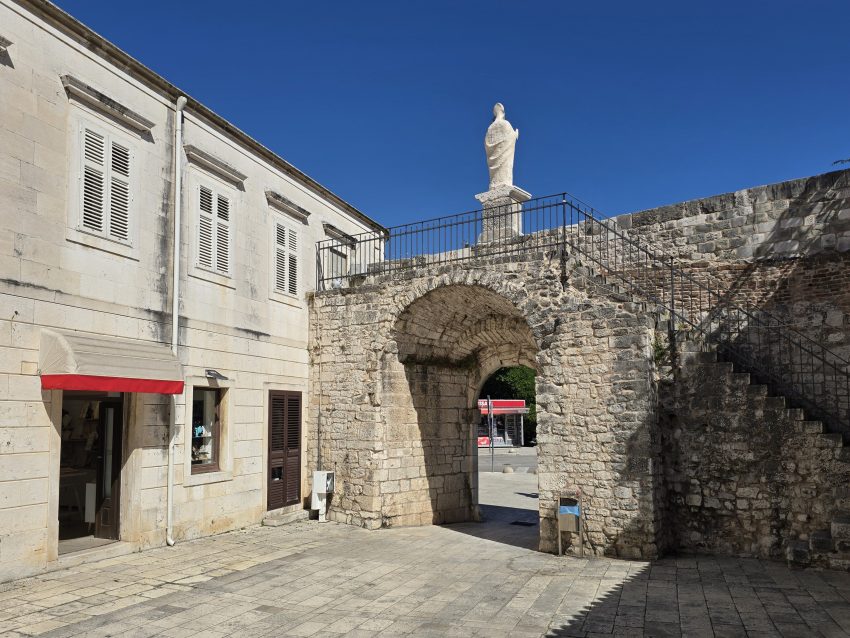
Sjeverna Vog (the North Gate) is one of the historic entrances through Trogir’s defensive walls, tied to the period of strong Venetian influence in Dalmatia. The gate is commonly dated to the 15th century and is closely associated with the town’s late-medieval fortification works. Look closely at the stonework and you’ll usually spot symbols that signal who held power here: the Lion of Saint Mark for Venice, and devotional sculpture linked to Trogir’s local patron tradition (often described as Blessed/ Saint John of Trogir). Those details make the gate more than a passageway; it’s a compact lesson in civic identity and overlordship carved in stone. What to see is simple but satisfying: the façade’s carving, the way the gate frames the first lanes of the old town, and how quickly the mood shifts from “outside” to the tight medieval street grid. It’s a good place to pause and notice how the walls and openings were designed to channel movement and control access.
Location: Unnamed Road, Ul. Gradska vrata 6, 21220, Trogir, Croatia | Hours: 24 Hours. | Price: Free.
10. Kula Sv. Marka
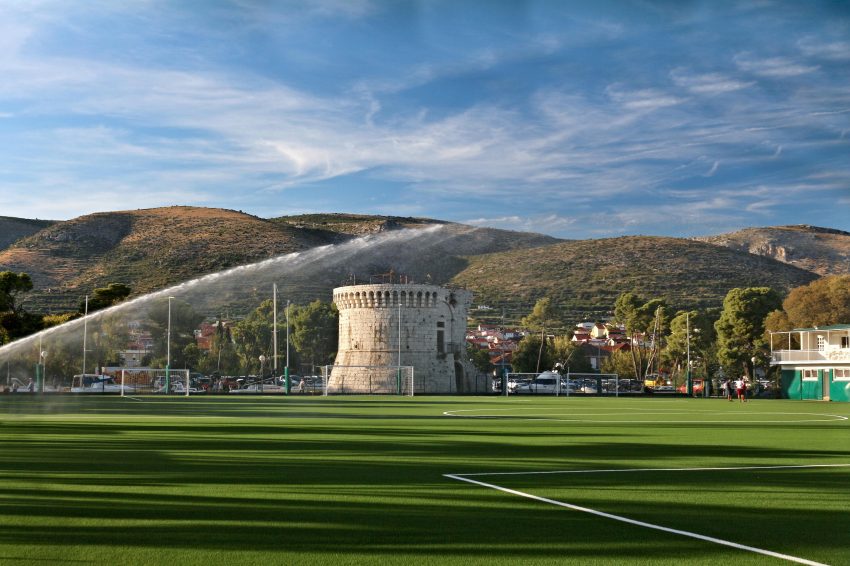
St Mark’s Tower in Trogir (Kula sv. Marka) is a Venetian-era defensive tower built in the 15th century, during a period when coastal Dalmatian towns strengthened their fortifications against regional threats. It originally occupied the north-west corner of Trogir’s town walls, forming part of the larger system that protected the old town’s vulnerable landward approaches. The tower’s round, cannon-resistant form reflects the shift in military architecture as gunpowder weapons became more important. Contemporary descriptions also note that it was originally linked by the city walls to Kamerlengo Fortress, so it functioned less as an isolated landmark and more as a connected piece of the perimeter defenses. When you visit, the main interest is the structure itself and its setting: the stout circular massing, defensive openings, and how it sits right on the edge of the old town near the waterfront/canal. Access can be limited at times (some visitors report finding it closed), so treat it primarily as an exterior stop unless you’ve confirmed it’s open.
Location: Ul. Hrvatskog proljeća 1971. 14, 21220, Trogir, Croatia | Hours: Check official website. | Price: Check official website.
11. Glorijet of Marshal Marmont
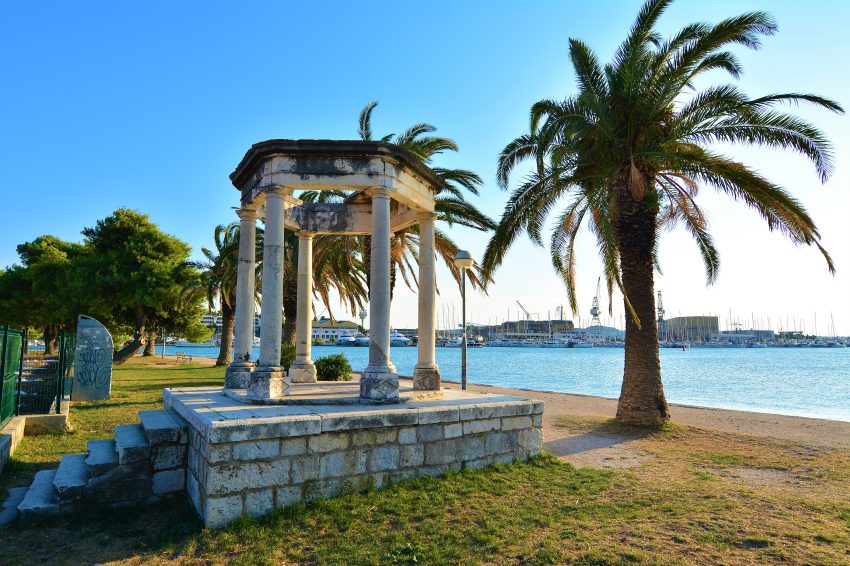
The Glorijet of Marshal Marmont (Croatian: Glorijet maršala Marmonta) is a small neoclassical pavilion built during the period of French rule in Dalmatia in the Napoleonic era. It’s associated with Marshal Auguste de Marmont and is typically described as being constructed by the French/under French administration in the early 19th century (often dated around 1808), when Trogir briefly sat within the French-controlled Illyrian Provinces context. Historically, it stands out in Trogir because most of the town’s landmark architecture is medieval or Venetian, while this is a later, classicist “garden pavilion” gesture tied to a short political chapter. Accounts of the site note that it originally sat in a more exposed position, with the sea around it and access via a bridge, which helps explain why it feels a bit detached from the dense core even though it’s close by. When you’re there, the appeal is the structure itself and its setting at the western tip of the old town area, between the major waterfront fortifications. Look for the elegant, simple classical lines (it’s essentially a gazebo/gloriette), then use the spot for views back toward Kamerlengo and along the water’s edge—this is one of those places where the “what to see” is less about interiors and more about atmosphere, position, and context.
Location: Ul. Hrvatskih mučenika 30, 21220, Trogir, Croatia | Hours: 24 Hours. | Price: Free.
12. Kula Kamerlengo
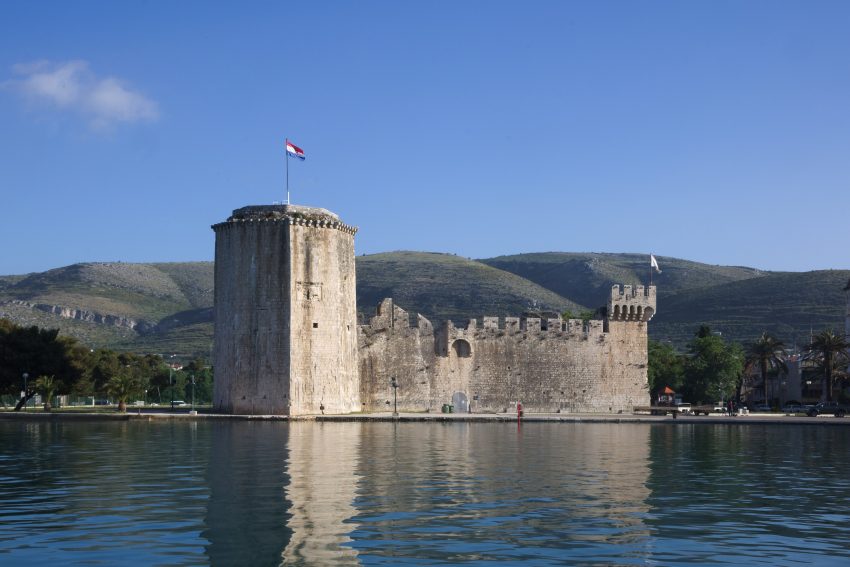
Kamerlengo Fortress (Kula Kamerlengo) is a mid-15th-century Venetian-built coastal fortress at the edge of Trogir’s old town, constructed after Venice took control of the city in 1420. It was built between 1420 and 1437 and functioned as a hard-power statement: a fortified seat to secure rule and protect the harbour approaches. Its name links to the Venetian administrative title “camerlengo,” underscoring that this was as much about governance as defense. Over time, as city walls were reduced and the town evolved, the fortress shifted from military utility toward a heritage and events role, but its mass and position still communicate its original purpose. What to see is the fortification logic: thick walls, angular corners, and the way it commands the waterfront. If you go inside and up onto the ramparts, the views explain everything—old town roofs, harbour traffic, and the strategic line between sea and settlement.
Location: Obala bana Berislavića, 21220, Trogir, Croatia | Hours: (April) Daily: 10:00–18:00. (May) Daily: 09:00–20:00. (June – August) Daily: 09:00–22:00. (September) Daily: 09:00–20:00. (October – November) Daily: 10:00–18:00. | Price: Adults: €5; Students/Children (7–18): €3; Groups (min. 10): €2.5. | Website

Moira & Andy
Hey! We're Moira & Andy. From hiking the Camino to trips around Europe in Bert our campervan — we've been traveling together since retirement in 2020!
This website uses affiliate links which earn a small commission at no additional cost to you.
Walking Tour Summary
Distance: 1.5 km
Sites: 12