Self-Guided Walking Tour of Skopje
This website uses affiliate links which earn a small commission at no additional cost to you.
Skopje is one of the Balkans’ most distinctive capitals, a city where Ottoman lanes, Byzantine echoes, Yugoslav-era planning, and modern monumental architecture sit side by side. The Stone Bridge over the Vardar links Macedonia Square with the Old Bazaar, giving the city a strong symbolic centre and a clear contrast between its newer civic spaces and older trading quarters. The Old Bazaar itself has been an important commercial district since at least the medieval period, and remains one of Skopje’s most atmospheric areas, with mosques, caravanserais, craft shops, cafés, and narrow streets that reflect the city’s mixed cultural inheritance.
The city also has a deeper historical and emotional significance because of its repeated rebuilding, especially after the destructive 1963 earthquake. Today, visitors find a capital that can feel unusual and sometimes visually surprising, with grand statues and recent civic architecture set close to older landmarks such as Kale Fortress, the Mustafa Pasha Mosque, and the Church of the Holy Salvation. Skopje works well as a city break because it combines walkable central sights with easy access to nearby landscapes, particularly Matka Canyon, while still feeling more lived-in and less polished than many larger European capitals.
How to get to Skopje
By Air: Skopje International Airport is the main airport for the city, with shuttle buses running between the airport and key stops in Skopje. Taxis are also available, and the road transfer into the centre is the simplest option if you are arriving late or carrying luggage. For the best deals and a seamless booking experience, check out these flights to Skopje on Booking.com.
By Train: Skopje has a central railway station, but train travel in North Macedonia is generally more limited than bus travel, so it is worth checking current timetables before planning a rail-based journey. Domestic railway services connect Skopje with several towns, while international rail options can vary by season and timetable changes. Train schedules and bookings can be found on Omio.
By Car: Skopje is straightforward to reach by road from other parts of North Macedonia and from neighbouring Balkan countries, especially if you are combining it with Ohrid, Bitola, Pristina, Sofia or Thessaloniki. Driving gives you flexibility for day trips to Matka Canyon or Mount Vodno, but for the central sights it is usually better to park once and continue on foot, as the main walking route is concentrated around the square, river, bazaar and fortress.
By Bus: Long-distance buses are often the most practical public transport option for reaching Skopje from elsewhere in the region. The city's main bus station handles both domestic and cross-border services, making it useful if you are travelling around North Macedonia or connecting from nearby Balkan cities.
How to get around the city. The centre of Skopje is best explored on foot, especially between Macedonia Square, the Stone Bridge, the Old Bazaar and Kale Fortress. Public buses are useful for longer hops across the city, while taxis can be convenient for reaching places beyond the compact central area.
A Short History of Skopje
Ancient Scupi and Roman Skopje
Skopje’s early history is linked with ancient Scupi, which developed from an Illyrian and Dardanian settlement into an important Roman centre. Under the Roman Empire, Scupi became an important administrative and military settlement, positioned on routes that helped connect the wider region.
This deep antiquity is not always obvious in the modern centre, but it explains why Skopje has repeatedly been rebuilt rather than simply expanded. Archaeological layers, fortress traditions and the wider Vardar route all helped shape the city as a place of movement, defence and administration. Kale Fortress is one of the clearest tourist attractions connected to this long defensive history, even though much of what visitors see today reflects later phases and repairs.
Medieval and Ottoman Skopje
In the medieval period, Skopje passed through different regional powers before becoming part of the Ottoman world. Ottoman rule left a lasting mark on the city’s street pattern, religious buildings, commercial culture and urban identity. The Old Bazaar is the best place to see this inheritance, with its mosques, hans, craft lanes and market spaces.
The Stone Bridge is one of the most important surviving landmarks from this period. It links the newer city centre with the Old Bazaar and is widely associated with the Ottoman era. Its position makes it more than a river crossing: it is the symbolic join between Skopje’s civic square and its older commercial quarter.
Earthquakes and Rebuilding in Skopje
Skopje has been shaped by earthquakes more than once, but the 1963 earthquake became the defining modern disaster. Large parts of the city were destroyed, and the disaster led to major international assistance and a large-scale reconstruction programme.
This catastrophe changed how Skopje looks today. The damaged railway station became part of the city’s memory, while post-earthquake reconstruction brought modernist planning, broad avenues and new civic architecture. When you see the mixture of monumental squares, reconstructed buildings and surviving older quarters, you are seeing a city rebuilt around rupture as much as continuity.
Modern Skopje and the City’s Tourist Landmarks
Modern Skopje is shaped by independence, national identity and a visible programme of urban display. Macedonia Square, the riverside monuments, the Archaeological Museum area and the bridges across the Vardar all contribute to this newer civic image. For visitors, these spaces are often the starting point before crossing into the older bazaar quarter.
The Mother Teresa Memorial House adds another strand to the city’s story. The exhibition follows Mother Teresa’s life from her childhood in Skopje through her later work as a Missionary of Charity. The building stands close to Macedonia Square, making it one of the easiest cultural stops to include in a central city route.
Where to Stay in Skopje
To make the most of visiting Skopje and this walking tour, then you should consider staying overnight in the centre. The most convenient area is around Macedonia Square and the streets just off it, as this keeps you close to the Stone Bridge, the riverfront, the Mother Teresa Memorial House and the start of the Old Bazaar. Good central choices include Skopje Marriott Hotel, Solun Hotel & Spa and Hotel Senigallia.
If you would rather stay closer to the Old Bazaar, look north of the river near Čaršija, where you are better placed for mosque courtyards, traditional restaurants, market streets and Kale Fortress. This area is atmospheric in the evening and works well if the older side of Skopje is the main focus of your trip. Useful options include Hotel De KOKA, Hotel Arka and Bushi Resort & Spa.
Your Self-Guided Walking Tour of Skopje
Discover Skopje on foot with our walking tour map guiding you between each stop as you explore its historic bazaar lanes, riverside bridges, fortress views, museums, squares and cafés. As this is a self-guided walking tour, you are free to skip places, slow down in the Old Bazaar, add museum stops, and take coffee breaks whenever you want.
1. Memorial House of Mother Teresa
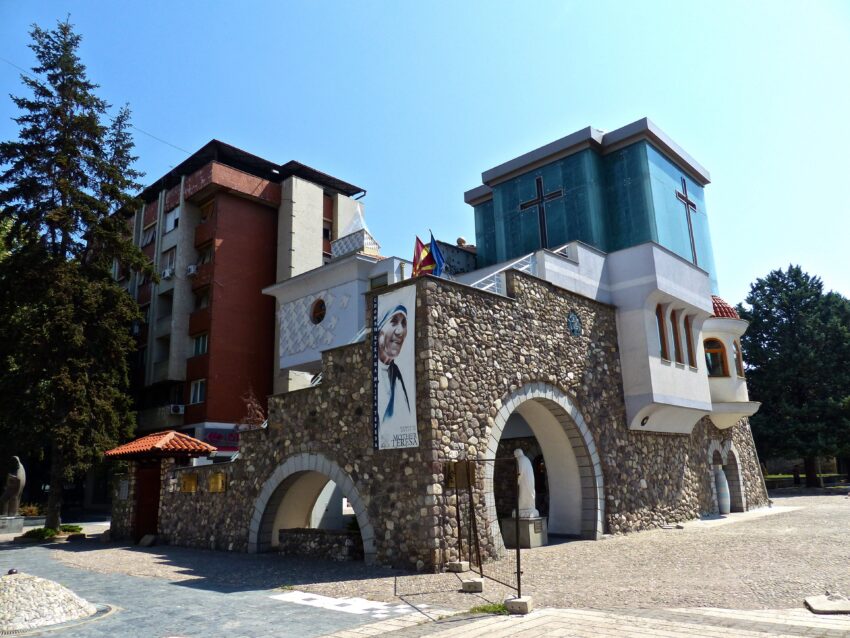
The Memorial House of Mother Teresa commemorates Skopje’s most internationally recognised modern figure, born here in 1910 to an Albanian Catholic family when the city was part of the Ottoman Empire. The original church connected to her early life was lost after the 1963 earthquake, and the memorial was created later to mark both her local origins and her global humanitarian legacy. The site reflects Skopje’s habit of anchoring modern identity through remembrance after periods of upheaval.
Inside, you typically find a small museum-style presentation of her life story—photographs, documents, and contextual material that traces her journey from Skopje to her work in India. The building itself is part of the visit, with a design that aims for a contemplative tone rather than grand scale. Even if you know her biography, the local framing is what makes it distinct.
What to see is the narrative connection between a specific place and a worldwide reputation: it’s as much about Skopje’s history and communities as it is about Mother Teresa herself. If you have time, pause in the quiet areas and read the interpretive panels carefully, because the details are often the most revealing. It’s a compact stop, but it adds depth to understanding the city’s cultural mix.
Location: Macedonia St 1000, Skopje 1000, North Macedonia | Hours: Check official website. | Price: Free.

2. Macedonia Square
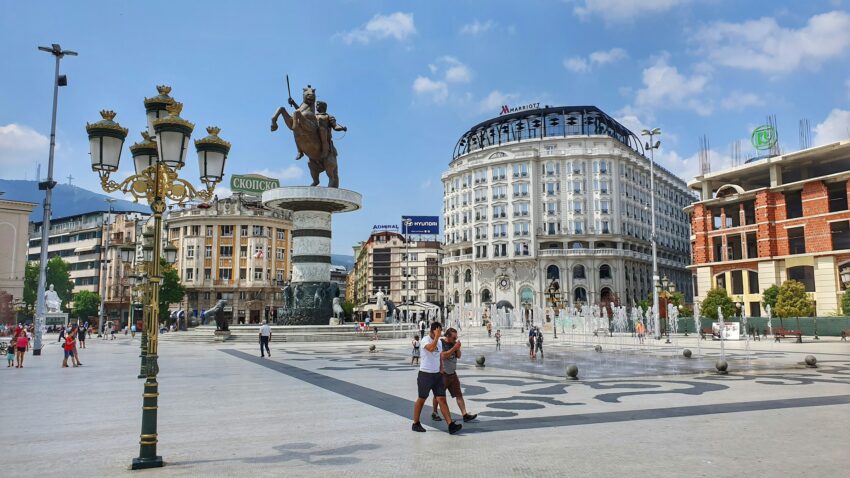
Macedonia Square is Skopje’s main civic square, laid out in its modern form as the city expanded in the late Ottoman and early Yugoslav periods, and then reshaped again after the 1963 earthquake. It has long been the natural gathering point for public celebrations, demonstrations, and everyday city life, so its open plan and broad sightlines are deliberate. In recent decades it has also become the focal point for major urban redevelopment, which has changed its visual character significantly.
What to see here is mainly the panorama: the riverfront edge, the views towards the bridge crossings, and the cluster of major landmarks that radiate out into the centre. The square is best approached slowly so you can read how different eras of Skopje sit side by side—modern commercial façades, post-earthquake planning, and newer monumental elements. If you want a simple orientation point for the city centre, this is it.
Because it’s a large open space, it’s also a good place to notice the rhythm of local life—commuters cutting across it, evening promenades, and seasonal events. If you’re visiting at dusk, the lighting brings out the theatre of the square and the surrounding architecture. It’s not a “single-attraction” stop so much as the place that helps everything else make sense spatially.
Location: Macedonia Square, 1000 Skopje, North Macedonia | Hours: 24 Hours. | Price: Free.
3. Porta Macedonia
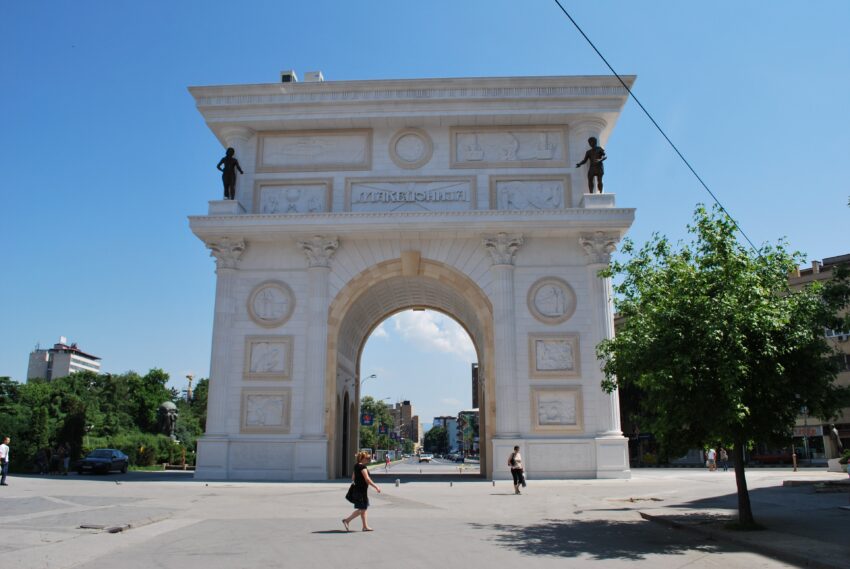
Porta Macedonia is a modern triumphal-arch style monument in central Skopje, built in the early 2010s as part of a wider programme of city-centre redevelopment. It was conceived as a highly visible statement piece—less a historic remnant than a deliberately new landmark intended to project a narrative of national continuity and statehood. As a result, it’s often discussed as much for what it represents politically and culturally as for its architecture.
What to see is the sculptural and decorative programme on the exterior, which uses relief panels and symbolic motifs to reference episodes and themes from Macedonian history. Walk around the arch rather than treating it as a single façade, because the detailing changes by side and reads differently depending on light and angle. From certain viewpoints it also functions as a frame for surrounding streets and monuments, which is part of its intended visual impact.
It’s most interesting when you approach it as civic messaging in built form: its classical vocabulary, its scale, and its placement in the modern city plan. If you visit in the evening, the lighting can emphasise the relief work and make the monument feel more theatrical. Whether you see it as impressive or controversial, it has become part of how contemporary Skopje signals identity in public space.
| Hours: The exterior can be viewed at any time. | Price: Free to view from outside
4. National Archaeological Museum Macedonia
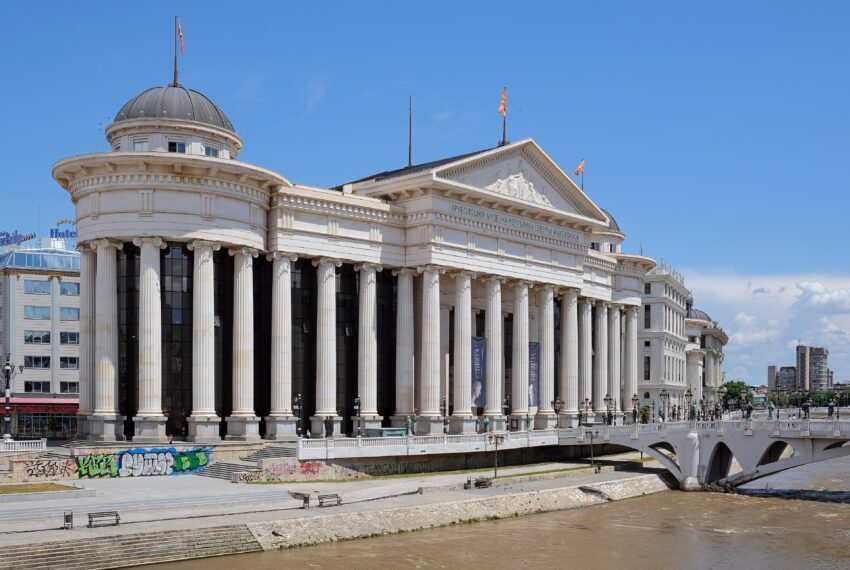
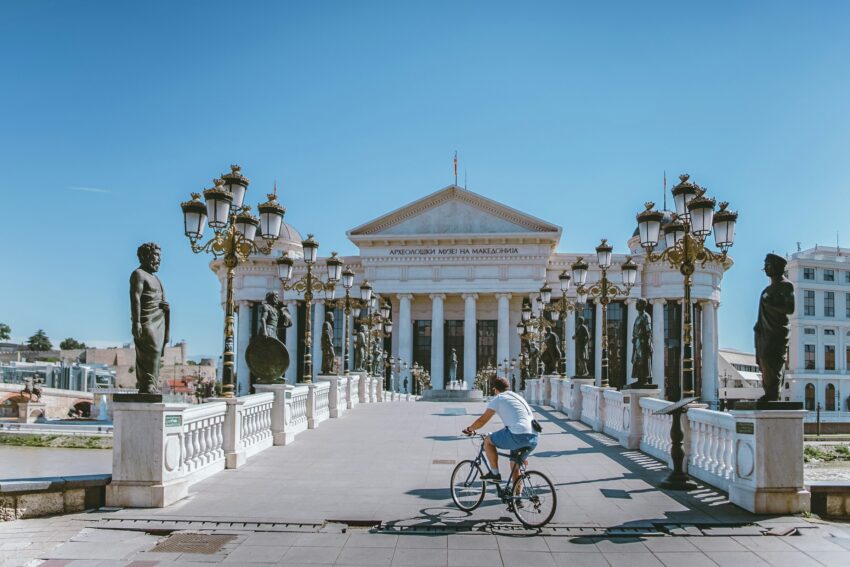
The National Archaeological Museum Macedonia presents the layered story of the region from prehistory through antiquity and into the medieval period, reflecting how the Vardar corridor connected the Balkans to wider Mediterranean and inland trade networks. Archaeology here is inseparable from shifting borders and identities, so museum collecting and interpretation have long carried a civic purpose as well as a scholarly one. In practical terms, it brings together material that helps you place Skopje within the longer arc of Paeonian, Macedonian, Roman, and Byzantine-era life.
What to see depends on your interests, but the highlights are typically stone sculpture, inscriptions, and small finds that reveal everyday patterns—burial practices, religious dedications, and traces of urban life. Look for objects that still carry clear provenance notes, because those details help you connect exhibits to specific ancient sites in the wider country. If you focus on a few well-labelled sections rather than trying to absorb everything, the visit becomes much more coherent.
The building itself can feel monumental, but the best moments are usually the intimate ones: finely worked jewellery, coins that map imperial power, and carved reliefs that show local artistic conventions. Give yourself time to read the contextual panels, because they often explain why a fragment matters, not just what it is. As a stop in the centre, it’s a useful counterbalance to the city’s outdoor monuments and gives you deeper historical grounding before you cross into the older quarters.
Location: Кеј Димитар Влахов 1000, Skopje 1000, North Macedonia | Hours: Tuesday – Sunday: 10:00–18:00. Closed on Monday. Last tickets are sold by 17:00. | Price: 400 MKD for foreign visitors; 200 MKD for students with valid ISIC or Euro 26 cards; 700 MKD for a family ticket. Free entry applies on selected days and for certain visitor categories. | Website
5. Kapan Han
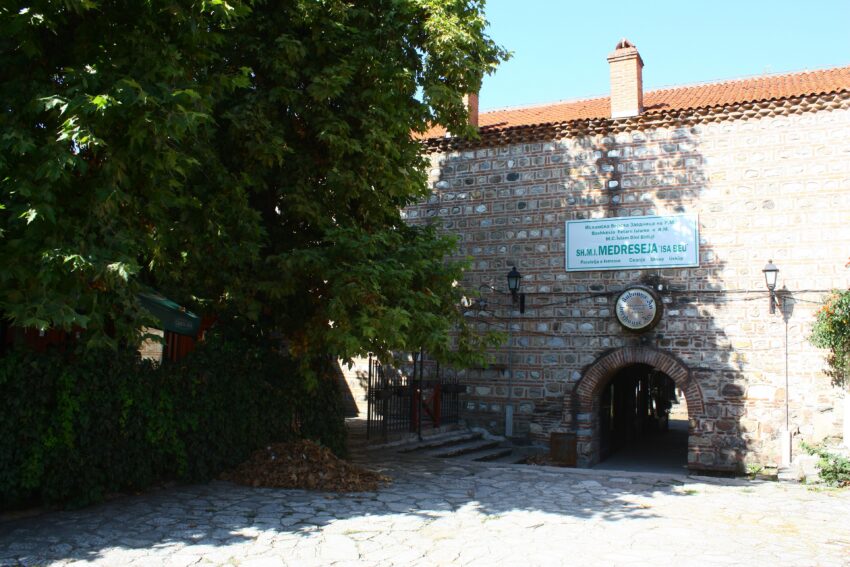
Kapan Han is a classic Ottoman-era caravanserai in the Old Bazaar, built to serve merchants traveling through the Balkans when Skopje was a major regional trading centre. Such buildings functioned as secure inns and warehouses, protecting goods and providing a courtyard-based refuge from the street. Its survival is important because it preserves the commercial architecture that once defined Skopje’s prosperity.
What to see is the enclosed courtyard and the robust, functional layout—thick walls, arched openings, and the sense of an interior world designed for trade logistics. Even if the building’s use has shifted over time, the spatial logic remains clear: arrival, unloading, storage, and rest arranged around a central open space. It’s one of the best places in the bazaar to visualise how commerce worked before modern transport and banking.
Take time to look at masonry details and proportions rather than rushing through. The courtyard is also a good spot to reset between the dense lanes of the bazaar. If you enjoy architectural continuity, this is a strong example of how Ottoman urban life was engineered for movement and exchange.
Location: Grafishte, Shkupi 1000, North Macedonia | Hours: 24 Hours. | Price: Free.
6. Old Bazaar
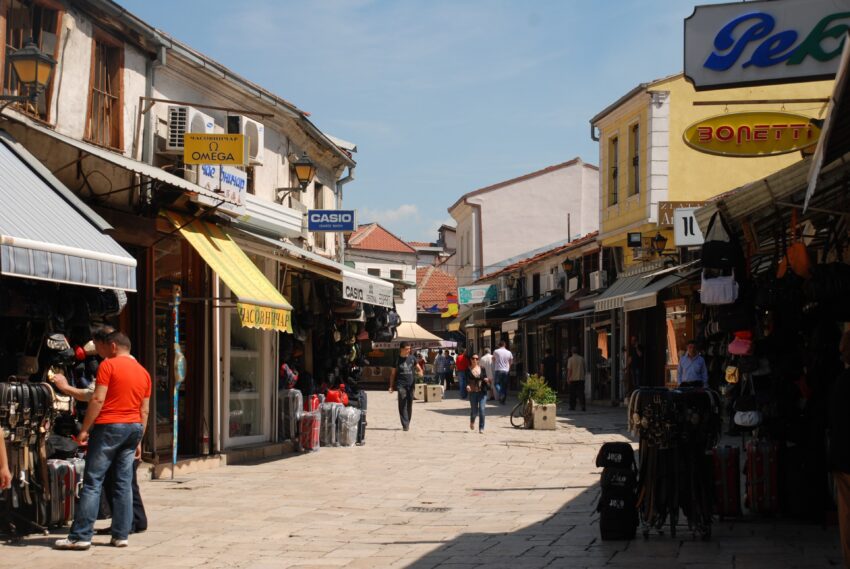
Skopje’s Old Bazaar is one of the largest and most historically continuous marketplaces in the Balkans, rooted in the city’s Ottoman-era role as a trading hub. Over centuries it accumulated mosques, hans, hammams, workshops, and small streets organised by craft and guild. Despite disasters and modern redevelopment elsewhere, the bazaar has retained a dense historic fabric that still functions as a living commercial quarter.
What to see is the street pattern itself—narrow lanes opening into small squares, clusters of traditional trade buildings, and the mix of religious and commercial structures within a few minutes’ walk. Even where businesses have modernised, the underlying urban form remains legible. If you like tangible history, this is where Skopje feels most layered and grounded.
Give yourself time to wander without trying to “cover” it all at speed, because its character comes from accumulation and detail. Look for old stone and brickwork, courtyards tucked behind street fronts, and the transitions between busy and quiet pockets. It’s also a good place to notice the city’s cultural mix expressed through food, crafts, and everyday conversation.
Location: MK, Shkupi 1000, North Macedonia | Hours: 24 Hours. | Price: Free.
7. Suli An
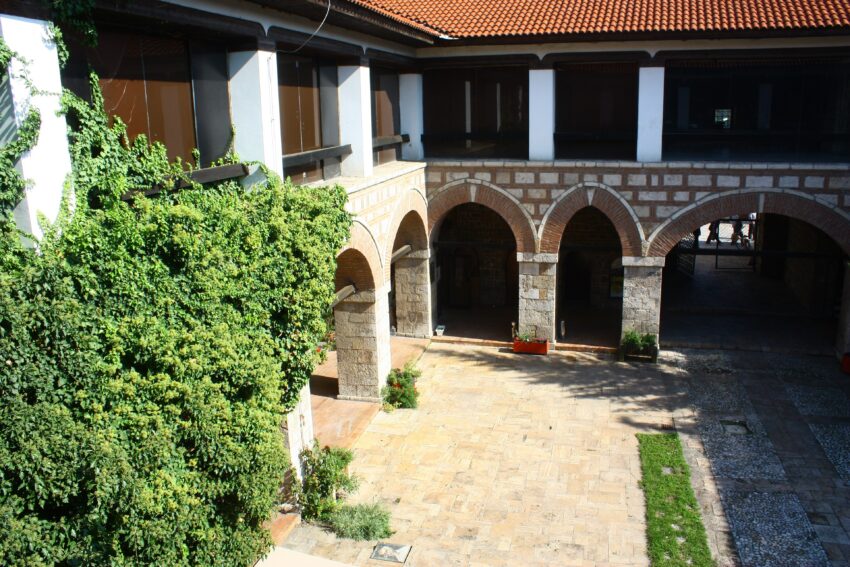
Suli An is another Ottoman-era han in the Old Bazaar, built to support the merchant economy with secure lodging and storage organised around a courtyard. These inns were essential to Skopje’s role as a market city, handling the constant circulation of people, animals, and goods. Over time, many hans adapted to new uses, but their spatial DNA remains a record of how trade was structured.
What to see is the courtyard plan and the repetitive rhythm of arches and rooms, which create a calm interior world away from the streets. The building’s strength is in its clarity: it’s easy to imagine pack animals, traders negotiating, and goods being catalogued and secured. Even if the rooms now host cultural or educational uses, the setting still reads as purpose-built for commerce.
If you enjoy photographing architecture, the courtyard is often one of the most coherent and visually satisfying spaces in the bazaar. Pay attention to textures—stone, plaster, timber—and the way light moves through the arcades. It’s a good place to understand the bazaar not just as streets, but as a network of specialised buildings.
Location: 2C2Q+J3X, Rruga e Bit Pazarit, Shkupi 1000, North Macedonia | Hours: 24 Hours. | Price: Free.
8. Čifte Hammam
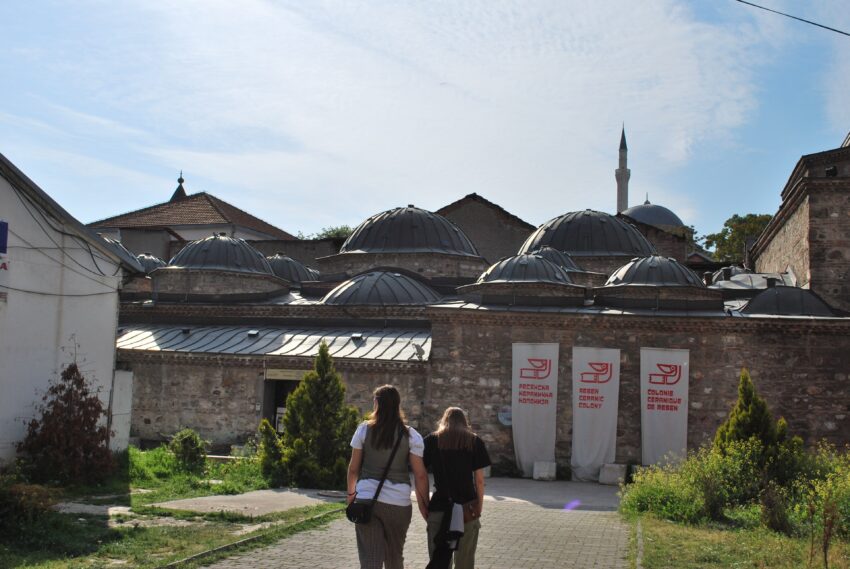
Čifte Hammam is a major Ottoman bath complex, built as part of the public infrastructure that supported urban life—hygiene, socialising, and ritual preparation. The “double” format traditionally served separate sections, reflecting the social norms of the period. Like other hammams in the region, it also demonstrates how civic architecture could be both practical and visually refined through domes, vaults, and careful control of light.
What to see is the architecture: domed rooms, thick masonry, and the way small openings shape a soft interior atmosphere. Even without the original bathing function, the building’s sequence of spaces still makes sense—gradual movement from cooler to warmer areas, with changing acoustics and proportions. If it’s used as a gallery or cultural venue, the contrast between contemporary exhibits and historic structure can be striking.
Take a moment to look upward: the domes are usually the most memorable element, and they explain the building’s engineering logic. Hammams are often overlooked compared to mosques and churches, but they reveal everyday history more directly. This one is a key piece of the Old Bazaar’s civic landscape.
Location: 2C2P+FW7, Arhiepiskop Angelarij, Skopje 1000, North Macedonia | Hours: Monday – Sunday: 10:00–18:00. | Price: Free. | Website
9. Mustafa Pasha Mosque
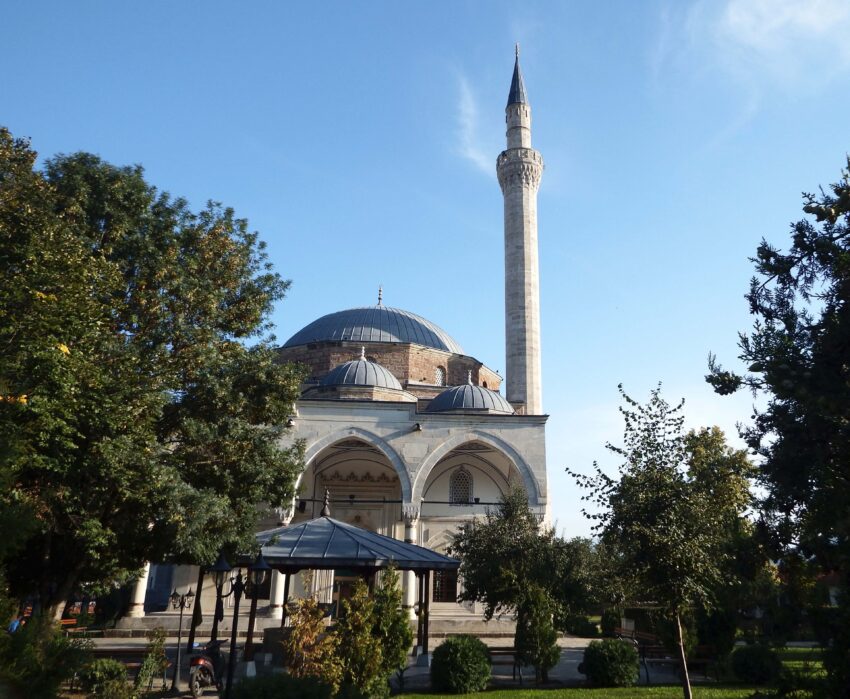
Mustafa Pasha Mosque is one of Skopje’s finest surviving Ottoman mosques, generally dated to the late 15th century and associated with a prominent Ottoman official. Its hilltop position near the Old Bazaar gives it both visibility and a sense of separation from the commercial bustle below. The mosque represents the era when Skopje was integrated into Ottoman administrative and religious networks, leaving a strong architectural imprint.
What to see is the elegant silhouette: the dome, the slender minaret, and the balanced proportions that mark high-quality Ottoman design. If you can go inside, look for the restrained interior decoration and the calm spatial geometry that contrasts with the busier textures of the bazaar. The surrounding grounds can also be part of the experience, offering quieter views back over the district.
This is a good stop for understanding how religious architecture anchored neighbourhood identity. It’s also useful as a vantage point for the relationship between sacred and commercial space in historic Skopje. Visit when the light is softer if you want the building’s stonework to read more clearly.
Location: MK MK, Fort Kale, Мустафа Пашина Џамија, Fort Kale 1000, Shkupi 1000, North Macedonia | Hours: 24 Hours. | Price: Free.
10. Kale Castle
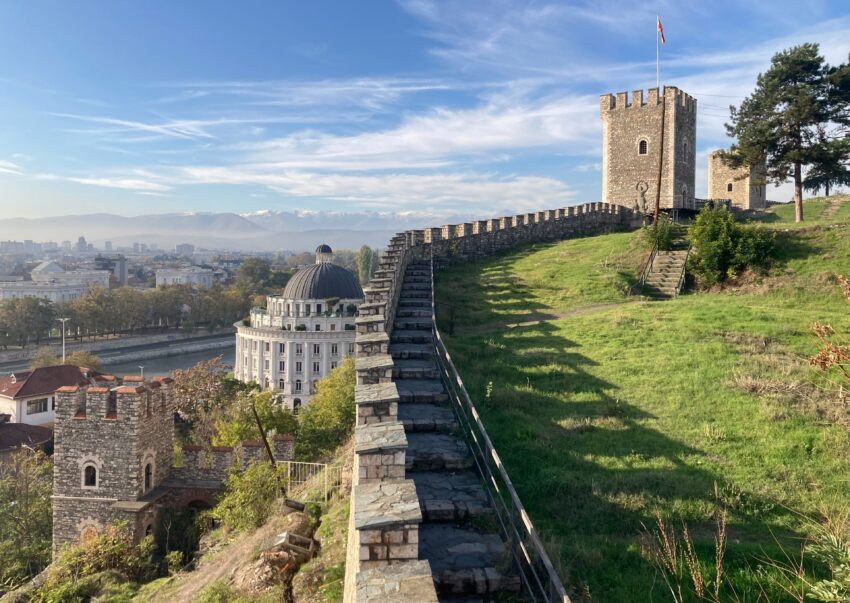
Kale Castle, commonly called Skopje Fortress, occupies the strategic hill above the river and has been used in various forms since antiquity, with major rebuilding and fortification across Byzantine, medieval, and Ottoman periods. Its position explains its importance: whoever held the fortress could monitor movement through the valley and control the city below. The fortress also suffered damage in earthquakes, including the 1963 event, and parts have been restored over time.
What to see is the circuit of walls and gates, which gives you a strong sense of defensive geography even where sections are fragmentary. The biggest draw is the viewpoint: from the ramparts you can read the whole city layout, with the Old Bazaar, river crossings, and modern districts spread out beneath. It’s one of the best places to understand why Skopje developed where it did.
Allow time to explore the perimeter rather than heading to a single point, because different sections offer different sightlines and textures of stonework. The atmosphere changes with weather—clear days emphasize the city’s scale, while cloudier light makes the fortress feel more austere. It’s a historically dense site, but it also works simply as the city’s most useful overlook.
Location: Samoilova, Skopje 1000, North Macedonia | Hours: 24 Hours. | Price: Free.
11. Church of the Ascension of Jesus
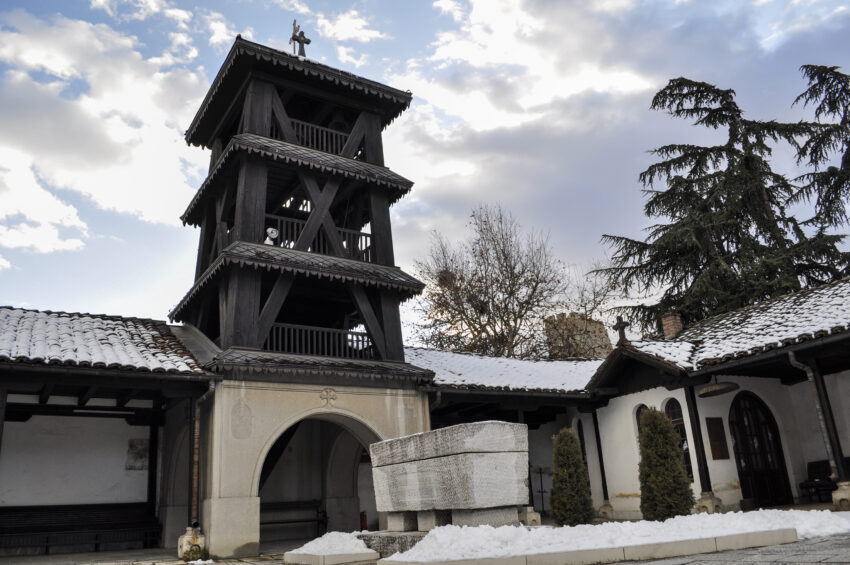
The Church of the Ascension of Jesus is one of the Old Bazaar’s most significant Orthodox churches, associated with the period when local Christian communities maintained their institutions under Ottoman rule. Its best-known feature is the richly carved iconostasis, a masterpiece of Balkan woodcarving that reflects both religious devotion and artisan skill. The church’s history is inseparable from Skopje’s multi-confessional past, where different communities lived and traded in close proximity.
What to see is the interior—especially the iconostasis and the icon program—because that is where the church’s artistic importance concentrates. The contrast between a relatively modest exterior and an elaborate interior is typical of the era and the setting, and it makes the reveal feel dramatic. Spend a few minutes letting your eyes adjust and then follow the carved narratives and icon details.
The church also rewards attention to atmosphere: quiet, incense, and the sense of continuity in a district dominated by commerce. If you’re interested in sacred art, it’s one of the most compelling stops in Skopje. Treat it as a place for slow looking rather than a quick checklist.
Location: 2C2P+77Q, Samoilova, Skopje 1000, North Macedonia | Hours: Check official website. | Price: Free; donations appreciated.
12. Stone Bridge
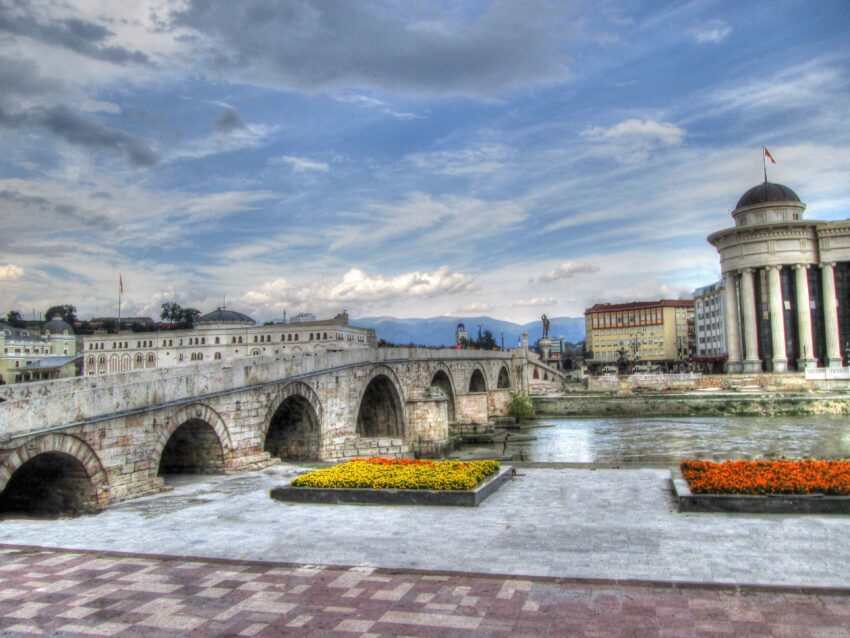
The Stone Bridge is Skopje’s most iconic river crossing and a rare piece of continuity in a city repeatedly reshaped by earthquakes, fires, and political change. Its core is generally associated with the Ottoman period, traditionally linked to the reign of Sultan Mehmed II, though the crossing itself likely rests on older precedents. For centuries it connected the commercial and administrative worlds on opposite sides of the Vardar, making it a practical artery as well as a symbol.
What to see is the bridge’s sturdy stone construction and the way it frames views along the river—especially towards the old bazaar side and back toward the modern centre. Walk to the mid-point to appreciate the arches and the slight changes in stonework that hint at repairs over time. It’s also a good place to understand how the city is organised: old trading quarters on one side, newer civic and commercial spaces on the other.
Because it’s central, it can be busy, but that’s part of the point: this is where Skopje flows. Early morning or late evening is best if you want cleaner photos and a calmer sense of the structure. Even a short pause here gives you a strong mental map of the city.
Location: Ura e Gurit, 1000 Shkupi, North Macedonia | Hours: 24 Hours. | Price: Free.

Moira & Andy
Hey! We're Moira & Andy. From hiking the Camino to trips around Europe in Bert our campervan — we've been traveling together since retirement in 2020!
This website uses affiliate links which earn a small commission at no additional cost to you.
Walking Tour Summary
Distance: 3.5 km
Sites: 12