Porta Macedonia, Skopje
near Skopje
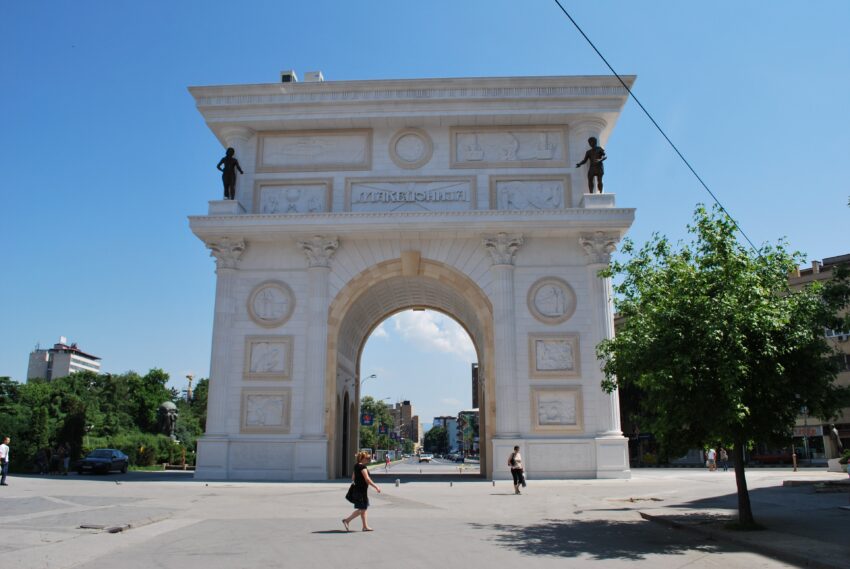
Porta Macedonia is one of the most recognisable modern landmarks in central Skopje, standing close to Macedonia Square and the main pedestrian route through the city centre. Built as a triumphal arch, it is hard to miss: a tall, pale stone gateway decorated with reliefs that refer to episodes, figures and symbols from Macedonian history. It is not an ancient monument, but it has become part of the visual identity of modern Skopje, particularly for visitors arriving from the south side of the city centre.
The arch was completed in 2012 as part of the wider Skopje 2014 redevelopment programme, a highly ambitious and controversial project that reshaped much of the capital's central area with new monuments, statues, facades and public buildings. Porta Macedonia was intended to create a ceremonial entrance into the heart of Skopje, linking the pedestrian streets around Pella Square and Macedonia Square with a monumental form usually associated with imperial capitals and state commemoration.
History and Significance of Porta Macedonia
Porta Macedonia was built during a period when central Skopje underwent rapid visual transformation. The Skopje 2014 project introduced a large number of monuments, classical-style buildings, bridges, fountains and statues into the city centre. The aim was to give Skopje a more monumental appearance and to connect the modern capital with a broader national historical narrative.
The arch itself follows the model of a triumphal arch, a form associated with victory, state power and commemoration. Its reliefs include historical and symbolic scenes connected with Macedonia’s past, including references to ancient, medieval and modern periods. This makes the structure more than a decorative gateway; it is a deliberate statement about identity and historical memory.
At the same time, Porta Macedonia remains controversial. Many locals and observers have criticised the Skopje 2014 project for its cost, style and political messaging, while others see the arch as a striking modern landmark. For travellers, this tension is part of the interest. The monument is not just something to photograph; it is a visible example of how Skopje has tried to reshape its image in the 21st century.
Things to See and Do at Porta Macedonia
The main thing to do at Porta Macedonia is to take time to look closely at the relief panels. From a distance, the arch can seem like a simple ceremonial structure, but up close the decoration is more detailed. The carved scenes and figures are intended to create a condensed version of Macedonian history, giving the arch a narrative role as well as an architectural one.
It is also worth viewing the arch from different angles. From one side, it frames the route towards Macedonia Square, the city's main central space. From the other, it connects with the pedestrian streets and shopping areas of central Skopje. This makes it a useful orientation point if you are exploring the city on foot, especially if you are moving between the Old Bazaar, Macedonia Square, the Stone Bridge and the newer monumental district.
Photographers will usually find the best views in the early morning or later in the day, when the light is softer and the surrounding streets are less busy. At night, the arch is often lit, giving it a more dramatic appearance. It works well as part of a broader look at Skopje’s city centre rather than as a long standalone visit.
How to Get to Porta Macedonia
Porta Macedonia is in central Skopje, a short walk from Macedonia Square. If you are already in the main square, it is only a few minutes away on foot, making it easy to combine with the Stone Bridge, the Vardar riverfront, the Warrior on a Horse monument and the pedestrian streets around the city centre.
By public transport, use buses serving central Skopje and get off close to Macedonia Square or the nearby central stops. From there, the arch is easily reached on foot. Skopje's central area is generally more practical to explore by walking than by repeatedly using transport between individual sights.
By car, it is better not to try to drive right up to the monument. Central Skopje can be busy, and parking close to the main square is limited. Use a nearby car park and continue on foot, especially if you are planning to visit several central landmarks in the same outing.
Is Porta Macedonia Worth Visiting?
Porta Macedonia is worth visiting if you are already exploring central Skopje. It is quick to see, easy to reach and helps explain the city's recent architectural transformation. It is not an old historic gate, and it should not be approached as a medieval or Ottoman-era landmark, but it is important for understanding the modern city.
The arch is especially worthwhile for travellers interested in urban design, national identity and contested monuments. Skopje is a city where different historical layers sit very close together, from Ottoman-era streets and Byzantine-influenced churches to brutalist buildings and recent neo-classical additions. Porta Macedonia is one of the clearest examples of that newest layer.
If your time in Skopje is short, do not treat Porta Macedonia as a major destination on its own. Instead, include it as part of a central walking route. It takes only a short stop, but it adds useful context to the city's public spaces and recent history.
Practical Tips on Visiting Porta Macedonia
Porta Macedonia is best visited while walking around Macedonia Square and the surrounding streets. You do not need to plan a separate trip for it, as it sits naturally on the route through the centre. Allow around 10 to 20 minutes if you want to look at the details and take photographs.
The exterior is free to view, and the surrounding area is open and public. Internal access, exhibitions or viewing areas should be checked locally if they are of particular interest, as this may not always be available in a predictable way.
The area around the arch is generally busiest during the middle of the day and early evening. For quieter photographs, visit early in the morning. For atmosphere, evening can be better, especially when the city centre is lit and people are out around the square.
Where to Stay Close to Porta Macedonia
For most visitors, the best area to stay is around Macedonia Square or the central pedestrian streets, as this puts Porta Macedonia, the Stone Bridge, the Old Bazaar and the main riverfront sights within easy walking distance.
A central hotel such as Skopje Marriott Hotel is one of the most convenient choices if you want to stay right by the main square and walk easily to Porta Macedonia. Another practical option is Hotel Alexandar II, which places you close to the city centre while keeping the main sights nearby. For a smaller central base, Hotel London B&B is also well positioned for exploring this part of Skopje on foot.
FAQs for Visiting Porta Macedonia
The Porta Macedonia appears in our Complete Guide to Visiting Skopje!

Moira & Andy
Hey! We're Moira & Andy. From hiking the Camino to trips around Europe in Bert our campervan — we've been traveling together since retirement in 2020!
This website uses affiliate links which may earn a commission at no additional cost to you!
Planning Your Visit
The exterior can be viewed at any time.
Free to view from outside