Self-Guided Walking Tour of Hvar (+ Maps!)
This website uses affiliate links which earn a small commission at no additional cost to you.
Hvar is the kind of place that rewards slow travel. The lanes are short, the views open up suddenly, and nearly every turn seems to land you in a postcard scene-stone façades, palm-lined waterfront, and a historic core that still feels lived-in rather than staged.
This self-guided walking tour is built for wandering, not rushing. You’ll cover Hvar’s harbourfront and key Old Town landmarks, then climb to Fortica for the panorama that explains why sailors, merchants, and empires all cared about this town.
If you're wondering about the best things to see in Hvar, this route stitches them together in a logical loop, with plenty of natural pause points for coffee, gelato, or a quick detour into a quieter backstreet.
How to get to Hvar
By Air: Hvar doesn't have a commercial airport, so you'll fly into Split Airport (SPU) or Dubrovnik Airport (DBV) and then continue by sea. Split is the most practical gateway because it has the densest ferry and catamaran network to the island, especially in the warmer months; from the airport you can bus, taxi, or transfer into Split's ferry port area. Once you arrive at Hvar's port, the Old Town is immediately walkable, which makes the whole door-to-door trip simpler than it looks on a map. For the best deals and a seamless booking experience, check out these flights to Hvar on Booking.com.
By Train: There's no train to Hvar, but rail can still be useful as the “backbone” for reaching Split if you're already travelling through the region. Aim for Split's main station, which sits close to the ferry port, then connect onward by catamaran or ferry depending on season and timetable. In practice, this works best when you plan an overnight or buffer time in Split so you're not stressed by tight connections. Train schedules and bookings can be found on Omio.
By Car: If you're road-tripping, drive to Split (or another suitable ferry port) and take a car ferry to the island, then continue by road to Hvar Town. In peak season, car space can be the bottleneck, so treat ferry reservations (when available) and early arrival as part of the plan, not an optional extra. Many visitors choose to leave the car on the mainland and take a faster passenger catamaran instead, especially if they're staying centrally in Hvar Town and prioritising walkability.
How to get around the city: Hvar Town's core is compact and best explored on foot, with stone steps and narrow lanes that aren't designed for cars. Taxis and water taxis are useful for beaches and nearby coves, while local buses help if you're staying farther out or linking to other settlements on the island. For this walking tour, you won't need anything beyond comfortable shoes and a bit of patience for uphill stretches.
A Short History of Hvar
Hvar in Antiquity and Early Maritime Life
Hvar’s early story is tied to the sea: safe anchorages, regional trade, and a strategic position that made the town valuable long before its current holiday reputation. Over centuries, seaborne commerce shaped the harbour zone and the compact street pattern behind it, laying the foundations for the civic spaces you’ll walk through today.
Hvar Under Venetian Influence and Adriatic Power
Venetian influence left a clear imprint on Hvar’s public face, from the formal waterfront to the civic architecture around the main square. Places like the Venetian Loggia and Clock Tower speak to a period when administration, ceremony, and maritime status mattered, and when the town’s identity was consciously presented to visitors arriving by boat.
Hvar’s Civic Golden Age and the Life of the Square
Trg Sv. Stjepana evolved into Hvar's social and symbolic centre, anchored by the cathedral and framed by important public buildings. The Hvar Arsenal and the historic theatre tradition reflect a town that wasn't only defensive and mercantile, but also culturally ambitious-an atmosphere you can still feel in the open, processional layout of the square.
Fortica, Defense, and Hvar’s Elevated Watchpoint
Fortress Fortica (Španjola) crowns the town for a reason: control and visibility. In eras when raids and rival powers were real threats, the high ground mattered, and the climb you do today mirrors an old logic-lookouts, warning systems, and a defensive posture built into daily life. The fortress now functions as Hvar’s best viewpoint, but it also explains why the town’s historic core developed where it did.
Hvar in Modern Tourism and the Living Old Town
As travel shifted from strategic necessity to leisure, Hvar’s harbourfront became more promenade than working quay, without losing its sense of arrival. The same landmarks-harbour, square, cathedral, arsenal, and fort-now form a visitor’s loop, which is exactly what this walking tour follows: a concentrated route through the layers of Hvar’s public history.
Where to Stay in Hvar
To make the most of visiting Hvar and this walking tour then you consider stay overnight at the centre. Staying along the harbour and Old Town edge means you can start early (or finish late) with the town at its most atmospheric, and you'll be steps from Hvar Harbour, the loggia, and the first climb toward Fortica. Good central options include Adriana, Hvar Spa Hotel and Riva Marina Hvar Hotel. (suncanihvar.com)
If you want the “front-row seat” feel near the main square and cathedral, base yourself around Trg Sv. Stjepana so the core landmarks are effectively on your doorstep. This is ideal if you like popping back to your room between stops, or if you’re planning a relaxed pace with long café breaks in the square. The classic pick here is Palace Elisabeth, Hvar Heritage Hotel. (Leading Hotels of the World)
For a slightly quieter sleep while staying walkable, look just outside the tightest Old Town streets, where you can still reach the harbour in minutes but avoid some late-night noise. This works well if you want pool time or an easy beach link-up alongside sightseeing, with options like Pharos, Hvar Bayhill Hotel and Amfora Hvar Grand Beach Resort. (suncanihvar.com)
If your priority is calm sea air and downtime between walking segments, consider the Podstine area, which gives you a more resort-like feel while still being close enough to rejoin the Old Town route on foot or by quick taxi. A strong base here is Podstine Boutique Hotel, and for a more budget-friendly, social stay that’s still close to the action, there’s Hostel Villa Zorana. (podstine.com)
Your Self-Guided Walking Tour of Hvar
Explore Hvar on foot with a walking tour map that guides you between each stop as you uncover the harbourfront, the Old Town's civic heart, and the fortress viewpoint above it. Because it's self-guided, you can linger where you like, skip anything that doesn't interest you, and build in coffee stops whenever the mood (or the view) demands.
1. Hvar Harbour
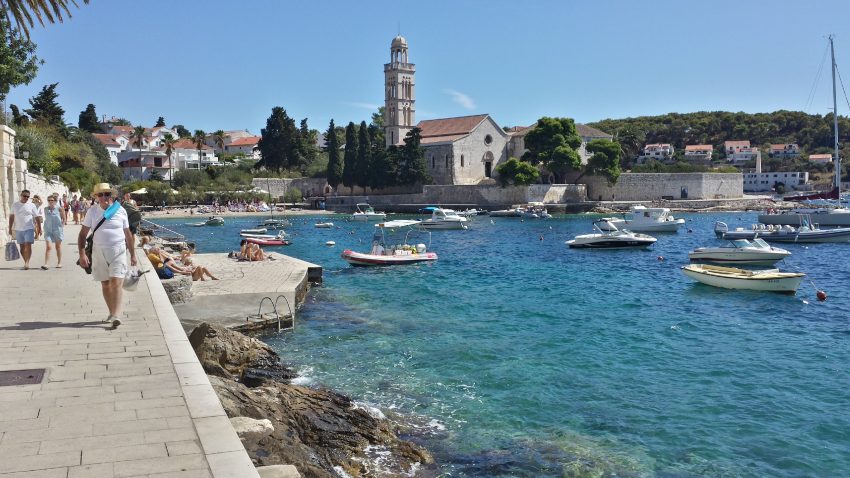
Hvar’s harbour is one of the main reasons the town mattered for centuries as a maritime stop in the central Adriatic. During the Venetian period, Hvar developed into a key naval and trading point, and the protected bay helped it function as a reliable anchorage in a busy sea-lane. The harbour’s importance is still easy to read in how the town’s public buildings and main square sit directly behind the waterfront.
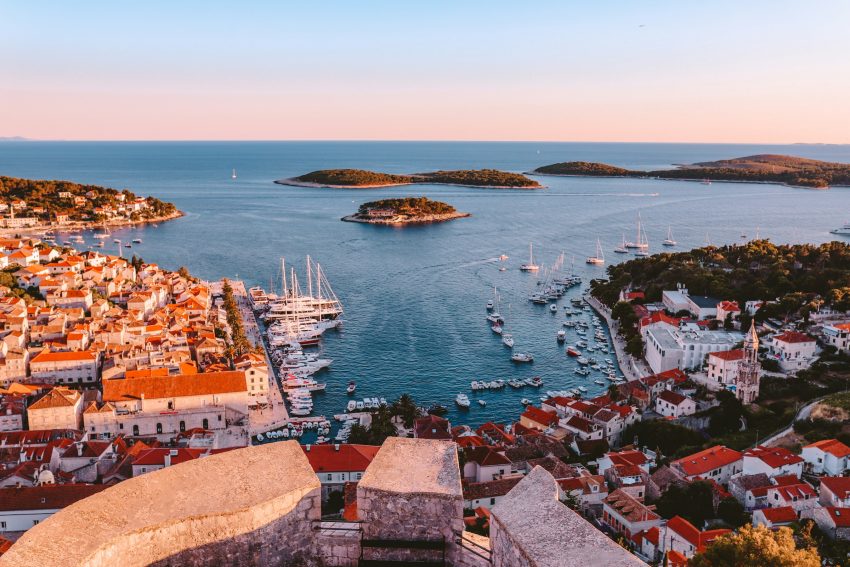
Today, the harbour is where Hvar’s layers meet: the historic stone quays and old façades on one side, and the constant movement of ferries, taxis, and pleasure boats on the other. It’s also the best place to understand the town’s geography in one glance, with the cathedral area just inland and the fortress high above the rooftops. Even if you don’t go far, standing near the centre of the bay gives you a clean “map view” of Hvar Town.
What to see is the harbour as a whole rather than a single landmark. Walk the curve of the waterfront to pick out different angles of the Pakleni Islands and the town skyline, and look back frequently for the classic view of the waterfront buildings stepping up toward the hill. If you want the most striking perspective, time it for late afternoon when the light hits the stone and the harbour feels busiest.
Location: Riva 7, 21450, Hvar, Croatia | Hours: 24 Hours. | Price: Free.

2. Venetian Loggia and Clock Tower
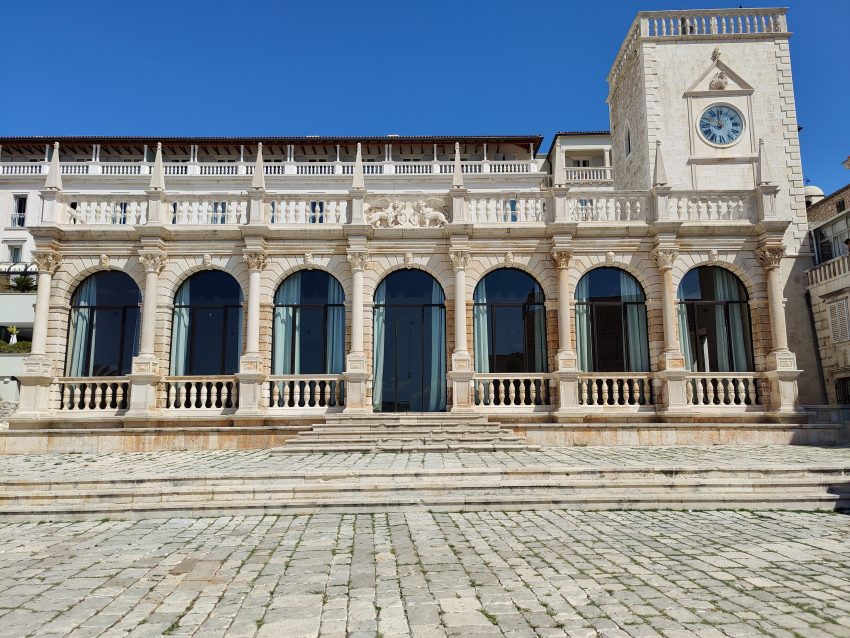
Hvar’s Venetian Loggia is a civic building shaped by the centuries when the town was part of the Venetian sphere. The loggia on the main square developed as a public space for civic business and official life, and its design reflects the Venetian preference for formal, open-fronted architecture facing central plazas. Over time, the structure was refined and rebuilt, leaving it as a compact but historically loaded piece of the town’s public core.
Unlike a church or palace, a loggia is about public function: a place where the town’s legal and administrative life could happen in the open, under shelter, and in full view of the square. That role explains its placement and its proportions—meant to frame civic life rather than dominate it. The clock tower element adds another layer, signalling the square’s importance as the town’s timekeeping and meeting point.
When you’re there, focus on the architectural details and how the building “addresses” the square. Look closely at the arches, carved elements, and the way the façade creates a dignified edge to the plaza without closing it off. It’s best appreciated as part of the square’s ensemble, so step back and take it in together with the surrounding historic buildings.
Location: Trg Sv. Stjepana 6, 21450, Hvar, Croatia | Hours: Daily: 10:00–21:00. | Price: Adults: €4; Combined ticket (selected sites): €15. | Website
3. Hvar Arsenal
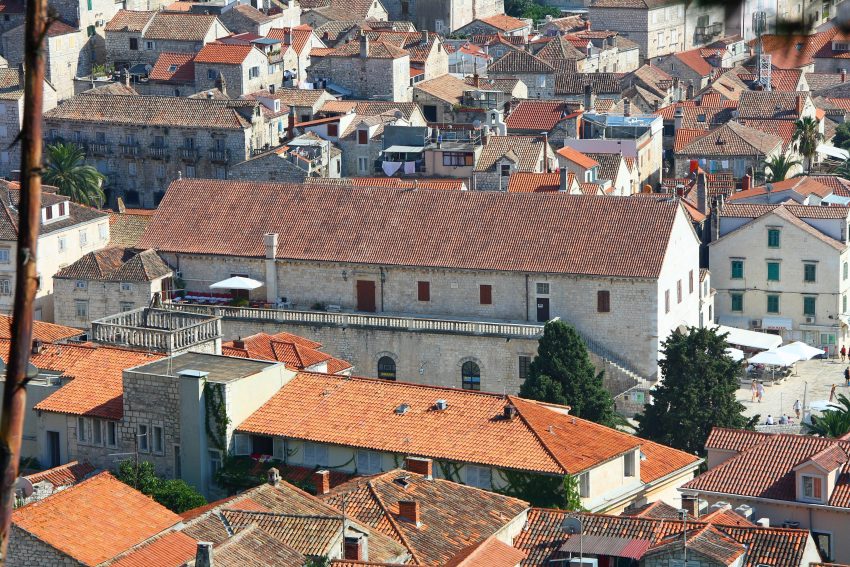
Hvar’s Arsenal began as a working maritime building, tied directly to the town’s seafaring economy and strategic position. It functioned as a practical space for ship-related needs, reflecting the period when Hvar’s prosperity depended on the sea and on the wider Adriatic world. Over the centuries it was rebuilt and adapted, so what survives is the result of multiple phases rather than a single moment.
Its most notable historical twist is that the building also became associated with civic culture, not just maritime work. That dual identity—ship-focused utility below, public life above—captures something distinctive about Hvar’s history: a town that invested in both defence and culture as it grew in regional significance. It’s a reminder that the main square and waterfront were not separate worlds, but two sides of the same urban system.
What to see is the Arsenal’s relationship to the harbour and square, and the sense of scale it brings to the waterfront. Even from outside, you can read it as a purposeful building: long, grounded, and designed for heavy use. If the interior is open when you visit, prioritise any historic rooms that show how the space evolved from maritime utility into a more public, civic landmark.
Location: Obala, Riva 1, 21450, Hvar, Croatia | Hours: Daily: 10:00–21:00. | Price: Adults: €10. | Website
4. Trg Sv Stjepana
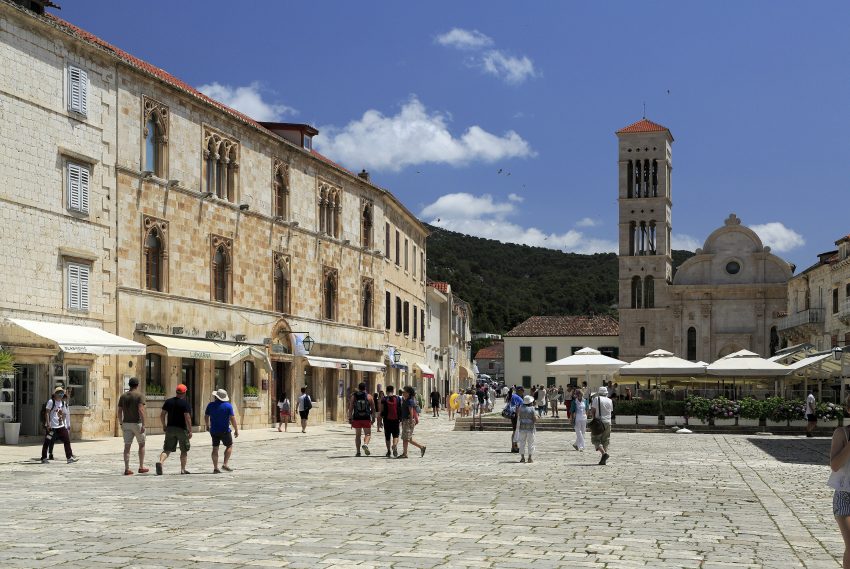
Trg Sv Stjepana is Hvar Town’s main square and the clearest expression of how the town was planned around public life. Its shape and size reflect centuries of gradual change, including the transformation of the shoreline and the steady formalisation of the town’s civic centre. The square is where Venetian-era authority, local identity, and everyday commerce converged in the open.
Historically, this is the space that anchored Hvar’s public rituals—religious festivals, civic announcements, and daily market activity. The surrounding buildings were chosen and positioned to reinforce that role, so the square reads like an outdoor civic room with carefully placed “walls.” Even if you don’t know the details of every façade, you can feel the logic of a town that wanted its most important structures facing the same shared space.
When you visit, treat the square as an ensemble rather than a checklist. Take time to look from end to end, then turn slowly to study the edges: the cathedral as the anchor, the public buildings that frame the sides, and the opening toward the harbour that links civic life to the sea. It’s also an ideal spot to pause and watch the town’s rhythm, because the square still functions as Hvar’s main stage.
Location: Trg Sv. Stjepana, 21450, Hvar, Croatia | Hours: 24 Hours. | Price: Free.
5. Hvar Cathedral
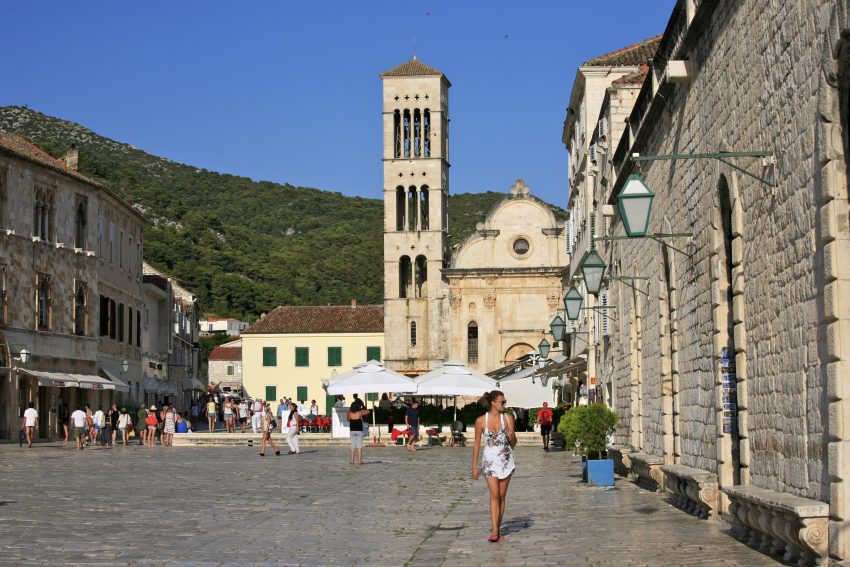
Hvar Cathedral, dedicated to St Stephen, reflects the town’s long arc from medieval roots to a more monumental early modern identity. Built and reshaped over an extended period, it carries the visual language of the eras that defined Hvar’s public life, with a façade and tower that signal both religious importance and civic pride. Its position at the head of the main square makes it as much an urban landmark as a church.
The cathedral’s story is tied to the town’s status and patronage, especially during the centuries when Hvar sat within a wider Venetian cultural world. That influence appears in the cathedral’s artistic character and the sense that it was intended to be seen by visitors arriving into the square, not hidden away. Over time, additions and refinements gave it the layered quality you often find in Dalmatian churches that were built across generations.
What to see begins with the exterior, because the cathedral’s relationship to the square is part of its impact. Step inside to absorb the change in atmosphere from bright plaza to cooler interior, then focus on the artworks and altars that show how the space was embellished over time. When you leave, look back from the middle of the square: it’s one of the best vantage points for appreciating the cathedral as the square’s architectural “endpoint.”
Location: Trg svetog Stjepana 26, 21450, Hvar, Croatia | Hours: Monday – Saturday: 09:30–12:30 & 16:30–19:30. Sunday: Closed. | Price: €2. | Website
6. Fortress Fortica
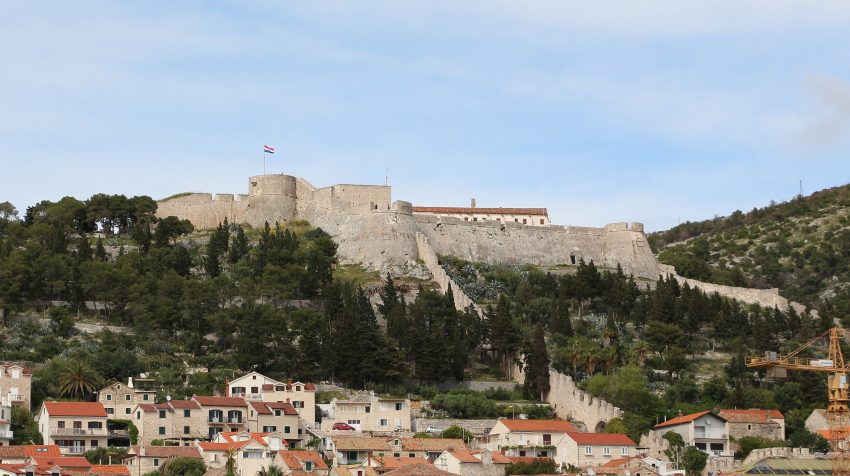
Fortress Fortica dominates Hvar Town from above, a direct product of the town’s need to defend itself in a contested maritime region. Strengthened during the centuries when Hvar was tied to Venetian strategic interests, the fortifications reflect a world where coastal towns had to think constantly about raids, naval power, and control of sea routes. The fortress you see today is the result of rebuilding and upgrades over time, shaped by both threat and accident.
Its history is not only about enemies outside the walls, but also the risks inside them—stores of weapons and gunpowder made fortresses vulnerable to disaster as well as siege. That reality drove repeated repairs and improvements, leaving a structure that feels like a layered solution rather than a single design. The fortress also explains the town’s silhouette: the defensive high ground and the civic centre below are locked into a single, readable system.
What to see is the fort itself and, just as importantly, the view it commands. From the walls you get the definitive panorama over the harbour, the Pakleni Islands, and the rooftops of the old town packed tightly against the slope. Spend time walking along the ramparts and looking down as well as outward—the best takeaway is how clearly the fortress lets you understand Hvar’s geography, defences, and relationship with the sea.
Location: Ul. Biskupa Jurja Dubokovica 80, 21450, Hvar, Croatia | Hours: Daily: 09:00–19:00. | Price: Adults: €12; Children (7–18), Students & Seniors: €8; Under 7: free. | Website

Moira & Andy
Hey! We're Moira & Andy. From hiking the Camino to trips around Europe in Bert our campervan — we've been traveling together since retirement in 2020!
This website uses affiliate links which earn a small commission at no additional cost to you.
Walking Tour Summary
Distance: 2.5 km
Sites: 6