Zeynel Abedin-Pasha Mosque, Ohrid

Historic Site, Mosque and Square in Ohrid
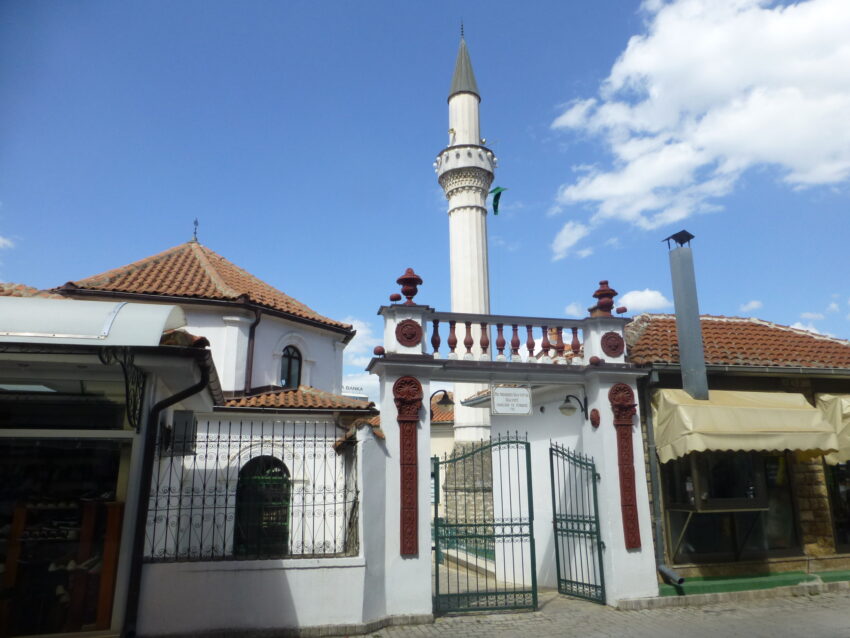
Zeynel Abedin-Pasha Mosque
CC BY-SA 2.0 / Vmenkov

Zeynel Abedin-Pasha Mosque in Ohrid is a compact Ottoman-era religious site on Krusevska Republika Square, just southeast of the city center. It is a mosque and historical monument rather than a large visitor complex, so the appeal is mainly architectural and contextual.

The setting matters as much as the building itself: the mosque sits near Cinar, the old plane tree, and a fountain, which makes it easy to include in a short walk around the area. It suits visitors interested in Ottoman heritage, religious history, and places that still carry a clear local function.

History and Significance of the Zeynel Abedin-Pasha Mosque

The mosque dates to the first half of the 17th century and is linked to Zeynel Abedin-Pasha. Its original use as a monastery for the Halveti Order gives it a different background from a standard neighborhood mosque and helps explain its place in Ohrid’s spiritual landscape.

Ottoman Ohrid

The mosque reflects the period when Ohrid was part of the Ottoman Empire, when Islamic institutions became more visible in the city. It also points to the wider demographic and cultural changes that shaped the region over time.

Religious memory

Inside the burial chamber is the tomb of Haji Muhammad Hayati, described as the first dervish sheikh in Ohrid. That detail gives the site added historical weight and makes it relevant for visitors interested in local religious lineages.

Things to See and Do in the Zeynel Abedin-Pasha Mosque

The main thing to do here is to pause at the mosque itself and take in its position on the square. I would use this stop to look at the building in context with Cinar and the nearby fountain, since the setting helps explain why it remains part of everyday city life.

If the site is open for viewing, the burial chamber is the detail to notice most carefully. The mosque is not a long visit, but small features and the surrounding square can make it more rewarding than a quick glance from the street.

How to Get to the Zeynel Abedin-Pasha Mosque

The nearest major air hub is Ohrid St. Paul the Apostle Airport, with onward transfer into the city center. For the best deals and a seamless booking experience, check out these flights to Ohrid on Booking.com.

Ohrid is not a rail-focused destination, so train travel is usually less practical than arriving by bus or road from other North Macedonian cities. Train schedules and bookings can be found on Omio.

If you are driving, aim for central Ohrid and then continue on foot from the square area; parking can be limited near the older streets, so a short walk is often the simplest option.

Is the Zeynel Abedin-Pasha Mosque Worth Visiting?

It is worth a short stop if you like Ottoman architecture, religious heritage, or compact city sights that fit naturally into a walk through central Ohrid. Treat it as optional if you are mainly focused on lakeside scenery, larger monuments, or experiences that take more time. The mosque is best for visitors who enjoy reading a place through its setting and history; skip it if you want a more active museum-style attraction.

What Other Travellers Say...

erad mubarak
a month ago
"Beautiful masjid"
Ahmet Suat PINAR
4 months ago
"In the Iskenderbey neighborhood of Ohrid, Macedonia, the imaret built by Aliağazâde Zeynelâbidin Pasha now contains only a mosque, the adjacent tekke(dervish lodge), the tomb belonging to the tekke, and a heptagonal fountain attached to the north facade of the tomb. The madrasa (religious school) and imaret belonging to the complex no longer exist. The Tekke Mosque, which is still in operation today, is actually a Halveti tekke (Eyice, no. 6 [1965], p. 141). Two waqf deeds belonging to Aliağazâde Zeynelâbidin Pasha are found in separate registers of the old waqf records from 1133 (1721) and 1198 (1784). In one of them, the founder is referred to as a bey (lord), and in the other, as a pasha (Ayverdi, Ottoman Architectural Works in Europe III, p. 142). Perhaps for this reason, it is also called the Zeynelabidin Tekke. Furthermore, it was mentioned as the Âsitâne-i Hayâtiyye during the period it was founded (Ćehajić, pp. 113-114). The semâhâne/mosque of the Halveti tekke is a square-plan structure measuring 7.95 × 7.90 m internally. The walls and minaret of this mosque date from the late 17th century. It is understood that the lower row of windows in the body walls have rectangular openings under pointed arched pediments, while the upper row of windows have pointed arched openings. In the 19th century, the mosque, rebuilt in the Empire style, has a prayer hall with rectangular windows and a staircase landing with rounded arched openings in front of it. The main prayer hall of the mosque is used as the tekke's semâhâne when not used for prayer. The interior decoration of the building is entirely new. The building, which has a rectangular plan including the last congregation area, was built in the style of a mosque with a covered roof, and is covered with a wooden roof covered with tiles (Eyice, no. 6 [1965], p. 141). It is known that the mihrab of the mosque originally had four rows of stalactites; however, they were plastered over during repairs in various periods. The mosque, which has a small and simple minbar, has a wooden ceiling made of coffered form and is quite simple. The gallery, which rests on two wooden pillars, is also very simple, and the pillars supporting the gallery support the ceiling above. There are eight windows on the lower level and six on the upper level in the mosque. As a result of the last repairs to the mosque walls and windows, it is observed that its original form has been lost (Ayverdi, Ottoman Architectural Works in Europe III, p. 144). The minaret, located on the west facade of the mosque, is accessed from the gallery section of the harim. The base and cube of the minaret are made of roughly hewn stone, and part of the cube, together with the body, is plastered. The minaret, with its double ring-shaped top, features four rows of sawtooth-shaped stalactite-like pendants. The cut-stone minaret conforms to the classical style. The Zeynelabidin Tekke, built adjacent to the mosque from the northeast, is two-story. The lower floor houses a winter coffee house and guest rooms, while the upper floor contains a summer coffee house. The winter coffee house on the lower floor is co ected to the mosque by a door and a window. Although the tekke and the mosque appear to be separate structures, their foundations were built together. A staircase from the last prayer area leads to a landing with ablution facilities. The tekke belongs to the Hayatiyye branch of the Ramazaniyye order within the Halvetiyye order. The founder of the tekke, Pir Mehmed Hayati from Bukhara, first came to Edirne, stayed for a while with Sheikh Hasan Sezai, and then resided with Sheikh Hussein Shirazi at the Serez Halveti Tekke in the 17th century. In the mid-17th century, after receiving authorization for the caliphate, he first came to Kırçova (Macedonia), and then to Ohrid to establish a tekke (Sufi lodge) (cf. Palikruševa – Tomovski, p. 205; Ćehajić, p. 113). Pir Mehmed, who facilitated the establishment of Halveti tekkes in the cities and towns of the region, granted authorization to many sheikhs of the order. After Pir Mehmed Hayâtî, nine sheikhs served here, and after the death of the last sheikh, Abdülkadrî, in the 1990s, the sheikhdom of the tekke remained vacant (see also RAMAZÂNİYYE). On the courtyard entrance gate of the tekke on the street, there is a plaque that was added in recent years with the inscription "Pîr Muhammed Mehmed Hayâtî Halvetî Dergâhı ve Türbesi 1720". (TDV Encyclopedia)..."
Burak
7 months ago
"My first impression upon entering the Zeynel Abidin Pasha Mosque, located in the heart of Ohrid's historic fabric, very close to Kruševska RepublikaSquare, was that I had stepped into a space of tranquility. This structure, dating from the Ottoman period, is not only a mosque but also a complex that functions as a Halveti Tekke (Sufi lodge). The domes and stone arches, in particular, showcase classic Ottoman architecture. The most impressive part of the mosque complex was the mausoleum area. In the cemetery next to the minaret are the tombs of Zeynel Abidin Pasha and his wife. Within a chamber is the tomb of Pir Mehmed Hayati Hazretleri; this dervish of Khorasan origin founded the Hayati branch of the Halveti Order in Ohrid and was a sheikh who passed away in 1766. Not only Hayati Baba, but also several other sheikhs who served the tekke are buried in the mausoleum. The mausoleum itself was built in the 18th century and restored by Sheikh Zekiriya in the 19th century. Unfortunately, I couldn't clearly observe the interior because it was closed, and sadly, since it's only open during prayer times, you're forced to perform your prayers outside. Therefore, only 1 star!!!! If you come to Ohrid, don't just take photos from the outside; go inside, visit the tomb, sit for a while, and then, like me, give it 1 star. Maybe they'll learn their lesson and open it for prayer during normal times too. What a shame......."
sinan “Sinko” beşinci
4 months ago
"Pir Mehmet's life, Hz. Halveti tomb and dervish lodgenIts historical structure invites you inside; it has a very spiritual atmosphere. However, themosque is closed; it only opens for prayers when the call to prayer is recited. I can't really blame this because there was nobody there except the imam and one other person during the afternoon prayer time. I was saddened that the tomb was closed; perhaps it's for protection. Still, there should be security here so that it can remain open continuously and those who want to visit can see both the tomb and the mosque. I hope that work will be done on this issue in the future. Because I haven't seen a closed church in Ohrid...."
Serhat Yılmaz
10 months ago
"The complex, built by Aliağazâde Zeynelâbidin Pasha, now only contains the mosque, the adjacent tekke (Sufi lodge), the tomb belonging to the tekke,and a heptagonal fountain attached to the north facade of the tomb. The madrasa (religious school) and imaret belonging to the complex no longer exist. The Tekke Mosque, which is still in operation today, is actually a Halveti tekke, and there are two endowment deeds belonging to Aliağazâde Zeynelâbidin Pasha in separate registers of the old waqf (endowment) records from 1784. In one, the founder is referred to as a bey (lord), and in the other, as a pasha (Ayverdi, Ottoman Architectural Works in Europe III, p. 142). Perhaps for this reason, it is also called the Zeynelâbidin Tekke. Furthermore, it was mentioned as Âsitâne-i Hayâtiyye (Life-Center) during its founding period. When we visited, the mosque, the dervish lodge, and the tomb containing the pirs (Sufi masters) were closed. I believe it is only opened during prayer times...."

Practical Tips on Visiting the Zeynel Abedin-Pasha Mosque

  • Entrance fee: Free.
  • Opening hours: 24 Hours.
  • Best time to visit: Early morning or late afternoon is best for a quieter stop and softer light around the square.
  • How long to spend: Plan 15–30 minutes unless you are spending extra time photographing the area or reading up on its history.
  • Accessibility: The site is in a central urban area, but old-city walking surfaces and any interior steps may make access less straightforward for visitors with limited mobility.
  • Facilities: Expect a city-square setting rather than dedicated tourist facilities; cafés and rest stops are easier to find elsewhere in central Ohrid.

Where to Stay Close to the Zeynel Abedin-Pasha Mosque

The best base for this stop is central Ohrid, especially if you want to walk to the mosque, the old town, and other nearby sights without relying on transport. That area works best for a culture-focused itinerary and keeps simple food, cafés, and evening strolls within easy reach.

For a stay that balances location and comfort, look for central properties near the historic core rather than out by the shore or on the edge of town. If you want to be within an easy walk of the old streets, a centrally placed hotel is usually more practical than something larger and farther away.

FAQs for Visiting the Zeynel Abedin-Pasha Mosque

Getting There

It stands on Krusevska Republika Square, just southeast of Ohrid’s city center, near Cinar and a nearby fountain.
Walk toward the square area southeast of the center and follow the streets around Cinar. It is a short urban walk rather than a long detour.
Ohrid is not commonly approached by train, so most visitors arrive by road or bus and continue on foot from the center. If you do come via rail connections elsewhere, take local transport into central Ohrid first.
Parking near the older center can be limited, so driving is usually only worth it if you are already exploring Ohrid by car. For a short visit, walking from central parking is the easier option.

Tickets & Entry

The exterior and square setting are generally a free, walk-up stop. Any access beyond that depends on on-site arrangements, so treat interior viewing as something to check locally.
No advance booking makes sense for a simple short stop. If interior access is available, it is more likely to be informal than ticketed in the usual tourist-attraction way.
As a local religious site, it is best approached as a place that may have variable access rather than fixed visitor hours. Check locally if you are planning an interior visit.

Visiting Experience

Fifteen to 30 minutes is usually enough for a quick stop, especially if you are combining it with nearby squares and streets.
Yes, if you want one compact Ottoman-era site in the center and already plan to walk through the old town. It is less essential if your one day is mostly devoted to the lakefront or major churches.
Pair it with a walk around Cinar, the square, and the nearby central streets. That makes a neat, low-effort heritage loop.
It works best as a fair-weather stop because the appeal is partly in the surrounding square and streets. In poor weather, it becomes more of a quick cultural detour than a destination in itself.

Photography

Yes, especially for exterior shots and contextual photos with the square, plane tree, and fountain. It is better for quick documentary-style images than for a long photo session.
Morning or late afternoon usually gives softer light and fewer people around the square. Midday is less forgiving because of harder shadows.
Photography rules can vary at active religious sites, especially indoors. Be discreet and check before taking pictures inside.

Accessibility & Facilities

Access may be challenging because the area sits in the older part of town, where pavements and approaches are not always smooth. If mobility is a concern, it is better viewed as a short exterior stop.
Do not expect dedicated visitor facilities at the mosque itself. Plan to use cafés or facilities elsewhere in central Ohrid.
Yes for a brief, low-effort stop, but only if your route through Ohrid already suits strollers or younger children. The site works better as part of a calm walk than as a standalone outing.

Food & Breaks Nearby

The central streets around Ohrid’s historic core are the easiest place to find cafés and casual food. You will have more choice there than right at the mosque.

Safety & Timing

The square area is generally fine for a short evening walk, especially when the center is active. As with any older city area, it is better to stay on the main streets and visit before it gets very late.

The Zeynel Abedin-Pasha Mosque appears in our Complete Guide to Visiting Ohrid!

Moira & Andy
Moira & Andy

Hey! We're Moira & Andy. From hiking the Camino to trips around Europe in Bert our campervan — we've been traveling together since retirement in 2020!

Read our full story here

This website uses affiliate links which may earn a commission at no additional cost to you!

Planning Your Visit

Hours:

24 Hours.

Price:

Free.

Ohrid: 1 km

Nearby Attractions

More from this area